



Community hub
Recent from talks
Knowledge base stats:
Talk channels stats:
Members stats:
Early Dynastic Period (Mesopotamia)
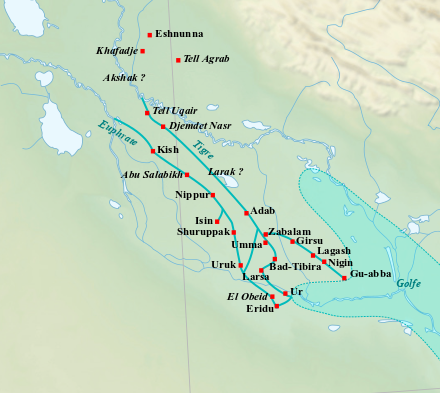
The Early Dynastic Period (abbreviated ED Period or ED) is an archaeological culture in Mesopotamia (modern-day Iraq) that is generally dated to c. 2900 – c. 2350 BC and was preceded by the Uruk and Jemdet Nasr periods. It saw the development of writing and the formation of the first cities and states. The ED itself was characterized by the existence of multiple city-states: small states with a relatively simple structure that developed and solidified over time. This development ultimately led, directly after this period, to broad Mesopotamian unification under the rule of Sargon, the first monarch of the Akkadian Empire. Despite their political fragmentation, the ED city-states shared a relatively homogeneous material culture. Sumerian cities such as Uruk, Ur, Lagash, Umma, and Nippur located in Lower Mesopotamia were very powerful and influential. To the north and west stretched states centered on cities such as Kish, Mari, Nagar, and Ebla.
The study of Central and Lower Mesopotamia has long been given priority over neighboring regions. Archaeological sites in Central and Lower Mesopotamia—notably Girsu but also Eshnunna, Khafajah, Ur, and many others—have been excavated since the 19th century. These excavations have yielded cuneiform texts and many other important artifacts. As a result, this area was better known than neighboring regions, but the excavation and publication of the archives of Ebla have changed this perspective by shedding more light on surrounding areas, such as Upper Mesopotamia, western Syria, and southwestern Iran. These new findings revealed that Lower Mesopotamia shared many socio-cultural developments with neighboring areas and that the entirety of the ancient Near East participated in an exchange network in which material goods and ideas were being circulated.
Dutch archaeologist Henri Frankfort coined the term Early Dynastic (ED) period for Mesopotamia, the naming convention having been borrowed from the similarly named Early Dynastic (ED) period for Egypt. The periodization was developed in the 1930s during excavations that were conducted by Henri Frankfort on behalf of the University of Chicago Oriental Institute at the archaeological sites of Tell Khafajah, Tell Agrab, and Tell Asmar in the Diyala Region of Iraq.
The ED was divided into the sub-periods ED I, II, and III. This was primarily based on complete changes over time in the plan of the Abu Temple of Tell Asmar, which had been rebuilt multiple times on exactly the same spot. During the 20th century, many archaeologists also tried to impose the scheme of ED I–III upon archaeological remains excavated elsewhere in both Iraq and Syria, dated to 3000–2000 BC. However, evidence from sites elsewhere in Iraq has shown that the ED I–III periodization, as reconstructed for the Diyala river valley region, could not be directly applied to other regions.
Research in Syria has shown that developments there were quite different from those in the Diyala river valley region or southern Iraq, rendering the traditional Lower Mesopotamian chronology useless. During the 1990s and 2000s, attempts were made by various scholars to arrive at a local Upper Mesopotamian chronology, resulting in the Early Jezirah (EJ) 0–V chronology that encompasses everything from 3000 to 2000 BC. The use of the ED I–III chronology is now generally limited to Lower Mesopotamia, with the ED II sometimes being further restricted to the Diyala river valley region or discredited altogether.
The ED was preceded by the Jemdet Nasr and then succeeded by the Akkadian period, during which, for the first time in history, large parts of Mesopotamia were united under a single ruler. The entirety of the ED is now generally dated to approximately 2900–2350 BC according to the widely accepted middle chronology or 2800–2230 BC according to the short chronology, which is increasingly less accepted by scholars. The ED was divided into the ED I, ED II, ED IIIa, and ED IIIb sub-periods. ED I–III were more or less contemporary with the Early Jezirah (EJ) I–III in Upper Mesopotamia. The exact dating of the ED sub-periods varies between scholars—with some abandoning ED II and using only Early ED and Late ED instead and others extending ED I while allowing ED III begin earlier so that ED III was to begin immediately after ED I with no gap between the two.
Many historical periods in the Near East are named after the dominant political force at that time, such as the Akkadian or Ur III periods. This is not the case for the ED Period. It is an archaeological division that does not reflect political developments, and it is based upon perceived changes in the archaeological record, e.g. pottery and glyptics. This is because the political history of the ED is unknown for most of its duration. As with the archaeological subdivision, the reconstruction of political events is hotly debated among researchers.
The ED I (2900–2750/2700 BC) is poorly known, relative to the sub-periods that followed it. In Lower Mesopotamia, it shared characteristics with the final stretches of the Uruk (c. 3300–3100 BC) and Jemdet Nasr (c. 3100–2900 BC) periods. ED I is contemporary with the culture of the Scarlet Ware pottery typical of sites along the Diyala in Lower Mesopotamia, the Ninevite V culture in Upper Mesopotamia, and the Proto-Elamite culture in southwestern Iran.
Hub AI
Early Dynastic Period (Mesopotamia) AI simulator
(@Early Dynastic Period (Mesopotamia)_simulator)
Early Dynastic Period (Mesopotamia)
The Early Dynastic Period (abbreviated ED Period or ED) is an archaeological culture in Mesopotamia (modern-day Iraq) that is generally dated to c. 2900 – c. 2350 BC and was preceded by the Uruk and Jemdet Nasr periods. It saw the development of writing and the formation of the first cities and states. The ED itself was characterized by the existence of multiple city-states: small states with a relatively simple structure that developed and solidified over time. This development ultimately led, directly after this period, to broad Mesopotamian unification under the rule of Sargon, the first monarch of the Akkadian Empire. Despite their political fragmentation, the ED city-states shared a relatively homogeneous material culture. Sumerian cities such as Uruk, Ur, Lagash, Umma, and Nippur located in Lower Mesopotamia were very powerful and influential. To the north and west stretched states centered on cities such as Kish, Mari, Nagar, and Ebla.
The study of Central and Lower Mesopotamia has long been given priority over neighboring regions. Archaeological sites in Central and Lower Mesopotamia—notably Girsu but also Eshnunna, Khafajah, Ur, and many others—have been excavated since the 19th century. These excavations have yielded cuneiform texts and many other important artifacts. As a result, this area was better known than neighboring regions, but the excavation and publication of the archives of Ebla have changed this perspective by shedding more light on surrounding areas, such as Upper Mesopotamia, western Syria, and southwestern Iran. These new findings revealed that Lower Mesopotamia shared many socio-cultural developments with neighboring areas and that the entirety of the ancient Near East participated in an exchange network in which material goods and ideas were being circulated.
Dutch archaeologist Henri Frankfort coined the term Early Dynastic (ED) period for Mesopotamia, the naming convention having been borrowed from the similarly named Early Dynastic (ED) period for Egypt. The periodization was developed in the 1930s during excavations that were conducted by Henri Frankfort on behalf of the University of Chicago Oriental Institute at the archaeological sites of Tell Khafajah, Tell Agrab, and Tell Asmar in the Diyala Region of Iraq.
The ED was divided into the sub-periods ED I, II, and III. This was primarily based on complete changes over time in the plan of the Abu Temple of Tell Asmar, which had been rebuilt multiple times on exactly the same spot. During the 20th century, many archaeologists also tried to impose the scheme of ED I–III upon archaeological remains excavated elsewhere in both Iraq and Syria, dated to 3000–2000 BC. However, evidence from sites elsewhere in Iraq has shown that the ED I–III periodization, as reconstructed for the Diyala river valley region, could not be directly applied to other regions.
Research in Syria has shown that developments there were quite different from those in the Diyala river valley region or southern Iraq, rendering the traditional Lower Mesopotamian chronology useless. During the 1990s and 2000s, attempts were made by various scholars to arrive at a local Upper Mesopotamian chronology, resulting in the Early Jezirah (EJ) 0–V chronology that encompasses everything from 3000 to 2000 BC. The use of the ED I–III chronology is now generally limited to Lower Mesopotamia, with the ED II sometimes being further restricted to the Diyala river valley region or discredited altogether.
The ED was preceded by the Jemdet Nasr and then succeeded by the Akkadian period, during which, for the first time in history, large parts of Mesopotamia were united under a single ruler. The entirety of the ED is now generally dated to approximately 2900–2350 BC according to the widely accepted middle chronology or 2800–2230 BC according to the short chronology, which is increasingly less accepted by scholars. The ED was divided into the ED I, ED II, ED IIIa, and ED IIIb sub-periods. ED I–III were more or less contemporary with the Early Jezirah (EJ) I–III in Upper Mesopotamia. The exact dating of the ED sub-periods varies between scholars—with some abandoning ED II and using only Early ED and Late ED instead and others extending ED I while allowing ED III begin earlier so that ED III was to begin immediately after ED I with no gap between the two.
Many historical periods in the Near East are named after the dominant political force at that time, such as the Akkadian or Ur III periods. This is not the case for the ED Period. It is an archaeological division that does not reflect political developments, and it is based upon perceived changes in the archaeological record, e.g. pottery and glyptics. This is because the political history of the ED is unknown for most of its duration. As with the archaeological subdivision, the reconstruction of political events is hotly debated among researchers.
The ED I (2900–2750/2700 BC) is poorly known, relative to the sub-periods that followed it. In Lower Mesopotamia, it shared characteristics with the final stretches of the Uruk (c. 3300–3100 BC) and Jemdet Nasr (c. 3100–2900 BC) periods. ED I is contemporary with the culture of the Scarlet Ware pottery typical of sites along the Diyala in Lower Mesopotamia, the Ninevite V culture in Upper Mesopotamia, and the Proto-Elamite culture in southwestern Iran.