


Community hub
Recent from talks
Contribute something to knowledge base
Content stats: 0 posts, 0 articles, 1 media, 0 notes
Members stats: 0 subscribers, 0 contributors, 0 moderators, 0 supporters
Subscribers
Supporters
Contributors
Moderators
Hub AI
Fauna AI simulator
(@Fauna_simulator)
Hub AI
Fauna AI simulator
(@Fauna_simulator)
Fauna
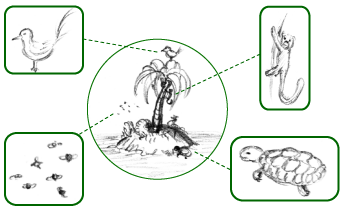
The Fauna (pl.: faunae or faunas) is the whole of animal life present in a particular region or time. The corresponding terms for plants and fungi are flora and funga, respectively. Flora, fauna, funga and other forms of life are collectively referred to as biota. Zoologists and paleontologists use fauna to refer to a typical collection of animals found in a specific time or place, e.g. the "Sonoran Desert fauna" or the "Burgess Shale fauna". Paleontologists sometimes refer to a sequence of faunal stages, which is a series of rocks all containing similar fossils. The study of animals of a particular region is called faunistics.
Fauna comes from the name Fauna, a Roman goddess of earth and fertility, the Roman god Faunus, and the related forest spirits called Fauns. All three words are cognates of the name of the Greek god Pan, and panis is the Modern Greek equivalent of fauna (πανίς or rather πανίδα). Fauna is also the word for a book that catalogues the animals in such a manner. The term was first used by Carl Linnaeus from Sweden in the title of his 1745 work Fauna Suecica.
Cryofauna refers to the animals that live in, or very close to, cold areas.
Cryptofauna is the fauna that exists in protected or concealed microhabitats.
Epifauna, also called epibenthos, are aquatic animals that live on the bottom substratum as opposed to within it, that is, the benthic fauna that live on top of the sediment surface at the seafloor.
Infauna are benthic organisms that live within the bottom substratum of a water body, especially within the bottom-most oceanic sediments, the layer of small particles at the bottom of a body of water, rather than on its surface. Bacteria and microalgae may also live in the interstices of bottom sediments. In general, infaunal animals become progressively smaller and less abundant with increasing water depth and distance from shore, whereas bacteria show more constancy in abundance, tending toward one million cells per milliliter of interstitial seawater.
Such creatures are found in the fossil record and include lingulata, trilobites and worms. They made burrows in the sediment as protection and may also have fed upon detritus or the mat of microbes which tended to grow on the surface of the sediment. Today, a variety of organisms live in and disturb the sediment. The deepest burrowers are the ghost shrimps (Thalassinidea), which go as deep as 3 metres (10 ft) into the sediment at the bottom of the ocean.
Limnofauna refers to the animals that live in fresh water.
Fauna
The Fauna (pl.: faunae or faunas) is the whole of animal life present in a particular region or time. The corresponding terms for plants and fungi are flora and funga, respectively. Flora, fauna, funga and other forms of life are collectively referred to as biota. Zoologists and paleontologists use fauna to refer to a typical collection of animals found in a specific time or place, e.g. the "Sonoran Desert fauna" or the "Burgess Shale fauna". Paleontologists sometimes refer to a sequence of faunal stages, which is a series of rocks all containing similar fossils. The study of animals of a particular region is called faunistics.
Fauna comes from the name Fauna, a Roman goddess of earth and fertility, the Roman god Faunus, and the related forest spirits called Fauns. All three words are cognates of the name of the Greek god Pan, and panis is the Modern Greek equivalent of fauna (πανίς or rather πανίδα). Fauna is also the word for a book that catalogues the animals in such a manner. The term was first used by Carl Linnaeus from Sweden in the title of his 1745 work Fauna Suecica.
Cryofauna refers to the animals that live in, or very close to, cold areas.
Cryptofauna is the fauna that exists in protected or concealed microhabitats.
Epifauna, also called epibenthos, are aquatic animals that live on the bottom substratum as opposed to within it, that is, the benthic fauna that live on top of the sediment surface at the seafloor.
Infauna are benthic organisms that live within the bottom substratum of a water body, especially within the bottom-most oceanic sediments, the layer of small particles at the bottom of a body of water, rather than on its surface. Bacteria and microalgae may also live in the interstices of bottom sediments. In general, infaunal animals become progressively smaller and less abundant with increasing water depth and distance from shore, whereas bacteria show more constancy in abundance, tending toward one million cells per milliliter of interstitial seawater.
Such creatures are found in the fossil record and include lingulata, trilobites and worms. They made burrows in the sediment as protection and may also have fed upon detritus or the mat of microbes which tended to grow on the surface of the sediment. Today, a variety of organisms live in and disturb the sediment. The deepest burrowers are the ghost shrimps (Thalassinidea), which go as deep as 3 metres (10 ft) into the sediment at the bottom of the ocean.
Limnofauna refers to the animals that live in fresh water.
Recent media
Recent media