
Recent from talks
Fedora
Knowledge base stats:
Talk channels stats:
Members stats:
Fedora
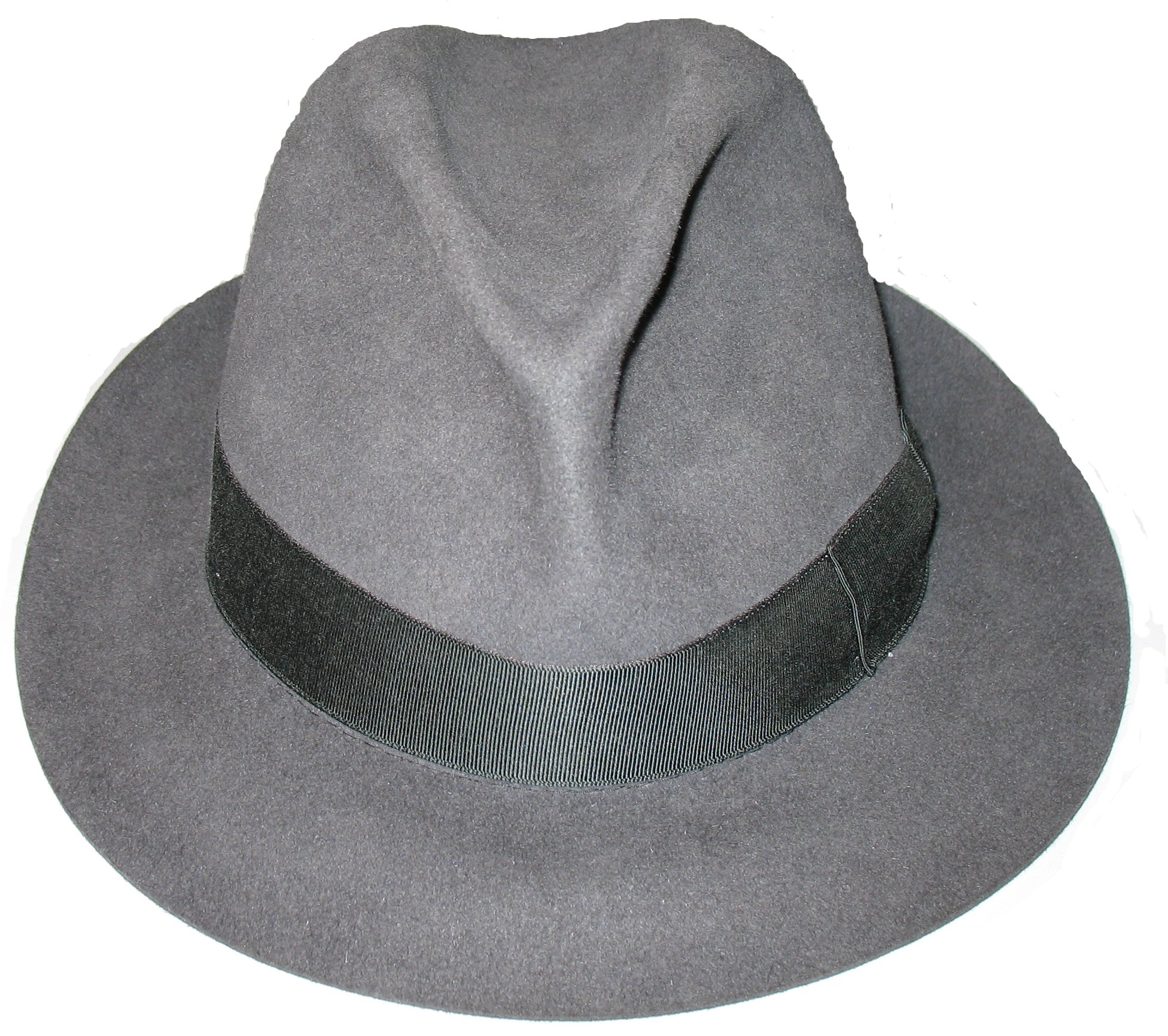
A fedora (/fəˈdɔːrə/) is a hat with a soft brim and indented crown. It is typically creased lengthwise down the crown and "pinched" near the front on both sides. Fedoras can also be creased with teardrop crowns, diamond crowns, center dents, and others, and the positioning of pinches can vary. The typical crown height is 4.5 inches (11 cm). The term fedora was in use as early as 1891. Its popularity soared, and eventually it eclipsed the similar-looking homburg. Despite falling out of fashion with other formal men's hats during the 1960s, the hat has seen some resurgence during the 21st century amongst men and women alike, though its current use is generally less associated with formal dress.
The fedora hat's brim is usually around 2.5 inches (6.4 cm) wide, but can be wider, can be left raw-edged (left as cut), finished with a sewn overwelt or underwelt, or bound with a trim-ribbon. Stitched edge means that there are one or more rows of stitching radiating inward toward the crown. The Cavanagh edge is a welted edge with invisible stitching to hold it in place and is a very expensive treatment that requires a highly-skilled craftsman. Fedora hats are not to be confused with small brimmed hats called trilbies.
Fedoras can be made of wool, cashmere, rabbit or beaver felt. These felts can also be blended to each other with mink or chinchilla and rarely with vicuña, guanaco, cervelt, or mohair. They can also be made of straw, cotton, waxed or oiled cotton, hemp, linen, or leather.
A special variation is the rollable, foldaway or crushable fedora (rollable and crushable are not the same) with a certain or open crown (open-crown fedoras can be bashed and shaped in many variations). Special fedoras have a ventilated crown with grommets, mesh inlets, or other penetrations for a better air circulation. Fedoras can be lined or unlined and have a leather, cloth, or ribbon sweatband. Small feathers are sometimes added as decoration. Fedoras can be equipped with a chinstrap, but this is uncommon.
The term fedora was in use as early as 1891. As a homburg style in the shape of a Panama Hat, its popularity soared, and eventually it eclipsed the homburg. The word fedora comes from the title of an 1882 play by dramatist Victorien Sardou, Fédora, which was written for Sarah Bernhardt. The play was first performed in the United States in 1889. Bernhardt played Princess Fédora Romazoff, the heroine of the play. During the play, Bernhardt—a noted cross-dresser—wore a center-creased, soft brimmed hat. The hat was fashionable for women, and the women's rights movement adopted it as a symbol. After Edward, Prince of Wales (later the Duke of Windsor) started to wear them in 1924, it became popular among men for its stylishness and its ability to protect the wearer's head from the wind and weather. Since the early part of the 20th century, many Haredi and other Orthodox Jews have made black fedoras normal to their daily wear.
During the early twentieth century, a hat was a staple of men's fashion and would be worn in almost all public places. However, as a social custom and common courtesy, men would remove their hats when at home or when engaged in conversation with women. In addition, the ability to own a hat was culturally considered a sign of wealth due to fashion being recognized as a status symbol. Only those with few economic resources would venture out without a hat. The introduction of a new line of felt hats made from nutria, an animal similar to the beaver, helped establish the fedora as a durable product. Prices, in the first decade of the twentieth century, for a nutria fedora ranged from ninety-eight cents to two dollars and twenty-five cents. Starting in the 1920s, fedoras began to rise in popularity after the Prince of Wales adopted the felt hat as his favored headwear. As a result, "the soft felt hat replaced the stiff hat as the best seller in the decade". The fedora soon took its place as a choice hat and joined other popular styles that included the derby and the homburg.
A notable trend that emerged during the rise in popularity of the fedora was to invert the lid of the hat itself and cut jagged edges across the brim. This style of hat would eventually be called a whoopee cap, and became a popular alternative to the more formal fedora for mechanics and children of the era.
During the 1940s, the brims of fedoras started to increase in width, while the British maintained a slightly smaller brim size. The colors of fedoras traditionally included shades of black, brown, and gray. However, this palette would grow at the onset of the second world war to include military themed colors such as khaki, blue, and green. One of the most prominent companies to sell fedoras was the department store Sears, Roebuck and Company. In addition, famous hat manufacturers which still exist today include Bailey, Borsalino, and Stetson.
Hub AI
Fedora AI simulator
(@Fedora_simulator)
Fedora
A fedora (/fəˈdɔːrə/) is a hat with a soft brim and indented crown. It is typically creased lengthwise down the crown and "pinched" near the front on both sides. Fedoras can also be creased with teardrop crowns, diamond crowns, center dents, and others, and the positioning of pinches can vary. The typical crown height is 4.5 inches (11 cm). The term fedora was in use as early as 1891. Its popularity soared, and eventually it eclipsed the similar-looking homburg. Despite falling out of fashion with other formal men's hats during the 1960s, the hat has seen some resurgence during the 21st century amongst men and women alike, though its current use is generally less associated with formal dress.
The fedora hat's brim is usually around 2.5 inches (6.4 cm) wide, but can be wider, can be left raw-edged (left as cut), finished with a sewn overwelt or underwelt, or bound with a trim-ribbon. Stitched edge means that there are one or more rows of stitching radiating inward toward the crown. The Cavanagh edge is a welted edge with invisible stitching to hold it in place and is a very expensive treatment that requires a highly-skilled craftsman. Fedora hats are not to be confused with small brimmed hats called trilbies.
Fedoras can be made of wool, cashmere, rabbit or beaver felt. These felts can also be blended to each other with mink or chinchilla and rarely with vicuña, guanaco, cervelt, or mohair. They can also be made of straw, cotton, waxed or oiled cotton, hemp, linen, or leather.
A special variation is the rollable, foldaway or crushable fedora (rollable and crushable are not the same) with a certain or open crown (open-crown fedoras can be bashed and shaped in many variations). Special fedoras have a ventilated crown with grommets, mesh inlets, or other penetrations for a better air circulation. Fedoras can be lined or unlined and have a leather, cloth, or ribbon sweatband. Small feathers are sometimes added as decoration. Fedoras can be equipped with a chinstrap, but this is uncommon.
The term fedora was in use as early as 1891. As a homburg style in the shape of a Panama Hat, its popularity soared, and eventually it eclipsed the homburg. The word fedora comes from the title of an 1882 play by dramatist Victorien Sardou, Fédora, which was written for Sarah Bernhardt. The play was first performed in the United States in 1889. Bernhardt played Princess Fédora Romazoff, the heroine of the play. During the play, Bernhardt—a noted cross-dresser—wore a center-creased, soft brimmed hat. The hat was fashionable for women, and the women's rights movement adopted it as a symbol. After Edward, Prince of Wales (later the Duke of Windsor) started to wear them in 1924, it became popular among men for its stylishness and its ability to protect the wearer's head from the wind and weather. Since the early part of the 20th century, many Haredi and other Orthodox Jews have made black fedoras normal to their daily wear.
During the early twentieth century, a hat was a staple of men's fashion and would be worn in almost all public places. However, as a social custom and common courtesy, men would remove their hats when at home or when engaged in conversation with women. In addition, the ability to own a hat was culturally considered a sign of wealth due to fashion being recognized as a status symbol. Only those with few economic resources would venture out without a hat. The introduction of a new line of felt hats made from nutria, an animal similar to the beaver, helped establish the fedora as a durable product. Prices, in the first decade of the twentieth century, for a nutria fedora ranged from ninety-eight cents to two dollars and twenty-five cents. Starting in the 1920s, fedoras began to rise in popularity after the Prince of Wales adopted the felt hat as his favored headwear. As a result, "the soft felt hat replaced the stiff hat as the best seller in the decade". The fedora soon took its place as a choice hat and joined other popular styles that included the derby and the homburg.
A notable trend that emerged during the rise in popularity of the fedora was to invert the lid of the hat itself and cut jagged edges across the brim. This style of hat would eventually be called a whoopee cap, and became a popular alternative to the more formal fedora for mechanics and children of the era.
During the 1940s, the brims of fedoras started to increase in width, while the British maintained a slightly smaller brim size. The colors of fedoras traditionally included shades of black, brown, and gray. However, this palette would grow at the onset of the second world war to include military themed colors such as khaki, blue, and green. One of the most prominent companies to sell fedoras was the department store Sears, Roebuck and Company. In addition, famous hat manufacturers which still exist today include Bailey, Borsalino, and Stetson.
Recent media