


Community hub
Recent from talks
Contribute something
Nothing was collected or created yet.


A hat is a head covering which is worn for various reasons, including protection against weather conditions, ceremonial reasons such as university graduation, religious reasons, safety, or as a fashion accessory.[1] Hats which incorporate mechanical features, such as visors, spikes, flaps, braces or beer holders shade into the broader category of headgear.
In the past, hats were an indicator of social status.[2] In the military, hats may denote nationality, branch of service, rank or regiment.[3] Police typically wear distinctive hats such as peaked caps or brimmed hats, such as those worn by the Royal Canadian Mounted Police. Some hats have a protective function. As examples, the hard hat protects construction workers' heads from injury by falling objects, a British police Custodian helmet protects the officer's head, a sun hat shades the face and shoulders from the sun, a cowboy hat protects against sun and rain and an ushanka fur hat with fold-down earflaps keeps the head and ears warm. Some hats are worn for ceremonial purposes, such as the mortarboard, which is worn (or carried) during university graduation ceremonies. Some hats are worn by members of a certain profession, such as the Toque worn by chefs, or the mitre worn by Christian bishops. Adherents of certain religions regularly wear hats, such as the turban worn by Sikhs, or the church hat that is worn as a headcovering by Christian women during prayer and worship.[4]
History
[edit]
While there are not many official records of hats before 3,000 BC, they probably were commonplace before that. The 27,000-to-30,000-year-old Venus of Willendorf figurine may depict a woman wearing a woven hat.[5] One of the earliest known confirmed hats was worn by a Bronze Age man (nicknamed Ötzi) whose body (including his hat) was found frozen in a mountain between Austria and Italy, where he had been since around 3250 BC. He was found wearing a bearskin cap with a chin strap, made of several hides stitched together, essentially resembling a Russian fur hat without the flaps.[6][7][8]
One of the first pictorial depictions of a hat appears in a tomb painting from Thebes, Egypt, which shows a man wearing a conical straw hat, dated to around 3200 BC. Hats were commonly worn in ancient Egypt. Many upper-class Egyptians shaved their heads, then covered it in a headdress intended to help them keep cool. Ancient Mesopotamians often wore conical hats or ones shaped somewhat like an inverted vase.

Other early hats include the Pileus, a simple skull-like cap; the Phrygian cap, worn by freed slaves in Greece and Rome (which became iconic in America during the Revolutionary War and the French Revolution, as a symbol of the struggle for liberty against the Monarchy); and the Greek petasos, the first known hat with a brim. Women wore veils, kerchiefs, hoods, caps and wimples.
Like Ötzi, the Tollund Man was preserved to the present day with a hat on, probably having died around 400 BC in a Danish bog, which mummified him. He wore a pointed cap made of sheepskin and wool, fastened under the chin by a hide thong.[9]
St. Clement, the patron saint of felt hatmakers, is said to have discovered felt when he filled his sandals with flax fibers to protect his feet, around 800 AD.[10]
In the Middle Ages, hats were a marker of social status and used to single out certain groups. The 1215 Fourth Council of the Lateran required that all Jews identify themselves by wearing the Judenhat ("Jewish hat"), marking them as targets for anti-Semitism.[11] The hats were usually yellow and were either pointed or square.[12]

In the Middle Ages, hats for women ranged from simple scarves to elaborate hennin,[13] and denoted social status. Structured hats for women similar to those of male courtiers began to be worn in the late 16th century.[14] The term 'milliner' comes from the Italian city of Milan, where the best quality hats were made in the 18th century. Millinery was traditionally a woman's occupation, with the milliner not only creating hats and bonnets but also choosing lace, trimmings and accessories to complete an outfit.[15]

In the first half of the 19th century, women wore bonnets that gradually became larger, decorated with ribbons, flowers, feathers, and gauze trims. By the end of the century, many other styles were introduced, among them hats with wide brims and flat crowns, the flower pot and the toque. By the middle of the 1920s, when women began to cut their hair short, they chose hats that hugged the head like a helmet.[14]
The tradition of wearing hats to horse racing events began at the Royal Ascot in Britain, which maintains a strict dress code. All guests in the Royal Enclosure must wear hats.[16] This tradition was adopted at other horse racing events, such as the Kentucky Derby in the United States.[17]

Extravagant hats were popular in the 1980s, and in the early 21st century, flamboyant hats made a comeback, with a new wave of competitive young milliners designing creations that include turban caps, trompe-l'œil-effect felt hats and tall headpieces made of human hair. Some new hat collections have been described as "wearable sculpture". Many pop stars, among them Lady Gaga, have commissioned hats as publicity stunts.[18]

Famous hatmakers
[edit]One of the most famous London hatters is James Lock & Co. of St James's Street.[19] The shop claims to be the oldest operating hat shop in the world.[20] Another was Sharp & Davis of 6 Fish Street Hill.[21] In the late 20th century, museums credited London-based David Shilling with reinventing hats worldwide. Notable Belgian hat designers are Elvis Pompilio and Fabienne Delvigne (Royal warrant of appointment holder), whose hats are worn by European royals.[22] Philip Treacy OBE is an Irish milliner whose hats have been commissioned by top designers[23] and worn at royal weddings.[24] In North America, the well-known cowboy-hat manufacturer Stetson made the headgear for the Royal Canadian Mounted Police and the Texas Rangers.[25] John Cavanagh was one of the notable American hatters.[26] Italian hat maker Borsalino has covered the heads of Hollywood stars and the world's rich and famous.[27]
Collections
[edit]The Philippi Collection is a collection of religious headgear assembled by a German entrepreneur, Dieter Philippi, located in Kirkel.[28] The collection features over 500 hats,[29] and is currently the world's largest collection of clerical, ecclesiastical and religious head coverings.[30]
Styles
[edit]This is a short list of some common and iconic examples of hats. There is a longer version at List of hat styles
| Image | Name | Description |
|---|---|---|

|
Ascot cap | A hard, men's cap, similar to the flat cap, but distinguished by its hardness and rounded shape |

|
Balmoral bonnet | Traditional Scottish bonnet or cap worn with Scottish Highland dress |

|
Baseball cap | A type of soft, light, wool or cotton cap with a rounded crown and a stiff, frontward-projecting brim |

|
Beanie (North America) | A brimless cap, made from triangular panels of material joined by a button at the crown and seamed together around the sides, with or without a small visor, once popular among schoolboys. Sometimes includes a propeller. In New Zealand, Australia, the United Kingdom and some parts of the United States, beanie refers to the knit cap. |

|
Bearskin | The tall, furry hat of the Brigade of Guards' full-dress uniform, originally designed to protect them against sword-cuts, etc. Commonly seen at Buckingham Palace in London, England. Sometimes mistakenly identified as a busby. |
.jpg)
|
Beret | A soft, round cap, usually of woollen felt, with a bulging flat crown and tight-fitting brimless headband. Worn by both men and women and traditionally associated with Basque people, France, and the military. |

|
Bicorne | A broad-brimmed, felt hat with brim folded up and pinned front and back to create a long-horned shape. Also known as a cocked hat. Worn by European military officers in the 1790s and, as illustrated, commonly associated with Napoleon. |
.jpg)
|
Bowler / Derby | A hard, felt hat with a rounded crown, created in 1850 by Lock's of St James's, the hatters to Thomas Coke, 2nd Earl of Leicester, for his servants. More commonly known as a derby in the United States. |

|
Buntal | A traditional straw hat from the Philippines woven from fibers extracted from buri palms |

|
Chullo | Peruvian or Bolivian hat with ear-flaps made from vicuña, alpaca, llama or sheep's wool[31] |

|
Cloche hat | A bell-shaped ladies' hat that was popular during the Roaring Twenties (Cloche hat as worn by silent film star Vilma Bánky, 1927) |

|
Cricket cap | A type of soft cap traditionally worn by cricket players (Sid Barnes with his Australian cap) |

|
Cordovan hat | A traditional flat-brimmed and flat-topped hat originating from Córdoba, Spain, associated with flamenco dancing and music and popularized by characters such as Zorro |

|
Conical Asian hat | A conical straw hat associated with East and Southeast Asia. Sometimes known as a "coolie hat", although the term "coolie" may be interpreted as derogatory.[32][33] |
.jpg)
|
Coonskin cap | A hat of the indigenous peoples of the Appalachian region, fashioned from the skin and fur of a raccoon, that became associated with Canadian and American frontiersmen of the 18th and 19th centuries |

|
Cowboy hat | A high-crowned, wide-brimmed hat, with a sweatband on the inside, and a decorative hat band on the outside. Early models such as the Boss of the Plains could be customized by creasing the crown and rolling the brim.[34] |

|
Custodian helmet | A helmet traditionally worn by British police constables while on foot patrol |

|
Deerstalker | A warm, close-fitting tweed cap, with brims front and behind and ear-flaps that can be tied together either over the crown or under the chin. Originally designed for use while hunting in the climate of Scotland. Worn by – and so closely associated with – the character Sherlock Holmes. |

|
Fedora | A soft, felt hat with a medium brim and lengthwise crease in the crown |

|
Fez | Red felt hat in the shape of a truncated cone, common to Arab-speaking countries |

|
Fulani hat | A conical, plant-fiber hat covered in leather both at the brim and top, worn by men of the Fulani people in West Africa |

|
Hard hat | A rounded, rigid helmet with a small brim, predominantly used in workplace environments, such as construction sites, to protect the head from injury by falling objects, debris and bad weather |

|
Homburg | A semi-formal hat of fur felt, with a single dent running down the centre of the crown, a wide silk grosgrain hatband ribbon, a flat brim shaped in a "pencil curl", and a ribbon-bound trim about the edge of the brim (Winston Churchill wearing a homburg) |

|
Keffiyeh | Three piece ensemble consisting of a thagiyah skullcap, gutrah scarf, and agal black cord. Gutrahs are plain white or patterned, denoting ethnic or national identities.[citation needed]. (Sultan bin Abdulaziz, Crown Prince of Saudi Arabia wearing Keffiyeh) |

|
Kippah | A hemispherical cap worn by Jews to fulfill the customary requirement held by halachic authorities that the head be covered at all times (IDF soldier, Lt. Asael Lubotzky, prays with kippah and tefillin.) |

|
Knit cap | A knitted hat, worn in winter, usually made from wool or acrylic. In New Zealand, Australia, the United Kingdom and some parts of the United States, the term beanie is applied to this cap, while in Canada it is known as a tuque. |

|
Kufi | A brimless, short, rounded cap worn by Africans and people throughout the African diaspora (Umaru Yar'Adua, President of Nigeria) |

|
Mitre | Distinctive hat worn by bishops in the Roman Catholic Church, Eastern Orthodox Church, the Lutheran Churches and the Anglican Communion (Pope Benedict XVI) |

|
Montera | A crocheted hat worn by bullfighters |

|
Panama | Straw hat made in Ecuador |

|
Phrygian cap | A soft conical cap, pulled forward. In sculpture, paintings and caricatures it represents freedom and the pursuit of liberty. The popular cartoon characters the Smurfs wear white or red Phrygian caps. |

|
Pillbox hat | A small hat with straight, upright sides, a flat crown, and no brim. (Actress Doris Day wearing a pillbox hat in 1960) |

|
Pith helmet | A lightweight, rigid, cloth-covered helmet made of cork or pith, with brims front and back. Worn by Europeans in tropical colonies in the 1800s. |

|
Rastacap | A tall, round, usually crocheted and brightly colored cap worn by Rastafarians and others with dreadlocks to tuck their locks away |

|
Rogatywka | An asymmetrical, peaked, four-pointed cap used by various Polish military units throughout the ages |
.jpg)
|
Santa hat | A floppy, pointed, red stocking cap, trimmed in white fur, traditionally associated with Christmas |

|
Sombrero | A Mexican hat with a conical crown and a very wide, saucer-shaped brim, highly embroidered and made of plush felt |

|
Tam o'Shanter | A traditional flat, round Scottish cap usually worn by men (in the British military sometimes abbreviated ToS) |

|
Top hat | Also known as a beaver hat, a magician's hat, or, in the case of the tallest examples, a stovepipe hat. A tall, flat-crowned, cylindrical hat worn by men in the 19th and early 20th centuries, now worn only with morning dress or evening dress. Cartoon characters Uncle Sam and Mr. Monopoly are often depicted wearing such hats. Once made from felted beaver fur. |

|
Toque | A tall, pleated, brimless, cylindrical hat, informally, known as a chef's hat |

|
Tricorne | A soft hat with a low crown and broad brim, pinned up on either side of the head and at the back, producing a triangular shape. Worn by Europeans in the 18th century. Larger, taller, and heavily ornamented brims were present in France and the Papal States. |

|
Turban | A headdress consisting of a scarf-like single piece of cloth wound around either the head itself or an inner hat |

|
Ushanka | A Russian fur hat with fold-down ear-flaps |

|
Zucchetto | Skullcap worn by clerics, typically in Roman Catholicism |
Size
[edit]Hat sizes are determined by measuring the circumference of a person's head about 1 centimetre (2⁄5 in) above the ears. Inches or centimeters may be used depending on the manufacturer. Felt hats can be stretched for a custom fit. Some hats, like hard hats and baseball caps, are adjustable. Cheaper hats come in "standard sizes", such as small, medium, large, extra large: the mapping of measured size to the various "standard sizes" varies from maker to maker and style to style, as can be seen by studying various catalogues, such as Hammacher Schlemmer.[35]
| size | Youth S/M | Youth L/XL | XXS | XS | S | M | L | XL | XXL | XXXL | ||||
|---|---|---|---|---|---|---|---|---|---|---|---|---|---|---|
| Age (years) | 0 | 1⁄2 | 1 | 1+1⁄2 | 2 | |||||||||
| Circumference in cm | 34 | 43 | 47 | 48 | 49 | 50 | 51–52 | 53–54 | 55–56 | 57–58 | 59–60 | 61–62 | 63–64 | 65–66 |
| Circumference in inches | 13+3⁄8 | 17 | 18+1⁄2 | 18+3⁄4 | 19+1⁄4 | 19+3⁄4 | 20+1⁄8–20+1⁄2 | 20+5⁄8–21+1⁄4 | 21+5⁄8–22 | 221⁄2–227⁄8 | 231⁄4–235⁄8 | 24–243⁄8 | 243⁄4–251⁄4 | 25–26 |
| UK hat size | 5 | 53⁄4 | 6–61⁄8 | 61⁄4–63⁄8 | 61⁄2–65⁄8 | 63⁄4–67⁄8 | 7–71⁄8 | 71⁄4–73⁄8 | 71⁄2–75⁄8 | 73⁄4–77⁄8 | 8–81⁄8 | |||
| US hat size | 57⁄8 | 6 | 61⁄8 | 61⁄4 | 63⁄8–61⁄2 | 65⁄8–63⁄4 | 67⁄8–7 | 71⁄8–71⁄4 | 73⁄8–71⁄2 | 75⁄8–73⁄4 | 77⁄8–8 | 81⁄8–81⁄4 | ||
| French hat size | 0 | 1⁄2 | 1 | 11⁄2 | 2–21⁄2 | 3–31⁄2 | 4–41⁄2 | 5–51⁄2 | 6–61⁄2 | 7–71⁄2 | 8–81⁄2 | 9–91⁄2 |
US hat size is a measurement of head diameter in inches. It can be computed from a measurement of circumference in centimeters by dividing by 8, because multiplying 2.54 (the number of centimeters per inch) by π (the multiplier to give circumference from diameter) is almost exactly 8.
Gallery
[edit]-

-
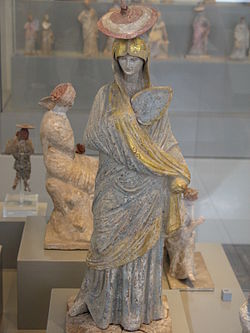 Ancient Greek statue of a lady with blue and gilt garment, a fan and a sun hat, from Tanagra, c. 325–300 BC
 -

-
 Hat fashions have sometimes been the subject of ridicule. This 1908 cartoon by Ion Theodorescu-Sion, which first appeared in a Romanian publication, satirised the popularity of mushroom hats.
 -
 Women's picture hats from 1911.
 -
 New York City, 1918: A large crowd of people, almost all wearing hats
 -
 Family-owned hat factory in Montevarchi, Italy, date unknown
 -
 Millinery department of Bourne & Hollingsworth, in London's Oxford Street in 1942. Unlike most other clothing, hats were not strictly rationed in wartime Britain and there was an explosion of adventurous millinery styles.
 -
 John Paul II wearing a zucchetto
 -
![17th century openwork hat Metropolitan Museum of Art[36]](//upload.wikimedia.org/wikipedia/commons/thumb/e/e5/Hat_MET_1988.342.1a.jpg/250px-Hat_MET_1988.342.1a.jpg) 17th century openwork hat Metropolitan Museum of Art[36]
17th century openwork hat Metropolitan Museum of Art[36] -
 Classic wide-brimmed Western hat crafted in felt, North Beach, San Francisco


![17th century openwork hat Metropolitan Museum of Art[36]](https://en.wikipedia.org/wiki/File:Hat_MET_1988.342.1a.jpg)

See also
[edit]References
[edit]- ^ Pauline Thomas (2007-09-08). "The Wearing of Hats Fashion History". Fashion-era.com. Retrieved 2011-07-02.
- ^ "The social meanings of hats". University of Chicago Press. Retrieved 2011-07-02.
- ^ "Insignia:The Way You Tell Who's Who in the Military". United States Department of Defense. Archived from the original on 2012-04-14. Retrieved 2011-07-02.
- ^ "What are Church Hats?". Southern Living. Southern Living. Archived from the original on 14 May 2021. Retrieved 10 May 2022.
Church hats have been a key part of churchgoers' Sunday best for years, and are still an important aspect of dress in some churches today. The practice of covering one's head for church originally came from the Bible—1 Corinthians 11:15, to be precise. The simple head covering has been adapted and expanded to become a stylish part of Southern women's churchgoing attire. At the turn of the century, many Southern ladies wore simple hats to church out of respect, reverence for the service, and continuity with passed-down traditions. The church hat tradition continues today, with hats—sometimes called crowns—in bright colors, bold patterns, and eye-catching styles at Sunday services across the South.
- ^ "BBC News | SCI/TECH | World's oldest hat revealed". news.bbc.co.uk. Retrieved 2018-09-25.
- ^ Davis, Nicola (30 August 2016). "It becometh the iceman: clothing study reveals stylish secrets of leather-loving ancient". The Guardian. Archived from the original on 30 August 2016. Retrieved 30 August 2016.
- ^ Romey, Kristin (18 August 2016). "Here's What the Iceman Was Wearing When He Died 5,300 Years Ago". National Geographic. Archived from the original on 19 August 2016. Retrieved 18 August 2016.
- ^ O'Sullivan, Niall J.; Teasdale, Matthew D.; Mattiangeli, Valeria; Maixner, Frank; Pinhasi, Ron; Bradley, Daniel G.; Zink, Albert (18 August 2016). "A whole mitochondria analysis of the Tyrolean Iceman's leather provides insights into the animal sources of Copper Age clothing". Scientific Reports. 6 31279. Bibcode:2016NatSR...631279O. doi:10.1038/srep31279. ISSN 2045-2322. PMC 4989873. PMID 27537861.
- ^ "The Tollund Man – Appearance". The Tollund Man – A face from prehistoric Denmark. 2004. Archived from the original on 2011-07-19. Retrieved 2016-09-30.
- ^ "History of Hats". Hatsandcaps.co.uk. Retrieved 2011-07-02.
- ^ Waldman, Katy (2013-10-17). "The history of the witch's hat". Slate.com. Retrieved 2014-03-26.
- ^ Johnston, Ruth A. (2011). All Things Medieval: An Encyclopedia of the Medieval World. ABC-CLIO. Retrieved 2014-03-26.
- ^ Vibbert, Marie, Headdresses of the 14th and 15th Centuries, No. 133, SCA monograph series (August 2006)
- ^ a b "Hat history". Hatsuk.com. Archived from the original on 2000-09-14. Retrieved 2012-01-07.
- ^ "History of Women's Hats". Vintagefashionguild.org. Retrieved 2012-01-07.
- ^ Lauren Turner (2012-06-21). "New dress code a hit at Ascots' Ladies Day". Independent.co.uk. Archived from the original on 2022-05-09. Retrieved 2013-08-29.
- ^ "Hats in History: The Kentucky Derby". Hats-plus.com. 2012-04-28. Archived from the original on 2013-08-19. Retrieved 2013-08-29.
- ^ Young, Robb (3 October 2011). "Millinery Madness: Hat Makers With Attitude". The New York Times. Archived from the original on 2017-06-30. Retrieved 2017-02-27.
- ^ See Whitbourn, F.: 'Mr Lock of St James's St Heinemann, 1971.
- ^ Mitic, Ginanne Brownell (30 March 2016). "Centuries of hats". The New York Times. Archived from the original on 2017-12-28. Retrieved 2017-02-27.
- ^ For an account of the Sharp family's hat-making business, see Knapman, D. – 'Conversation Sharp – The Biography of a London Gentleman, Richard Sharp (1759–1835), in Letters, Prose and Verse'. [Private Publication, 2004]. British Library.
- ^ "Brussels life". Brusselslife.be. Retrieved 2013-04-15.
- ^ "Philip Treacy 'Hatforms' at IMMA Thursday". Raidió Teilifís Éireann. 5 April 2001. Archived from the original on August 17, 2012. Retrieved 11 December 2010.
- ^ Philip Treacy: King of Royal wedding hats Archived 2011-08-31 at the Wayback Machine Irish Independent, 2011-04-29
- ^ Snyder, Jeffrey B. (1997). Stetson Hats and the John B. Stetson Company 1865–1970. Atglen: Schiffer. p. 57. ISBN 0-7643-0211-6.
- ^ "Cavanagh Hats". Bernard Hats. 22 June 2014. Retrieved 2019-12-06.
- ^ Hats and Headwear around the World: A Cultural Encyclopedia, Beverly Chico, ABC-CLIO, 03.10.2013, p. 155.
- ^ "Neue Zürcher Zeitung FOLIO". Nzzfolio.ch. 2011-02-08. Retrieved 2012-01-07.
- ^ Smoltczyk, Alexander (4 December 2009). "Der Spiegel". Spiegel.de. Retrieved 2012-01-07.
- ^ "Philippi Collection". Philippi-collection.blogspot.com. 2011-11-23. Retrieved 2012-01-07.
- ^ Klinkenborg, Verlyn (2009-02-03). "Season of the chullo". International Herald Tribune. Archived from the original on January 30, 2009. Retrieved 2011-07-02.
- ^ "Malema under fire over slur on Indians". News24. 2011-10-20. Retrieved 2013-06-16.
- ^ Most current dictionaries do not record any offensive meaning ("an unskilled laborer or porter usually in or from India hired for low or subsistence wages" Merriam-Webster Archived 2008-01-26 at the Wayback Machine) or make a distinction between an offensive meaning in referring to "a person from the Indian subcontinent or of Indian descent" and an at least originally inoffensive, old-fashioned meaning, for example "dated an unskilled native labourer in India, China, and some other Asian countries" (Compact Oxford English Dictionary). However, some dictionaries indicate that the word may be considered offensive in all contexts today. For example, Longman Archived 2006-11-27 at the Wayback Machine's 1995 edition had "old-fashioned an unskilled worker who is paid very low wages, especially in parts of Asia", but the current version adds "taboo old-fashioned a very offensive word ... Do not use this word".
- ^ Snyder, Jeffrey B. (1997). Stetson Hats and the John B. Stetson Company 1865–1970. Atglen: Schiffer. p. 5. ISBN 0-7643-0211-6.
- ^ "Helmet sizes". Enduroworld.com.au. Archived from the original on March 25, 2012.
- ^ "Hat, British, 17th century". Metropolitan Museum of Art website.
External links
[edit] Quotations related to Hat at Wikiquote
 Media related to Hats at Wikimedia Commons
 The dictionary definition of hat at Wiktionary


| Headwear | |||||||||
|---|---|---|---|---|---|---|---|---|---|
| Neckwear | |||||||||
| Underwear and lingerie |
| ||||||||
| Tops | |||||||||
| Bottoms |
| ||||||||
| Full-Body Wear |
| ||||||||
| Coats and outerwear |
| ||||||||
| Nightwear | |||||||||
| Swimwear | |||||||||
| Legwear | |||||||||
| Footwear | |||||||||
| Accessories |
| ||||||||
| Dress codes |
| ||||||||
| Related | |||||||||

| International | |
|---|---|
| National | |
| Other | |

Definition and Etymology
Definition
A hat is a head covering designed to fit over the crown of the head, typically featuring a shaped portion that conforms to the skull and, in many cases, a projecting brim or edge for additional coverage.[1] This structure distinguishes hats from other headgear like caps, which usually incorporate a stiff bill or visor extending only forward rather than a full circumferential brim providing 360-degree protection.[7] While some variations exist without brims—such as certain knitted or soft styles—traditional definitions emphasize the crown-and-brim form, often constructed from materials like felt, straw, or wool for durability outdoors.[2][8] Hats fulfill practical roles such as shielding against sun, rain, or cold, alongside symbolic or decorative uses in social, professional, or religious contexts; for instance, specific designs denote roles like those in military or clerical attire.[9] The term encompasses a wide array of styles but excludes rigid protective gear like helmets, which prioritize impact resistance over everyday wear.[10] Empirical observations of global headwear confirm hats' prevalence in temperate climates for thermal regulation, with brimmed variants reducing ultraviolet exposure by up to 50% in field studies.[11]Etymology
The English word hat originates from Old English hæt or hætt, denoting a head covering such as a cap, hood, or helmet, with attestations dating to before 1150 CE.[12] [1] This term derives from Proto-Germanic \hattuz (reconstructed form meaning "hood" or "cowl"), shared with cognates like Old Norse hǫttr ("hood"), Old Frisian het ("hat"), and Middle Dutch hatte ("headdress").[13] The Proto-Germanic root likely emphasized protective coverings for the head, reflecting practical utility in early Germanic societies exposed to harsh climates.[13] Further tracing to a Proto-Indo-European antecedent remains uncertain and debated among linguists, with no consensus on a precise root; proposed connections include speculative links to terms for "cover" or "sharp edge" (as in cutting or shaping materials), but these lack robust phonological or semantic support.[13] By Middle English (circa 1100–1500 CE), hat had standardized to refer to shaped headwear with a crown and often a brim, distinguishing it from softer caps or hoods, as evidenced in texts like the Ancrene Wisse (early 13th century), which describes protective headgear.[12] This evolution underscores a shift from broad "head covering" to specific apparel, influenced by material advancements like felt or wool felting in medieval Europe.[13] In related Romance languages, no direct cognates exist, as terms like French chapeau (from Latin cappellus, "small cape") or Italian cappello developed independently via ecclesiastical and feudal headwear traditions, highlighting Germanic innovation in secular head protection nomenclature.[13] Modern usage retains the core sense, with extensions like "top-hat" (coined circa 1800) building on the base form to denote tall-crowned variants.[14]History
Prehistoric and Ancient Origins
The earliest potential evidence of head coverings dates to the Upper Paleolithic period, as depicted in small carved figurines such as the Venus of Willendorf, discovered in Austria and dated to approximately 28,000–25,000 BCE. This limestone statuette features a faceless female figure with rows of chevron-like patterns encircling the head, interpreted by some archaeologists as representing braided or beaded hair, while others propose it illustrates a woven or knitted cap pulled low over the forehead.[15] Supporting this latter view, ethnographic analogies and evidence of early textile production from plant fibers during the period suggest that such headwear could have served practical purposes like protection from environmental elements or insulation.[16] Similar motifs appear in other Venus figurines across Europe, indicating that head adornments or coverings may have held cultural or symbolic significance in prehistoric societies, though direct physical remains of perishable hats are rare due to decomposition.[17] By the Bronze Age in Europe, around 1400–800 BCE, more substantial artifacts emerge, including four tall, conical gold hats discovered in Germany, France, and Switzerland, which likely functioned as ceremonial or astronomical devices rather than everyday wear. These folded-sheet gold objects, standing up to 91 cm tall, feature markings interpreted as solar calendars, underscoring hats' role in ritual and elite status.[18] In contrast, functional head coverings from natural materials like birch bark appear in Iron Age contexts, but prehistoric use likely involved simple constructions from animal skins, plant fibers, or feathers for protection against sun, cold, and injury, as inferred from first-principles needs in hunter-gatherer lifestyles and sparse iconographic evidence.[19] In ancient Mesopotamia and Egypt from circa 3000 BCE, headwear evolved into structured forms for both utility and hierarchy; Egyptian elites, often shaving their heads to combat lice and heat, donned white linen headdresses or nemes cloths striped in blue to signify status and provide shade.[20] Greek travelers wore the petasos, a wide-brimmed straw hat secured by a chin strap for sun protection during journeys, as described in Homeric epics around 800 BCE.[21] Romans favored the pileus, a felt skullcap symbolizing freedman status, though everyday hat use was limited compared to hooded cloaks.[22] These ancient examples highlight hats' primary causal role in shielding against environmental hazards while denoting social roles, with materials like wool and felt enabling durability in arid or temperate climates.[23]Medieval and Early Modern Eras
During the medieval period in Europe, spanning roughly the 5th to 15th centuries, headwear evolved from simple protective coverings to markers of social status and profession, often regulated by sumptuary laws that restricted luxurious materials and styles to nobility and clergy. Basic coifs—close-fitting linen or wool caps tied under the chin—served as foundational undergarments for both men and women, providing hygiene and a base for outer layers, with archaeological evidence from sites like Herjolfsnes, Greenland, yielding examples dated to the early 14th century via stylistic and radiocarbon analysis. Hoods and cowls, initially functional for weather protection among peasants and monks, incorporated decorative elements like embroidered edges by the 12th century, as depicted in illuminated manuscripts.[24][25][26] Men's hats diversified in the 13th and 14th centuries with the chaperon, a versatile hooded cape featuring a long liripipe tail that could be draped over the shoulder or wound into a turban-like form, originating among nobility but spreading across classes by the 15th century; this style's adaptability is evidenced in frescoes and surviving textiles showing variations from simple wool to velvet with jewels. Bycockets, with their pointed, upturned brims, and early berets appeared for urban artisans and gentry, while pointed caps were mandated or caricatured for Jewish communities from the 12th century onward, symbolizing otherness in Christian iconography rather than voluntary fashion. Knights and warriors supplemented soft hats with kettle helmets featuring brims derived from ancient designs, prioritizing combat utility over ornament.[27][28][29] Women's headgear emphasized modesty and hierarchy, with veils and wimples covering hair from the early Middle Ages, evolving into elaborate 15th-century hennins—tall, conical frames veiled in sheer fabric, peaking in Burgundian courts around 1420–1470 and supported by wire structures for height up to 70 cm, as illustrated in contemporary portraits; these were often paired with undercaps to conceal hair, reflecting both fashion and religious norms against exposure. Straw or felt brimmed hats provided practical sun protection for rural women, contrasting elite extravagance. Removing hats indoors emerged as a chivalric gesture of respect by the 12th century, tied to feudal oaths and humility before superiors.[26][30] In the early modern era (c. 1500–1800), Renaissance influences broadened hat styles toward individualism and humanism, with men's berets and birettas—flat, round wool or felt caps—gaining prominence in Italy and France from the 1520s, often adorned with feathers or slashes to echo doublet fashion, as seen in portraits by Titian and Holbein. Headwear underscored masculinity, shielding from sun and rain while signaling rank through materials like beaver felt, which dominated due to its durability and water resistance, with production centers in Flanders exporting thousands annually by the 16th century. Women's French hoods, a structured crescent of fabric with veil, persisted from Tudor England into the 1600s, framing faces in court portraits.[31][32] By the 17th century, wide-brimmed slouch hats for men transitioned into folded tricornes around 1650–1700, folding brims upward for practicality in travel and military use, evidenced in uniform regulations for European armies like the British from 1660 onward; these persisted into the 18th century alongside bicornes for naval officers. Felt remained primary, with hatters' guilds in Paris and London standardizing techniques, producing up to 100,000 hats yearly by 1700 in major cities. Sumptuary echoes lingered in colonial contexts, but hats increasingly reflected emerging bourgeois wealth over feudal display.[33]18th and 19th Centuries
In the 18th century, the tricorne hat prevailed as the primary men's headwear across Europe and colonial America, featuring a wide brim folded up on three sides to form corners, typically worn with one corner facing forward.[34] This style complemented full-bottomed and powdered wigs, serving practical roles in shading the face and signaling social rank in both civilian and military contexts.[35] The tricorne's design originated from earlier broad-brimmed hats adapted for convenience, maintaining dominance until the late 18th century when neoclassical influences began favoring taller crowns.[36] Women's headwear emphasized indoor caps and outdoor bonnets, with millinery emerging as a specialized trade by mid-century, producing straw and silk varieties adorned with ribbons and lace.[37] The bergère hat, a wide-brimmed pastoral style often in straw, gained favor for its airy silhouette, reflecting Enlightenment-era romanticism in rural pursuits.[38] By the early 19th century, the top hat supplanted the tricorne, with the first silk examples appearing in England around 1793, crafted by hatter George Dunnage.[39] Attributed in legend to John Hetherington's 1797 public debut, which reportedly caused a sensation, the style symbolized rising industrial prosperity and gentlemanly decorum, peaking in height during the 1840s under figures like Prince Albert.[40][41] The bowler hat debuted in 1849, commissioned by Norfolk landowner Edward Coke from Lock & Co. Hatters and executed by brothers Thomas and William Bowler using stiffened felt for durability.[42] Designed to shield gamekeepers from thorny hedges and low branches while riding, its rounded crown and narrow brim offered practical protection over the top hat's formality, quickly adopting urban appeal among the middle class.[43] Women's fashions shifted to Regency-era poke bonnets framing the face, evolving into Victorian extravagances laden with ostrich plumes, fruits, and taxidermy by the 1860s, driven by imperial trade in exotic materials and societal emphasis on elaborate display.[44][45] Military headgear transitioned to shakos and bearskins for infantry, reflecting Napoleonic influences before standardizing in peaked caps by century's end.[35]20th Century Evolution
In the early 20th century, hats remained integral to formal attire for both men and women, with styles like the fedora and boater prevalent among men for business and leisure, reflecting continued emphasis on social propriety and protection from elements. Women's headwear featured large, elaborate hats with feathers and ribbons during the Edwardian era, transitioning to more structured designs by the 1910s amid rising hemlines and simplified silhouettes.[46][47] The 1920s marked a pivotal shift, particularly for women, as the cloche hat— a fitted, bell-shaped felt design invented by milliner Caroline Reboux around 1908—gained dominance, complementing the era's bobbed hairstyles and flapper aesthetic, with its popularity peaking by 1925 due to associations with modernity and Jazz Age liberation. Men's hats, such as the fedora and homburg, persisted in urban settings, but early signs of decline emerged with the widespread adoption of automobiles, reducing the practical need for head protection in enclosed vehicles.[48][49][50] During the 1930s, women's hats evolved from the tight cloche to wider-brimmed variations, turbans, and berets, accommodating longer hair trends and Hollywood influences, while economic pressures from the Great Depression favored simpler, affordable styles. World War II further prioritized utility, with women adopting practical snoods and turbans for factory work, and men in military service wearing utilitarian helmets that influenced postwar civilian designs.[51][52] Postwar prosperity in the late 1940s and 1950s saw brief revivals, including pillbox hats popularized by figures like Jackie Kennedy in the early 1960s, but overall hat-wearing declined sharply among men due to improved central heating, air conditioning, and a cultural shift toward casual youth styles, with President John F. Kennedy's hatless 1961 inauguration symbolizing—though not solely causing—this trend. By the mid-1950s, youth rebellion against formal dress accelerated the drop, as elaborate hairstyles like pompadours rendered hats impractical.[53][50][54] The latter half of the century emphasized casual and functional headwear, with the baseball cap—standardized in design by the early 1900s for sports and featuring ventilation holes by the 1940s—rising as everyday apparel from the 1950s onward, driven by suburban leisure, team loyalty, and its adoption in countercultures by the 1980s. Fashion hats persisted in niche contexts, such as wide-brimmed sun hats or novelty items, but daily mandatory wear faded, reflecting broader societal moves toward informality and individualism.[55][56]21st Century Developments
In the early 21st century, hat usage continued its shift toward casual and athletic styles, with the baseball cap solidifying as the dominant form of everyday headwear, worn by billions globally for sun protection, branding, and informality. Beanies, fedoras, and cowboy hats also ranked among the most prevalent styles, reflecting preferences for versatile, low-maintenance options over rigid formal varieties like the homburg or boater, whose daily wear had plummeted since the mid-20th century due to enclosed vehicles, air conditioning, and evolving grooming norms that prioritized visible hairstyles.[57][50] By 2021, baseball caps alone accounted for a significant share of the global headwear market, often customized with logos or adjustable snaps for mass appeal.[58] From the 2010s onward, hats experienced a fashion revival, particularly in streetwear and runway collections, driven by influencers and designers reintroducing bucket hats, wide-brim fedoras, berets, and Panama styles as statement pieces blending vintage aesthetics with contemporary minimalism.[59][60] This resurgence contrasted with the ongoing rarity of formal hats in business or social attire, though exceptions persisted in events like horse racing or weddings, where structured brims evoked tradition.[61] Vintage influences, amplified by social media, boosted demand for retro-inspired caps like dad hats and trucker styles, with sales surging amid nostalgic trends post-2020.[62] Sustainability became a key focus in hat manufacturing, with producers shifting to eco-friendly materials such as organic cotton—which requires up to 71% less water than conventional variants—alongside hemp, recycled polyester, and natural straw fibers to minimize environmental impact.[63][64] Parallel technological advancements introduced smart features, including Bluetooth-enabled caps with built-in headphones, NFC chips for augmented reality interactions, and moisture-wicking performance fabrics derived from synthetic innovations post-2000.[65][66] These developments catered to active lifestyles, with brands patenting sweatband technologies and digital customization tools to enhance fit and personalization.[67]Materials and Manufacturing
Primary Materials
Felt constitutes a primary material in hat production, formed by compressing and matting animal or vegetable fibers under heat and moisture. Fur felt, derived from the fine underfur of animals such as beaver, rabbit, or hare, yields hats with superior durability, water resistance, and a smooth finish due to the interlocking of barbed fibers during felting.[68] [69] Historically, beaver fur dominated fur felt production until the early 19th century, when shortages led to blends with rabbit fur, which comprises most modern fur felt hats rated at X-quality levels from 5X to 100X based on fur content percentage.[68] Wool felt, processed from sheep's wool fibers, provides a coarser, more affordable option suitable for everyday wear but absorbs moisture more readily than fur felt.[70] [71] Straw and other plant-based fibers form another core category of hat materials, valued for breathability in warm climates. Common types include wheat straw, harvested from the stalks of Triticum species after grain removal, and toyo derived from abaca (Manila hemp) fibers treated for pliability.[72] Raffia, extracted from the leaves of the Raphia palm, and sisal from Agave sisalana plants, are braided or woven into lightweight hoods or bodies, often bleached or dyed for aesthetic appeal.[73] These natural fibers dominate summer and tropical headwear, with historical use tracing back to ancient Egyptian and Asian civilizations for sun protection.[72] Leather, typically from cowhide or other animal skins tanned for flexibility and strength, serves as a rugged primary material for protective and western-style hats. Full-grain leather retains natural surface texture for longevity, while split leather offers lighter weight at reduced cost.[74] Its natural oils provide water resistance, making it suitable for outdoor applications, though it requires conditioning to prevent cracking.[74] Woven fabrics such as cotton, linen, silk, and wool blends constitute versatile materials for structured or soft hats, often used in fashion millinery. Silk, prized for its sheen and lightness, appears in linings or high-end toppers, while cotton and synthetics like polyester enable mass-produced casual caps with added prints or patterns.[69] These textiles allow for diverse styling but generally lack the stiffness of felt or straw without supportive framing.[75]Construction and Production Methods
Hat construction typically involves shaping a pliable material over a wooden or metal block using steam or moisture to conform it to the desired form, a process known as blocking.[76] This method applies to both traditional and modern production, where the crown and brim are formed separately or integrally before trimming and finishing.[77] For felt hats, production begins with processing animal fur, such as rabbit or beaver, into a loose cone through blowing and felting. The fur is treated, often with chemical processes to enhance felting properties, then agitated with hot water and pressure to interlock fibers into a cohesive sheet.[68] This cone is subsequently shrunk, steamed, and pulled over a hat block to define the crown shape, followed by brim formation via additional steaming and ironing.[78] Finishing includes pouncing to smooth the surface, dyeing, and applying linings or ribbons, with high-quality fur felt requiring up to 50 percent beaver for durability and water resistance.[79] Straw hat production centers on plaiting or braiding cleaned and bleached straw fibers, such as wheat or sisal, into continuous strips that are coiled and sewn spirally onto a mold starting from the crown apex.[80] The plaits, varying in width for different styles, are stitched by hand or machine, then the hood is blocked, stiffened if needed, and edged for brims.[81] Traditional techniques remain labor-intensive, often performed in regions like Ecuador for toquilla straw Panama hats, where each hat may require 1,800 to 5,000 weaves per square inch.[82] Fabric and knitted hats involve cutting patterns from cloth or yarn and sewing seams, with construction methods like top-down knitting for seamless crowns or panel assembly for baseball caps.[83] Modern machinery, including automated sewing and embroidery units, facilitates mass production of soft hats, though blocking persists for structured forms; for instance, cap manufacturing sequences include pattern cutting, sewing visor and crown panels, and lining insertion before quality inspection.[84] In industrial settings, hydraulic presses and steam tables replace manual effort for efficiency, yet artisanal methods endure for bespoke items, ensuring variations in felt density or straw tightness affect hat longevity and weather resistance.[68][80]Types and Styles
Functional and Protective Varieties
Functional hats emphasize practical utility over aesthetics, providing protection from environmental elements, physical hazards, or occupational dangers. These include headwear designed to mitigate risks such as impacts, electrical shocks, ultraviolet radiation, precipitation, or extreme temperatures. Standards like ANSI/ISEA Z89.1 govern protective helmets, ensuring they withstand specified forces without compromising wearer safety.[85] In construction and industrial settings, hard hats serve as primary protective gear against falling objects and debris. Type I hard hats offer vertical impact resistance, suitable for top-down hazards, while Type II variants include lateral protection for side blows, reducing severe head injuries as evidenced by adoption trends in North America.[86][87] Classes denote electrical insulation: Class G for general low-voltage (up to 2,200 volts), Class E for higher voltages (up to 20,000 volts), and Class C for conductivity in non-electrical environments.[85] Bump caps, resembling baseball caps, provide lightweight defense against minor bumps in confined spaces but lack full impact absorption.[88] Military and tactical helmets prioritize ballistic resistance, absorbing energy from projectiles and shrapnel to prevent penetration and traumatic brain injury. Modern designs incorporate aramid fibers or composites, tested to NIJ Level IIIA standards for handgun threats, while enhancing situational awareness through modular attachments.[89][90] Custodian helmets, used by law enforcement, feature rigid shells for blow deflection and visibility aids like crests for identification.[91] Weather-specific varieties address elemental exposure. Wide-brim sun hats with UPF 50+ ratings block over 98% of ultraviolet rays, reducing skin cancer risk during prolonged outdoor activity.[92] Waterproof rain hats, often constructed with breathable membranes like Gore-Tex, repel moisture while allowing ventilation to prevent overheating.[93] For cold climates, insulated beanies or chullos retain body heat by covering the head, where significant thermal loss occurs, though they offer minimal impact protection.[91] Sports-oriented functional hats, such as baseball or cricket caps, provide shade and sweat absorption but are not rated for high-impact scenarios.[94]Fashion and Ornamental Styles
Fashion and ornamental hat styles prioritize aesthetic enhancement and social display over protection, incorporating embellishments like feathers, ribbons, lace, and artificial flowers to align with prevailing clothing silhouettes and cultural norms. These hats often served as focal points of ensembles, signaling wealth and refinement through material quality and craftsmanship. In Western fashion, such styles proliferated from the 19th century, when mass production enabled wider access, though elite custom designs remained prestigious.[95] During the Victorian era (1837-1901), women's ornamental hats evolved from deep bonnets with forward-projecting brims, secured by hatpins and trimmed with ostrich plumes or silk flowers, to smaller, tilted perches and flower-pot shapes by the 1880s-1890s, accommodating towering updos and emphasizing verticality. Men's fashion featured the bowler hat, patented in 1850 by brothers Thomas and William Bowler at their London firm, initially designed for gamekeeper Edward Coke as a low-crowned, stiff-felt protector against branches, but adopted for its compact elegance in urban settings.[96][42] The early 20th century introduced streamlined forms reflecting modernist shifts; the cloche, a bell-shaped felt or straw hat invented around 1908 by milliner Caroline Reboux, gained dominance in the 1920s by hugging bobbed hairlines and framing angular faces, symbolizing flapper emancipation and often adorned with minimalistic pins or embroidery. Post-World War II, the pillbox—a brimless, cylindrical wool or felt hat—emerged as a refined choice, notably popularized by Jacqueline Kennedy at John F. Kennedy's 1961 inauguration, where designer Halston's version complemented her Chanel-inspired suit, influencing mid-century poised femininity.[97][98] Ornamental hats persisted into the 21st century primarily for ceremonial occasions, such as fascinators—small, veiled or feathered clusters pinned to hair—revived in the 2010s via events like the 2011 wedding of Prince William and Catherine Middleton, where attendees displayed elaborate versions echoing Regency-era lappets but scaled for contemporary minimalism. These styles underscore hats' role as transient trend markers, declining in everyday wear due to automotive convenience and casual norms by the 1960s, yet enduring in high fashion for their sculptural impact.[99]Religious and Traditional Headwear
In Judaism, the kippah, also known as yarmulke, is a small cloth skullcap worn primarily by men as a customary sign of reverence and humility before God, symbolizing the acknowledgment that divine presence is above the individual. This practice, while not mandated by halakha (Jewish law), emerged from Talmudic traditions emphasizing head covering during prayer and study, with Orthodox Jewish men typically wearing it continuously outside the home to maintain constant awareness of God's oversight. Variations include knitted, suede, or velvet styles, often black but sometimes colorful for personal or denominational expression.[100][101] In Islam, the taqiyah (or kufi) consists of a short, rounded skullcap worn by men, particularly during salah (prayer), to fulfill the sunnah recommendation of covering the head as a mark of modesty and submission to Allah, drawing from prophetic traditions where Muhammad wore similar caps. Constructed from cotton, wool, or crochet, it varies regionally—plain white in Arab cultures or embroidered in South Asian ones—but serves no obligatory ritual function beyond enhancing prayer's propriety. Turbans (imamah) appear in some Sunni and Shia contexts for scholars or during specific rites, symbolizing dignity and emulating early Islamic figures, though their use has declined in modern urban settings.[102][103] Sikhism mandates the dastar, a turban wound from 5 to 10 meters of cloth around uncut hair (kesh), as one of the Five Ks for initiated (Khalsa) members, embodying equality, self-respect, courage, and spiritual discipline since Guru Gobind Singh's 1699 declaration formalizing it as a badge of sovereignty against Mughal oppression. Men and some women tie it daily, with styles like the patka for youth or elaborate dumalla for ceremonies; colors signify occasions, such as blue for warriors or saffron for martyrs, reinforcing communal identity and protection of the head as a sacred site. Refusal to remove it underscores commitment, as evidenced by legal battles in Western countries for workplace accommodations since the 1980s.[104][105] Christian clerical headwear includes the zucchetto, a hemispherical skullcap worn by Roman Catholic and some Anglican clergy under other vestments for warmth and rank distinction—white for the pope, scarlet for cardinals, violet for bishops, and black for priests—originating in the 13th century as practical cover for tonsured heads, with colors codified by the 19th-century papal decree Inter Multiplices. The mitre, a stiffened, peaked hat donned by bishops during Eucharist and ordinations, evolved from the 10th-century Byzantine influences to symbolize the Old and New Testaments' flames, measuring about 30 cm tall and crafted from silk or brocade with gold wiring for rigidity; its use peaked in medieval liturgy but persists in high-church traditions for denoting apostolic authority.[106][107] In Tibetan Buddhism, ceremonial hats for monks and lamas, such as the yellow pandita hat or five-pointed zhva during debates and rituals, denote scholarly rank and tantric lineages, with origins traceable to 8th-century Indian pandit influences adapted for high-altitude functionality and symbolic enlightenment stages; these are worn only in formal contexts, not daily, contrasting shaved heads' emphasis on detachment. Hindu traditions feature turbans (pagri) in regional rites, like Rajasthan's Safa for priests during weddings, signifying purity and status, though less standardized than in Abrahamic faiths, often tied from cotton dyed auspiciously and removed post-ceremony.[6] Traditional headwear persists in indigenous practices, such as the Andean chullo—a knitted woolen cap with earflaps from Quechua and Aymara weavers since pre-Inca times (circa 1200 CE)—providing thermal protection at altitudes over 4,000 meters while denoting clan motifs through geometric patterns, as documented in ethnographic studies of Bolivian altiplano communities. In Mongolian culture, the peaked gutul hat, felted from sheep wool, reflects nomadic heritage and social hierarchy, with taller crests for nobility since the 13th-century Yuan dynasty, embroidered with symbols of fertility and used in Naadam festivals to honor ancestral spirits.[108]Sizing and Fit
Measurement Standards
Hat sizes are primarily determined by the wearer's head circumference, measured to ensure proper fit and comfort.[109] The standard measurement method requires a flexible tape measure placed around the head at the mid-forehead level, approximately 1 inch (2.5 cm) above the eyebrows and ears, where the hat band would sit.[110] The tape should be snug without compressing the head, mimicking the hat's contact points, and measurements are taken twice for accuracy, using the larger value if discrepancies occur.[111] If a tape is unavailable, a string can substitute, measured afterward against a ruler.[112] Regional standards differ in units and conventions. In the United States, sizes are expressed as fractions of an inch (e.g., 7 or 7⅛), derived from dividing the head circumference in inches by π (≈3.1416) to approximate the hat's inner brim diameter, with common adult ranges from 6⅝ (53 cm) to 8⅛ (65 cm).[113] UK sizing aligns closely with US numeric scales but may incorporate inches directly for custom fits.[109] European and metric systems use the head circumference in whole centimeters (e.g., 56–62 cm for average adults), providing a direct numerical equivalent without fractional conversion.[109]| Head Circumference (inches) | Head Circumference (cm) | US Size | UK Size | EU Size |
|---|---|---|---|---|
| 20¾ | 53 | 6⅝ | 6⅝ | 53 |
| 21¼ | 54 | 6¾ | 6¾ | 54 |
| 21⅝ | 55 | 6⅞ | 6⅞ | 55 |
| 21⅞ | 56 | 7 | 7 | 56 |
| 22¼ | 57 | 7⅛ | 7⅛ | 57 |
| 22⅝ | 58 | 7¼ | 7¼ | 58 |
| 23 | 59 | 7⅜ | 7⅜ | 59 |
| 23½ | 60 | 7½ | 7½ | 60 |
| 23⅞ | 61 | 7⅝ | 7⅝ | 61 |
| 24¼ | 62 | 7¾ | 7¾ | 62 |
| 24⅝ | 63 | 7⅞ | 7⅞ | 63 |
| 25 | 64 | 8 | 8 | 64 |
| 25⅜ | 65 | 8⅛ | 8⅛ | 65 |