Hubbry Logo
BorsalinoBorsalinoMain
Open search
Borsalino
Community hub
Borsalino
logo
8 pages, 0 posts
0 subscribers
Be the first to start a discussion here.
Contribute something
Borsalino
Borsalino
from Wikipedia

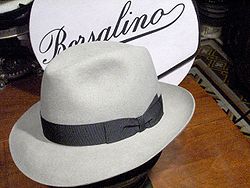
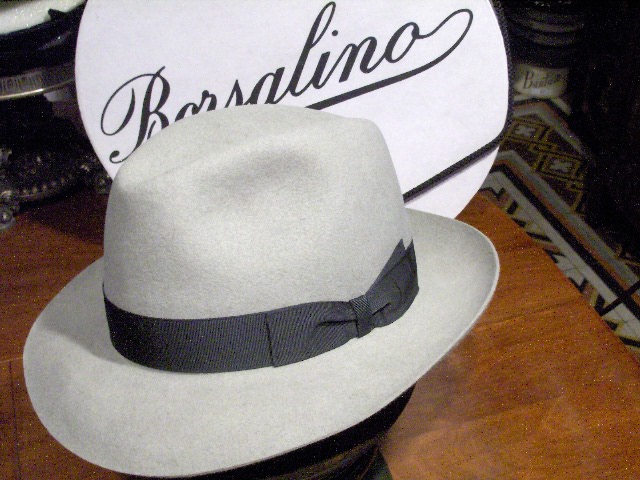
Borsalino Giuseppe e Fratello S.p.A.[1] is the oldest Italian company specializing in the manufacture of luxury hats. Since 1857, the manufacturer has been based in Alessandria, Piedmont. The founder, Giuseppe Borsalino, is remembered for creating a particular model of felt hat characterized by the registered trademark Borsalino.[2][3]

Key Information

History

[edit]
Giuseppe Borsalino (1834–1900), the founder of Borsalino

On 4 April 1857, Giuseppe Borsalino started a workshop in Alessandria that specialized in the production of felt hats. The workshop eventually grew to industrial production, and in 1888 the company moved to a new factory designed by Arnaldo Gardella, located on Corso Cento Cannoni, Alessandria. In these years Borsalino produced 2,500 hats a day, but when the company won the Grand Prix, an important quality certificate, at the Paris Exposition Universelle in 1900, it spread the brand's fame globally. The succession of Giuseppe Borsalino was complicated: the designated heir, Teresio Borsalino, was opposed to his cousin Giovanni Borsalino, son of Lazzaro, who inaugurated a new hat factory using the family name. Between Borsalino Antica Casa and Borsalino Fu Lazzaro were years of hard commercial battles, but in the end, the Teresio came out and the name Borsalino became one again.

On the eve of the First World War, Borsalino produced about 2,000,000 hats annually. The manufacturer employed over 2,500 employees, representing a significant resource in the economy of the Piedmontese city. Abroad, the brand spread everywhere, conquering the most important markets: the British, but especially the U.S., where the hats produced in Alessandria were adopted by the Hollywood star system.

A downsizing of the company occurred in 1950 in conjunction with the beginning of the fall into disuse of formal hats: Borsalino was thus transformed from a mass product into a cult object. In 1987 the hat factory moved from the historic center in Alessandria to the current one of Spinetta Marengo, in the suburbs of the city, and the president, Vittorio Vaccarino, the last descendant of the Borsalino family, sold the company to a group of Milanese entrepreneurs.

In the 1990s, the company changed ownership several times, ultimately being bought by the entrepreneur Marco Marenco, involved in a €3.5 billion financial crack. On 18 December 2017, the Court of Alessandria declared the bankruptcy of Borsalino Giuseppe and Fratello Spa.[4][5] Haeres Equita, a private equity fund which managed the brand's activities since 2016, confirmed the will to continue the production, distribution and promoting activities of the forthcoming collections, keeping all employment and maintaining the production site in Alessandria.[6] In 2017, on the occasion of the 160th anniversary of the company, the Italian Ministry of Economic Development recognized Borsalino as one of the 'Excellencies of the production system', dedicating it a stamp worth €0.95.[7] On 12 July 2018, the company was sold in a court auction for €6.4 million (US$7.4 million) to Haeres Equita.[8]

Production

[edit]

Borsalino manufacturing has remained faithful to a production process that represents the cultural values of the company, handed down from generation to generation. The hats continue to be produced in Alessandria close to the area of the company's original foundation. The felt models, created from fur fibers, require more than 50 manual steps and seven weeks of work to create; the straw models, which are hand twisted, can take up to 6 months for a single hat.[9][10][11]

Borsalino and Alessandria

[edit]

The Borsalino business dynasty has made an important contribution to the city of Alessandria, building the aqueduct, the sewerage network, the hospital, the sanatorium and the retirement home.[12] The historic headquarters of the company, currently located in Corso 100 Cannoni, now hosts the University of Eastern Piedmont Amedeo Avogadro and the Borsalino Hat Museum.[13][14][15][16] In 2016, independent film director Enrica Viola dedicated a documentary to the relationship between Borsalino and Alessandria: Borsalino City[17][18][19] was presented at film festivals in Turin, Barcelona, and Melbourne.

The Borsalino Hat Museum

[edit]

In the spring of 2006, the Borsalino Hat Museum opened in the company's historical headquarters in Corso 100 Cannoni, Alessandria. A joint initiative by Alessandria town council and the Borsalino company, the museum covers an exhibition area of roughly 400 square metres (4,300 sq ft) and houses about two thousand hats, displayed in the historic Chippendale style cabinets made in the 1920s by Arnaldo Gardella for the factory sample room. In 2018, the museum planned to move to a larger venue with a completely renovated exhibition.[20]

In Orthodox Jewish communities

[edit]

Among Orthodox Jewish men and boys, covering the head is an identifier of religiousity.[21] Many men in strictly Orthodox Jewish communities wear a black, wide-brimmed hat, with Borsalino being one of the most popular makers.

[edit]

Borsalino and art

[edit]

The relationship between Borsalino and the art world has ancient origins. Since the birth of advertising in Italy, at the turn of the late nineteenth and early twentieth century, Borsalino has entrusted the realization of its posters to the most important artists of the time. This privileged relationship with art has been confirmed over time and has led the company to collaborate with Cesare Simonetti, Giorgio Muggiani, Giovanni Dradi, Franz Laskoff, Marcello Dudovich, winner in 1910 of a competition organized by Borsalino to publicize the Zenit hat, Giuseppe Minonzio, Gino Boccasile, Luigi Bompard, Jeanne Grignani, Luigi Veronesi, Max Huber and Armando Testa. Today, the antique Borsalino advertising posters are collector items.

Borsalino and theatre

[edit]

In Arthur Miller's play The Price, character Solomon mentions regretting that his hat is not a Borsalino, in spite of looking so.

Borsalino and cinema and television

[edit]

Borsalino has a long-running and special bond with the film industry. Humphrey Bogart and Ingrid Bergman in the final scene of Casablanca tends to stand out as the most popular in which a Borsalino hat makes an appearance. The relationship with the cinema was destined to last: in addition to Bogart and Bergman in Casablanca, Marcello Mastroianni in 8 ½ and Jean Paul Belmondo in Breathless both wore a Borsalino.

The Alessandria factory granted the use of its name to two cult films of the 1970s: Borsalino and Borsalino & Co.. The idea was Alain Delon's, and Borsalino accepted on the condition that the company logo would appear on the posters. The Italian company was the first luxury brand to give its name to two films.

Robert De Niro in Once Upon a Time in America (1984) wore Borsalino hats.

In the 2010 TV series The Trip to Italy, in episode 6, located in Capri, Steve Coogan says that he is wearing a Borsalino hat, and Al Capone "used to wear one of these".

In 2011, the Triennale Design Museum in Milan hosted an exhibition entitled "Il cinema con il cappello. Borsalino e altre storie".[22][23][24]

The actor Toni Servillo wears a Borsalino in the film The Great Beauty, which won Best Foreign Language Film at the 86th Academy Awards.

In 2018, Borsalino celebrated its deep and lasting relationship with the world of cinema by introducing The Bogart by Borsalino, a special collection dedicated to Humphrey Bogart, the great Hollywood actor. The hats collection was created in collaboration with Humphrey Bogart Estate.[25]

In the TV show "Shantaram", a secondary but recurring character in season 1, episode 5, titled "The Sin in the Crime", uses a metaphor about the quality of a Borsalino hat to describe the main character's (Lin Ford, played by Charlie Hunnam) relationship with the city of Bombay, India.

In the Netflix series "Ripley", a witness to the disposal of Freddie's body described him as a thin man wearing a Borsalino hat.[26] In the TV series The Blacklist Season 10 episode 11 (The Man With the Hat) the main character Raymond Reddington played by James Spader is shown to wear a Borsolino hat.

Borsalino and design

[edit]

In 2009, Borsalino was included by the Triennale Design Museum in Milan among quintessential Italian icons in the 'Serie Fuori Serie' exhibition.[27] The exhibition was replicated in March 2017 at the National Museum of China in Beijing.[28]

The Chapeau Lamp[29] (2014) designed by Philippe Starck for Flos and the sculpture The Hatband[30](2016) by Moritz Waldemeyer are both tributes to Borsalino.

Borsalino and fashion

[edit]

Borsalino has been collaborating with important names in the fashion system since the beginning of the millennium. These have led to the creation of capsule collections with Nick Fouquet,[31] Tom Ford, Versace, Krizia, Valentino, Moschino, Yohji Yamamoto, Marni, Gianfranco Ferré, Rochas, Italia Independent, and DSquared.

See also

[edit]

References

[edit]
[edit]
Revisions and contributorsEdit on WikipediaRead on Wikipedia
from Grokipedia
Borsalino is an Italian luxury hat manufacturer founded on April 4, 1857, by Borsalino in , , specializing in high-quality felt hats crafted through traditional artisan techniques blended with French influences learned during the founder's in . The company, which began as a small employing and his brother Lazzaro, quickly gained renown for its innovative approach to hat-making, emphasizing superior materials, refined details, and a distinctive "Borsalino style" of elegance that extended from men's fedoras to women's collections, straw models, and accessories like and perfumes. Under subsequent generations, particularly Teresio Borsalino, the firm modernized into a leading manufacturing group while preserving its heritage, expanding production to include fabric and hats and pioneering advertising strategies that leveraged cinema to promote its iconic designs worldwide. By the early , Borsalino hats had become cultural symbols of sophistication, worn by figures in and associated with timeless Italian craftsmanship, with the brand now headquartered in nearby Valenza and offering services alongside its lines. Today, as part of Haeres Equita srl, Borsalino continues to embody excellence, producing models through processes like the "Felt Journey" and maintaining a dedicated museum in to showcase its legacy.

History

Founding and Early Development

Giuseppe Borsalino, born in 1834 in , , , began his hat-making career at the age of 13 as an apprentice in a local workshop. At 16, in 1850, he traveled to to advance his skills at the renowned Berteil hat factory, where he trained for seven years in the art of crafting high-quality felt hats from fine furs. Upon returning to Alessandria, Borsalino, then 23 years old, founded the company on April 4, 1857, by establishing a small workshop in a on Via Schiavina, specializing in soft felt hats made from and fur. Assisted by his brother Lazzaro, he took over and expanded an existing modest operation into what would become a cornerstone of Italian craftsmanship. The early years of Borsalino emphasized meticulous, handcrafted production of men's soft felt hats, utilizing premium and fur to achieve a supple, durable material prized for its quality and comfort. Starting with a small team of around ten workers producing about 50 hats per day, the workshop quickly scaled through Borsalino's dedication to superior techniques, transitioning to industrial production in the late while maintaining artisanal standards. Giuseppe Borsalino's innovations in hat shaping and finishing techniques were pivotal to the brand's early reputation for excellence. He developed the "pinching" method, creasing the crown's front sides to allow easier removal and handling, which influenced the evolution of the style and distinguished Borsalino hats for their practical elegance. These advancements, combined with rigorous finishing processes like hand-shaving and steaming the felt for smoothness, ensured hats that were not only stylish but also lightweight and resilient. In its formative decade, Borsalino concentrated on domestic markets within , building a loyal clientele through word-of-mouth and regional trade fairs. By the , the company initiated exports to other European countries, leveraging its growing production capacity to supply discerning buyers in , , and beyond, thus laying the groundwork for international recognition.

Expansion and Innovations

Following the initial establishment of its workshop, Borsalino underwent rapid industrialization in the late , transitioning from artisanal production to large-scale . By 1888, the company had expanded to produce approximately 2,000 hats daily, reflecting the implementation of modern machinery and organized labor processes. This growth continued exponentially, with production reaching around 750,000 hats per year in the early 1900s and peaking at over 2 million annually by 1913, just before ; at its height, Borsalino employed up to 2,500 workers across multiple factories in , solidifying its position as a leading European hat producer. A pivotal stylistic during this period was the introduction of the style in the 1880s, which featured a pinched crown and curved brim, distinguishing it from earlier rigid hat forms and establishing it as Borsalino's signature design. This model combined elegance with practicality, appealing to a broadening market of urban professionals and contributing to the brand's international appeal. The 's refined shape, achieved through advanced felt molding techniques, helped Borsalino differentiate its products in a competitive industry. Borsalino's innovations garnered significant recognition, most notably the Grand Prix at the 1900 Paris Exposition Universelle, honoring the superior quality and design of its hats. This prestigious accolade, the highest honor bestowed at the event, validated Borsalino's craftsmanship and propelled its global reputation, leading to increased exports across and beyond. The underscored the company's commitment to excellence in material selection and finishing processes. In the early , Borsalino further diversified its offerings to meet evolving fashion demands. Starting in 1920, the company began producing straw hats, incorporating lightweight, breathable materials like those used in styles to expand beyond traditional felt. A decade later, in 1930, Borsalino introduced its first collection of women's hats, adapting classic shapes such as the fedora for feminine silhouettes and broadening its market to include female consumers. These developments marked a strategic shift toward product versatility while maintaining artisanal standards.

20th Century Challenges

Following the death of founder Giuseppe Borsalino in 1900, his son Teresio Borsalino assumed leadership of the company, maintaining family oversight that would persist until the mid-1980s. Under Teresio's direction, the firm solidified its position as a global leader in luxury production, with the family emphasizing artisanal techniques and in felt and designs. This familial continuity provided stability amid early 20th-century upheavals, allowing Borsalino to navigate economic and geopolitical pressures while preserving its reputation for quality. World War I significantly disrupted Borsalino's operations, reducing output from its pre-war peak of approximately 2 million hats annually and affecting its workforce of over 2,500 employees through export blockades and resource constraints. Despite these challenges, the company adapted by focusing on domestic markets and sustaining core production capabilities. The marked a resurgence, with growth fueled by international acclaim; by the , Borsalino hats had become a Hollywood staple during the era, and production expanded to include elegant straw styles starting in 1920, followed by the introduction of women's hats a decade later. This era saw the brand achieve peak popularity in , exporting 60% of its output worldwide and embedding "Borsalino" as a generic term for fedora-style hats in the . World War II brought severe setbacks, including Allied bombings that damaged the factories in 1944 and widespread material shortages that halted much of the production process. The export blockade exacerbated the crisis, nearly crippling the firm's operations amid Italy's wartime turmoil. Postwar recovery was gradual but effective; by the late , Borsalino had rebuilt its facilities, improved sourcing of high-quality furs like and , and reestablished its market presence, leveraging its iconic status in films such as (1942) to regain momentum. Family leadership under subsequent generations ensured a focus on craftsmanship, enabling the company to weather the immediate reconstruction challenges. By the and , Borsalino faced mounting economic pressures from shifting trends that diminished the cultural necessity of formal hats, particularly after the movements prioritized casual attire. Intense competition from lower-cost manufacturers further eroded , leading to a drastic reduction in production to about 1,500 hats per day and a halving of the . The company transitioned from to a niche luxury model, retaining a dedicated clientele but grappling with declining demand as global tastes evolved away from traditional menswear accessories. This period culminated in the sale of the family-held business in the mid- to external investors, marking the end of over a century of direct familial control.

Acquisition and Recent Developments

In the early 21st century, Borsalino faced mounting financial difficulties, culminating in a declaration of by an court on December 18, 2017, after sustained losses and a rejected creditor repayment proposal from its then-managers. The company's woes stemmed from years of declining sales in a shrinking hat market, exacerbated by competition from and changing consumer preferences. Despite these challenges, Borsalino marked its 160th anniversary in 2017 with celebrations that highlighted its enduring legacy, including the issuance of a €0.95 commemorative by the Italian Ministry of and on April 4, featuring the brand's logo and signature design. Following the bankruptcy, Borsalino's assets were auctioned, and on July 12, 2018, investment firm Haeres Equita, led by Swiss-Italian financier Philippe Camperio, acquired the company for €6.4 million—the minimum bid set by the court—securing its industrial assets, brand, and production facilities in . Under Haeres Equita's stewardship, the firm has pursued revitalization, emphasizing heritage preservation alongside modernization; a key milestone was the opening of the Borsalino Hat Museum on April 4, 2023, in 's historic Palazzo Borsalino, in partnership with the city and the Borsalino Foundation, to showcase over 2,000 artifacts and safeguard the brand's cultural patrimony. Recent developments under Haeres Equita have focused on stabilizing and expanding operations through strategic partnerships, digital enhancement, and sustainable practices. In , Borsalino signed a licensing agreement with Italian helmet manufacturer Nolan for a new headwear line debuting in summer, and launched a zero-waste capsule collection with Neapolitan tie maker E. , utilizing recovered fabrics to promote environmental responsibility. The brand has bolstered its online presence via its official platform, supporting global sales of its core lines, while maintaining artisanal craftsmanship through in-house training at its Alessandria atelier, where each felt requires seven weeks of handwork by skilled craftspeople. By 2025, these efforts have enabled Borsalino to release seasonal collections like Fall-Winter 2025, featuring innovative designs that blend tradition with contemporary appeal, signaling a return to robust production and market positioning.

Products and Manufacturing

Hat Styles and Materials

Borsalino offers a diverse array of hat styles, with the classic serving as its signature offering, characterized by a soft felt construction, a crown height of approximately 10-11 cm featuring a center dent and lateral pinches, and a brim width typically ranging from 6 to 7.5 cm that can snap up or down for versatility. These fedoras are available in variations for both men and women, including wider brims for a more dramatic silhouette or narrower profiles for everyday wear, and they maintain a timeless appeal rooted in early 20th-century design. Complementing the fedora, Borsalino produces straw hats, which feature a lightweight, handwoven structure with a medium crown and brim widths of 6-8 cm, ideal for summer protection and often finished with a ribbon. Boater models, crafted in braided straw, offer a flat crown and straight brim of about 5-6 cm, evoking nautical elegance and suitable for formal occasions, with options including chin straps for added security. The brand's primary materials emphasize premium quality and functionality, with high-grade fur felt derived from 100% or fur forming the backbone of its winter and all-season hats; fur provides a soft, velvety texture, while fur enhances durability, water resistance, and shape retention even in adverse weather. For summer styles like Panamas and boaters, Borsalino utilizes Ecuadorian toquilla straw from the plant, sourced from regions such as Montecristi and Jipijapa, where the fine weave—sometimes requiring up to six months of handcrafting—ensures and flexibility. These materials are selected for their natural resilience, allowing hats to age gracefully while resisting deformation. Customization options allow for personalization in brim widths from 6 to 10 cm and various shapes, such as teardrop or cattleman creases, enabling tailored fits for individual face shapes and preferences through Borsalino's service. Distinguishing hallmarks of Borsalino hats include the signature leather sweatband embossed with the "Borsalino" logo, which provides comfort and moisture absorption, and presentation in branded hatboxes made of reinforced for protection during storage and travel. These elements underscore the brand's commitment to artisanal excellence, ensuring each piece arrives as a complete luxury experience.

Production Techniques and Facilities

Borsalino's felt hat production involves a meticulous multi-step comprising more than 50 manual stages, spanning approximately seven weeks from raw material to finished product. The begins with the careful selection and sorting of high-quality , primarily or , sourced as by-products from the to ensure . Artisans then steam and full the to create a dense felt hood, followed by blocking to form the crown and brim, and precise ironing to achieve the signature smooth finish. These tasks are performed exclusively by skilled craftsmen in , many with over 20 years of experience, preserving techniques handed down through generations. Straw hat production at Borsalino demands even greater time investment, often extending up to six months, with the majority of labor—estimated at around 80%—conducted by hand to maintain artisanal precision. Straw, typically , undergoes harvesting, boiling, and drying before being woven into hoods by local artisans in a UNESCO-recognized . Upon arrival in , the hoods are bleached for color uniformity, steamed for pliability, and hand-shaped on wooden blocks to define the style, followed by edging and ribbon attachment. This labor-intensive approach ensures the lightweight yet durable quality of models like the . The company's primary production facility, established in 1857, remains in , , where all hats are crafted under one roof to uphold standards. As of 2023, the factory employs over 150 workers, stabilized following the recovery plan after the 2018 acquisition that revitalized operations. In 2025, Borsalino entered a licensing agreement with Swiss firm Gamat for the production of goods, expanding activities beyond hats with the first collection set for 2026. is integrated through certifications for sourcing, including mulesing-free from Australian farms and felt from partners practicing selective culling to protect ecosystems. Quality control is rigorous, with each undergoing multiple individual inspections, including backlit examinations in darkened rooms to detect imperfections early in the process. This commitment to excellence helps preserve the brand's exclusivity and artisanal integrity amid growing demand.

Connection to Alessandria

Economic and Social Impact

Borsalino's operations in have long served as a of local , reaching a peak of over 2,500 workers in the early and providing stable jobs that supported a significant portion of the city's population. These roles emphasized skilled craftsmanship in production, fostering economic stability through consistent demand for . In the early , company profits under Teresio Borsalino funded key civic projects that enhanced Alessandria's , including the construction of health facilities, schools, and the municipal aqueduct. These initiatives, driven by a philanthropic vision, addressed public welfare needs and contributed to the city's modernization following the demolition of its historic walls in 1922. Giuseppe Borsalino established pioneering social initiatives, such as and a for employees, reflecting that predated widespread Italian labor protections. These programs influenced modern Italian labor practices by setting precedents for worker benefits in industrial settings. Borsalino continues to play a vital role in the region's luxury goods sector, where the 2023 opening of the Borsalino Museum has spurred and supported ancillary industries like and retail.

The Borsalino Hat Museum

The Borsalino Hat Museum opened on April 4, 2023, coinciding with the 166th anniversary of the company's founding, in the restored historic Palazzo Borsalino in , —a 19th-century building that originally served as the hat manufacturer's for nearly a century. Spanning approximately 620 square meters across multiple spaces including exhibition areas and a café, the museum provides free admission to holders of the Piedmont-Valle d'Aosta Museum Subscription card, while standard entry costs €12 for adults with reduced rates of €10 for students and seniors, and free access for children under 12 and disabled visitors. Managed by the City of in collaboration with the Borsalino Foundation, the institution serves as a dedicated space for preserving and promoting the brand's artisanal legacy through immersive displays and public engagement. Key exhibits at the museum include over 2,000 historical hats arranged in eight narrative sections that trace the evolution of Borsalino's craftsmanship, alongside displays of hat molds, tools from the production process, and archival photographs documenting the factory's operations since 1857. Rotating installations feature select hats linked to cinematic history, highlighting the brand's iconic presence in while emphasizing the technical artistry behind each piece. These elements collectively illustrate the cultural and technical significance of Italian hat-making, with supports detailing the 52-step process required to create a single Borsalino hat. The museum supports educational programs such as guided tours that explore the brand's and hands-on workshops where visitors learn basic hat-making techniques using traditional methods. Since its opening, it includes an enhanced digital component through the Borsalino Museum App, allowing users to access interactive anecdotes and virtual explorations of the collection's intangible heritage. Partnerships with local schools integrate the museum into cultural curricula, offering tailored programs that foster appreciation for Alessandria's industrial past and the enduring value of skilled craftsmanship. As a cornerstone of local tourism, the Borsalino Hat Museum attracts visitors, drawing international interest in the brand's story and boosting Alessandria's profile as a hub for fashion heritage. By combining preservation efforts with accessible programming, it ensures the ongoing relevance of Borsalino's contributions to global style and design.

Cultural Significance

Use in Orthodox Jewish Communities

In Orthodox Jewish communities, particularly among Hasidic and Yeshivish groups in the United States and Israel, Borsalino fedoras have been embraced since the mid-20th century as a preferred alternative to more rigid traditional black hats, offering a blend of religious observance and refined style. This adoption gained prominence following World War II, when the fedora style became standardized in Haredi attire, with Lubavitch Hasidim notably favoring the black Borsalino model emulated from their late leader, Rabbi Menachem Mendel Schneerson, who wore it from the 1950s onward. The hat's wide-brimmed design aligns with religious requirements for head coverage during prayer and daily life, symbolizing modesty (tzniut) while conveying modernity and elegance within communal dress codes. Customizations, such as wider brims (often 6-7 cm or more) and downward-facing edges, are common to suit specific sectarian preferences, like those in certain Yeshiva or Hasidic subgroups, ensuring compliance with interpretive religious standards for headwear. These tailored features are available through specialized retailers in Orthodox enclaves, including Brooklyn's Borsalino for Atica outpost, which opened in 2015 as the first exclusive shop catering to the Jewish community and operates in alignment with observant practices. The cultural significance of Borsalino in these communities extends to its role as a marker of and , endorsed implicitly by influential rabbis like Schneerson during the 1980s, when his public appearances reinforced its acceptance as an elevated yet humble accessory. By adhering to black felt and avoiding ostentation, it upholds modesty while distinguishing wearers in urban settings like New York or . Orthodox Jewish buyers represent approximately 10% of Borsalino's global sales as of recent years, with a notable concentration in the U.S. market driven by this demographic's loyalty. This segment prompted dedicated retail initiatives, such as the Atica collaboration, to meet demand for authentic, community-oriented products.

Depictions in Art and Literature

Borsalino hats have been prominently featured in early 20th-century Italian , particularly through illustrations that captured the era's urban sophistication and modernity. Renowned poster artist Marcello Dudovich created several iconic advertisements for the brand in the , depicting elegant figures in Borsalino fedoras to symbolize refined Italian style amid the dynamic cultural shifts of the . These works, blending influences with emerging modernist elements, portrayed the hat as an essential accessory for the cosmopolitan man, often set against backdrops of theaters or cityscapes that evoked a sense of poised elegance. Similarly, posters by artists like Cesare Simonetti in the early further established the Borsalino as a playful yet sophisticated emblem in Italian , reinforcing its role in visual narratives of leisure and status. In literature, Borsalino hats appear as markers of and personal character, particularly in 20th-century Italian works tied to the brand's Piedmontese origins. In Umberto Eco's 2004 novel The Mysterious Flame of Queen Loana, the protagonist Yambo reflects on his upbringing in —a town synonymous with Borsalino hat production—as a foundational element of local identity and everyday masculinity, evoking memories of familial and communal life shaped by the industry's legacy. Eco, himself born in Alessandria and a habitual wearer of Borsalino hats, often wove such regional symbols into his narratives to denote intellectual depth and understated elegance, as seen in his personal anecdotes and interviews where the hat represents a connection to Italian craftsmanship. These literary references highlight the Borsalino's function as a subtle indicator of era-specific social standing, blending personal nostalgia with broader themes of heritage in post-war European prose. Modern art installations have continued to position Borsalino hats as cultural artifacts, showcasing their enduring symbolic weight. In 2009, the Triennale Design Museum in included Borsalino in its "Serie Fuori Serie" exhibition, celebrating the hat alongside other icons as a timeless emblem of innovation and national pride. This was followed in 2011 by "Il Cinema con il Cappello: Borsalino e Altre Storie," another Triennale presentation that explored the hat's visual and emotional resonance through curated displays, transforming it into a centerpiece of contemporary discourse. Such exhibits underscore the Borsalino's evolution from functional object to artistic symbol, inviting reflection on its craftsmanship in gallery settings. Throughout 20th-century European and illustrations, Borsalino hats consistently symbolize Italian elegance and masculinity, often connoting a refined yet assertive . In visuals and alike, the fedora's soft felt crown and structured brim evoke a poised , as articulated in design histories that trace its adoption by intellectuals and professionals to signify cultural sophistication. This imagery permeates European creative works, where the hat serves as a for enduring style amid modernist upheavals, without delving into performative contexts.

Role in Theatre and Performance

Borsalino hats, particularly its signature s, trace their theatrical origins to the late 19th century, when the style gained prominence through the 1882 play by French playwright , written specifically for actress ; the character's hat became the archetype for the soft felt that Borsalino would later perfect. This connection underscores the brand's early integration into European stage aesthetics, where elegant headwear symbolized character sophistication and period authenticity in revivals of traditional forms like during the early . Borsalino's high-quality felt hats, prized for their malleability and luxurious finish, were favored for costuming roles requiring refined yet versatile appearances, enhancing the visual storytelling in Italian productions that emphasized historical realism. In mid-20th-century Anglo-American theatre, Borsalino hats appeared in prominent Broadway and West End shows, often adorning characters in or urbane roles to evoke 1930s-1950s noir elegance; for instance, in the 1950 Broadway musical , performers wore fedora-style hats akin to Borsalino models to capture the gritty charm of New York gamblers and hustlers. The brand's prestige was further highlighted in Arthur Miller's 1968 play The Price, where a pawnshop owner laments that his hat merely resembles a Borsalino but lacks its authentic quality, reflecting the hat's status as a symbol of aspiration and refinement on stage. Collaborations with houses emerged in the 1990s, with Borsalino providing custom felt hats for productions such as Mozart's at major European venues, where the hats lent aristocratic poise to noble characters in period attire. In contemporary live performances, Borsalino continues to emphasize its heritage through custom designs and archival loans, as seen in the 1983 by , where the singer wore a beige-grey felt crafted by Borsalino, complete with a pale green silk band, to accentuate his charismatic stage persona. Recent 2020s stage works have incorporated tailored Borsalino pieces to highlight cultural legacy, with the company loaning vintage models from its archives for heritage-focused revivals that blend tradition with modern interpretation, ensuring the hats remain vital costume elements in evoking timeless narratives.

Appearances in Film and Television

Borsalino hats gained prominence in cinema through their association with Hollywood icons, beginning with Humphrey Bogart's portrayal of Rick Blaine in the 1942 film . Bogart wore a signature Borsalino throughout the movie, particularly in the iconic final scene where he and share a moment amid the fog of a runway, cementing the hat as a staple of and sophisticated masculinity. The brand's cultural footprint expanded significantly with the 1970 French gangster film Borsalino, directed by Jacques Deray and starring and as rival gangsters in . The movie's title was directly inspired by the hat maker, marking the first time a luxury brand lent its name to a ; Belmondo and Delon donned authentic Borsalino fedoras, which became integral to the characters' dapper, underworld style and propelled the hat's global recognition. In television, Borsalino hats have symbolized refined, era-specific elegance, appearing in period dramas that evoke mid-20th-century aesthetics, such as (1999–2007) and (2007–2015), where fedoras underscore themes of power and nostalgia. More recently, the brand featured in (2016–2023) to authentically depict historical figures and events, enhancing the series' attention to wardrobe detail. By 2025, Borsalino hats have accumulated credits in over 100 films and series, reflecting their enduring role in visual storytelling across genres from noir to historical epics.

Influence on Fashion and Design

Borsalino's designs significantly contributed to the evolution of menswear aesthetics in the mid-20th century, particularly during the when the brand's hats became synonymous with sophisticated urban style and were widely adopted as essential accessories in European circles. The pinched crown and soft felt construction of the classic Borsalino influenced broader trends in tailored ensembles, emphasizing refined proportions and versatility that extended beyond headwear to complementary accessories like scarves and ties. In recent decades, Borsalino has expanded its influence through strategic collaborations with luxury brands, blending its artisanal heritage with contemporary interpretations. Notable partnerships include a 2023 capsule with Saint Laurent featuring reimagined wool felt fedoras in black and navy, highlighting the brand's adaptability to modern luxury aesthetics. Similarly, a 2025 collection with introduced exclusive hat designs that fuse classic silhouettes with bold, archival-inspired patterns, reinforcing Borsalino's role in elevating accessory lines across high-end menswear. These collaborations have inspired similar experimental approaches in runway presentations by other Italian houses, promoting the integration of heritage craftsmanship into seasonal collections. The brand's design legacy extends to practical innovations in accessory and , such as its FSC-certified cardboard hatboxes, which prioritize while maintaining an elegant, logo-embossed form that has become a standard for premium storage in the industry. This has shaped menswear accessory standards, encouraging competitors to adopt durable, eco-conscious solutions that preserve garment integrity during travel and display. Borsalino's emphasis on fine materials and timeless proportions continues to inform broader design principles in luxury menswear, where hats serve as focal points for coordinated outfits. As of 2025, Borsalino is experiencing a revival in contemporary through its Fall-Winter collection, which incorporates subtle graphic motifs drawn from regimental ties and patterns into brims and linings, influencing luxury branding in lines. This trend toward heritage-infused graphics has permeated streetwear-adjacent styling, with Borsalino pieces appearing in urban ensembles that blend formal with casual elements, signaling a broader resurgence of structured headwear in global design narratives.

References

Add your contribution
Related Hubs
Contribute something
User Avatar
No comments yet.