


Community hub
Recent from talks
Contribute something
Nothing was collected or created yet.
Félibrige
View on Wikipedia

The Félibrige (French pronunciation: [felibʁiʒ]; Lo Felibritge in classical Occitan, Lou Felibrige in Mistralian spelling, pronounced [lu feliˈβɾidʒe]) is a literary and cultural association founded in 1854 by Frédéric Mistral and other Provençal writers to defend and promote the Occitan language (also called the langue d'Oc) and literature. It is presided over by a capoulié (classical norm: capolièr).[1] The name possibly derives from an apocryphal Provençal story of Christ disputing in the temple with the seven doctors [sét félibre] of law.
Etymology
[edit]Origins
[edit].svg)
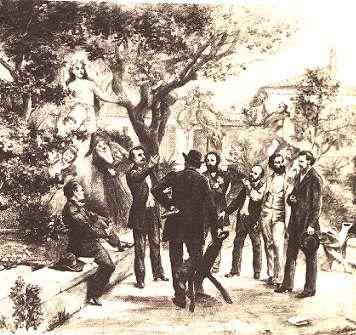
Le Félibrige was founded at the Château de Font-Ségugne (located in Châteauneuf-de-Gadagne, Vaucluse) on 21 May 1854 (Saint Estelle's day), by seven young Provençal poets: Théodore Aubanel, Jean Brunet, Paul Giéra, Anselme Mathieu, Frédéric Mistral, Joseph Roumanille and Alphonse Tavan. Together, they aimed to restore the Provençal language and codify its orthography.
Its symbol is a seven-pointed star which, as Frederic Mistral writes in Lou tresor dóu Felibrige, is "a tribute to its seven founders".[2]
The movement was launched in Provence but quickly reached the entire Occitania. It spread among Occitanian writers such as Michel Camélat and Simin Palay (from Gascony and Béarn), Albert Arnavielle, Justin Bessou, Jacques and Gabriel Azaïs and Achille Mir (Languedoc), Arsène Vermenouze (Auvergne), Joseph Roux (Limousin), José Mange (Provence), Brémonde de Tarascon (Bouches-du-Rhône), Batisto Bonnet (Gard) and Charles Maurras.
The Félibrige is an organisation focussed on protecting and promoting Occitan language and culture, fighting for recognition of cultural diversity both within France and across the wider world. It is also one of the two organisations represented across Occitania since 1945, along with the Institut d'Estudis Occitans (IEO).
Felebrigian festivals
[edit]There is a yearly meeting, Santo Estello, held in a different town in the Pays d'Oc. The traditional banquet is ended with the ritual of the Copa Santa.
There are also other Fêtes Félibréennes:
- Since 1323, the Jeux floraux of Toulouse, considered as the model
- Jeux floraux of Barcelona
- Orange
- In 1868 at Saint-Rémy-de-Provence[3]
- In 1895 at Vic-en-Carladès, with a programme of music and dance (Cabrette)[4]
- In 1900 at the Château de Ventadour, under the name Fête de l'églantine
- In 1902 at Béziers
- In June 1903 and in 2009 at Sceaux
- In 1907 at Mauvezin, in the Hautes-Pyrénées[5]
- In August 1914, at Sauveterre-de-Béarn
- At Puy-en-Velay[6]
- In 1935 at Monistrol-sur-Loire
- Perhaps Argentat, after 1935 with the Chorale des gabariers de la Dordogne[7]
The Jardin des Félibres in Sceaux
[edit]In 1950 Sceaux, Hauts-de-Seine (one of the Parisien banlieue) was named Cité Félibréenne. A memorial garden for this event was created around the tomb of Jean-Pierre Claris de Florian, a French poet and romancier, well known for his fables and a noted Félibrigist (perhaps because his mother was Castilian). The garden displays eleven busts in all.
The garden is located behind the church of Saint Jean-Baptiste (Saint John the Baptist) in Sceaux. The entry, signed: Parc de Sceaux, Jardin des Félibres is located on Avenue du Président Franklin Roosevelt in Sceaux.
-

-

-

-

-

-

-

-

-
 Commemorative plaque


Capouliés of the Félibrige
[edit]The Félibrige is presided over by a capoulié.
- 1876–1888: Frédéric Mistral
- 1888–1891: Joseph Roumanille
- 1891–1901: Félix Gras
- 1901–1909: Pierre Devoluy
- 1909–1919: Valère Bernard
- 1919–1922: Joseph Fallen
- 1922–1941: Marius Jouveau
- 1941–1956: Frédéric Mistral
- 1956–1962: Charles Rostaing
- 1962–1971: Elie Bachas
- 1971–1982: René Jouveau
- 1982–1989: Paul Roux
- 1989–1992: Paul Pons
- 1992–2006: Pierre Fabre
- 2006–2022: Jacques Mouttet
- 2022–: Paulin Reynard
See also
[edit]References
[edit]- ^ "capolier". Dicod'Òc. Lo Congrès permanent de la lenga occitana. Archived from the original on 20 September 2022. Retrieved 18 September 2022.
- ^ Frederic Mistral, Lo tresor dóu Felibrige, vol. II, p. 887: Una estela a sèt rais es lo simbòl dau Felibritge, en memòria dei sèt felibres que lo fondèron a Font Segunha. (A seven-pointed star is the symbol of the Félibrige, in memory of the seven félibres who founded it in Font-Ségugne.)
- ^ Marcel Bonnet, « À propos des Fêtes Félibréennes de Saint Rémy en 1868: Zola contre Mistral », in Congrès de civilisation et de culture provençales. Éd. B. A. Taladoire. Avignon, Palais du Roure, 1961, pp. 31 38
- ^ "Cabrettes et cabrettaïres (Auvergne) avec gravure dans le texte de cet instrument et de photos dans le texte de Vic Sur Cère et du concours de cabrettes de la ville aux fêtes félibréennes de 1895." Charles Mayet, in Le Magasin pittoresque, 1896, livraison n°13, pp. 209-224
- ^ Une affiche est conservée au Musée d'Arles. Elle représente des instruments de musique: guitare, vielle, fifre-tambour et cornemuse.
- ^ Les fêtes Félibréennes du Puy, slnd, in-12°, 148 p, 10 photographies hors-texte
- ^ Fête son soixante-dixième anniversaire en 2005, avec la participation de L’École Ventadour de Tulle, La Bourrée Limousine de Brive, Les Vergnassous de St Germain Les Vergnes, Lou Gerbassous d’Ambazac, Les Pastourelles de Brive la Gaillarde, L’Eicola dau Barbichet de Limoges, L’Eiscola Dau Mont-Gargan de La Croisille-sur-Brillance, L’Églantino Dau Lémouzi de Limoges, Les Pastoureaux de la Valoine de Feytiat, Les Réveillés de Saintet-Fortunade, Les Amis de la Bourrée de Saint-Privat, Les Ranchos de Tulle
Sources
[edit]- Eugène Lintilhac, Les Félibres, 1895, édition Alphonse Lemerre, in-12°, 136 p. Première partie – Félibres et Félibrige : L'énigme du Félibrige : les félibres de Paris, Cigaliers et félibres de Paris, le royaume poètique de Sainte-Estelle le capoulié Félix Gras, Un jour de printemps chez Mistral. Deuxième partie – Théodore Aubanel, La genése du Félibrige et Aubanel, le mouvement de Mistral, Jasmin, l'oeuvre d'Aubanel.
- La Plume, revue littéraire artistique et sociale, Paris, dir. Léon Deschamps, n° 53 du 1 juillet 1891, p. 213–237 du recueil annuel. (Numéro consacré au Félibrige à l’occasion de la mort de Joseph Roumanille)
- Émile Ripert, La Renaissance Provençale, Paris, Librairie Champion, 1918
- Émile Ripert, Le Félibrige, Armand Colin, 1924; réédition Éditions Jeanne Laffitte, 2001 ISBN 2-86276-363-2
- René Jouveau, Histoire du Félibrige (4 volumes), Imprimerie Bené, Nîmes, 1970–1979; réédition 1984-1987
- Valère Bernard, Bagatouni, rééd. Alandis Editions, 2000.
- Philippe Martel, Les Félibres et leur temps : Renaissance d'oc et opinion (1850-1914), Bordeaux, PUB, 2010
External links
[edit]
- Félibrige
- History of Félibrige on NotreProvence.fr
- Felibrige sur lexilogos
- La Plume, n° 53 du 1 juillet 1891 (pdf) (cité supra dans la bibliographie)
- Conférence de Paul Ruat sur "le Félibrige", 8 février 1905.
- Lou Tresor dóu Felibrige online
| International | |
|---|---|
| National | |
| Other | |
