


Community hub
Recent from talks
Contribute something to knowledge base
Content stats: 0 posts, 0 articles, 1 media, 0 notes
Members stats: 0 subscribers, 0 contributors, 0 moderators, 0 supporters
Subscribers
Supporters
Contributors
Moderators
Hub AI
Gascony AI simulator
(@Gascony_simulator)
Hub AI
Gascony AI simulator
(@Gascony_simulator)
Gascony
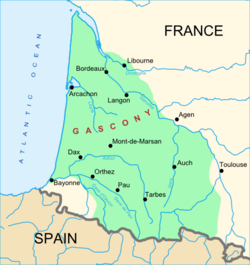
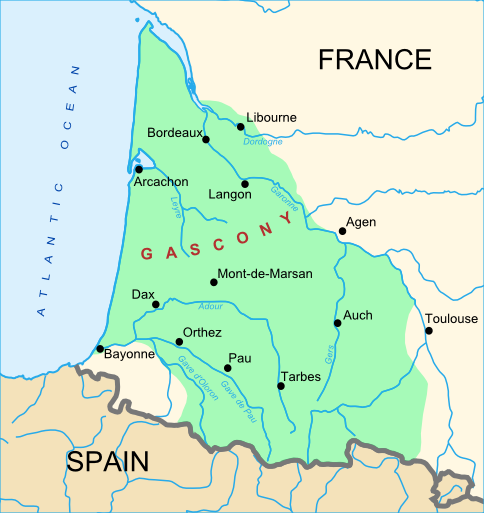
Gascony (/ˈɡæskəni/; French: Gascogne [ɡaskɔɲ] ⓘ; Occitan: Gasconha [ɡasˈkuɲɔ]) was a province of the southwestern Kingdom of France that succeeded the Duchy of Gascony (602–1453). From the 17th century until the French Revolution (1789–1799), it was part of the combined Province of Guyenne and Gascony. The region is vaguely defined, and the distinction between Guyenne and Gascony is unclear; by some they are seen to overlap, while others consider Gascony a part of Guyenne. Most definitions put Gascony east and south of Bordeaux.
It is currently divided between the region of Nouvelle-Aquitaine (departments of Landes, Pyrénées-Atlantiques, southwestern Gironde, and southern Lot-et-Garonne) and the region of Occitanie (departments of Gers, Hautes-Pyrénées, southwestern Tarn-et-Garonne, and western Haute-Garonne).
Gascony was historically inhabited by Basque-related people who appear to have spoken a language similar to Basque. The name Gascony comes from the same root as the word Basque (see Wasconia below). From the Middle Ages until today, the Gascon language has been spoken, usually classified as a regional variety of the Occitan language.
Gascony is the land of d'Artagnan, who inspired Alexandre Dumas's character d'Artagnan in The Three Musketeers, as well as the land of Cyrano de Bergerac, the eponymous character of the play by Edmond Rostand and the home of Emily St. Aubert, the central character of The Mysteries of Udolpho by Ann Radcliffe. It is also home to Henry III of Navarre, who later became king of France as Henry IV.
In pre-Roman times, the inhabitants of Gascony were the Aquitanians (Latin: Aquitani), who spoke a non-Indo-European language related to modern Basque.
The Aquitanians inhabited a territory limited to the north and east by the river Garonne, to the south by the Pyrenees mountain range, and to the west by the Atlantic Ocean. The Romans called this territory Aquitania, either from the Latin word aqua (meaning "water"), in reference to the many rivers flowing from the Pyrenees through the area, or from the name of the Aquitanian Ausci tribe, in which case Aquitania would mean "land of the Ausci".
In the 50s BC, Aquitania was conquered by lieutenants of Julius Caesar and became part of the Roman Empire.
Later, in 27 BC, during the reign of Emperor Augustus, the province of Gallia Aquitania was created. Gallia Aquitania was far larger than the original Aquitania, as it extended north of the Garonne, in fact all the way north to the river Loire, thus including the Celtic Gauls that inhabited the regions between the rivers Garonne and Loire.
Gascony
Gascony (/ˈɡæskəni/; French: Gascogne [ɡaskɔɲ] ⓘ; Occitan: Gasconha [ɡasˈkuɲɔ]) was a province of the southwestern Kingdom of France that succeeded the Duchy of Gascony (602–1453). From the 17th century until the French Revolution (1789–1799), it was part of the combined Province of Guyenne and Gascony. The region is vaguely defined, and the distinction between Guyenne and Gascony is unclear; by some they are seen to overlap, while others consider Gascony a part of Guyenne. Most definitions put Gascony east and south of Bordeaux.
It is currently divided between the region of Nouvelle-Aquitaine (departments of Landes, Pyrénées-Atlantiques, southwestern Gironde, and southern Lot-et-Garonne) and the region of Occitanie (departments of Gers, Hautes-Pyrénées, southwestern Tarn-et-Garonne, and western Haute-Garonne).
Gascony was historically inhabited by Basque-related people who appear to have spoken a language similar to Basque. The name Gascony comes from the same root as the word Basque (see Wasconia below). From the Middle Ages until today, the Gascon language has been spoken, usually classified as a regional variety of the Occitan language.
Gascony is the land of d'Artagnan, who inspired Alexandre Dumas's character d'Artagnan in The Three Musketeers, as well as the land of Cyrano de Bergerac, the eponymous character of the play by Edmond Rostand and the home of Emily St. Aubert, the central character of The Mysteries of Udolpho by Ann Radcliffe. It is also home to Henry III of Navarre, who later became king of France as Henry IV.
In pre-Roman times, the inhabitants of Gascony were the Aquitanians (Latin: Aquitani), who spoke a non-Indo-European language related to modern Basque.
The Aquitanians inhabited a territory limited to the north and east by the river Garonne, to the south by the Pyrenees mountain range, and to the west by the Atlantic Ocean. The Romans called this territory Aquitania, either from the Latin word aqua (meaning "water"), in reference to the many rivers flowing from the Pyrenees through the area, or from the name of the Aquitanian Ausci tribe, in which case Aquitania would mean "land of the Ausci".
In the 50s BC, Aquitania was conquered by lieutenants of Julius Caesar and became part of the Roman Empire.
Later, in 27 BC, during the reign of Emperor Augustus, the province of Gallia Aquitania was created. Gallia Aquitania was far larger than the original Aquitania, as it extended north of the Garonne, in fact all the way north to the river Loire, thus including the Celtic Gauls that inhabited the regions between the rivers Garonne and Loire.
Recent media
Recent media