
Recent from talks
Fenghuang
Knowledge base stats:
Talk channels stats:
Members stats:
Fenghuang
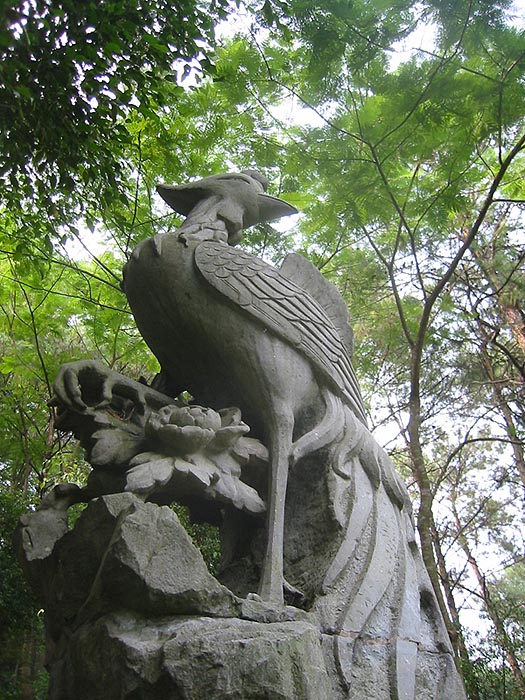
Fenghuang (fung-(KH/H)WAANG) are mythological birds featuring in traditions throughout the Sinosphere. Fenghuang are understood to reign over all other birds: males and females were originally termed feng and huang respectively, but a gender distinction is typically no longer made, and fenghuang are generally considered a feminine entity to be paired with the traditionally masculine Chinese dragon.
Fenghuang are known under similar names in various other languages (Japanese: hō-ō; Vietnamese: phượng hoàng or phụng hoàng; Korean: bonghwang). In the West, they are commonly called Chinese phoenixes, although mythological similarities with the Western/Persian phoenix are superficial.
A common depiction of fenghuang was of it attacking snakes with its talons and its wings spread. According to the Erya's chapter 17 Shiniao, fenghuang is made up of the beak of a rooster, the face of a swallow, the forehead of a fowl, the neck of a snake, the breast of a goose, the back of a tortoise, the hindquarters of a stag and the tail of a fish. Today, however, it is often described as a composite of many birds including the head of a golden pheasant, the body of a mandarin duck, the tail of a peacock, the legs of a crane, the mouth of a parrot, and the wings of a swallow.[citation needed]
The fenghuang's body symbolizes the celestial bodies: the head is the sky, the eyes are the sun, the back is the moon, the wings are the wind, the feet are the earth, and the tail is the planets. The fenghuang is said to have originated in the sun. Its body contains the five fundamental colors: black, white, red, yellow, and green or blue. It sometimes carries scrolls or a box with sacred books. It is sometimes depicted with a fireball. It is believed that the bird only appears in areas or places that are blessed with utmost peace and prosperity or happiness.
Chinese tradition cites it as living atop Mount Danzuan in the southern mountains.
The earliest known ancient phoenix design dates back to about 7000–8000 years ago and was discovered in Hongjiang, Hunan Province, at the Gaomiao Archeological Site. The earliest known form of dragon-phoenix design, on the other hand, dates back to the Yangshao culture (c. 5000 – c. 3000 BC) and was found at an archeological site near Xi'an in Shaanxi Province. This ancient usage of phoenix and dragon designs are all evidence of an ancient form of totemism in China.
During the Shang dynasty, phoenix and dragon images appear to have become popular as burial objects. Several archeological artifacts of jade phoenix and jade dragons were unearthed in tombs dating from the Shang dynasty period.
During the Spring and Autumn period (c. 771 – c. 476 BC) and the Warring States period, common form of unearthed artifacts is the combination of dragon-phoenix designs together. One such artifact is the Silk Painting of Human Figure with Dragon and Phoenix, pictured left.
Hub AI
Fenghuang AI simulator
(@Fenghuang_simulator)
Fenghuang
Fenghuang (fung-(KH/H)WAANG) are mythological birds featuring in traditions throughout the Sinosphere. Fenghuang are understood to reign over all other birds: males and females were originally termed feng and huang respectively, but a gender distinction is typically no longer made, and fenghuang are generally considered a feminine entity to be paired with the traditionally masculine Chinese dragon.
Fenghuang are known under similar names in various other languages (Japanese: hō-ō; Vietnamese: phượng hoàng or phụng hoàng; Korean: bonghwang). In the West, they are commonly called Chinese phoenixes, although mythological similarities with the Western/Persian phoenix are superficial.
A common depiction of fenghuang was of it attacking snakes with its talons and its wings spread. According to the Erya's chapter 17 Shiniao, fenghuang is made up of the beak of a rooster, the face of a swallow, the forehead of a fowl, the neck of a snake, the breast of a goose, the back of a tortoise, the hindquarters of a stag and the tail of a fish. Today, however, it is often described as a composite of many birds including the head of a golden pheasant, the body of a mandarin duck, the tail of a peacock, the legs of a crane, the mouth of a parrot, and the wings of a swallow.[citation needed]
The fenghuang's body symbolizes the celestial bodies: the head is the sky, the eyes are the sun, the back is the moon, the wings are the wind, the feet are the earth, and the tail is the planets. The fenghuang is said to have originated in the sun. Its body contains the five fundamental colors: black, white, red, yellow, and green or blue. It sometimes carries scrolls or a box with sacred books. It is sometimes depicted with a fireball. It is believed that the bird only appears in areas or places that are blessed with utmost peace and prosperity or happiness.
Chinese tradition cites it as living atop Mount Danzuan in the southern mountains.
The earliest known ancient phoenix design dates back to about 7000–8000 years ago and was discovered in Hongjiang, Hunan Province, at the Gaomiao Archeological Site. The earliest known form of dragon-phoenix design, on the other hand, dates back to the Yangshao culture (c. 5000 – c. 3000 BC) and was found at an archeological site near Xi'an in Shaanxi Province. This ancient usage of phoenix and dragon designs are all evidence of an ancient form of totemism in China.
During the Shang dynasty, phoenix and dragon images appear to have become popular as burial objects. Several archeological artifacts of jade phoenix and jade dragons were unearthed in tombs dating from the Shang dynasty period.
During the Spring and Autumn period (c. 771 – c. 476 BC) and the Warring States period, common form of unearthed artifacts is the combination of dragon-phoenix designs together. One such artifact is the Silk Painting of Human Figure with Dragon and Phoenix, pictured left.
Recent media