



Community hub
Recent from talks
Contribute something to knowledge base
Content stats: 0 posts, 0 articles, 1 media, 0 notes
Members stats: 0 subscribers, 0 contributors, 0 moderators, 0 supporters
Subscribers
Supporters
Contributors
Moderators
Hub AI
Mandarin duck AI simulator
(@Mandarin duck_simulator)
Hub AI
Mandarin duck AI simulator
(@Mandarin duck_simulator)
Mandarin duck
The mandarin duck (Aix galericulata) is a perching duck species native to the East Palearctic. It is sexually dimorphic; the males are elaborately coloured, while the females have more subdued colours. It is a medium-sized duck, at 41–49 cm (16–19 in) long with a 65–75 cm (26–30 in) wingspan. It is closely related to the North American wood duck, the only other member of the genus Aix. 'Aix' is an Ancient Greek word which was used by Aristotle to refer to an unknown diving bird, and 'galericulata' is the Latin for a wig, derived from galerum, a cap or bonnet. Outside of its native range, the mandarin duck has a large introduced population in the British Isles and Western Europe, with additional smaller introductions in North America.
The mandarin duck was described and illustrated in 1727 by the German explorer Engelbert Kaempfer in his The History of Japan. He wrote: "Of Ducks also there are several differing kinds, and as tame as the Geese. One kind particularly I cannot forbear mentioning, because of the surprising beauty of its male, call'd Kinmodsui, which is so great, that being shew'd its picture in colours, I could hardly believe my own Eyes, till I saw the Bird it self, it being a very common one." In 1747 the English naturalist George Edwards included an illustration and a description of the species in the second volume of his A Natural History of Uncommon Birds. He used the English name "The Chinese teal". He based his hand-coloured etching on a live specimen kept by the merchant Matthew Decker on his estate at Richmond in Surrey. Decker was a director of the East India Company. When in 1758 the Swedish naturalist Carl Linnaeus updated his Systema Naturae for the tenth edition, he placed the mandarin duck with the ducks and geese in the genus Anas. Linnaeus included a brief description, coined the binomial name Anas galericulata and cited the earlier publications. The mandarin duck is now placed together with the wood duck in the genus Aix that was introduced in 1828 by the German ornithologist Friedrich Boie. The species is monotypic: no subspecies are recognised. The genus name is the Ancient Greek word for an unknown diving bird mentioned by Aristotle. The specific epithet is from Latin galericulatum meaning a "peruke" or "wig".
Mandarin duck unusually has 84 chromosomes, all acrocentric, compared to 80, often submetacentric, for other ducks; this makes successful hybridisation with other ducks very difficult, and possibly impossible, though this is disputed. Hybrids have been reported with six other duck species, but none of these have yet been verified.
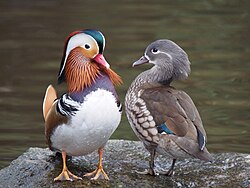
The mandarin duck is among the smaller species of waterfowl, with a shorter body and smaller overall body size than most dabbling ducks, and is slightly smaller than its American wood duck relative. The adult male has a small red bill, large white crescent above the eye and reddish face and "whiskers". The male's breast is purple with two vertical white bars, the flanks ruddy, and has two orange 'sail' feathers at the back (modified 12th secondary flight feathers whose enlarged medial vane sticks up similar to boat sails). The female is similar to the female wood duck, with greyish-brown plumage, and a slender white eye-ring and stripe running back from the eye. The female is paler on the underside, has a small white flank stripe, and a pale tip to its bill.
Both the males and females have crests, but the purple crest is more pronounced on the male.Like many other species of ducks, the male undergoes a moult after the mating season into eclipse plumage. When in eclipse plumage, the male looks similar to the female, but can be distinguished by its bright yellow-orange or red beak, lack of any crest, and a less pronounced eye-stripe.
Mandarin duck ducklings are almost identical in appearance to wood duck ducklings, and very similar to mallard ducklings. The ducklings can be distinguished from mallard ducklings because the eye-stripe of mandarin duck ducklings (and wood duck ducklings) stops at the eye, while in mallard ducklings it reaches all the way to the bill.[citation needed]
The species was once widespread in East Asia, but large-scale exports and the destruction of its forest habitat have reduced populations in eastern Russia and in China to below 1,000 pairs in each country; Japan, however, is thought to still hold some 5,000 pairs. The Asian populations are migratory, overwintering in lowland eastern China and southern Japan.[needs update]
A fossil coracoid from the Middle Pleistocene of West Runton, England, was originally referred to this species and was thought to indicate a formerly much more extensive distribution. However this has now been reinterpreted as an indeterminate member of Anatinae.
Mandarin duck
The mandarin duck (Aix galericulata) is a perching duck species native to the East Palearctic. It is sexually dimorphic; the males are elaborately coloured, while the females have more subdued colours. It is a medium-sized duck, at 41–49 cm (16–19 in) long with a 65–75 cm (26–30 in) wingspan. It is closely related to the North American wood duck, the only other member of the genus Aix. 'Aix' is an Ancient Greek word which was used by Aristotle to refer to an unknown diving bird, and 'galericulata' is the Latin for a wig, derived from galerum, a cap or bonnet. Outside of its native range, the mandarin duck has a large introduced population in the British Isles and Western Europe, with additional smaller introductions in North America.
The mandarin duck was described and illustrated in 1727 by the German explorer Engelbert Kaempfer in his The History of Japan. He wrote: "Of Ducks also there are several differing kinds, and as tame as the Geese. One kind particularly I cannot forbear mentioning, because of the surprising beauty of its male, call'd Kinmodsui, which is so great, that being shew'd its picture in colours, I could hardly believe my own Eyes, till I saw the Bird it self, it being a very common one." In 1747 the English naturalist George Edwards included an illustration and a description of the species in the second volume of his A Natural History of Uncommon Birds. He used the English name "The Chinese teal". He based his hand-coloured etching on a live specimen kept by the merchant Matthew Decker on his estate at Richmond in Surrey. Decker was a director of the East India Company. When in 1758 the Swedish naturalist Carl Linnaeus updated his Systema Naturae for the tenth edition, he placed the mandarin duck with the ducks and geese in the genus Anas. Linnaeus included a brief description, coined the binomial name Anas galericulata and cited the earlier publications. The mandarin duck is now placed together with the wood duck in the genus Aix that was introduced in 1828 by the German ornithologist Friedrich Boie. The species is monotypic: no subspecies are recognised. The genus name is the Ancient Greek word for an unknown diving bird mentioned by Aristotle. The specific epithet is from Latin galericulatum meaning a "peruke" or "wig".
Mandarin duck unusually has 84 chromosomes, all acrocentric, compared to 80, often submetacentric, for other ducks; this makes successful hybridisation with other ducks very difficult, and possibly impossible, though this is disputed. Hybrids have been reported with six other duck species, but none of these have yet been verified.
The mandarin duck is among the smaller species of waterfowl, with a shorter body and smaller overall body size than most dabbling ducks, and is slightly smaller than its American wood duck relative. The adult male has a small red bill, large white crescent above the eye and reddish face and "whiskers". The male's breast is purple with two vertical white bars, the flanks ruddy, and has two orange 'sail' feathers at the back (modified 12th secondary flight feathers whose enlarged medial vane sticks up similar to boat sails). The female is similar to the female wood duck, with greyish-brown plumage, and a slender white eye-ring and stripe running back from the eye. The female is paler on the underside, has a small white flank stripe, and a pale tip to its bill.
Both the males and females have crests, but the purple crest is more pronounced on the male.Like many other species of ducks, the male undergoes a moult after the mating season into eclipse plumage. When in eclipse plumage, the male looks similar to the female, but can be distinguished by its bright yellow-orange or red beak, lack of any crest, and a less pronounced eye-stripe.
Mandarin duck ducklings are almost identical in appearance to wood duck ducklings, and very similar to mallard ducklings. The ducklings can be distinguished from mallard ducklings because the eye-stripe of mandarin duck ducklings (and wood duck ducklings) stops at the eye, while in mallard ducklings it reaches all the way to the bill.[citation needed]
The species was once widespread in East Asia, but large-scale exports and the destruction of its forest habitat have reduced populations in eastern Russia and in China to below 1,000 pairs in each country; Japan, however, is thought to still hold some 5,000 pairs. The Asian populations are migratory, overwintering in lowland eastern China and southern Japan.[needs update]
A fossil coracoid from the Middle Pleistocene of West Runton, England, was originally referred to this species and was thought to indicate a formerly much more extensive distribution. However this has now been reinterpreted as an indeterminate member of Anatinae.
Recent media
Recent media