Recent from talks
Nothing was collected or created yet.
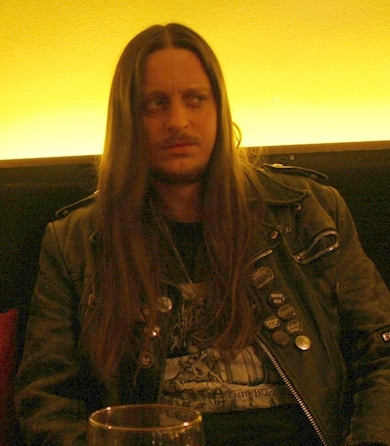
Fenriz
View on Wikipedia
Key Information
Gylve Fenris Nagell (born Leif Nagell; 28 November 1971), known professionally as Fenriz, is a Norwegian musician, part-time music journalist and online radio host (with the show "Radio Fenriz")[1] who is best known as one half of the black metal duo Darkthrone, alongside Nocturno Culto. Although primarily a drummer and songwriter, he has also played bass and guitar and performed vocals for Darkthrone and several other metal bands. Fenriz is famed for his encyclopedic knowledge of metal music, his eager promotion of underground bands and the DIY ethic, and his rejection of the "showbiz side of the music industry".[1][2][3] Fenriz was also the studio drummer for doom metal band Valhall, and has had several solo projects, including the folk black metal project Isengard and the dark ambient project Neptune Towers.
Biography
[edit]Fenriz's first exposure to heavy metal music came when he was a child and received Uriah Heep's album Sweet Freedom from his uncle for his birthday.[4] At age 16, Fenriz dropped out of school and began working full time to support his music. In 1986 he co-founded the death metal band Black Death with Ivar Enger and Anders Risberget. By 1988 they had been joined by Ted Skjellum (Nocturno Culto) and were renamed Darkthrone. After releasing their first death metal album in 1991, the band changed style and became one of the leading bands in the early Norwegian black metal scene. Fenriz said he had a passive interest in Bathory and Celtic Frost, but claims that he did not understand the "darkness" of black metal until hearing a song by the Hungarian band Tormentor. The second album released by Darkthrone, A Blaze in the Northern Sky, recorded in August 1991[5] at Creative Studios but not released until February 1992,[6] is regarded as one of the most important albums that defined the black metal genre.[6] Darkthrone were not involved in the church burnings and murders carried out by some other members of the scene,[7] and Fenriz has denounced the "hype" surrounding it.[4]
Since 1993, Darkthrone have been a duo of Fenriz and Nocturno Culto. Fenriz recorded all instruments on their albums Transilvanian Hunger (1994) and Panzerfaust (1995). From the late 1980s to the mid-1990s Fenriz also founded several solo projects, including the folk black metal project Isengard and the dark ambient project Neptune Towers. He was also the drummer for the band Valhall on their three studio albums. In the 1990s he co-founded the folk metal band Storm with Sigurd Wongraven, which released one album.
Both he and Nocturno have refused to play live since the 1990s.[7] In 2004, they turned down a nomination for a Norwegian Alarm Award for their album Sardonic Wrath. Fenriz said, "we have no interest in being part of the glitter and showbiz side of the music industry".[8] Fenriz (alongside Varg Vikernes) is the principal focus of the 2008 black metal documentary film Until The Light Takes Us.
In 2016, it was widely reported that Fenriz had been elected to his local municipal council, Oppegård. He was elected for a four-year term as a substitute councillor for the Liberal Party,[9] explaining that he would "have to step in when the usual people who go to the big meetings are sick or something". Fenriz said: "They called and asked if I wanted to be on the list [of backup representatives]. I said yeah, thinking I would be like 18th on the list and I wouldn't really have to do anything". His "campaign" was a photo of him holding his cat with the caption "Please Don't Vote For Me".[1][10][11][12]
Fenriz lives in his hometown of Kolbotn.[10] According to The Guardian, Fenriz "has long been a hero in the underground scene" and "has an obsession with unearthing new music and promoting it with rabid enthusiasm".[1] The heavy metal magazine Iron Fist noted he has a reputation as a "walking metal encyclopedia".[13] He is a part-time music journalist and hosts a monthly online radio show on NTS called "Radio Fenriz".[14] He created the "Band of the Week" blog from which the acts for the underground metal festival Live Evil are sourced.[2] Fenriz has famously been working part-time in the postal service since the late 1980s, which he says allows him to spend many hours each week listening to new music.[7][15] He has also appeared on a Norwegian television show about hiking in forests.[15]
Musical projects
[edit]- Darkthrone — drums, bass, rhythm guitar, vocals, lyrics (1986–present)
- Valhall — drums (1987–1989, 1993–?, 2007–present)
- Fenriz' Red Planet – everything (1993–?) (solo project)
- Isengard — everything (1989–1995) (solo project)
- Neptune Towers – everything (1993–1995) (solo project)
- Dødheimsgard — bass and additional vocals (1994–1995)
- Storm — drums, vocals (1995) (with Satyr from Satyricon and Kari Rueslåtten)
- Eibon — drums (1999) (with Satyr from Satyricon, Killjoy from Necrophagia, and Phil Anselmo from Pantera)
- Fuck You All — bass (2002)
- Regress FF — everything (1994) (solo project)
- Coffin Storm - vocals (2024–present)
Discography
[edit]| Year | Title | Band | Instruments |
|---|---|---|---|
| 1987 | Trash Core '87 (demo) | Black Death (pre-Darkthrone) | drums, vocals |
| 1987 | Black is Beautiful (demo) | Black Death (pre-Darkthrone) | drums, vocals |
| 1987 | Land of Frost (demo) | Darkthrone | drums, vocals |
| 1987 | A New Dimension (demo) | Darkthrone | drums |
| 1988 | The Castle of Death (demo) | Valhall | drums |
| 1989 | Thulcandra (demo) | Darkthrone | drums, vocals |
| 1989 | Cromlech (demo) | Darkthrone | drums |
| 1989 | Spectres Over Gorgoroth (demo) | Isengard | everything |
| 1991 | Horizons (demo) | Isengard | everything |
| 1991 | Soulside Journey | Darkthrone | drums |
| 1991 | Goatlord (demo) | Darkthrone | drums, vocals |
| 1992 | A Blaze in the Northern Sky | Darkthrone | drums |
| 1993 | Under a Funeral Moon | Darkthrone | drums |
| 1993 | Vanderen (demo) | Isengard | everything |
| 1994 | Transilvanian Hunger | Darkthrone | drums, rhythm guitar, bass |
| 1994 | Caravans to Empire Algol | Neptune Towers | everything |
| 1994 | Promo 1994 (demo) | Dødheimsgard | bass |
| 1995 | Høstmørke | Isengard | everything |
| 1995 | Transmissions from Empire Algol | Neptune Towers | everything |
| 1995 | Panzerfaust | Darkthrone | drums, guitar, bass |
| 1995 | Nordavind | Storm | drums, additional vocals |
| 1995 | Kronet Til Konge | Dødheimsgard | bass, additional vocals |
| 1995 | Moonstoned | Valhall | drums |
| 1995 | Promo 1995 (demo) | Dødheimsgard | bass, additional vocals |
| 1996 | Total Death | Darkthrone | drums; additional guitar and bass |
| 1997 | Heading for Mars | Valhall | drums |
| 1999 | Ravishing Grimness | Darkthrone | drums |
| 2001 | Plaguewielder | Darkthrone | drums |
| 2003 | Hate Them | Darkthrone | drums |
| 2004 | Sardonic Wrath | Darkthrone | drums; additional vocals |
| 2006 | Too Old, Too Cold (single) | Darkthrone | drums; additional vocals and guitars |
| 2006 | The Cult is Alive | Darkthrone | drums; additional vocals and guitars |
| 2006 | Forebyggende krig (single) | Darkthrone | drums; additional vocals |
| 2007 | NWOBHM (EP) | Darkthrone | drums; additional vocals and guitars |
| 2007 | F.O.A.D. | Darkthrone | drums; additional vocals |
| 2008 | Dark Thrones and Black Flags | Darkthrone | drums; vocals and guitars (shared) |
| 2009 | Red Planet | Valhall | drums |
| 2009 | Engangsgrill (split) | Fenriz' Red Planet/Nattefrost | everything (tracks 1–3) (recorded in 1993) |
| 2009 | Fuck You All | Fuck You All | bass (recorded in 2002) |
| 2010 | Circle the Wagons | Darkthrone | drums; vocals and guitars (shared) |
| 2013 | The Underground Resistance | Darkthrone | drums, vocals (shared), guitar solo on track 2, bass on track 4 |
| 2015 | Regress FF | Regress FF | everything (recorded in 1994) |
| 2016 | Arctic Thunder | Darkthrone | drums; additional bass and guitars |
| 2016 | Traditional Doom Cult | Isengard | everything (recorded 1989–1990) |
| 2019 | Old Star | Darkthrone | Drums |
| 2021 | Eternal Hails...... | Darkthrone | Drums, bass, synthesizer, additional guitar and vocals |
| 2022 | Astral Fortress | Darkthrone | Drums, synthesizer and vocals |
| 2024 | It Beckons Us All......[16] | Darkthrone | drums |
| 2024 | Arcana Rising | Coffin Storm | vocals |
- Note: All Darkthrone lyrics are written by Fenriz, with the exception of Transilvanian Hunger tracks 5–8, Panzerfaust track 6–7 and the Total Death album. Songwriting is usually split between Fenriz and Nocturno Culto, but varies from album to album.
Guest appearances
[edit]- Ulver – vocals on "A Song of Liberty Plates 25–27" from the album Themes from William Blake's The Marriage of Heaven and Hell (1998)
- Satyricon – percussion (tracks 4–5) on Rebel Extravaganza (1999)
- Aura Noir – additional vocals on Dreams like Deserts (1995), Increased Damnation (2000) and The Merciless (2004)
- Thorns – vocals and drums (track 9) on Thorns vs. Emperor (2011) (recorded sometime between 1998 and 1999)
- Red Harvest – backing vocals on "Absolut Dunkel:heit" from the album Cold Dark Matter (2000)
- Cadaver Inc. – additional vocals on Discipline (2001)
- Audiopain – additional lyrics on Revel in Desecration (2002)
- Trashcan Darlings – additional vocals on "Dehumanizer" from the album Episode 1: The Lipstick Menace (2002)
References
[edit]- ^ a b c d "Meet Fenriz, the black metal hero who is now an Oslo councillor". The Guardian, 21 November 2016.
- ^ a b "Underground Attitude: Fenriz Of Darkthrone Interviewed". The Quietus, 19 March 2013.
- ^ Ruskell, Nick (25 June 2021). "The 10 greatest Fenriz moments". Kerrang!. London: Wasted Talent Ltd. ISSN 0262-6624. Archived from the original on 11 February 2022. Retrieved 27 March 2022.
- ^ a b Fenriz interview. Voices from the Darkside.
- ^ Darkthrone – A Blaze in the Northern Sky CD cover Archived 11 July 2012 at the Wayback Machine
- ^ a b Fenriz (16 November 2020). The album that defined early Norwegian black metal – Interview with Fenriz with English subtitles (Videotape) (in English and Norwegian). Nasjonalbiblioteket. Retrieved 24 March 2022 – via YouTube.
- ^ a b c "Inside Darkthrone's 'Old Star' With No-Longer Norwegian Politician Fenriz". Loudwire, 29 May 2019.
- ^ "DARKTHRONE Refuse ALARM Award Nomination". Blabbermouth. 16 December 2004.
- ^ "Det nye kommunestyret – Oppegård kommune". 16 September 2015. Archived from the original on 8 November 2016. Retrieved 23 September 2018.
- ^ a b "Darkthrone Iconoclast Fenriz Is a Reluctant Politician". CLRVYNT, 6 September 2016.
- ^ Metal Injection Accessed 12 September 2016
- ^ Rosenberg, Axl (8 September 2016). "Fenriz from Darkthrone Accidentally Got Elected to His Town Council". Metal Sucks. Retrieved 27 August 2018.
- ^ Fenriz interview. Iron Fist, 16 January 2013.
- ^ Radio Fenriz. NTS Radio.
- ^ a b Norton, Justin (15 March 2013). "I Am The Working Class: The MetalSucks Interview with Fenriz". Metal Sucks. Retrieved 27 August 2018.
- ^ "Darkthrone - It Beckons Us All....... - Encyclopaedia Metallum: The Metal Archives".
External links
[edit]- Fenriz on Encyclopaedia Metallum
- Fenriz interviewed by Travis Jeppesen
Fenriz
View on GrokipediaEarly Life and Background
Childhood and Formative Influences
Gylve Fenris Nagell, born Leif Gylve Nagell on November 28, 1971, spent his early years in Kolbotn, a suburb south of Oslo, Norway.[9][10] Nagell's introduction to heavy music occurred at age three in 1974, when he began listening to Uriah Heep's album Sweet Freedom, which became a longstanding favorite and prompted him to play tracks like "Dreamer" at high volumes even as a young child to drown out neighboring music he disliked.[5][11] This early immersion in hard rock shaped his defiant approach to music appreciation, as he recalled overriding weaker sounds from others with Uriah Heep's heavier riffs from a small age.[12] These formative experiences instilled a lifelong obsession with heavy sounds, influencing his later pivot to extreme metal genres, though his childhood listening remained rooted in 1970s heavy rock prototypes like Uriah Heep's proto-doom elements in tracks such as "Pilgrim."[13][14] By his pre-teen years, this foundation had evolved into broader explorations of heavy metal, setting the stage for his active involvement in the Norwegian underground scene.[5]Initial Involvement in Music
Nagell's initial exposure to rock and heavy music occurred in 1974 at age three, when his uncle Stein Tomter introduced him to albums such as Morrison Hotel by The Doors and works by Uriah Heep, fostering an early interest in the genre.[5] Around the same period, he received his first drum kit, a children's model, which he played despite later wrecking it due to limited spare parts availability.[5] These early encounters laid the groundwork for his musical development, though systematic playing began later in his childhood with additional instruments, including an acoustic guitar acquired in 1981 and an electric guitar with amplifier in 1985.[5] By the mid-1980s, Nagell's influences expanded to include heavy metal and thrash acts such as Metallica, Slayer, Celtic Frost, Iron Maiden, and Uriah Heep, alongside crossover elements from bands like English Dogs and Napalm Death.[5] This period marked his transition from casual experimentation to active participation, as he began recording rudimentary tracks using multiple instruments.[15] His formal entry into band performance came in December 1986, when he co-founded Black Death—a death metal outfit in Kolbotn, Norway—with guitarist Ivar Enger and bassist Anders Risberget, initially drawing from the burgeoning extreme metal scene.[5][16] Black Death represented Nagell's debut in organized music-making, predating side projects and emphasizing drums as his primary instrument amid the group's raw, aggressive sound inspired by international death and thrash pioneers.[5] The band's activities in the late 1980s honed his skills and network within Norway's underground, setting the stage for its rebranding to Darkthrone shortly thereafter.[16]Musical Career with Darkthrone
Formation and Early Albums (1980s–Early 1990s)
Darkthrone was initially conceived as the band Black Death around Christmas 1986 in Kolbotn, Norway, with Gylve Nagell—known as Fenriz—emerging as a central figure in its establishment as a thrash-influenced death metal project limited by the musicians' equipment and technical abilities.[17] The group rebranded to Darkthrone in 1987, drawing early inspiration from Celtic Frost's slow, primitive style, and Fenriz handled drums while contributing to songwriting amid an unstable lineup.[17] [18] Ted Skjellum (later Nocturno Culto) joined as guitarist in spring 1988, solidifying the core duo alongside Fenriz, though additional members like bassist Ivar Enger participated sporadically in rehearsals and recordings.[17] [18] The band's initial output consisted of underground demos that showcased a progression from thrashy death metal roots. In 1988, they released the Land of Frost demo, featuring raw tracks blending death and thrash elements influenced by early extreme metal acts.[19] This was followed by the 1989 A New Dimension demo and the pivotal Cromlech tape, which captured a shift toward more generic death metal aggression, incorporating riffs echoing Death and Metallica while securing attention from labels.[17] [19] Fenriz's drumming provided a foundation of relentless, mid-tempo grooves on these recordings, produced in makeshift setups that emphasized lo-fi aggression over polish.[17] Darkthrone's debut full-length album, Soulside Journey, emerged in November 1991 via Peaceville Records after the Cromlech demo led to a contract.[17] Recorded earlier that year at Sunlight Studios in Sweden—home to producers like Tomas Skogsberg—the album adhered to death metal conventions with guttural vocals, intricate guitar leads from Zephyrous, and Fenriz's precise, Autopsy-inspired battery on drums, though tracks like the epic "Snowfall" hinted at atmospheric experimentation rooted in Black Sabbath and doom influences.[17] [18] At eight tracks spanning 45 minutes, it sold modestly but established the band in the Scandinavian death metal scene without achieving widespread commercial traction.[18] By 1992, Darkthrone began pivoting toward black metal aesthetics, evident in their second album A Blaze in the Northern Sky, released that September.[17] Fenriz played a key role in this evolution, advocating for rawer production and influences from Bathory and Hellhammer, resulting in faster tempos, shrieking vocals, and frostbitten riffs that abandoned death metal's technicality for primitive intensity recorded at Antiham Studios.[17] [19] The album's seven tracks, including the title track's howling opener, marked the onset of the band's "unholy trinity" phase, though internal tensions led Zephyrous to depart shortly after, leaving Fenriz and Nocturno Culto to helm future efforts.[17] This shift reflected Fenriz's preference for artistic autonomy over scene conformity, prioritizing causal influences from 1980s underground metal over polished extremity.[17]Evolution to Black Metal and Key Releases (1990s)
Darkthrone's shift from death metal to black metal began after their debut album Soulside Journey, released on April 1, 1991, via Peaceville Records, which showcased growled vocals, complex guitar work, and blast beats typical of early 1990s Scandinavian death metal. Influenced by the emerging Norwegian black metal scene, band members Fenriz (drums and bass) and Nocturno Culto (guitars and vocals) abandoned death metal's technicality for raw production, tremolo-picked riffs, and frostbitten atmospheres, a change Fenriz later attributed to seeking a more hypnotic and minimalistic sound over polished aggression.[20] This evolution crystallized on their second album, A Blaze in the Northern Sky, recorded in August 1991 at Creative Studios and released on February 26, 1992, marking one of the foundational releases of the second wave of black metal with tracks emphasizing pagan imagery and relentless riffing.[21] Fenriz's drumming provided a primitive, punk-infused backbone, enhancing the album's lo-fi aesthetic despite initial label concerns over its unpolished quality.[22] The band's third album, Under a Funeral Moon, released on April 20, 1993, further entrenched their black metal identity with slower, doom-laden passages and shrieking vocals, solidifying Darkthrone's role in defining the genre's misanthropic ethos amid Norway's early 1990s inner circle. By this point, original guitarist Zephyrous had departed, leaving Fenriz and Nocturno Culto as a duo, with Fenriz expanding to handle bass and additional guitars. Transilvanian Hunger, self-recorded by Fenriz at his Necrohell Studio and released on February 17, 1994, epitomized their raw approach: Fenriz performed all instruments except Nocturno Culto's lead vocals, yielding eight tracks of repetitive, trance-like riffs and sub-zero production that prioritized atmosphere over melody, running 39 minutes total.[23] [24] This album's stark minimalism—featuring no bass prominence and echoing howls—drew acclaim for capturing black metal's essence of isolation and endurance.[17] Subsequent 1990s releases like Panzerfaust (May 1995) introduced martial themes and cleaner guitar tones while retaining frostbitten intensity, with Fenriz's multi-instrumental duties and screamed vocals adding to the warlike urgency across its 41-minute runtime. These albums collectively propelled Darkthrone from death metal obscurity to black metal pioneers, emphasizing DIY ethos over commercial viability, as Fenriz has noted in reflections on the era's anti-industry stance.[17] By decade's end, their output influenced global black metal's shift toward punk simplicity and thematic paganism, though Fenriz later critiqued scene commercialization in interviews.[25]Later Phases and Recent Albums (2000s–2020s)
Following a period of relative inactivity after Total Death (1996), Darkthrone resumed output with Plaguewinger, released on September 10, 2001, via Moonfog Productions, maintaining a raw black metal style.[26] Fenriz, who composed the material amid personal depression, described the album's sound as akin to prior works like Ravishing Grimness, with no major shifts in production or tempo despite fan interpretations.[17] Subsequent releases Hate Them (March 18, 2003) and Sardonic Wrath (September 6, 2004), both on Moonfog Productions, continued this black metal trajectory, though Fenriz noted technical recording issues affected the latter's intended companion-piece dynamics to earlier efforts.[26][17] By mid-decade, The Cult Is Alive (February 27, 2006, Peaceville Records) introduced a more spontaneous approach, with Fenriz highlighting its manic, grim, and angry character enabled by the band's mini-studio setup.[26][17] F.O.A.D. (September 13, 2007, Peaceville) followed suit in black metal vein before a stylistic pivot in Dark Thrones and Black Flags (October 20, 2008, Peaceville), blending black and heavy metal with punk edges and covers of influences like Dennis Dread, forming the start of a trilogy alongside Circle the Wagons (April 5, 2010) and The Underground Resistance (February 25, 2013).[26][17] Fenriz emphasized the trilogy's consistent mindset, rapid recording, and Ted Skjellum's (Nocturno Culto) songwriting contributions, evoking a fuller band sound with speed metal and classic heavy metal nods in Circle the Wagons.[17] The 2010s saw Darkthrone solidify a black/heavy metal hybrid, as in Arctic Thunder (October 14, 2016), which Fenriz characterized as darker and slower with linear structures recorded at the Bomb Shelter.[26][17] Old Star (May 31, 2019, Peaceville) featured epic, slow tracks with stronger riffs and an '80s arena drum sound, drawing from black, doom, death, and thrash elements under Fenriz's primary songwriting.[26][17][27] Eternal Hails...... (October 25, 2021) extended this fusion before It Beckons Us All....... (April 22, 2024, Peaceville), which amplified Celtic Frost-inspired gothic heavy metal with doomy, mid-paced brooding aggression and organic production.[26][28][29] Throughout these phases, Fenriz handled drums, bass, most guitars, and vocals, prioritizing raw, influence-driven authenticity over polished trends.[17]Solo and Side Projects
Ambient and Experimental Works
Neptune Towers, a solo dark ambient project by Fenriz (Gylve Nagell), emerged in 1993 as an outlet for synthesizer-based compositions separate from his black metal activities.[30] The endeavor emphasized instrumental, atmospheric soundscapes crafted primarily on keyboards, eschewing vocals and traditional metal structures.[1] The project's debut album, Caravans to Empire Algol, appeared in December 1994 via Moonfog Productions, spanning 37 minutes across tracks evoking cosmic isolation through slow, droning synth layers.[31] Its follow-up, Transmissions from Empire Algol, followed in 1995 on the same label, condensing similar themes into a 35-minute runtime recorded between April and May 1994.[32] Fenriz characterized the music as "avant garde astral/alien synth," intended to facilitate escape from terrestrial existence into a lifeless void, drawing inspiration from 1970s German electronic pioneers like Klaus Schulze and Tangerine Dream.[33] [34] A third recording, tentatively titled Space Lab, was completed but remained unreleased, marking the project's conclusion by 1995.[30] These works represent Fenriz's exploration of space ambient aesthetics, prioritizing expansive, otherworldly drones over rhythmic or melodic conventions.[35] Reissues of the albums surfaced later, including vinyl editions in 2022 by Season of Mist, affirming their niche endurance within electronic and metal-adjacent circles.[32]Folk and Pagan-Inspired Projects
Isengard, Fenriz's longest-running solo project, originated in 1989 as an outlet for his diverse musical ideas that diverged from Darkthrone's direction, incorporating elements of folk metal, doom, and black metal with prominent pagan and Norse themes drawn from Norwegian folklore.[36] [37] The project debuted with the demo Spectres over Gorgoroth that year, featuring raw, atmospheric tracks blending heavy riffs with acoustic passages inspired by traditional Norwegian melodies and Bathory's epic Viking-era works like Hammerheart (1990) and Twilight of the Gods (1991).[38] [39] Subsequent demos Horizons (1991) and Vandreren (1993) shifted toward a more pronounced folk-black metal hybrid, emphasizing acoustic folk structures, melancholic Norwegian shepherd songs, and anti-Christian pagan motifs, as Fenriz described it in a 1994 interview as "Norse antichristian music" rooted in his personal affinity for regional traditional sounds.[40] [39] These efforts culminated in the 1994 compilation Vinterskugge, which assembled early material, followed by the full-length Høstmørke on July 3, 1995, via Moonfog Productions—a label run by Satyricon's Satyr, to whom the album was dedicated alongside Frost.[41] [37] Høstmørke ("Autumn Darkness") exemplifies the project's pagan essence through its evocation of seasonal Norwegian landscapes, folklore-driven lyrics, and fusion of clean folk vocals with distorted black metal aggression, reflecting Fenriz's rejection of mainstream black metal trends in favor of authentic cultural revivalism.[42] Fenriz largely shelved Isengard after the mid-1990s amid Darkthrone commitments, but archival releases revived it, including contributions to splits like Crusade from the North (1996) and the 2020 album Vårjevndøgn (October 2 release), compiling previously lost tracks from the project's formative era that maintain its folk-pagan core with raw, unpolished production.[43] [37] Throughout, Isengard stands as Fenriz's most explicit exploration of pagan traditionalism, prioritizing undiluted Norse heritage over commercial metal subgenres, as evidenced by its avoidance of synthesized or overly theatrical elements common in later Viking metal acts.[38]Other Professional Activities
Radio Hosting and Music Journalism
Fenriz has hosted several online radio programs focused on underground metal, emphasizing obscure bands and historical influences over mainstream acts. In 2016, he launched Radio Fenriz on NTS Radio, a monthly one-hour show broadcast on channel 2, where he curated playlists of lesser-known metal tracks accompanied by personal commentary.[44] Episodes, such as the August 18, 2016, installment, highlighted Norwegian and international underground acts, drawing from Fenriz's extensive personal collection and knowledge of the genre's roots.[45] The program paused after several years but maintained availability through archives on platforms like SoundCloud, where Fenriz shared additional mixes under his real name, Gylve Nagell.[46] In June 2021, Fenriz revived his radio hosting with The Fenriz Metal Pact, a subscriber-exclusive show on Patreon priced at $3 per month. Released bi-monthly, episodes feature in-depth discussions of metal tracks from specially curated playlists, prioritizing "hard sounds for wise ears" and avoiding commercial trends.[47] [48] By September 2021, at least eight episodes had aired, with Fenriz personally introducing selections to foster appreciation for the underground scene.[49] These efforts underscore his role in preserving and promoting non-commercial metal without reliance on traditional media structures.[50] As a part-time music journalist, Fenriz has written for Close-Up, a Swedish heavy metal magazine, contributing coverage of live performances and genre-related topics as of 2016. This freelance work allowed him to attend concerts more frequently while claiming tax deductions, integrating his journalistic output with his broader engagement in the metal community.[51] His writings align with his radio persona, favoring authentic, riff-driven metal over polished or trend-driven content, though specific articles remain niche within Scandinavian metal publications.Brief Political Involvement
In September 2016, Gylve Nagell, known as Fenriz, was elected as an alternate representative to the Oppegård municipal council in Kolbotn, Norway, during local elections, despite his active attempts to avoid the position.[6] He had been nominally listed as a backup candidate for the left-wing Red Party (Rødt) after local organizers approached him, but he produced campaign posters featuring his cat alongside the slogan "Please don't vote for me" to deter support.[4][52] Fenriz's widespread popularity among voters resulted in sufficient votes to secure the alternate seat, committing him to a potential four-year term beginning in 2017, though he described the outcome as involuntary and expressed no interest in active participation.[53] He later clarified in interviews that he had no prior political ambitions and viewed the role as an unwelcome obligation under Norwegian electoral rules, which do not permit easy withdrawal from elected alternates.[52] This incident marked his only documented foray into formal politics, with no evidence of subsequent engagement or affiliation beyond the initial election.[4]Personal Views and Philosophy
Critiques of the Metal Scene and Commercialism
Fenriz has consistently criticized the commercialization of black metal, arguing that the genre's participation in arena tours and events like the Eurovision Song Contest—exemplified by bands such as Keep of Kalessin—marks a betrayal of its anti-establishment origins, surpassing even MTV's influence in diluting authenticity.[54] He maintains that an underground ethos is fundamentally attitudinal, independent of popularity, and dismisses bands with "overground mentalities," such as cover acts drawing Rammstein influences, as inherently disconnected from true metal spirit regardless of attendance figures.[54] In assessing industry structures, Fenriz has faulted major metal magazines like Rock Hard and Terrorizer for favoring promotional cycles of commercial entities—citing acts like My Chemical Romance and Rammstein—over diverse underground releases, which stifles genuine discovery and perpetuates a homogenized scene.[55] He contrasts this with the enhanced vitality of the contemporary metal underground, bolstered by online platforms reminiscent of 1980s tape-trading, where fans access historical demos (e.g., Tormentor) alongside emerging bands like Bölzer, rendering the 1990s era comparatively stagnant and less innovative.[55] Darkthrone's decision to cease live performances after 1996 aligns with Fenriz's broader rejection of commercial incentives, prioritizing raw artistic control over festival circuits, trend-chasing, or high-production gloss that he associates with genre dilution.[56] This stance echoes his earlier aversion to perceived over-polish in extreme metal, as when he deemed Carcass's 1991 album Necroticism – Descending into Total Transparency excessively commercial in sound compared to rawer precedents.[57] Fenriz's advocacy for lo-fi production and DIY principles underscores his view that black metal's integrity lies in anti-commercial rebellion, not market adaptation.[58]Paganism, Nature, and Cultural Traditionalism
Fenriz has articulated a strong affinity for Norse pagan archetypes, advocating a return to pre-Christian spiritual roots in opposition to what he describes as the imposed "warmth and light" of Christianity. In a 1994 interview, he stated, "1000 years of warmth and light is enough! Let us all follow our norse gods," positioning Norse paganism as a cultural and spiritual antidote to historical Christian dominance in Norway.[59] He has referenced paganism, heathenism, and related occult traditions as formative influences during his youth, treating them with a mix of respect and critical engagement, often crediting figures like Quorthon of Bathory for spearheading such explorations in metal music.[7] His reverence for nature manifests in a dedicated lifestyle centered on Norway's vast wilderness, where he conducts frequent hikes and camping expeditions, logging over 35 tent trips annually from April to October as of 2019. Fenriz credits these forest immersions with alleviating depression and fostering creativity, viewing the Oslo region's 1,600 square kilometers of accessible woodland as an integral extension of Norwegian identity rather than mere recreation.[7][12] He has shared practical philosophies on forest walking in interviews, emphasizing self-reliance with tools like maps and sticks while warning against disorientation, underscoring nature as a raw, unmediated force uninfluenced by urban modernity.[60] In terms of cultural traditionalism, Fenriz integrates elements of Norwegian folklore and heritage into his artistic output, early adopting works by artist Theodor Kittelsen—known for depicting trolls and mythical landscapes—for Darkthrone's visuals four years before broader adoption in the black metal scene.[7] Albums like Storm of the Light's Bane (1995) foreground traditional Norwegian folk music motifs, reflecting his view of Norge's "essence" as a source of hostility, eccentricity, and misanthropy that shapes his work.[59] While later expressing regret over inspiring "folk metal" dilutions, he consistently prioritizes authentic Norse and regional archetypes, critiquing modern metal's polished production as a betrayal of underground authenticity post-1990 technological accessibility.[7] This stance aligns with a broader preservationist ethos, where cultural continuity through native traditions counters globalized homogenization.[59]Discography
Darkthrone Contributions
Fenriz co-founded Darkthrone in 1987 with Ted Skjellum (Nocturno Culto) and others, initially as a death metal band before transitioning to black metal.[18] He has remained the band's drummer across all studio albums, progressively expanding to vocals, bass, guitars, songwriting, and lyrics, especially after the group reduced to a duo in 1993.[61] His home studio, Necrohell, facilitated raw, lo-fi recordings starting with key releases in the mid-1990s.[62] On early albums such as Soulside Journey (1991), Fenriz provided drums and backing vocals amid a full band lineup.[61] By A Blaze in the Northern Sky (1992), he contributed drums, vocals, and lyrics, marking the band's shift to black metal.[61] For Transilvanian Hunger (1994), Fenriz recorded all instruments on a four-track setup in his bedroom, with Nocturno Culto handling primary vocals; he also wrote lyrics for several tracks.[62][61] Panzerfaust (1995) followed a similar one-man recording approach by Fenriz, encompassing all instruments, select vocals, and songwriting.[63] Subsequent releases solidified Fenriz's multi-instrumental role, often including drums, bass, guitars, lead and backing vocals, plus co-songwriting with Nocturno Culto. Examples include Ravishing Grimness (1999), where he handled drums, vocals, and lyrics; Sardonic Wrath (2004), featuring his songwriting and vocal duties; and Circle the Wagons (2010), crediting him with drums, vocals, bass, and songwriting.[61] Recent albums like Eternal Hails...... (2021) continue this pattern, with Fenriz on drums, guitars, bass, vocals, and production elements.[61] His contributions emphasize punk-influenced rawness and thematic consistency in anti-commercialism and Nordic imagery.[64]| Album | Year | Key Fenriz Roles |
|---|---|---|
| Soulside Journey | 1991 | Drums, vocals, songwriting |
| A Blaze in the Northern Sky | 1992 | Drums, vocals, lyrics, songwriting |
| Under a Funeral Moon | 1993 | Drums, vocals, lyrics, songwriting |
| Transilvanian Hunger | 1994 | All instruments (except vocals), lyrics, songwriting |
| Panzerfaust | 1995 | All instruments, vocals, lyrics, songwriting |
| Total Death | 1996 | Drums, vocals, lyrics, songwriting |
| Ravishing Grimness | 1999 | Drums, vocals, lyrics, songwriting |
| Plaguewielder | 2001 | Drums, vocals, lyrics, songwriting |
| Sardonic Wrath | 2004 | Drums, vocals, lyrics, songwriting |
| The Cult Is Alive | 2006 | Drums, vocals, lyrics, songwriting |
| Dark Thrones and Black Flags | 2008 | Drums, vocals, lyrics, songwriting |
| Circle the Wagons | 2010 | Drums, vocals, bass, songwriting |
| The Underground Resistance | 2013 | Drums, vocals, lyrics, songwriting |
| Arctic Thunder | 2016 | Drums, vocals, lyrics, songwriting |
| Old Star | 2019 | Drums, vocals, lyrics, songwriting |
| Eternal Hails......... | 2021 | Drums, vocals, lyrics, songwriting |
