


Community hub
Recent from talks
Contribute something
Nothing was collected or created yet.
Radio personality
View on Wikipedia
A radio personality is a person who has an on-air position in radio broadcasting. A radio personality who hosts a radio show is also known as a radio host (North American English), radio presenter (British English) or radio jockey. Radio personalities who introduce and play individual selections of recorded music are known as disc jockeys or "DJs" for short. Broadcast radio personalities may include talk radio hosts, AM/FM radio show hosts, and satellite radio program hosts, and non-host contributors to radio programs, such as reporter
Description
[edit]A radio personality can be someone who introduces and discusses genres of music; hosts a talk radio show that may take calls from listeners; interviews celebrities or guests; or gives news, weather, sports, or traffic information. The radio personality may broadcast live or use voice-tracking techniques.[1] Increasingly in the 2010s, radio personalities are expected to supplement their on-air work by posting information online, such as on a blog or on another web forum. This may be either to generate additional revenue or connect with listeners.[2] With the exception of small or rural radio stations, much of music radio broadcasting is done by broadcast automation, a computer-controlled playlist airing MP3 audio files which contain the entire program consisting of music, commercials, and a radio announcer's pre-recorded comments.
History
[edit]In the past, the term "disc jockey" (or "DJ") was exclusively used to describe on-air radio personalities who played recorded music and hosted radio shows that featured popular music.[3] Unlike the modern club DJ who uses beatmatching to mix transitions between songs to create continuous play, radio DJs played individual songs or music tracks while voicing announcements, introductions, comments, jokes, and commercials in between each song or short series of songs.[4] During the 1950s, '60s and '70s, radio DJs exerted considerable influence on popular music, especially during the Top 40 radio era, because of their ability to introduce new music to the radio audience and promote or control which songs would be given airplay.[5][6]
Although radio personalities who specialized in news or talk programs such as Dorothy Kilgallen and Walter Winchell have existed since the early days of radio, exclusive talk radio formats emerged and multiplied in the 1960s, as telephone call in shows, interviews, news, and public affairs became more popular. In New York, WINS (AM) switched to a talk format in 1965, and WCBS (AM) followed two years later. Early talk radio personalities included Bruce Williams and Sally Jesse Raphael.[7] The growth of sports talk radio began in the 1960s, and resulted in the first all-sports station in the US, WFAN (AM) that would go on to feature many sports radio personalities such as Marv Albert and Howie Rose.
Types of radio personalities
[edit]- FM/AM radio – AM/FM personalities play music, talk, or both.[8] Some examples are Rick Dees, Elvis Duran, Big Boy, Kidd Kraddick, John Boy and Billy, The Bob and Tom Show, The Breakfast Club, and Rickey Smiley.
- Talk radio – Talk radio personalities often discuss social and political issues from a particular political point of view.[8] Some examples are Rush Limbaugh, Art Bell, George Noory, Brian Lehrer, and Don Geronimo.
- Sports talk radio – Sports talk radio personalities are often former athletes, sports writers, or television anchors and discuss sports news.[8] Some examples are Dan Patrick, Tony Kornheiser, Dan Sileo, Colin Cowherd, and Mike Francesa.
- Satellite radio – Satellite radio personalities are subject to fewer government broadcast regulations and may be allowed to play explicit music. Howard Stern, Opie and Anthony, Dr. Laura, and Chris "Mad Dog" Russo are some of the notable personalities who have successfully made the move from terrestrial radio to satellite radio.[8]
- Internet radio - Internet radio personalities appear on internet radio stations that offer news, sports, talk, and various genres of music that are carried by streaming media outlets such as AccuRadio, Pandora Radio, Slacker Radio and Jango.
Notable radio personalities
[edit]Notable radio personalities include pop music radio hosts Wolfman Jack, Jim Pewter, Dick Clark, Casey Kasem, John Peel, Charlie Gillett, Walt Love, Alan Freed, Cousin Brucie, Mamy Baby, Frida Amani, The Real Don Steele, Charlie Tuna, Terry Wogan;[9] sports talk hosts such as Mike Francesa; shock jocks and political talk hosts such as Don Imus, Howard Stern and Rush Limbaugh.[10]
Career
[edit]Education
[edit]Many radio personalities do not have a post-high school education, but some do hold degrees in audio engineering.[11] If a radio personality has a degree it's typically a bachelor's degree level qualification in radio-television-film, mass communications, journalism, or English.[12]
Training
[edit]Universities offer classes in radio broadcasting and often have a college radio station, where students can obtain on-the-job training and course credit.[13] Prospective radio personalities can also intern at radio stations for hands-on training from professionals. Training courses are also available online.[13]
Requirements
[edit]A radio personality position generally has the following requirements:[14][15]
- Good clear voice with excellent tone and modulation[16]
- Great communication skills and creativity to interact with listeners[16]
- Knowledgeable on current affairs, news issues and social trends
- Creative thinking, to be able to think of new ideas or topics for show
- Able to improvise and think "on the spot"
- Ability to develop their own personal style
- A good sense of humor
Opportunities
[edit]Due to radio personalities' vocal training, opportunities to expand their careers often exist. Over time a radio personality could be paid to do voice-overs for commercials, television shows, and movies.[17]
Salary in the US
[edit]Radio personality salaries are influenced by years of experience and education. In 2013, the median salary of a radio personality in the US was $28,400.
- 1–4 years: $15,200–39,400,
- 5–9 years: $20,600–41,700,
- 10–19 years: $23,200–51,200,
- 20 or more years: $26,300–73,000.
A radio personality with a bachelor's degree had a salary range of $19,600–60,400.[18]
The salary of a local radio personality will differ from a national radio personality. National personality pay can be in the millions because of the increased audience size and corporate sponsorship. For example, Rush Limbaugh was reportedly paid $38 million annually as part of the eight-year $400 million contract he signed with Clear Channel Communications.[19]
Gallery
[edit]-
 Jessica Letshwiti, ICE100 Radio, Botswana, Southern Africa
 -
 Ibrahim Astady, Dubai 93 FM, United Arab Emirates
 -
-
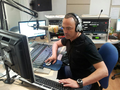
 Norman Batley, WMNF, Tampa, FL, 2013
 -
 Kevin Joseph O'Donnell, Australian Army station "Radio Commonwealth", Korea 1955
 -

-

-
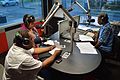 Talk radio host and guests, Radio Fiji One, Fiji Broadcasting Corporation


.jpg)


.jpg)
See also
[edit]References
[edit]- ^ L. A. Heberlein - The Rough Guide to Internet Radio 2002 - Page v. "In addition to putting songs together, a good radio host can tell you things you didn't know about the artists, the songs, and the times."
- ^ Rooke, Barry; Odame, Helen Hambly (2013). ""I Have to Blog a Blog Too?" Radio Jocks and Online Blogging". Journal of Radio & Audio Media. 20 (1): 35. doi:10.1080/19376529.2013.777342. S2CID 144905276.
- ^ Shelly Field (21 April 2010). Career Opportunities in Radio. Infobase Publishing. pp. 2–. ISBN 978-1-4381-1084-4.
- ^ Higgins, Terry. "Club Features New Breed of Disc Jockey". Milwaukee Sentinel. Milwaukee Sentinel, June 29, 1984. Retrieved 7 July 2016.
- ^ Udovitch, Mim. "Last Night a DJ Saved My Life: The History of the Disc Jockey By BILL BREWSTER and FRANK BROUGHTON Grove Press". New York Times Book Review. New York Times Company. Retrieved 8 July 2016.
- ^ Battaglio, Stephen (10 March 2002). "Television/Radio; When AM Ruled Music, and WABC Was King". New York Times. Retrieved 8 July 2016.
- ^ Jim Cox (26 October 2009). American Radio Networks: A History. McFarland. ISBN 978-0-7864-5424-2.
- ^ a b c d "Radio and Television Job Description". CareerPlanner.com. Retrieved 28 February 2013.
- ^ "Series: Charlie Tuna". www.radioechoes.com.
- ^ Leopold, Todd. "The kings of the radio: All-time great DJs". CNN. Archived from the original on 14 April 2016. Retrieved 9 January 2017.
- ^ "Radio Jockey Education and Job requirements". educationrequirements.org. Retrieved 12 March 2013.
- ^ "Announcers and DJs". Occupational Outlook Handbook. bls.gov. September 8, 2022.
- ^ a b "ASU Dept. of Radio-TV". Arkansas State University. Retrieved 5 March 2013.
- ^ "Radio Jockey education and job requirements". educationrequirements.org. Retrieved 12 March 2013.
- ^ "RJs Talk About Their Careers in Radio". YouCareer.in. 1 September 2013. Archived from the original on 31 May 2016. Retrieved 28 October 2015.
- ^ a b "La locución es mostrarte tal cual eres -" (in Spanish). 2018-05-08. Retrieved 2020-05-09.
- ^ "Radio Jockey: Job Prospects & Career Options". webindia123.com. Retrieved 28 February 2013.
- ^ "Disc Jockey (DJ), Radio Salary, Average Salaries". Payscale.com. Retrieved 22 March 2013.
- ^ Farhi, Paul (3 July 2008). "Rush Limbaugh Signs $400 Million Radio Deal". Retrieved 26 September 2018.

Radio personality
View on GrokipediaDefinition and Role
Core Responsibilities
Core responsibilities of radio personalities encompass on-air performance, content preparation, and audience interaction, tailored to the program's format such as music, talk, or news. These duties require maintaining a consistent broadcast schedule, often involving shifts of three to five hours, during which the personality announces station identifications, introduces musical selections or segments, and delivers commercials or public service announcements.[1] [8] Personalities must operate basic studio controls to cue audio elements, ensuring seamless transitions between content while adhering to time constraints and regulatory standards like those set by the Federal Communications Commission (FCC) in the United States.[1] [8] A primary duty involves researching and scripting material to inform or entertain listeners, including gathering facts for commentary, preparing weather or traffic updates, and rewriting content to fit allotted slots.[1] For music-oriented shows, this includes reviewing playlists, front- and back-announcing tracks, and coordinating with producers to align selections with audience demographics.[9] In talk formats, responsibilities extend to moderating discussions, interviewing guests, and fielding listener calls to facilitate real-time engagement, often requiring quick ad-libbing to handle unexpected inputs.[5] [1] Radio personalities also promote station events, host off-air appearances at civic or charitable functions, and collaborate with production teams to record segments or commercials for later broadcast.[8] They monitor audience feedback through metrics like ratings from services such as Nielsen Audio, adjusting delivery to sustain listenership amid competition from digital media.[1] Compliance with equal-time rules for political content and obscenity prohibitions remains essential, as violations can result in fines or license revocation, underscoring the role's legal accountability.[1] These tasks demand versatility, as personalities often multitask without a script, fostering a distinctive on-air voice that builds listener loyalty.[10]Essential Skills and Traits
Strong speaking skills form the foundation of effective radio personalities, requiring a pleasant, well-controlled voice, precise pronunciation, and impeccable timing to maintain listener engagement in an audio-only medium.[1] These abilities enable broadcasters to convey information and entertainment clearly without visual cues, as evidenced by occupational standards that emphasize vocal modulation to prevent listener fatigue during extended airtime.[1] Interpersonal and people skills are critical for building rapport with audiences, involving the capacity to entertain, inform, and respond to feedback in real-time, such as through call-ins or social media interactions.[1] Successful personalities demonstrate authenticity and relatability, fostering loyalty by presenting genuine personas rather than contrived characters, which industry analyses link to higher listener retention rates.[11] Adaptability ranks highly among traits, allowing hosts to pivot during live mishaps, format changes, or shifting audience preferences, as radio's fast-paced environment demands quick recovery from technical glitches or unexpected events.[12] Communication skills, encompassing verbal clarity and the ability to multitask—such as scripting segments while monitoring cues—appear in over 10% of job postings for radio roles, underscoring their empirical demand.[11] Traits like confidence and a sense of humor further distinguish top performers, enabling quick-witted responses that humanize broadcasts and differentiate them from scripted media.[13] Physical stamina supports endurance for irregular hours, including overnight shifts, while basic technical proficiency in audio equipment ensures seamless delivery.[1] Overall, these elements combine causal factors—voice as the primary tool, personality as the hook—with verifiable industry benchmarks to sustain career longevity amid competition from digital alternatives.[14]Historical Evolution
Origins in Early Broadcasting (1920s-1930s)
The origins of radio personalities trace to the nascent commercial broadcasting era following KDKA's inaugural transmission on November 2, 1920, when the Pittsburgh station aired live returns from the U.S. presidential election between Warren G. Harding and James M. Cox, with announcer Leo Rosenberg delivering the scripted updates to an estimated audience of amateur wireless enthusiasts.[15][16] This event marked the shift from experimental wireless telegraphy to scheduled entertainment and information dissemination, where on-air voices began serving as intermediaries between remote events and listeners, relying on clear diction and minimal equipment like a single microphone in makeshift studios.[17] Early announcers operated without formal training or precedents, improvising techniques such as vocal modulation and pacing to compensate for the absence of visual cues, thus laying the groundwork for personality-driven delivery.[18] Harold W. Arlin, hired as KDKA's first full-time staff announcer in early 1921, exemplified this evolution by pioneering descriptive play-by-play narration for live sports events, including the first Major League Baseball game broadcast on August 5, 1921—a Pittsburgh Pirates victory over the Philadelphia Phillies at Forbes Field, where he conveyed ball trajectories and crowd reactions using rudimentary field wires.[19][20] Arlin extended this format to tennis matches on August 6, 1921, and college football games later that year, establishing announcers as authoritative interpreters of distant spectacles and fostering listener loyalty through vivid, real-time storytelling that transformed radio from mere transcription into an immersive medium.[21] By 1922, as U.S. radio stations proliferated to over 500, Arlin's approach influenced a cadre of local broadcasters who prioritized engaging vocal presence over scripted neutrality, marking the emergence of individualized on-air identities amid growing receiver ownership, from fewer than 100,000 sets in 1922 to millions by decade's end.[15] The 1920s network expansion amplified these roles, with Graham McNamee rising as a national figure after joining the nascent NBC in 1923, where his operatic background enabled emotive announcements of landmark events like the 1927 World Series and the Jack Dempsey-Gene Tunney heavyweight bout, drawing millions through hyperbolic phrasing and atmospheric sound effects that blurred the line between reporter and performer.[22][23] McNamee's style, characterized by enthusiastic exclamations and personal flair, resonated in an era of limited programming—primarily live vaudeville, news bulletins, and weather reports—allowing announcers to cultivate fame as "godlike presences" in households, as listeners anthropomorphized disembodied voices into familiar companions.[24] Into the 1930s, as economic pressures during the Great Depression spurred cost-effective talk formats, early personalities like McNamee influenced successors by demonstrating how vocal charisma could sustain audience engagement without visual aids, though regulatory constraints and live-only mandates initially curbed scripted monologues in favor of event facilitation.[25] This foundational period thus solidified radio personalities as skilled vocal artisans whose rapport-building techniques predated recorded music's dominance and presaged talk radio's conversational turn.Expansion During the Golden Age (1940s-1950s)
During World War II, radio personalities expanded their roles as essential conduits for national unity and information dissemination, with listenership peaking as the medium became the household's central source for war updates and escapism. By 1940, radio ownership had reached 82.8% of American households, reflecting widespread adoption that intensified during the conflict when factories and homes relied on broadcasts for real-time news from correspondents like Edward R. Murrow reporting from London in 1940.[26] Personalities such as Jack Benny and Bing Crosby hosted network variety shows that drew audiences exceeding 20 million weekly by the mid-1940s, blending comedy, music, and light propaganda to sustain civilian morale while promoting war bond sales through appearances organized by groups like the Hollywood Victory Committee.[27] [28] This era saw a proliferation of scripted drama and comedy programs, where on-air talent like Fibber McGee and Molly's Marian Jordan cultivated loyal followings through recurring characters and serialized storytelling, unburdened by visual competition. Post-war economic prosperity fueled further expansion, with returning veterans and suburban migration increasing car radio installations and overall sets to over 90% household penetration by 1950, enabling personalities to reach mobile audiences during commutes and leisure.[29] The 1950s witnessed the shift toward music-focused formats, as disc jockeys gained prominence by curating playlists that bridged big band remnants with emerging genres like rhythm and blues. Pioneers such as Martin Block, whose "Make Believe Ballroom" simulated live concerts since 1935 but peaked in the 1940s with national syndication, exemplified how DJs personalized broadcasts, fostering listener intimacy through banter and record spins that anticipated the Top 40 format introduced by Todd Storz in 1951 on Omaha's KOWH.[30] [31] Alan Freed's "Moondog Coronation Ball" in Cleveland on March 21, 1952, drew 25,000 attendees, highlighting DJs' cultural sway in popularizing rock and roll precursors among youth, though this also sparked early controversies over racial integration in music airplay. This golden age expansion was causally tied to radio's technological maturity—clear-channel stations broadcasting up to 50,000 watts enabled coast-to-coast reach—and regulatory stability under the Federal Communications Commission, which licensed over 2,700 AM stations by 1950 without the fragmentation that television later induced.[32] Personalities transitioned from ensemble casts in dramas to solo hosts commanding advertising revenue, with figures like Arthur Godfrey leveraging morning shows on CBS from 1945 onward to build empires spanning radio and emerging TV, amassing sponsor deals worth millions annually by emphasizing authentic, folksy personas over scripted rigidity. However, by the late 1950s, television's visual allure began eroding radio's dominance, prompting personalities to adapt by emphasizing localism and music niches that sustained their viability.[4]Transformation with Talk Radio and Deregulation (1960s-1990s)
The Fairness Doctrine, a Federal Communications Commission (FCC) policy enacted in 1949, constrained the development of opinion-driven talk radio during the 1960s and 1970s by requiring broadcasters to cover controversial public issues and provide equitable time for opposing viewpoints, often resulting in legal challenges and self-censorship by stations wary of enforcement costs.[33] Early talk formats emerged nonetheless, such as confrontational call-in programs hosted by figures like Joe Pyne, who began broadcasting in 1965 on KABC in Los Angeles, blending entertainment with provocative discussions on social and political topics, though limited by regulatory pressures that favored neutral or balanced presentation over partisan advocacy.[34] These hosts marked a shift from scripted entertainment to interactive formats, but the doctrine's requirements—rooted in the scarcity of broadcast spectrum—deterred stations from risking unbalanced commentary, keeping radio personalities primarily as moderators rather than ideological influencers.[35] Deregulatory changes accelerated in the 1980s under the Reagan administration, as the FCC relaxed ownership limits and programming rules to foster competition amid expanding media options like cable television, culminating in the doctrine's repeal on August 5, 1987, which eliminated mandates for viewpoint balance and personal attack rebuttals.[36] This causal shift enabled stations to prioritize profitable, audience-attracting content without regulatory burdens, spurring the syndication of talk shows and transforming radio into a platform for unfiltered opinion.[37] The repeal aligned with broader FCC actions, including the 1981 elimination of guidelines on minimum local programming, allowing markets to respond to listener demand for specialized formats over homogenized content.[38] Post-repeal, talk radio experienced explosive growth, with conservative-leaning programs dominating due to unmet demand in an era when television and print media were perceived as left-leaning by many audiences, creating a market niche for hosts offering alternative perspectives.[39] Rush Limbaugh's nationally syndicated show, launched in August 1988 on 56 stations via the EFM network, exemplified this transformation, expanding rapidly to reach an estimated 20 million weekly listeners by the mid-1990s through affiliate growth and caller-driven engagement that built loyal followings.[37] Other personalities, such as G. Gordon Liddy and Sean Hannity, followed suit, leveraging AM frequencies' suitability for talk amid FM's music focus, with syndication revenues driving industry consolidation.[40] Radio personalities evolved into authoritative voices on policy and culture, wielding influence on public discourse—evident in Limbaugh's role mobilizing opposition to 1993 healthcare reforms—while empirical listener metrics underscored talk's viability, as AM revenues rose alongside format adoption in over 500 markets by decade's end.[36] This period's deregulation thus causally elevated radio hosts from entertainers to de facto political actors, unhindered by prior equal-time obligations.[34]Digital Transition and Decline (2000s-Present)
The advent of widespread broadband internet in the early 2000s and the proliferation of smartphones by the mid-2010s fragmented radio audiences, as listeners gained access to on-demand streaming services, podcasts, and music apps like Spotify and Apple Music. Terrestrial radio's weekly reach among Americans aged 12 and older fell from approximately 96% in 2009 to 83% by 2022, reflecting a shift toward digital alternatives that offered greater flexibility and personalization.[41][42] This transition eroded the mass-appeal model that had sustained radio personalities, who previously commanded captive audiences during fixed broadcast slots, particularly in vehicles where over-the-air (OTA) radio remained dominant with 84% of daily listeners relying exclusively on it as of 2024.[43] Podcasting emerged as a direct competitor, with the share of U.S. adults who had ever listened rising from near zero in the early 2000s to 42% by 2023, capturing 17% of ad-supported audio time compared to AM/FM radio's 71%.[44][45] Radio personalities adapted by repurposing live shows into on-demand podcasts, facilitated by platforms like Spotify's broadcast-to-podcast tools launched in 2023, which automated episode creation from linear broadcasts to reach digital audiences.[46] This hybrid approach allowed established hosts to extend their reach via social media integration and algorithmic recommendations, though it favored those with preexisting fame over newcomers, as fragmented listenership reduced the visibility of syndicated or local talent.[47] Despite adaptations, traditional radio personalities faced decline in influence and viability, with industry consolidation post-Telecommunications Act of 1996 accelerating in the digital era through voice-tracking and automation, diminishing live, personality-driven content. Ad revenue for OTA radio stagnated as digital audio siphoned shares, with streaming accounting for 20% of AM/FM listening by 2023 and younger demographics (under 35) preferring on-demand formats that bypassed scheduled programming.[45][48] Personalities who failed to migrate digitally often saw ratings erode, exemplified by the broader trend where radio's time spent listening per capita halved relative to digital growth since 2000, though OTA retained advantages in reach (twice that of podcasts) due to its ubiquity in cars and low barriers to entry.[49] By the present, successful radio figures operate across platforms, blending linear broadcasts with podcasts to combat audience fragmentation, yet the era's hallmark is a contraction in the number of full-time, high-profile terrestrial hosts amid competition from infinite digital choices.[50][51]Types and Formats
Disc Jockeys and Music Hosts
Disc jockeys, commonly abbreviated as DJs, and music hosts constitute a primary category of radio personalities focused on curating and broadcasting recorded music selections to engage listeners. Their core function involves selecting tracks from music libraries, sequencing playlists to maintain flow and appeal, and transitioning between songs with verbal announcements that provide context, artist background, or promotional details.[52] This role emerged prominently in the mid-20th century as radio stations shifted from live performances to phonograph records, enabling broader access to commercial recordings. The term "disc jockey" was coined in 1935 by radio commentator Walter Winchell to describe announcer Martin Block, who popularized the format through his program featuring record playback and audience interaction.[53] Responsibilities extend beyond mere playback to fostering listener connection through live commentary, handling call-in requests, and occasionally integrating brief news, weather updates, or celebrity interviews to sustain program dynamism. Shifts typically last 3 to 5 hours, requiring DJs to operate broadcast consoles, cue audio, and adhere to station formatting guidelines while improvising to address technical issues or audience feedback in real time.[13] [54] Music hosts often specialize in genres such as rock, pop, or electronic, tailoring content to demographic targets and promoting emerging artists by premiering tracks, which can influence chart performance and sales.[55] Essential skills include extensive knowledge of music catalogs across eras and styles, enabling informed curation that anticipates audience preferences and trends. On-air proficiency demands clear diction, charismatic delivery, and rapid adaptability under live pressure, as errors cannot be edited post-broadcast.[56] Technical competence in audio equipment and software is critical, particularly in modern setups incorporating digital automation for seamless transitions.[13] Radio DJs have historically shaped the music industry by amplifying songs to mass audiences, driving record sales and artist visibility before streaming dominance; for instance, airplay endorsements often correlated with Billboard chart ascents and increased physical sales in the pre-digital era.[57] Despite challenges like pay-for-play scandals in the 1950s-1960s, which prompted regulatory oversight, their tastemaking role persists, with stations generating revenues exceeding recorded music industry figures through advertising tied to listenership.[58] In contemporary broadcasting, automated playlists have reduced live DJ involvement at major outlets, yet niche and community stations retain human hosts for personalized engagement.[59]Talk Show Hosts
 | 91% | 9% | 2007[80] |
| Top 15 Syndicated Hosts | 80% (12/15) | 20% | 2020[81] |
| News/Talk in Top 10 Markets | 76% | 24% | 2007[82] |
Criticisms from Left-Leaning Perspectives
Left-leaning media outlets and advocacy groups have frequently criticized conservative radio personalities for amplifying misinformation and conspiracy theories, arguing that this erodes democratic discourse. A 2023 NPR analysis of the podcast The Divided Dial contends that right-wing talk radio, popularized since the 1980s, systematically disseminates false claims on topics like elections and public health, reaching millions daily via syndicated programs.[87] Similarly, a 2024 review by Wisconsin Watch of Wisconsin stations found conservative hosts, including Vicki McKenna on WIBA, airing far more unsubstantiated assertions—such as exaggerated claims about election fraud—than progressive or centrist counterparts, with one analyzed show propagating zero misinformation before its cancellation.[88] Critics from progressive organizations assert that such programming fosters hate speech and targets marginalized groups. The National Hispanic Media Coalition's study, drawing from content analysis of major shows, claims conservative talk radio builds networks that normalize derogatory rhetoric against minorities, religious communities, and LGBT individuals, citing examples like slurs and dehumanizing stereotypes aired between 2018 and 2020.[89] Outlets like the Missouri Independent have echoed this, portraying hosts' "venomous" commentary as a driver of national radicalization, linking it to events such as the spread of anti-immigrant sentiments in the 2010s and beyond.[90] Liberal commentators have targeted prominent figures like Rush Limbaugh and Sean Hannity for personal and rhetorical excesses, including Limbaugh's 1990s attacks on feminists as "feminazis" and his defense of tobacco industry positions despite health evidence, which outlets framed as hypocritical given his later opioid addiction acknowledged in 2003.[91] Hannity has faced accusations of stoking fear-mongering, such as amplifying unverified claims about voter fraud in 2020, with progressive analyses attributing this to a format that prioritizes outrage over verification, unlike left-leaning media's emphasis on institutional trust.[92] These critiques often emanate from advocacy-aligned sources like Media Matters for America, which, while dedicated to monitoring conservative media, reflect a systemic opposition to right-leaning narratives prevalent in such organizations.[93]Notable Examples
Pioneering Figures
Ray Newby is recognized as the world's first disc jockey, beginning to play phonograph records over the airwaves in 1909 at age 16 on experimental station 6KCF in Stockton, California, under the supervision of radio pioneer Charles "Doc" Herrold.[94] This predated commercial broadcasting by over a decade and laid groundwork for music programming by demonstrating recorded sound's viability on radio.[95] Martin Block advanced the disc jockey format in the 1930s, launching "Make Believe Ballroom" on WNEW in New York City on February 3, 1935, as filler during the Lindbergh kidnapping trial coverage; the program simulated a live orchestra ballroom using records, drawing up to 5 million listeners weekly by presenting music with engaging commentary.[96] Block's success popularized the term "disc jockey," reportedly coined by columnist Walter Winchell to describe his style, and established the personality-driven music host as a central radio figure, influencing subsequent formats through audience interaction and record promotion.[97] In talk radio, Father Charles E. Coughlin pioneered mass-audience commentary starting in 1926 from the Shrine of the Little Flower in Royal Oak, Michigan, initially with religious sermons that evolved into political discussions on economic issues and criticism of the Federal Reserve by the early 1930s.[98] His broadcasts peaked at an estimated 30 to 40 million weekly listeners—one-third of the U.S. population—making him one of radio's first personalities to wield significant influence on public opinion through direct address, predating structured call-in shows and foreshadowing modern opinion-driven formats despite his later controversial antisemitic rhetoric.[99] Among women, Bertha E. Brainard became the first salaried female radio announcer in 1925 on WEAF in New York, hosting programs that broke gender barriers in a male-dominated field by delivering continuity announcements and light entertainment, thus expanding opportunities for female voices in early broadcasting.[100] Similarly, Edythe Meserand hosted one of the earliest women's programs in the late 1920s, focusing on advice and homemaking, which helped define niche audience engagement.[101]High-Impact Talk Personalities
Rush Limbaugh's The Rush Limbaugh Show, syndicated nationally starting in 1988, achieved the largest audience in talk radio history, with an estimated 15.5 million weekly listeners by 2019.[102][103] The program's three-hour daily format emphasized conservative critique of government overreach, media bias, and liberal policies, drawing from caller interactions and monologue-style analysis. Limbaugh's reach spanned over 600 stations, generating over $1 billion in career earnings through syndication fees and advertising.[104] His commentary correlated with shifts in Republican voter mobilization, including heightened turnout during the 1994 midterm elections that yielded GOP majorities in Congress, as evidenced by contemporaneous polling data linking listener engagement to political activism.[105] Sean Hannity's The Sean Hannity Show, launched in 1996 and syndicated widely by Premiere Networks, ranks as the second-most-listened-to talk program, with approximately 13.5 to 14 million weekly listeners across over 500 affiliates as of the early 2020s.[106][107] Hannity's content focuses on defense of conservative principles, interviews with political figures, and rebuttals to perceived left-wing narratives, often integrating his Fox News television role for cross-platform amplification. The show's structure includes listener calls and segments on current events, sustaining high ratings post-Limbaugh's 2021 death by filling similar ideological space.[108] Empirical listener demographics skew heavily conservative, with surveys indicating 80% alignment among regular audiences, underscoring its role in reinforcing partisan viewpoints amid broader media fragmentation.[109] Glenn Beck's The Glenn Beck Program, syndicated since 2001 and airing on over 400 stations, holds the third position in national talk radio ratings, appealing to millions through historical contextualization of policy debates and warnings against progressive expansions of state power.[110] Beck's format blends monologue, multimedia elements, and guest analysis, peaking in influence during the early Obama administration with campaigns against legislative initiatives like the Affordable Care Act, which mobilized grassroots opposition tracked in contemporaneous public opinion shifts.[111] His audience, estimated in the multi-millions weekly, has driven ancillary impacts such as the formation of the 9/12 Project in 2009, a citizen advocacy group that organized tea party-aligned rallies influencing midterm outcomes.[111] These personalities exemplify talk radio's capacity for sustained, ideologically consistent discourse, where audience loyalty stems from perceived alignment with empirical critiques of institutional overreach rather than balanced presentation.Modern and Transitional Personalities
Howard Stern exemplifies a transitional radio personality, having pioneered the shock jock format on terrestrial radio in the 1980s and 1990s before shifting to the subscription-based Sirius XM satellite platform in 2006 under a five-year, $500 million contract. This move was driven by FCC indecency fines totaling over $2.5 million imposed on his terrestrial broadcasts, prompting Stern to seek uncensored digital distribution, which boosted Sirius XM's subscriber base from 6 million to over 17 million by 2010.[112][113] In the modern era, Sean Hannity has emerged as a dominant conservative talk radio host, succeeding Rush Limbaugh in the 3 p.m. ET slot on Premiere Networks following Limbaugh's death in February 2021. His syndicated program reaches an estimated 14-15 million weekly listeners across over 500 affiliates, emphasizing policy critiques and guest interviews that align with empirical audience preferences in commercial talk radio, where conservative voices consistently outperform liberal counterparts in ratings.[108][114] Ryan Seacrest represents a contemporary music and entertainment host, syndicating On Air with Ryan Seacrest since 2004 on Premiere Networks to over 200 stations and reviving American Top 40 with weekly countdowns drawing millions. His format integrates pop culture segments and celebrity access, adapting to digital streaming by offering podcast versions and maintaining relevance through cross-media presence, with the show generating peak listenership in morning drive times.[115][116] Transitional figures like Dan Bongino illustrate adaptation to the podcast era, transitioning from syndicated radio (e.g., Westwood One from 2019-2020) to independent podcasting, where his daily show amassed over 8 million downloads per episode by 2023, leveraging on-demand audio to bypass traditional ad constraints while retaining radio-style monologues on politics and culture.[117][118] Community and niche broadcasters like Norman Batley of Tampa's WMNF, active into the 2010s, highlight transitional roles in public radio, blending live call-ins with online archiving to sustain local engagement amid declining ad revenue, with stations like his reporting steady audiences through hybrid analog-digital models.[119]Career Dynamics
Entry Requirements and Training
Entry into the field of radio personality typically lacks strict formal prerequisites, with many professionals entering via demonstrated skills rather than credentials. A high school diploma suffices for initial opportunities at smaller stations, though a bachelor's degree in communications, journalism, or broadcasting is commonly held by announcers and enhances competitiveness for larger markets.[1][120] According to U.S. Bureau of Labor Statistics data, approximately 52% of broadcast announcers and radio disc jockeys possess a bachelor's degree, 20% have some college without a degree, and 11% hold only a high school diploma or equivalent.[121] Essential skills include a clear, engaging voice, public speaking proficiency, and familiarity with audio equipment operation, often prioritized over academic qualifications.[122] For music-focused roles like DJs, broad musical knowledge and awareness of industry trends are critical, while talk hosts benefit from strong writing, interviewing, and analytical abilities.[13] Experience gained through college radio stations, community outlets, or personal online broadcasts serves as a primary entry mechanism, allowing aspiring personalities to build demos and airtime portfolios without institutional barriers.[123] Training occurs predominantly on-the-job, supplemented by formal programs emphasizing hands-on production and performance. Apprenticeships or mentorships at stations provide practical exposure to scripting, editing, and live hosting, often lasting from months to years depending on market size.[124] Specialized certificate programs, such as those offered by institutions like Central Washington University or Broadcasting School of Excellence, cover radio technology, news gathering, and promotion, typically spanning 6-9 months with studio access and job placement assistance.[125][126] Self-directed paths, including free online courses on platforms like RadioKing Academy, enable beginners to learn broadcasting basics remotely, though these lack the networking of professional mentorships.[127] Entry-level positions at low-power or internet stations frequently serve as informal training grounds, where persistence and adaptability outweigh prior certification.Professional Opportunities and Pathways
Aspiring radio personalities typically enter the field through a combination of formal education, practical experience, and skill-building in smaller markets. A bachelor's degree in communications, broadcasting, or journalism is commonly pursued, as it provides foundational training in public speaking, audio production, and media ethics, with many employers preferring candidates holding such credentials.[128][129] Hands-on involvement in college or community radio stations serves as a critical entry point, allowing individuals to gain on-air time, develop a demo reel, and network with industry professionals without formal licensing requirements.[56][130] Initial professional opportunities often involve support roles that build toward on-air positions, such as board operator, production assistant, or promotional staff at local stations, where tasks include cueing music, scripting segments, and assisting hosts.[131][132] These entry-level positions, frequently obtained via internships or volunteering, enable personalities to hone vocal delivery, timing, and audience engagement skills while observing established broadcasters. Progression typically occurs by relocating to larger markets or specializing in formats like talk radio, where demonstrated listener draw—measured by ratings from services like Nielsen—can lead to syndicated shows or network affiliations.[69][122] Emerging pathways reflect the industry's adaptation to digital fragmentation, with radio personalities increasingly leveraging podcasts, streaming platforms, and social media to cultivate audiences independently before transitioning to traditional broadcasts. Specialized training programs, lasting 6-9 months, offer intensive mentorship and on-the-job apprenticeships at stations, accelerating entry for those bypassing traditional degrees.[133][134] Despite a projected 4% decline in radio host jobs through 2028 due to automation and competing media, niches like local news-talk and event-driven programming sustain demand, particularly for voices adept at real-time commentary and community relevance.[135][136]Economic Realities and Compensation
Compensation for radio personalities typically follows a structure combining base salaries, performance bonuses tied to ratings, and revenue shares from advertising or syndication, with wide disparities driven by market size, audience reach, and format. In local terrestrial radio, most announcers and disc jockeys earn modest wages reflective of the industry's consolidation and competition from digital media; the U.S. Bureau of Labor Statistics reported a median annual wage of $44,910 for broadcast announcers and radio disc jockeys in May 2023, with the 10th percentile at $24,400 and the 90th at $98,800.[137] Small-market personalities often start below $30,000 annually, supplemented by part-time shifts or side gigs, as stations prioritize cost-cutting amid fragmented listenership.[138]| Wage Percentile | Annual Wage (May 2023) |
|---|---|
| 10th | $24,400 |
| 25th | $30,920 |
| Median (50th) | $44,910 |
| 75th | $66,060 |
| 90th | $98,800 |