


Community hub
Recent from talks
Contribute something to knowledge base
Content stats: 0 posts, 0 articles, 1 media, 0 notes
Members stats: 0 subscribers, 0 contributors, 0 moderators, 0 supporters
Subscribers
Supporters
Contributors
Moderators
Hub AI
Feral pig AI simulator
(@Feral pig_simulator)
Hub AI
Feral pig AI simulator
(@Feral pig_simulator)
Feral pig
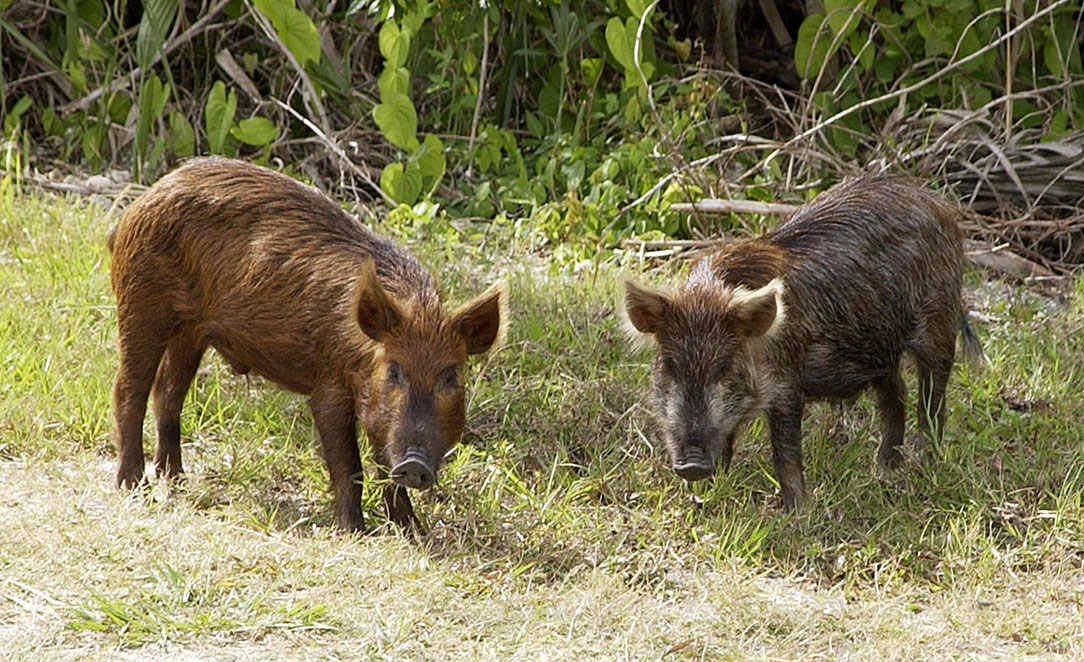
A feral pig is a domestic pig which has gone feral, meaning it lives in the wild. The term feral pig has also been applied to wild boars, which can interbreed with domestic pigs. They are found mostly in the Americas and Australia. Razorback and wild hog are sometimes used in the United States in reference to feral pigs or boar–pig hybrids.
A feral pig is a domestic pig that has escaped or been released into the wild, and is living more or less as a wild animal, or one that is descended from such animals. Zoologists generally exclude from the feral category animals that, although captive, were genuinely wild before they escaped. Accordingly, Eurasian wild boar, released or escaped into habitats where they are not native, such as in North America, are not generally considered feral, although they may interbreed with feral pigs. Likewise, reintroduced wild boars in Western Europe are also not considered feral, despite the fact that they were raised in captivity prior to their release.
Domestic pigs were first introduced to the Americas in the 16th century. Christopher Columbus intentionally released domestic swine in the West Indies during his second voyage to provide future expeditions with a freely available food supply. Hernando de Soto is known to have introduced Eurasian domestic swine to Florida in 1539, though it is possible that Juan Ponce de León had already introduced the first pigs into mainland Florida in 1521.
The practice of introducing domestic pigs into the New World persisted throughout the exploration periods of the 16th and 17th centuries. The Eurasian wild boar (S. s. scrofa), which originally ranged from Great Britain to European Russia, may have also been introduced. By the 19th century, their numbers were sufficient in some areas such as the Southern United States to become a common game animal.
Feral pigs are a growing problem in the United States and also on the southern prairies in Canada. As of 2013[update], the estimated population of 6 million feral pigs causes billions of dollars in property and agricultural damage every year in the United States,[citation needed] both in wild and agricultural lands. Their ecological damage may be equally problematic with 26% lower vertebrate species richness in forest fragments they have invaded. Because pigs forage by rooting for their food under the ground with their snouts and tusks, a group of feral pigs can damage acres of planted fields in just a few nights. As an omnivore, it is a danger to both plants and animals endemic to the area it is invading. Game animals such as deer and turkeys, and more specifically, flora such as the Opuntia plant have been especially affected by the feral hog's aggressive competition for resources. Feral pigs have been determined to be potential hosts for at least 34 pathogens that can be transmitted to livestock, wildlife, and humans. For commercial pig farmers, great concern exists that some of the hogs could be a vector for swine fever to return to the U.S., which has been extinct in America since 1978. Feral pigs could also present an immediate threat to "nonbiosecure" domestic pig facilities because of their likeliness to harbor and spread pathogens, particularly the protozoan Sarcocystis.
The population of feral pigs has increased from 2 million pigs ranging over 20 states in 1990, to triple that number 25 years later, ranging over 38 states with new territories expanding north into Oregon, Pennsylvania, Ohio, and New Hampshire. Some of these feral pigs have mixed with escaped Russian boars that have been introduced for hunters since the early 1990s.
Feral pigs are opportunistic omnivores, with about 85%-90% of their diet being plant matter, and the remainder animal. Plants have difficulties regenerating from their wallowing, as North American flora did not evolve to withstand the destruction caused by rooting pigs, unlike European or Asian flora. Feral pigs in the U.S. eat small animals, mostly invertebrates like insects and worms but also vertebrates such as wild turkey poults, toads, tortoises, and the eggs of reptiles and birds. This can deprive other wildlife that normally would feed upon these important food sources.
In some case, other wildlife are out-competed by the feral pigs' higher reproductive rate; a sow can become pregnant as early as six months old and bear multiple litters of piglets yearly. In the autumn, other animals such as the American black bear compete directly with feral pigs as both forage for tree mast (the fruit of forest trees). These are likely reasons that they reduce diversity when they invade.
Feral pig
A feral pig is a domestic pig which has gone feral, meaning it lives in the wild. The term feral pig has also been applied to wild boars, which can interbreed with domestic pigs. They are found mostly in the Americas and Australia. Razorback and wild hog are sometimes used in the United States in reference to feral pigs or boar–pig hybrids.
A feral pig is a domestic pig that has escaped or been released into the wild, and is living more or less as a wild animal, or one that is descended from such animals. Zoologists generally exclude from the feral category animals that, although captive, were genuinely wild before they escaped. Accordingly, Eurasian wild boar, released or escaped into habitats where they are not native, such as in North America, are not generally considered feral, although they may interbreed with feral pigs. Likewise, reintroduced wild boars in Western Europe are also not considered feral, despite the fact that they were raised in captivity prior to their release.
Domestic pigs were first introduced to the Americas in the 16th century. Christopher Columbus intentionally released domestic swine in the West Indies during his second voyage to provide future expeditions with a freely available food supply. Hernando de Soto is known to have introduced Eurasian domestic swine to Florida in 1539, though it is possible that Juan Ponce de León had already introduced the first pigs into mainland Florida in 1521.
The practice of introducing domestic pigs into the New World persisted throughout the exploration periods of the 16th and 17th centuries. The Eurasian wild boar (S. s. scrofa), which originally ranged from Great Britain to European Russia, may have also been introduced. By the 19th century, their numbers were sufficient in some areas such as the Southern United States to become a common game animal.
Feral pigs are a growing problem in the United States and also on the southern prairies in Canada. As of 2013[update], the estimated population of 6 million feral pigs causes billions of dollars in property and agricultural damage every year in the United States,[citation needed] both in wild and agricultural lands. Their ecological damage may be equally problematic with 26% lower vertebrate species richness in forest fragments they have invaded. Because pigs forage by rooting for their food under the ground with their snouts and tusks, a group of feral pigs can damage acres of planted fields in just a few nights. As an omnivore, it is a danger to both plants and animals endemic to the area it is invading. Game animals such as deer and turkeys, and more specifically, flora such as the Opuntia plant have been especially affected by the feral hog's aggressive competition for resources. Feral pigs have been determined to be potential hosts for at least 34 pathogens that can be transmitted to livestock, wildlife, and humans. For commercial pig farmers, great concern exists that some of the hogs could be a vector for swine fever to return to the U.S., which has been extinct in America since 1978. Feral pigs could also present an immediate threat to "nonbiosecure" domestic pig facilities because of their likeliness to harbor and spread pathogens, particularly the protozoan Sarcocystis.
The population of feral pigs has increased from 2 million pigs ranging over 20 states in 1990, to triple that number 25 years later, ranging over 38 states with new territories expanding north into Oregon, Pennsylvania, Ohio, and New Hampshire. Some of these feral pigs have mixed with escaped Russian boars that have been introduced for hunters since the early 1990s.
Feral pigs are opportunistic omnivores, with about 85%-90% of their diet being plant matter, and the remainder animal. Plants have difficulties regenerating from their wallowing, as North American flora did not evolve to withstand the destruction caused by rooting pigs, unlike European or Asian flora. Feral pigs in the U.S. eat small animals, mostly invertebrates like insects and worms but also vertebrates such as wild turkey poults, toads, tortoises, and the eggs of reptiles and birds. This can deprive other wildlife that normally would feed upon these important food sources.
In some case, other wildlife are out-competed by the feral pigs' higher reproductive rate; a sow can become pregnant as early as six months old and bear multiple litters of piglets yearly. In the autumn, other animals such as the American black bear compete directly with feral pigs as both forage for tree mast (the fruit of forest trees). These are likely reasons that they reduce diversity when they invade.
Recent media
Recent media