
Recent from talks
Opuntia
Knowledge base stats:
Talk channels stats:
Members stats:
Opuntia
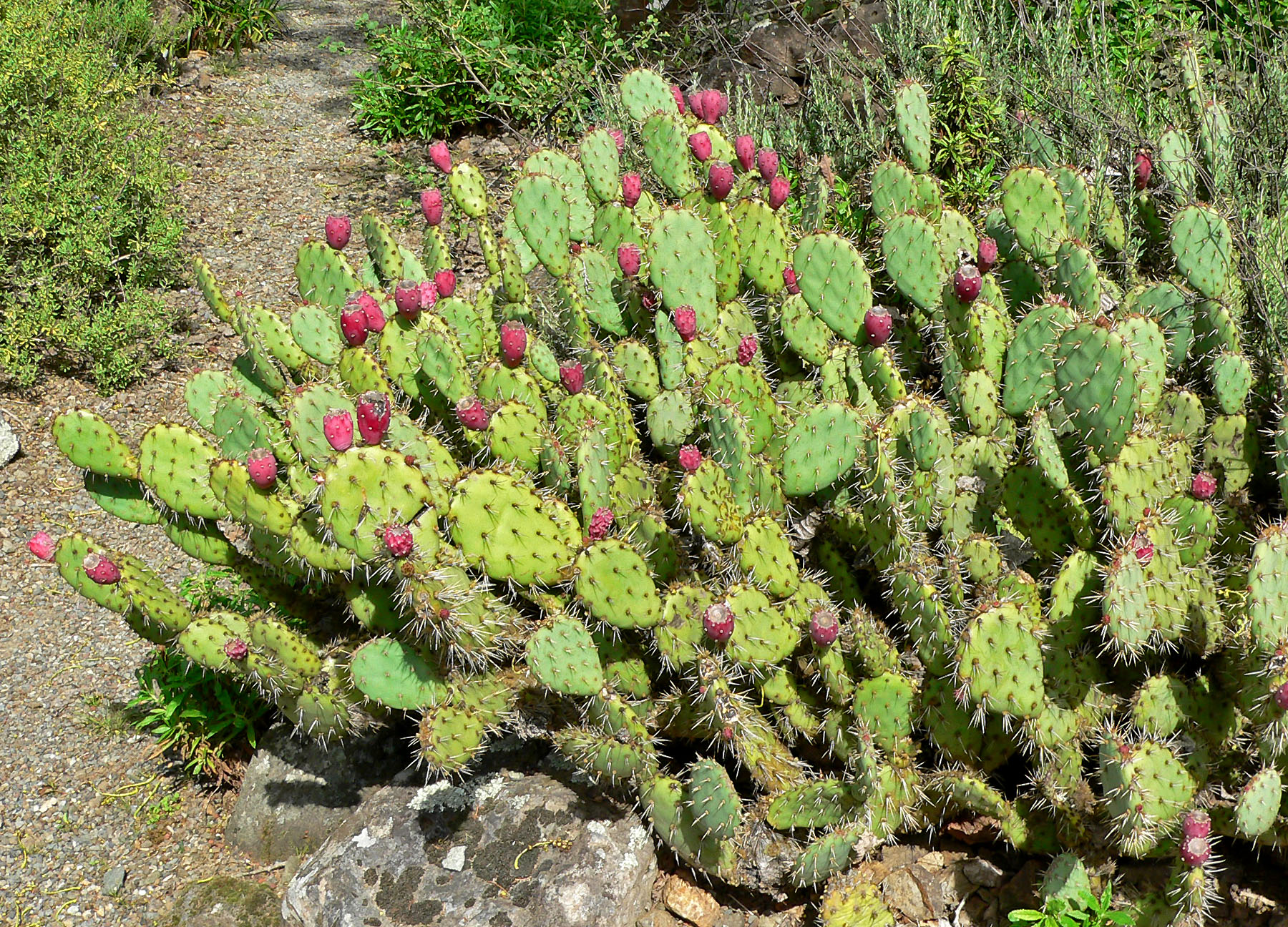
Opuntia, commonly called the prickly pear cactus, is a genus of flowering plants in the cactus family Cactaceae, many known for their flavorful fruit and showy flowers. Cacti are native to the Americas, and are well adapted to arid climates; however, they are still vulnerable to alterations in precipitation and temperature driven by climate change. The plant has been introduced to Australia, southern Europe, the Middle East, and parts of Africa.
Prickly pear alone is also used to refer to the fruit, but may also be used for the plant itself; in addition, other names given to the plant and its specific parts include tuna (fruit), sabra, sabbar, nopal (pads, plural nopales, from the Nahuatl word nōpalli), nostle (fruit) from the Nahuatl word nōchtli, and paddle cactus. The genus is named for the Ancient Greek city of Opus. The fruit and leaves are edible. The most common culinary species is the "Barbary fig" (Opuntia ficus-indica).
In places where they have been introduced outside their native range, some species in the genus Opuntia behave as aggressive invasive species.
O. ficus-indica is a large, trunk-forming, segmented cactus that may grow to 5–7 metres (16–23 feet) with a crown of over 3 m (10 ft) in diameter and a trunk diameter of 1 m (1 yard). Cladodes (large pads) are green to blue-green, bearing few spines up to 2.5 centimetres (1 inch) or may be spineless. Prickly pears typically grow with flat, rounded cladodes (also called platyclades) containing large, smooth, fixed spines and small, hairlike prickles called glochids that readily adhere to skin or hair, then detach from the plant. The flowers are typically large, axillary, solitary, bisexual, and epigynous, with a perianth consisting of distinct, spirally arranged tepals and a hypanthium. The stamens are numerous and in spiral or whorled clusters, and the gynoecium has numerous inferior ovaries per carpel. Placentation is parietal, and the fruit is a berry with arillate seeds. Prickly pear species can vary greatly in habit; most are shrubs, but some, such as O. galapageia of the Galápagos, are trees.
When Carl Linnaeus published Species Plantarum in 1753 – the starting point for modern botanical nomenclature – he placed all the species of cactus known to him in one genus, Cactus. In 1754, the Scottish botanist Philip Miller divided them into several genera, including Opuntia. He distinguished the genus largely on the form of its flowers and fruits.
Considerable variation of taxonomy occurs within Opuntia species, resulting in names being created for variants or subtypes within a species, and use of DNA sequencing to define and isolate various species.
Opuntia hybridizes readily between species. This can make classification difficult, yielding a reticulate phylogeny where different species come together in hybridization. Opuntia also has a tendency for polyploidy. The ancestral diploid state was 2n=22, but many species are hexaploid (6n = 66) or octaploid (8n = 88).
Chollas, now recognized to belong to the distinct genus Cylindropuntia, are distinguished by having cylindrical, rather than flattened, stem segments with large barbed spines. The stem joints of several species, notably the jumping cholla (C. fulgida), are very brittle on young stems, readily breaking off when the barbed spines stick to clothing or animal fur as a method of vegetative reproduction. The barbed spines can remain embedded in the skin, causing discomfort and sometimes injury.
Hub AI
Opuntia AI simulator
(@Opuntia_simulator)
Opuntia
Opuntia, commonly called the prickly pear cactus, is a genus of flowering plants in the cactus family Cactaceae, many known for their flavorful fruit and showy flowers. Cacti are native to the Americas, and are well adapted to arid climates; however, they are still vulnerable to alterations in precipitation and temperature driven by climate change. The plant has been introduced to Australia, southern Europe, the Middle East, and parts of Africa.
Prickly pear alone is also used to refer to the fruit, but may also be used for the plant itself; in addition, other names given to the plant and its specific parts include tuna (fruit), sabra, sabbar, nopal (pads, plural nopales, from the Nahuatl word nōpalli), nostle (fruit) from the Nahuatl word nōchtli, and paddle cactus. The genus is named for the Ancient Greek city of Opus. The fruit and leaves are edible. The most common culinary species is the "Barbary fig" (Opuntia ficus-indica).
In places where they have been introduced outside their native range, some species in the genus Opuntia behave as aggressive invasive species.
O. ficus-indica is a large, trunk-forming, segmented cactus that may grow to 5–7 metres (16–23 feet) with a crown of over 3 m (10 ft) in diameter and a trunk diameter of 1 m (1 yard). Cladodes (large pads) are green to blue-green, bearing few spines up to 2.5 centimetres (1 inch) or may be spineless. Prickly pears typically grow with flat, rounded cladodes (also called platyclades) containing large, smooth, fixed spines and small, hairlike prickles called glochids that readily adhere to skin or hair, then detach from the plant. The flowers are typically large, axillary, solitary, bisexual, and epigynous, with a perianth consisting of distinct, spirally arranged tepals and a hypanthium. The stamens are numerous and in spiral or whorled clusters, and the gynoecium has numerous inferior ovaries per carpel. Placentation is parietal, and the fruit is a berry with arillate seeds. Prickly pear species can vary greatly in habit; most are shrubs, but some, such as O. galapageia of the Galápagos, are trees.
When Carl Linnaeus published Species Plantarum in 1753 – the starting point for modern botanical nomenclature – he placed all the species of cactus known to him in one genus, Cactus. In 1754, the Scottish botanist Philip Miller divided them into several genera, including Opuntia. He distinguished the genus largely on the form of its flowers and fruits.
Considerable variation of taxonomy occurs within Opuntia species, resulting in names being created for variants or subtypes within a species, and use of DNA sequencing to define and isolate various species.
Opuntia hybridizes readily between species. This can make classification difficult, yielding a reticulate phylogeny where different species come together in hybridization. Opuntia also has a tendency for polyploidy. The ancestral diploid state was 2n=22, but many species are hexaploid (6n = 66) or octaploid (8n = 88).
Chollas, now recognized to belong to the distinct genus Cylindropuntia, are distinguished by having cylindrical, rather than flattened, stem segments with large barbed spines. The stem joints of several species, notably the jumping cholla (C. fulgida), are very brittle on young stems, readily breaking off when the barbed spines stick to clothing or animal fur as a method of vegetative reproduction. The barbed spines can remain embedded in the skin, causing discomfort and sometimes injury.
Recent media