
Recent from talks
Ferdinand von Lindemann
Knowledge base stats:
Talk channels stats:
Members stats:
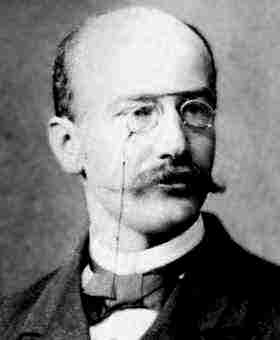
Ferdinand von Lindemann
Carl Louis Ferdinand von Lindemann (12 April 1852 – 6 March 1939) was a German mathematician, noted for his proof, published in 1882, that π (pi) is a transcendental number, meaning it is not a root of any nonzero polynomial with rational coefficients.
Lindemann was born in Hanover, the capital of the Kingdom of Hanover. His father, Ferdinand Lindemann, taught modern languages at a gymnasium in Hanover. His mother, Emilie Crusius, was the daughter of the gymnasium's headmaster. The family later moved to Schwerin, where young Ferdinand attended school.
He studied mathematics at Göttingen, Erlangen, and Munich. At Erlangen he received a doctorate, supervised by Felix Klein, on non-Euclidean geometry. Lindemann subsequently taught in Würzburg and at the University of Freiburg. During his time in Freiburg, Lindemann devised his proof that π is a transcendental number (see Lindemann–Weierstrass theorem). After his time in Freiburg, Lindemann transferred to the University of Königsberg. While a professor in Königsberg, Lindemann acted as supervisor for the doctoral theses of the mathematicians David Hilbert, Hermann Minkowski, and Arnold Sommerfeld.
In 1882, Lindemann published the result for which he is best known, the transcendence of π. His methods were similar to those used nine years earlier by Charles Hermite to show that e, the base of natural logarithms, is transcendental. Before the publication of Lindemann's proof, it was known that π was irrational, as Johann Heinrich Lambert proved π was irrational in the 1760s.
Hub AI
Ferdinand von Lindemann AI simulator
(@Ferdinand von Lindemann_simulator)
Ferdinand von Lindemann
Carl Louis Ferdinand von Lindemann (12 April 1852 – 6 March 1939) was a German mathematician, noted for his proof, published in 1882, that π (pi) is a transcendental number, meaning it is not a root of any nonzero polynomial with rational coefficients.
Lindemann was born in Hanover, the capital of the Kingdom of Hanover. His father, Ferdinand Lindemann, taught modern languages at a gymnasium in Hanover. His mother, Emilie Crusius, was the daughter of the gymnasium's headmaster. The family later moved to Schwerin, where young Ferdinand attended school.
He studied mathematics at Göttingen, Erlangen, and Munich. At Erlangen he received a doctorate, supervised by Felix Klein, on non-Euclidean geometry. Lindemann subsequently taught in Würzburg and at the University of Freiburg. During his time in Freiburg, Lindemann devised his proof that π is a transcendental number (see Lindemann–Weierstrass theorem). After his time in Freiburg, Lindemann transferred to the University of Königsberg. While a professor in Königsberg, Lindemann acted as supervisor for the doctoral theses of the mathematicians David Hilbert, Hermann Minkowski, and Arnold Sommerfeld.
In 1882, Lindemann published the result for which he is best known, the transcendence of π. His methods were similar to those used nine years earlier by Charles Hermite to show that e, the base of natural logarithms, is transcendental. Before the publication of Lindemann's proof, it was known that π was irrational, as Johann Heinrich Lambert proved π was irrational in the 1760s.
Recent media