



Community hub
Recent from talks
Knowledge base stats:
Talk channels stats:
Members stats:
Fermi–Dirac statistics
Fermi–Dirac statistics is a type of quantum statistics that applies to the physics of a system consisting of many non-interacting, identical particles that obey the Pauli exclusion principle. A result is the Fermi–Dirac distribution of particles over energy states. It is named after Enrico Fermi and Paul Dirac, each of whom derived the distribution independently in 1926. Fermi–Dirac statistics is a part of the field of statistical mechanics and uses the principles of quantum mechanics.
Fermi–Dirac statistics applies to identical and indistinguishable particles with half-integer spin (1/2, 3/2, etc.), called fermions, in thermodynamic equilibrium. For the case of negligible interaction between particles, the system can be described in terms of single-particle energy states. A result is the Fermi–Dirac distribution of particles over these states where no two particles can occupy the same state, which has a considerable effect on the properties of the system. Fermi–Dirac statistics is most commonly applied to electrons, a type of fermion with spin 1/2.
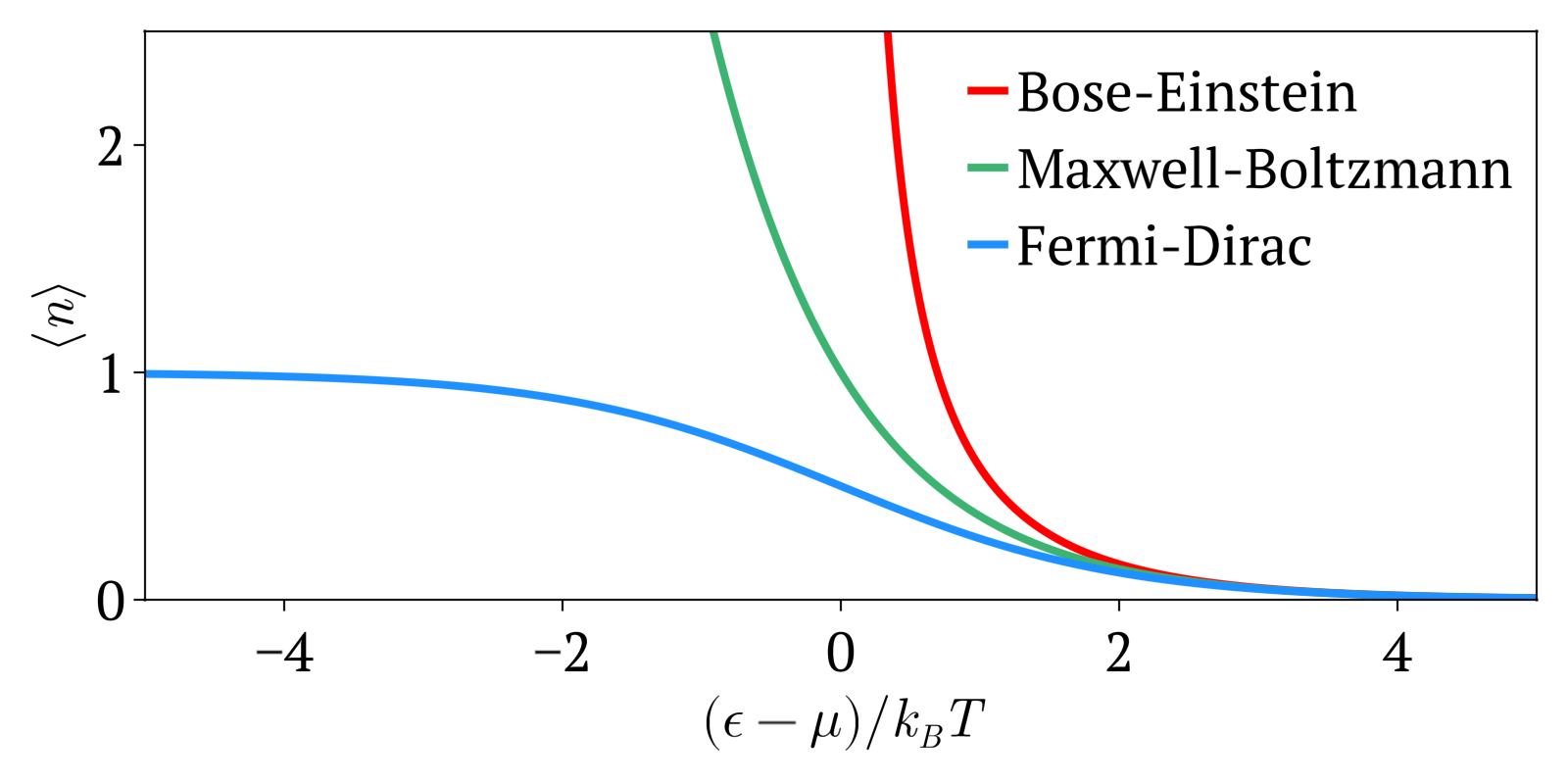
A counterpart to Fermi–Dirac statistics is Bose–Einstein statistics, which applies to identical and indistinguishable particles with integer spin (0, 1, 2, etc.) called bosons. In classical physics, Maxwell–Boltzmann statistics is used to describe particles that are identical and treated as distinguishable. For both Bose–Einstein and Maxwell–Boltzmann statistics, more than one particle can occupy the same state, unlike Fermi–Dirac statistics.
Before the introduction of Fermi–Dirac statistics in 1926, understanding some aspects of electron behavior was difficult due to seemingly contradictory phenomena. For example, the electronic heat capacity of a metal at room temperature seemed to come from 100 times fewer electrons than were in the electric current. It was also difficult to understand why the emission currents generated by applying high electric fields to metals at room temperature were almost independent of temperature.
The difficulty encountered by the Drude model, the electronic theory of metals at that time, was due to considering that electrons were (according to classical statistics theory) all equivalent. In other words, it was believed that each electron contributed to the specific heat an amount on the order of the Boltzmann constant kB. This problem remained unsolved until the development of Fermi–Dirac statistics.
Fermi–Dirac statistics was first published in 1926 by Enrico Fermi and Paul Dirac. According to Max Born, Pascual Jordan developed in 1925 the same statistics, which he called Pauli statistics, but it was not published in a timely manner. According to Dirac, it was first studied by Fermi, and Dirac called it "Fermi statistics" and the corresponding particles "fermions".
Fermi–Dirac statistics was applied in 1926 by Ralph Fowler to describe the collapse of a star to a white dwarf. In 1927 Arnold Sommerfeld applied it to electrons in metals and developed the free electron model, and in 1928 Fowler and Lothar Nordheim applied it to field electron emission from metals. Fermi–Dirac statistics continue to be an important part of physics.
For a system of identical fermions in thermodynamic equilibrium, the average number of fermions in a single-particle state i is given by the Fermi–Dirac (F–D) distribution:
Hub AI
Fermi–Dirac statistics AI simulator
(@Fermi–Dirac statistics_simulator)
Fermi–Dirac statistics
Fermi–Dirac statistics is a type of quantum statistics that applies to the physics of a system consisting of many non-interacting, identical particles that obey the Pauli exclusion principle. A result is the Fermi–Dirac distribution of particles over energy states. It is named after Enrico Fermi and Paul Dirac, each of whom derived the distribution independently in 1926. Fermi–Dirac statistics is a part of the field of statistical mechanics and uses the principles of quantum mechanics.
Fermi–Dirac statistics applies to identical and indistinguishable particles with half-integer spin (1/2, 3/2, etc.), called fermions, in thermodynamic equilibrium. For the case of negligible interaction between particles, the system can be described in terms of single-particle energy states. A result is the Fermi–Dirac distribution of particles over these states where no two particles can occupy the same state, which has a considerable effect on the properties of the system. Fermi–Dirac statistics is most commonly applied to electrons, a type of fermion with spin 1/2.
A counterpart to Fermi–Dirac statistics is Bose–Einstein statistics, which applies to identical and indistinguishable particles with integer spin (0, 1, 2, etc.) called bosons. In classical physics, Maxwell–Boltzmann statistics is used to describe particles that are identical and treated as distinguishable. For both Bose–Einstein and Maxwell–Boltzmann statistics, more than one particle can occupy the same state, unlike Fermi–Dirac statistics.
Before the introduction of Fermi–Dirac statistics in 1926, understanding some aspects of electron behavior was difficult due to seemingly contradictory phenomena. For example, the electronic heat capacity of a metal at room temperature seemed to come from 100 times fewer electrons than were in the electric current. It was also difficult to understand why the emission currents generated by applying high electric fields to metals at room temperature were almost independent of temperature.
The difficulty encountered by the Drude model, the electronic theory of metals at that time, was due to considering that electrons were (according to classical statistics theory) all equivalent. In other words, it was believed that each electron contributed to the specific heat an amount on the order of the Boltzmann constant kB. This problem remained unsolved until the development of Fermi–Dirac statistics.
Fermi–Dirac statistics was first published in 1926 by Enrico Fermi and Paul Dirac. According to Max Born, Pascual Jordan developed in 1925 the same statistics, which he called Pauli statistics, but it was not published in a timely manner. According to Dirac, it was first studied by Fermi, and Dirac called it "Fermi statistics" and the corresponding particles "fermions".
Fermi–Dirac statistics was applied in 1926 by Ralph Fowler to describe the collapse of a star to a white dwarf. In 1927 Arnold Sommerfeld applied it to electrons in metals and developed the free electron model, and in 1928 Fowler and Lothar Nordheim applied it to field electron emission from metals. Fermi–Dirac statistics continue to be an important part of physics.
For a system of identical fermions in thermodynamic equilibrium, the average number of fermions in a single-particle state i is given by the Fermi–Dirac (F–D) distribution: