



Community hub
Recent from talks
Contribute something
Nothing was collected or created yet.
Field trace
View on WikipediaIn mathematics, the field trace is a particular function defined with respect to a finite field extension L/K, which is a K-linear map from L onto K.
Definition
[edit]Let K be a field and L a finite extension (and hence an algebraic extension) of K. L can be viewed as a vector space over K. Multiplication by α, an element of L,
- ,

is a K-linear transformation of this vector space into itself. The trace, TrL/K(α), is defined as the trace (in the linear algebra sense) of this linear transformation.[1]
For α in L, let σ1(α), ..., σn(α) be the roots (counted with multiplicity) of the minimal polynomial of α over K (in some extension field of K). Then
![{\displaystyle \operatorname {Tr} _{L/K}(\alpha )=[L:K(\alpha )]\sum _{j=1}^{n}\sigma _{j}(\alpha ).}](https://wikimedia.org/api/rest_v1/media/math/render/svg/aa4f423368097975441959e7544cd874456e3bab)
If L/K is separable then each root appears only once[2] (however this does not mean the coefficient above is one; for example if α is the identity element 1 of K then the trace is [L:K] times 1).
More particularly, if L/K is a Galois extension and α is in L, then the trace of α is the sum of all the Galois conjugates of α,[1] i.e.,
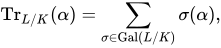
where Gal(L/K) denotes the Galois group of L/K.
Example
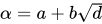
[edit]Let be a quadratic extension of . Then a basis of is If then the matrix of is:



- ,
![{\displaystyle \left[{\begin{matrix}a&bd\\b&a\end{matrix}}\right]}](https://wikimedia.org/api/rest_v1/media/math/render/svg/9874d45b8c9da9e90b57f725cad7f3adef701496)
and so, .[1] The minimal polynomial of α is X2 − 2a X + (a2 − db2).
![{\displaystyle \operatorname {Tr} _{L/\mathbb {Q} }(\alpha )=[L:\mathbb {Q} (\alpha )]\left(\sigma _{1}(\alpha )+\sigma _{2}(\alpha )\right)=1\times \left(\sigma _{1}(\alpha )+{\overline {\sigma _{1}}}(\alpha )\right)=a+b{\sqrt {d}}+a-b{\sqrt {d}}=2a}](https://wikimedia.org/api/rest_v1/media/math/render/svg/50c997744da837647ba9d193cf5b6d75fc5d4526)
Properties of the trace
[edit]Several properties of the trace function hold for any finite extension.[3]
The trace TrL/K : L → K is a K-linear map (a K-linear functional), that is
- .

If α ∈ K then
![{\displaystyle \operatorname {Tr} _{L/K}(\alpha )=[L:K]\alpha .}](https://wikimedia.org/api/rest_v1/media/math/render/svg/5df17fe0dbc3a0b9a696db1a90d2e8aa42b7ff84)
Additionally, trace behaves well in towers of fields: if M is a finite extension of L, then the trace from M to K is just the composition of the trace from M to L with the trace from L to K, i.e.
- .

Finite fields
[edit]Let L = GF(qn) be a finite extension of a finite field K = GF(q). Since L/K is a Galois extension, if α is in L, then the trace of α is the sum of all the Galois conjugates of α, i.e.[4]

In this setting we have the additional properties:[5]
- .
- For any , there are exactly elements with .



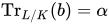
Theorem.[6] For b ∈ L, let Fb be the map Then Fb ≠ Fc if b ≠ c. Moreover, the K-linear transformations from L to K are exactly the maps of the form Fb as b varies over the field L.

When K is the prime subfield of L, the trace is called the absolute trace and otherwise it is a relative trace.[4]
Application
[edit]A quadratic equation, ax2 + bx + c = 0 with a ≠ 0, and coefficients in the finite field has either 0, 1 or 2 roots in GF(q) (and two roots, counted with multiplicity, in the quadratic extension GF(q2)). If the characteristic of GF(q) is odd, the discriminant Δ = b2 − 4ac indicates the number of roots in GF(q) and the classical quadratic formula gives the roots. However, when GF(q) has even characteristic (i.e., q = 2h for some positive integer h), these formulas are no longer applicable.

Consider the quadratic equation ax2 + bx + c = 0 with coefficients in the finite field GF(2h).[7] If b = 0 then this equation has the unique solution in GF(q). If b ≠ 0 then the substitution y = ax/b converts the quadratic equation to the form:


This equation has two solutions in GF(q) if and only if the absolute trace In this case, if y = s is one of the solutions, then y = s + 1 is the other. Let k be any element of GF(q) with Then a solution to the equation is given by:



When h = 2m' + 1, a solution is given by the simpler expression:

Trace form
[edit]When L/K is separable, the trace provides a duality theory via the trace form: the map from L × L to K sending (x, y) to TrL/K(xy) is a nondegenerate, symmetric bilinear form called the trace form. If L/K is a Galois extension, the trace form is invariant with respect to the Galois group.
The trace form is used in algebraic number theory in the theory of the different ideal.
The trace form for a finite degree field extension L/K has non-negative signature for any field ordering of K.[8] The converse, that every Witt equivalence class with non-negative signature contains a trace form, is true for algebraic number fields K.[8]
If L/K is an inseparable extension, then the trace form is identically 0.[9]
See also
[edit]Notes
[edit]- ^ a b c Rotman 2002, p. 940
- ^ Rotman 2002, p. 941
- ^ Roman 2006, p. 151
- ^ a b Lidl & Niederreiter 1997, p.54
- ^ Mullen & Panario 2013, p. 21
- ^ Lidl & Niederreiter 1997, p.56
- ^ Hirschfeld 1979, pp. 3-4
- ^ a b Lorenz (2008) p.38
- ^ Isaacs 1994, p. 369 as footnoted in Rotman 2002, p. 943
References
[edit]- Hirschfeld, J.W.P. (1979), Projective Geometries over Finite Fields, Oxford Mathematical Monographs, Oxford University Press, ISBN 0-19-853526-0
- Isaacs, I.M. (1994), Algebra, A Graduate Course, Brooks/Cole Publishing
- Lidl, Rudolf; Niederreiter, Harald (1997) [1983], Finite Fields, Encyclopedia of Mathematics and its Applications, vol. 20 (Second ed.), Cambridge University Press, ISBN 0-521-39231-4, Zbl 0866.11069
- Lorenz, Falko (2008). Algebra. Volume II: Fields with Structure, Algebras and Advanced Topics. Springer. ISBN 978-0-387-72487-4. Zbl 1130.12001.
- Mullen, Gary L.; Panario, Daniel (2013), Handbook of Finite Fields, CRC Press, ISBN 978-1-4398-7378-6
- Roman, Steven (2006), Field theory, Graduate Texts in Mathematics, vol. 158 (Second ed.), Springer, Chapter 8, ISBN 978-0-387-27677-9, Zbl 1172.12001
- Rotman, Joseph J. (2002), Advanced Modern Algebra, Prentice Hall, ISBN 978-0-13-087868-7
Further reading
[edit]- Conner, P.E.; Perlis, R. (1984). A Survey of Trace Forms of Algebraic Number Fields. Series in Pure Mathematics. Vol. 2. World Scientific. ISBN 9971-966-05-0. Zbl 0551.10017.
- Section VI.5 of Lang, Serge (2002), Algebra, Graduate Texts in Mathematics, vol. 211 (Revised third ed.), New York: Springer-Verlag, ISBN 978-0-387-95385-4, MR 1878556, Zbl 0984.00001