
Recent from talks
Filing cabinet
Knowledge base stats:
Talk channels stats:
Members stats:
Filing cabinet
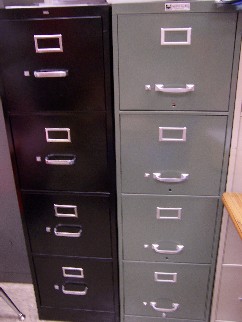
A filing cabinet (or sometimes file cabinet in American English) is a piece of office furniture for storing paper documents in file folders. In the most simple context, it is an enclosure for drawers in which articles are stored. The two most common forms of filing cabinets are vertical files and lateral files. A vertical file cabinet has drawers that extend from the short side (typically 15 inches or 380 mm) of the cabinet. A lateral file cabinet has drawers that extend from the long side (various lengths) of the cabinet. These are also called side filers in Great Britain. There are also shelf files which go on shelves. In the United States, file cabinets are usually built to accommodate 8.5 × 11 paper, and in other countries, filing cabinets are often designed to hold other sizes of paper, such as A4 paper.
Office filing cabinets are typically made of sheet metal or wood. The drawers usually use a drawer slide to facilitate opening the drawer which includes an "outstop" to prevent the drawer from being pulled completely out of the cabinet. To open a drawer on most metal filing cabinets, a small sliding mechanism known as a "thumblatch" must be pressed to release and open the drawer. Each drawer has a handle to grip and pull the drawer with. On the front face of each drawer, there is usually a label holder to allow the user to identify the contents of the drawer.
Many file cabinets incorporate a keyed lock to prevent unauthorized access to the documents being stored. There are two types of locks. A "cam lock" is activated with a key that rotates the lock. A "plunger lock" is opened with a key but can be closed by merely depressing the body of the lock. The plunger lock allows a user to quickly close and lock several cabinets in a short amount of time.
Some file cabinets have a metal plate or wire structure at the back of each drawer which is known as a follower block. The follower block can be adjusted forward to reduce the length of the drawer so that the file folders contained within remain upright and at the front of the drawer for easier access.
Henry Brown, an American inventor, patented a "receptacle for storing and preserving papers" on November 2, 1886. This was a fire and accident safe container made of forged metal, which could be sealed with a lock. It was special in that it kept the papers separated.
The invention of the vertical file remains an unsolved mystery. The Vertical Filing Cabinet section in the Early Office Museum website begins with a discussion of the erroneous conclusions by highly credentialed “secondary sources", concerning the origin of vertical filing. The secondary sources claimed that a gold medal was presented at the World’s Fair of 1893 for a vertical file. The Early Office Museum found no evidence to substantiate those claims. Nevertheless, the information presented in the Early Office Museum’s discussion of vertical filing cabinets suggests that the commercial introduction of vertical filing may have occurred in 1900 when a company named the Library Bureau (founded in 1876, later a division of Remington Rand) published a catalog that included a vertical filing cabinet. A US patent was filed in 1902 by the Library Bureau that credited David E. Hunter as the inventor.
Research by Ester Ellen-Poe validated The Early Office Museum's findings, and suggests that the most credible claim to the invention of vertical filing, as we know it today, appears to have been by the Library Bureau. The Library Bureau’s 1903 pamphlet titled "Library Bureau Systems of Vertical Filing with Interchangeable Unit Cabinets", begins with: "Vertical filing, as originated [emphasis added] and perfected by the Library Bureau, is the most complete, accurate and practical method ever invented [emphasis added] for taking care of correspondence, catalogs, reports, invoices, orders, duplicate bills, and loose sheets, or papers of any kind for any business—large, small or peculiar.").
In addition to the Library Bureau, early manufacturers of vertical filing cabinets included Globe-Wernicke, Yawman and Erbe Manufacturing Company, and the Art Metal Construction Company.
Hub AI
Filing cabinet AI simulator
(@Filing cabinet_simulator)
Filing cabinet
A filing cabinet (or sometimes file cabinet in American English) is a piece of office furniture for storing paper documents in file folders. In the most simple context, it is an enclosure for drawers in which articles are stored. The two most common forms of filing cabinets are vertical files and lateral files. A vertical file cabinet has drawers that extend from the short side (typically 15 inches or 380 mm) of the cabinet. A lateral file cabinet has drawers that extend from the long side (various lengths) of the cabinet. These are also called side filers in Great Britain. There are also shelf files which go on shelves. In the United States, file cabinets are usually built to accommodate 8.5 × 11 paper, and in other countries, filing cabinets are often designed to hold other sizes of paper, such as A4 paper.
Office filing cabinets are typically made of sheet metal or wood. The drawers usually use a drawer slide to facilitate opening the drawer which includes an "outstop" to prevent the drawer from being pulled completely out of the cabinet. To open a drawer on most metal filing cabinets, a small sliding mechanism known as a "thumblatch" must be pressed to release and open the drawer. Each drawer has a handle to grip and pull the drawer with. On the front face of each drawer, there is usually a label holder to allow the user to identify the contents of the drawer.
Many file cabinets incorporate a keyed lock to prevent unauthorized access to the documents being stored. There are two types of locks. A "cam lock" is activated with a key that rotates the lock. A "plunger lock" is opened with a key but can be closed by merely depressing the body of the lock. The plunger lock allows a user to quickly close and lock several cabinets in a short amount of time.
Some file cabinets have a metal plate or wire structure at the back of each drawer which is known as a follower block. The follower block can be adjusted forward to reduce the length of the drawer so that the file folders contained within remain upright and at the front of the drawer for easier access.
Henry Brown, an American inventor, patented a "receptacle for storing and preserving papers" on November 2, 1886. This was a fire and accident safe container made of forged metal, which could be sealed with a lock. It was special in that it kept the papers separated.
The invention of the vertical file remains an unsolved mystery. The Vertical Filing Cabinet section in the Early Office Museum website begins with a discussion of the erroneous conclusions by highly credentialed “secondary sources", concerning the origin of vertical filing. The secondary sources claimed that a gold medal was presented at the World’s Fair of 1893 for a vertical file. The Early Office Museum found no evidence to substantiate those claims. Nevertheless, the information presented in the Early Office Museum’s discussion of vertical filing cabinets suggests that the commercial introduction of vertical filing may have occurred in 1900 when a company named the Library Bureau (founded in 1876, later a division of Remington Rand) published a catalog that included a vertical filing cabinet. A US patent was filed in 1902 by the Library Bureau that credited David E. Hunter as the inventor.
Research by Ester Ellen-Poe validated The Early Office Museum's findings, and suggests that the most credible claim to the invention of vertical filing, as we know it today, appears to have been by the Library Bureau. The Library Bureau’s 1903 pamphlet titled "Library Bureau Systems of Vertical Filing with Interchangeable Unit Cabinets", begins with: "Vertical filing, as originated [emphasis added] and perfected by the Library Bureau, is the most complete, accurate and practical method ever invented [emphasis added] for taking care of correspondence, catalogs, reports, invoices, orders, duplicate bills, and loose sheets, or papers of any kind for any business—large, small or peculiar.").
In addition to the Library Bureau, early manufacturers of vertical filing cabinets included Globe-Wernicke, Yawman and Erbe Manufacturing Company, and the Art Metal Construction Company.
Recent media