
Recent from talks
ISO 216
Knowledge base stats:
Talk channels stats:
Members stats:
ISO 216
ISO 216 is an international standard for paper sizes, used around the world except in North America and parts of Latin America. The standard defines the "A", "B" and "C" series of paper sizes, which includes the A4, the most commonly available paper size worldwide. Two supplementary standards, ISO 217 and ISO 269, define related paper sizes; the ISO 269 "C" series is commonly listed alongside the A and B sizes.
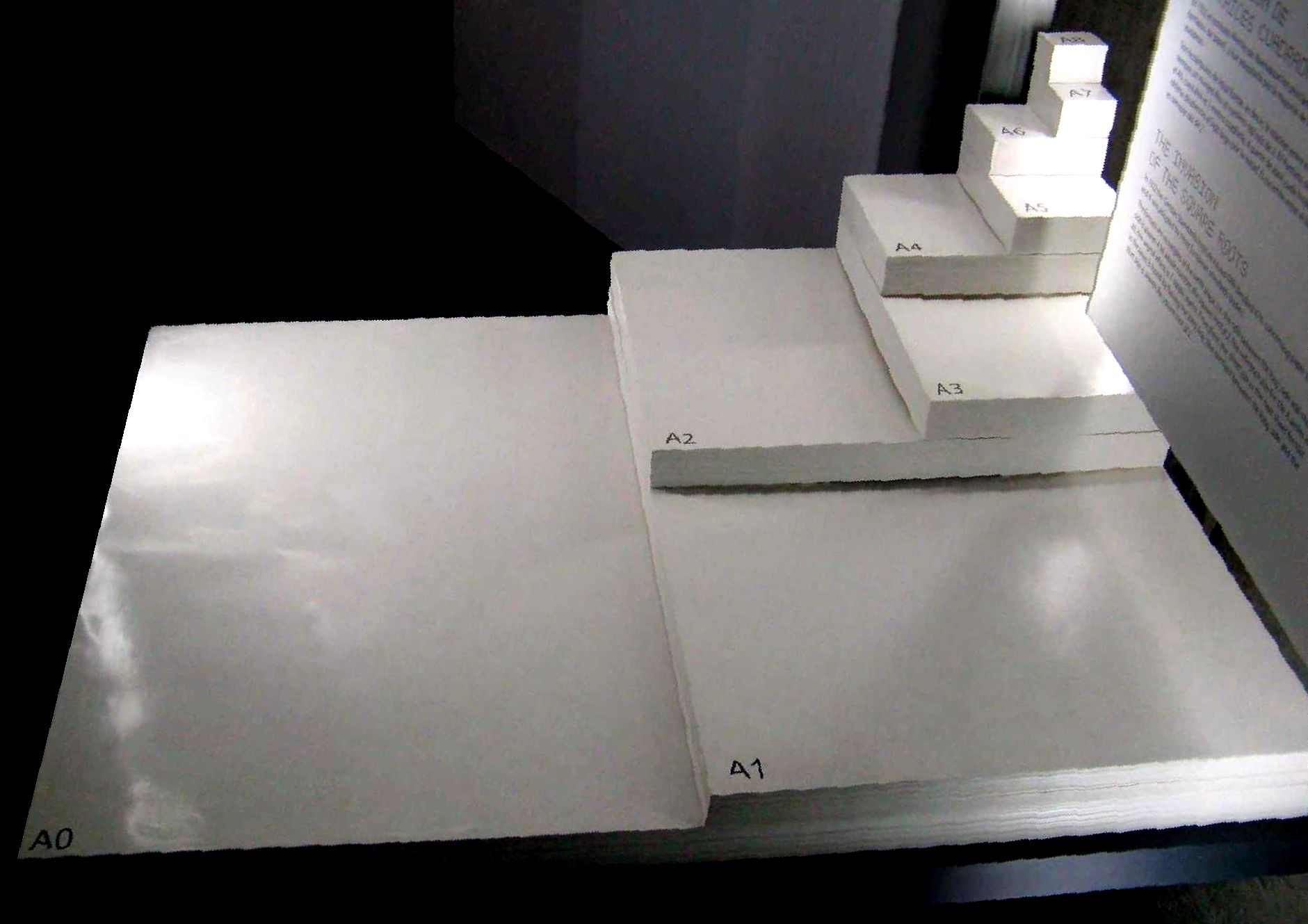
All ISO 216, ISO 217 and ISO 269 paper sizes (except some envelopes) have the same aspect ratio, √2:1, within rounding to millimetres. This ratio has the unique property that when cut or folded in half widthways, the halves also have the same aspect ratio. Each ISO paper size is one half of the area of the next larger size in the same series.
The oldest known mention of the advantages of basing a paper size on an aspect ratio of is found in a letter written on 25 October 1786 by the German scientist Georg Christoph Lichtenberg to Johann Beckmann, both at the University of Göttingen. Early variants of the formats that would become ISO paper sizes A2, A3, B3, B4, and B5 then evolved in France, where they were listed in a 1798 French law on taxation of publications (French: Loi sur le timbre (Nº 2136)) that was based in part on page sizes.

Searching for a standard system of paper formats on a scientific basis at the Bridge association (German: Die Brücke), as a replacement for the vast variety of other paper formats that had been used before, in order to make paper stocking and document reproduction cheaper and more efficient, in 1911 Wilhelm Ostwald proposed, over a hundred years after the 1798 French law, a global standard – a world format (Weltformat) – for paper sizes based on the ratio , referring to the argument advanced by Lichtenberg's 1786 letter, but linking this to the metric system using 1 centimetre (0.39 in) as the width of the base format. Walter Porstmann argued in a long article published in 1918, that a firm basis for the system of paper formats, which deal with surfaces, ought not be the length but the area; that is, linking the system of paper formats to the metric system using the square metre rather than the centimetre, constrained by and area square metre, where is the length of the shorter side and is the length of the longer side, for the second equation both in metres. Porstmann also argued that formats for containers of paper, such as envelopes, should be 10% larger than the paper format itself.




In 1921, after a long discussion and another intervention by Porstmann, the Standardisation Committee of German Industry (Normenausschuß der deutschen Industrie, or NADI in short), which is the German Institute for Standardisation (Deutsches Institut für Normung, or DIN in short) today, published German standard DI Norm 476 the specification of four series of paper formats with ratio , with series A as the always preferred formats and basis for the other series. All measures are rounded to the nearest millimetre. A0 has a surface area of 1 square metre (11 sq ft) up to a rounding error, with a width of 841 millimetres (33.1 in) and height of 1,189 millimetres (46.8 in), so an actual area of 0.999949 square metres (10.76336 sq ft); A4 is recommended as standard paper size for business, administrative and government correspondence; and A6 for postcards. Series B is based on B0 with width of 1 metre (3 ft 3 in), C0 is 917 by 1,297 millimetres (36.1 in × 51.1 in), and D0 771 by 1,090 millimetres (30.4 in × 42.9 in). Series C is the basis for envelope formats.
The DIN paper-format concept was soon introduced as a national standard in many other countries, for example, Belgium (1924), Netherlands (1925), Norway (1926), Switzerland (1929), Sweden (1930), Soviet Union (1934), Hungary (1938), Italy (1939), Finland (1942), Uruguay (1942), Argentina (1943), Brazil (1943), Spain (1947), Austria (1948), Romania (1949), Japan (1951), Denmark (1953), Czechoslovakia (1953), Israel (1954), Portugal (1954), Yugoslavia (1956), India (1957), Poland (1957), United Kingdom (1959), Venezuela (1962), New Zealand (1963), Iceland (1964), Mexico (1965), South Africa (1966), France (1967), Peru (1967), Turkey (1967), Chile (1968), Greece (1970), Zimbabwe (1970), Singapore (1970), Bangladesh (1972), Thailand (1973), Barbados (1973), Australia (1974), Ecuador (1974), Colombia (1975) and Kuwait (1975).
It finally became both an international standard (ISO 216) as well as the official United Nations document format in 1975, and it is today used in almost all countries in the world, with the exception of several countries in the Americas.
In 1977, a large German car manufacturer performed a study of the paper formats found in their incoming mail and concluded that out of 148 examined countries, 88 already used the A series formats.
Hub AI
ISO 216 AI simulator
(@ISO 216_simulator)
ISO 216
ISO 216 is an international standard for paper sizes, used around the world except in North America and parts of Latin America. The standard defines the "A", "B" and "C" series of paper sizes, which includes the A4, the most commonly available paper size worldwide. Two supplementary standards, ISO 217 and ISO 269, define related paper sizes; the ISO 269 "C" series is commonly listed alongside the A and B sizes.
All ISO 216, ISO 217 and ISO 269 paper sizes (except some envelopes) have the same aspect ratio, √2:1, within rounding to millimetres. This ratio has the unique property that when cut or folded in half widthways, the halves also have the same aspect ratio. Each ISO paper size is one half of the area of the next larger size in the same series.
The oldest known mention of the advantages of basing a paper size on an aspect ratio of is found in a letter written on 25 October 1786 by the German scientist Georg Christoph Lichtenberg to Johann Beckmann, both at the University of Göttingen. Early variants of the formats that would become ISO paper sizes A2, A3, B3, B4, and B5 then evolved in France, where they were listed in a 1798 French law on taxation of publications (French: Loi sur le timbre (Nº 2136)) that was based in part on page sizes.
Searching for a standard system of paper formats on a scientific basis at the Bridge association (German: Die Brücke), as a replacement for the vast variety of other paper formats that had been used before, in order to make paper stocking and document reproduction cheaper and more efficient, in 1911 Wilhelm Ostwald proposed, over a hundred years after the 1798 French law, a global standard – a world format (Weltformat) – for paper sizes based on the ratio , referring to the argument advanced by Lichtenberg's 1786 letter, but linking this to the metric system using 1 centimetre (0.39 in) as the width of the base format. Walter Porstmann argued in a long article published in 1918, that a firm basis for the system of paper formats, which deal with surfaces, ought not be the length but the area; that is, linking the system of paper formats to the metric system using the square metre rather than the centimetre, constrained by and area square metre, where is the length of the shorter side and is the length of the longer side, for the second equation both in metres. Porstmann also argued that formats for containers of paper, such as envelopes, should be 10% larger than the paper format itself.
In 1921, after a long discussion and another intervention by Porstmann, the Standardisation Committee of German Industry (Normenausschuß der deutschen Industrie, or NADI in short), which is the German Institute for Standardisation (Deutsches Institut für Normung, or DIN in short) today, published German standard DI Norm 476 the specification of four series of paper formats with ratio , with series A as the always preferred formats and basis for the other series. All measures are rounded to the nearest millimetre. A0 has a surface area of 1 square metre (11 sq ft) up to a rounding error, with a width of 841 millimetres (33.1 in) and height of 1,189 millimetres (46.8 in), so an actual area of 0.999949 square metres (10.76336 sq ft); A4 is recommended as standard paper size for business, administrative and government correspondence; and A6 for postcards. Series B is based on B0 with width of 1 metre (3 ft 3 in), C0 is 917 by 1,297 millimetres (36.1 in × 51.1 in), and D0 771 by 1,090 millimetres (30.4 in × 42.9 in). Series C is the basis for envelope formats.
The DIN paper-format concept was soon introduced as a national standard in many other countries, for example, Belgium (1924), Netherlands (1925), Norway (1926), Switzerland (1929), Sweden (1930), Soviet Union (1934), Hungary (1938), Italy (1939), Finland (1942), Uruguay (1942), Argentina (1943), Brazil (1943), Spain (1947), Austria (1948), Romania (1949), Japan (1951), Denmark (1953), Czechoslovakia (1953), Israel (1954), Portugal (1954), Yugoslavia (1956), India (1957), Poland (1957), United Kingdom (1959), Venezuela (1962), New Zealand (1963), Iceland (1964), Mexico (1965), South Africa (1966), France (1967), Peru (1967), Turkey (1967), Chile (1968), Greece (1970), Zimbabwe (1970), Singapore (1970), Bangladesh (1972), Thailand (1973), Barbados (1973), Australia (1974), Ecuador (1974), Colombia (1975) and Kuwait (1975).
It finally became both an international standard (ISO 216) as well as the official United Nations document format in 1975, and it is today used in almost all countries in the world, with the exception of several countries in the Americas.
In 1977, a large German car manufacturer performed a study of the paper formats found in their incoming mail and concluded that out of 148 examined countries, 88 already used the A series formats.
Recent media