



Community hub
Recent from talks
Knowledge base stats:
Talk channels stats:
Members stats:
Fingerprint
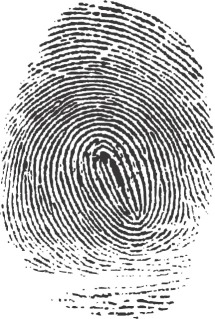
A fingerprint is an impression left by the friction ridges of a human finger. The recovery of partial fingerprints from a crime scene is an important method of forensic science. Moisture and grease on a finger result in fingerprints on surfaces such as glass or metal. Deliberate impressions of entire fingerprints can be obtained by ink or other substances transferred from the peaks of friction ridges on the skin to a smooth surface such as paper. Fingerprint records normally contain impressions from the pad on the last joint of fingers and thumbs, though fingerprint cards also typically record portions of lower joint areas of the fingers.
Human fingerprints are detailed, unique, difficult to alter, and durable over the life of an individual, making them suitable as long-term markers of human identity. They may be employed by police or other authorities to identify individuals who wish to conceal their identity, or to identify people who are incapacitated or dead and thus unable to identify themselves, as in the aftermath of a natural disaster.
Their use as evidence has been challenged by academics, judges and the media. There are no uniform standards for point-counting methods, and academics have argued that the error rate in matching fingerprints has not been adequately studied and that fingerprint evidence has no secure statistical foundation. Research has been conducted into whether experts can objectively focus on feature information in fingerprints without being misled by extraneous information, such as context.
Fingerprints are impressions left on surfaces by the friction ridges on the finger of a human. The matching of two fingerprints is among the most widely used and most reliable biometric techniques. Fingerprint matching considers only the obvious features of a fingerprint.
The composition of fingerprints consists of water (95–99%), as well as organic and inorganic constituents. The organic component is made up of amino acids, proteins, glucose, lactase, urea, pyruvate, fatty acids and sterols. Inorganic ions such as chloride, sodium, potassium and iron are also present. Other contaminants such as oils found in cosmetics, drugs and their metabolites and food residues may be found in fingerprint residues.
A friction ridge is a raised portion of the epidermis on the digits (fingers and toes), the palm of the hand or the sole of the foot, consisting of one or more connected ridge units of friction ridge skin.[citation needed] These are sometimes known as "epidermal ridges" which are caused by the underlying interface between the dermal papillae of the dermis and the interpapillary (rete) pegs of the epidermis. These unique features are formed at around the 15th week of fetal development and remain until after death, when decomposition begins. During the development of the fetus, around the 13th week of a pregnancy, ledge-like formation is formed at the bottom of the epidermis beside the dermis. The cells along these ledges begin to rapidly proliferate. This rapid proliferation forms primary and secondary ridges. Both the primary and secondary ridges act as a template for the outer layer of the skin to form the friction ridges seen on the surface of the skin.
These epidermal ridges serve to amplify vibrations triggered, for example, when fingertips brush across an uneven surface, better transmitting the signals to sensory nerves involved in fine texture perception. Although it seems unlikely that fingerprints increase gripping surfaces in general, the ridges may assist in gripping rough surfaces and may improve surface contact in wet conditions.
Consensus within the scientific community suggests that the dermatoglyphic patterns on fingertips are hereditary. The fingerprint patterns between monozygotic twins have been shown to be very similar (though not identical), whereas dizygotic twins have considerably less similarity. Significant heritability has been identified for 12 dermatoglyphic characteristics. Current models of dermatoglyphic trait inheritance suggest Mendelian transmission with additional effects from either additive or dominant major genes.
Hub AI
Fingerprint AI simulator
(@Fingerprint_simulator)
Fingerprint
A fingerprint is an impression left by the friction ridges of a human finger. The recovery of partial fingerprints from a crime scene is an important method of forensic science. Moisture and grease on a finger result in fingerprints on surfaces such as glass or metal. Deliberate impressions of entire fingerprints can be obtained by ink or other substances transferred from the peaks of friction ridges on the skin to a smooth surface such as paper. Fingerprint records normally contain impressions from the pad on the last joint of fingers and thumbs, though fingerprint cards also typically record portions of lower joint areas of the fingers.
Human fingerprints are detailed, unique, difficult to alter, and durable over the life of an individual, making them suitable as long-term markers of human identity. They may be employed by police or other authorities to identify individuals who wish to conceal their identity, or to identify people who are incapacitated or dead and thus unable to identify themselves, as in the aftermath of a natural disaster.
Their use as evidence has been challenged by academics, judges and the media. There are no uniform standards for point-counting methods, and academics have argued that the error rate in matching fingerprints has not been adequately studied and that fingerprint evidence has no secure statistical foundation. Research has been conducted into whether experts can objectively focus on feature information in fingerprints without being misled by extraneous information, such as context.
Fingerprints are impressions left on surfaces by the friction ridges on the finger of a human. The matching of two fingerprints is among the most widely used and most reliable biometric techniques. Fingerprint matching considers only the obvious features of a fingerprint.
The composition of fingerprints consists of water (95–99%), as well as organic and inorganic constituents. The organic component is made up of amino acids, proteins, glucose, lactase, urea, pyruvate, fatty acids and sterols. Inorganic ions such as chloride, sodium, potassium and iron are also present. Other contaminants such as oils found in cosmetics, drugs and their metabolites and food residues may be found in fingerprint residues.
A friction ridge is a raised portion of the epidermis on the digits (fingers and toes), the palm of the hand or the sole of the foot, consisting of one or more connected ridge units of friction ridge skin.[citation needed] These are sometimes known as "epidermal ridges" which are caused by the underlying interface between the dermal papillae of the dermis and the interpapillary (rete) pegs of the epidermis. These unique features are formed at around the 15th week of fetal development and remain until after death, when decomposition begins. During the development of the fetus, around the 13th week of a pregnancy, ledge-like formation is formed at the bottom of the epidermis beside the dermis. The cells along these ledges begin to rapidly proliferate. This rapid proliferation forms primary and secondary ridges. Both the primary and secondary ridges act as a template for the outer layer of the skin to form the friction ridges seen on the surface of the skin.
These epidermal ridges serve to amplify vibrations triggered, for example, when fingertips brush across an uneven surface, better transmitting the signals to sensory nerves involved in fine texture perception. Although it seems unlikely that fingerprints increase gripping surfaces in general, the ridges may assist in gripping rough surfaces and may improve surface contact in wet conditions.
Consensus within the scientific community suggests that the dermatoglyphic patterns on fingertips are hereditary. The fingerprint patterns between monozygotic twins have been shown to be very similar (though not identical), whereas dizygotic twins have considerably less similarity. Significant heritability has been identified for 12 dermatoglyphic characteristics. Current models of dermatoglyphic trait inheritance suggest Mendelian transmission with additional effects from either additive or dominant major genes.