
Recent from talks
First-order partial differential equation
Knowledge base stats:
Talk channels stats:
Members stats:
First-order partial differential equation
In mathematics, a first-order partial differential equation is a partial differential equation that involves the first derivatives of an unknown function of variables. The equation takes the form using subscript notation to denote the partial derivatives of .


Such equations arise in the construction of characteristic surfaces for hyperbolic partial differential equations, in the calculus of variations, in some geometrical problems, and in simple models for gas dynamics whose solution involves the method of characteristics, e.g., the advection equation. If a family of solutions of a single first-order partial differential equation can be found, then additional solutions may be obtained by forming envelopes of solutions in that family. In a related procedure, general solutions may be obtained by integrating families of ordinary differential equations.
The general solution to the first order partial differential equation is a solution which contains an arbitrary function. But, the solution to the first order partial differential equations with as many arbitrary constants as the number of independent variables is called the complete integral. The following n-parameter family of solutions
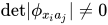
is a complete integral if . The below discussions on the type of integrals are based on the textbook A Treatise on Differential Equations (Chaper IX, 6th edition, 1928) by Andrew Forsyth.
The solutions are described in relatively simple manner in two or three dimensions with which the key concepts are trivially extended to higher dimensions. A general first-order partial differential equation in three dimensions has the form
where Suppose be the complete integral that contains three arbitrary constants . From this we can obtain three relations by differentiation



Along with the complete integral , the above three relations can be used to eliminate three constants and obtain an equation (original partial differential equation) relating . Note that the elimination of constants leading to the partial differential equation need not be unique, i.e., two different equations can result in the same complete integral, for example, elimination of constants from the relation leads to and .





Once a complete integral is found, a general solution can be constructed from it. The general integral is obtained by making the constants functions of the coordinates, i.e., . These functions are chosen such that the forms of are unaltered so that the elimination process from complete integral can be utilized. Differentiation of the complete integral now provides


Hub AI
First-order partial differential equation AI simulator
(@First-order partial differential equation_simulator)
First-order partial differential equation
In mathematics, a first-order partial differential equation is a partial differential equation that involves the first derivatives of an unknown function of variables. The equation takes the form using subscript notation to denote the partial derivatives of .
Such equations arise in the construction of characteristic surfaces for hyperbolic partial differential equations, in the calculus of variations, in some geometrical problems, and in simple models for gas dynamics whose solution involves the method of characteristics, e.g., the advection equation. If a family of solutions of a single first-order partial differential equation can be found, then additional solutions may be obtained by forming envelopes of solutions in that family. In a related procedure, general solutions may be obtained by integrating families of ordinary differential equations.
The general solution to the first order partial differential equation is a solution which contains an arbitrary function. But, the solution to the first order partial differential equations with as many arbitrary constants as the number of independent variables is called the complete integral. The following n-parameter family of solutions
is a complete integral if . The below discussions on the type of integrals are based on the textbook A Treatise on Differential Equations (Chaper IX, 6th edition, 1928) by Andrew Forsyth.
The solutions are described in relatively simple manner in two or three dimensions with which the key concepts are trivially extended to higher dimensions. A general first-order partial differential equation in three dimensions has the form
where Suppose be the complete integral that contains three arbitrary constants . From this we can obtain three relations by differentiation
Along with the complete integral , the above three relations can be used to eliminate three constants and obtain an equation (original partial differential equation) relating . Note that the elimination of constants leading to the partial differential equation need not be unique, i.e., two different equations can result in the same complete integral, for example, elimination of constants from the relation leads to and .
Once a complete integral is found, a general solution can be constructed from it. The general integral is obtained by making the constants functions of the coordinates, i.e., . These functions are chosen such that the forms of are unaltered so that the elimination process from complete integral can be utilized. Differentiation of the complete integral now provides