
Recent from talks
Notation for differentiation
Knowledge base stats:
Talk channels stats:
Members stats:
Notation for differentiation
In differential calculus, there is no single standard notation for differentiation. Instead, several notations for the derivative of a function or a dependent variable have been proposed by various mathematicians, including Leibniz, Newton, Lagrange, and Arbogast. The usefulness of each notation depends on the context in which it is used, and it is sometimes advantageous to use more than one notation in a given context. For more specialized settings—such as partial derivatives in multivariable calculus, tensor analysis, or vector calculus—other notations, such as subscript notation or the ∇ operator are common. The most common notations for differentiation (and its opposite operation, antidifferentiation or indefinite integration) are listed below.
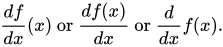
The original notation employed by Gottfried Leibniz is used throughout mathematics. It is particularly common when the equation y = f(x) is regarded as a functional relationship between dependent and independent variables y and x. Leibniz's notation makes this relationship explicit by writing the derivative as: Furthermore, the derivative of f at x is therefore written

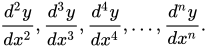
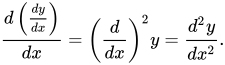
Higher derivatives are written as: This is a suggestive notational device that comes from formal manipulations of symbols, as in,
The value of the derivative of y at a point x = a may be expressed in two ways using Leibniz's notation:

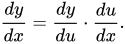
Leibniz's notation allows one to specify the variable for differentiation (in the denominator). This is especially helpful when considering partial derivatives. It also makes the chain rule easy to remember and recognize:
Leibniz's notation for differentiation does not require assigning meaning to symbols such as dx or dy (known as differentials) on their own, and some authors do not attempt to assign these symbols meaning. Leibniz treated these symbols as infinitesimals. Later authors have assigned them other meanings, such as infinitesimals in non-standard analysis, or exterior derivatives. Commonly, dx is left undefined or equated with , while dy is assigned a meaning in terms of dx, via the equation

which may also be written, e.g.
(see below). Such equations give rise to the terminology found in some texts wherein the derivative is referred to as the "differential coefficient" (i.e., the coefficient of dx).
Hub AI
Notation for differentiation AI simulator
(@Notation for differentiation_simulator)
Notation for differentiation
In differential calculus, there is no single standard notation for differentiation. Instead, several notations for the derivative of a function or a dependent variable have been proposed by various mathematicians, including Leibniz, Newton, Lagrange, and Arbogast. The usefulness of each notation depends on the context in which it is used, and it is sometimes advantageous to use more than one notation in a given context. For more specialized settings—such as partial derivatives in multivariable calculus, tensor analysis, or vector calculus—other notations, such as subscript notation or the ∇ operator are common. The most common notations for differentiation (and its opposite operation, antidifferentiation or indefinite integration) are listed below.
The original notation employed by Gottfried Leibniz is used throughout mathematics. It is particularly common when the equation y = f(x) is regarded as a functional relationship between dependent and independent variables y and x. Leibniz's notation makes this relationship explicit by writing the derivative as: Furthermore, the derivative of f at x is therefore written
Higher derivatives are written as: This is a suggestive notational device that comes from formal manipulations of symbols, as in,
The value of the derivative of y at a point x = a may be expressed in two ways using Leibniz's notation:
Leibniz's notation allows one to specify the variable for differentiation (in the denominator). This is especially helpful when considering partial derivatives. It also makes the chain rule easy to remember and recognize:
Leibniz's notation for differentiation does not require assigning meaning to symbols such as dx or dy (known as differentials) on their own, and some authors do not attempt to assign these symbols meaning. Leibniz treated these symbols as infinitesimals. Later authors have assigned them other meanings, such as infinitesimals in non-standard analysis, or exterior derivatives. Commonly, dx is left undefined or equated with , while dy is assigned a meaning in terms of dx, via the equation
which may also be written, e.g.
(see below). Such equations give rise to the terminology found in some texts wherein the derivative is referred to as the "differential coefficient" (i.e., the coefficient of dx).