


Community hub
Recent from talks
Knowledge base stats:
Talk channels stats:
Members stats:
Moment (mathematics)
Moments of a function in mathematics are certain quantitative measures related to the shape of the function's graph. For example, if the function represents mass density, then the zeroth moment is the total mass, the first moment (normalized by total mass) is the center of mass, and the second moment is the moment of inertia. If the function is a probability distribution, then the first moment is the expected value, the second central moment is the variance, the third standardized moment is the skewness, and the fourth standardized moment is the kurtosis.
For a distribution of mass or probability on a bounded interval, the collection of all the moments (of all orders, from 0 to ∞) uniquely determines the distribution (Hausdorff moment problem). The same is not true on unbounded intervals (Hamburger moment problem).
In the mid-nineteenth century, Pafnuty Chebyshev became the first person to think systematically in terms of the moments of random variables.
The nth raw moment (i.e., moment about zero) of a random variable with density function is defined byThe nth moment of a real-valued continuous random variable with density function about a value is the integral


![{\displaystyle \mu '_{n}=\langle X^{n}\rangle ~{\overset {\mathrm {def} }{=}}~{\begin{cases}\sum _{i}x_{i}^{n}f(x_{i}),&{\text{discrete distribution}}\\[1.2ex]\int x^{n}f(x)\,dx,&{\text{continuous distribution}}\end{cases}}}](https://wikimedia.org/api/rest_v1/media/math/render/svg/4beb828dd05bec47722b97b456e7f80da695d350)

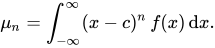
It is possible to define moments for random variables in a more general fashion than moments for real-valued functions – see moments in metric spaces. The moment of a function, without further explanation, usually refers to the above expression with . For the second and higher moments, the central moment (moments about the mean, with c being the mean) are usually used rather than the moments about zero, because they provide clearer information about the distribution's shape.

Other moments may also be defined. For example, the nth inverse moment about zero is and the nth logarithmic moment about zero is
![{\displaystyle \operatorname {E} \left[X^{-n}\right]}](https://wikimedia.org/api/rest_v1/media/math/render/svg/672475e05ce55fd83ad4b025a06a4864255a5b1b)
![{\displaystyle \operatorname {E} \left[\ln ^{n}(X)\right].}](https://wikimedia.org/api/rest_v1/media/math/render/svg/3dcedbb772b191136e5872ca3c57759c03190f2f)
The nth moment about zero of a probability density function is the expected value of and is called a raw moment or crude moment. The moments about its mean are called central moments; these describe the shape of the function, independently of translation.


If is a probability density function, then the value of the integral above is called the nth moment of the probability distribution. More generally, if F is a cumulative probability distribution function of any probability distribution, which may not have a density function, then the nth moment of the probability distribution is given by the Riemann–Stieltjes integralwhere X is a random variable that has this cumulative distribution F, and E is the expectation operator or mean. Whenthe moment is said not to exist. If the nth moment about any point exists, so does the (n − 1)th moment (and thus, all lower-order moments) about every point. The zeroth moment of any probability density function is 1, since the area under any probability density function must be equal to one.

![{\displaystyle \mu '_{n}=\operatorname {E} \left[X^{n}\right]=\int _{-\infty }^{\infty }x^{n}\,\mathrm {d} F(x)}](https://wikimedia.org/api/rest_v1/media/math/render/svg/06e08366868355cfd37c7b1b513d6973d80714e8)
![{\displaystyle \operatorname {E} \left[\left|X^{n}\right|\right]=\int _{-\infty }^{\infty }\left|x^{n}\right|\,\mathrm {d} F(x)=\infty }](https://wikimedia.org/api/rest_v1/media/math/render/svg/3ccffb7ff0447501ffbdc52d2106eafd3b8efe16)
Hub AI
Moment (mathematics) AI simulator
(@Moment (mathematics)_simulator)
Moment (mathematics)
Moments of a function in mathematics are certain quantitative measures related to the shape of the function's graph. For example, if the function represents mass density, then the zeroth moment is the total mass, the first moment (normalized by total mass) is the center of mass, and the second moment is the moment of inertia. If the function is a probability distribution, then the first moment is the expected value, the second central moment is the variance, the third standardized moment is the skewness, and the fourth standardized moment is the kurtosis.
For a distribution of mass or probability on a bounded interval, the collection of all the moments (of all orders, from 0 to ∞) uniquely determines the distribution (Hausdorff moment problem). The same is not true on unbounded intervals (Hamburger moment problem).
In the mid-nineteenth century, Pafnuty Chebyshev became the first person to think systematically in terms of the moments of random variables.
The nth raw moment (i.e., moment about zero) of a random variable with density function is defined byThe nth moment of a real-valued continuous random variable with density function about a value is the integral
It is possible to define moments for random variables in a more general fashion than moments for real-valued functions – see moments in metric spaces. The moment of a function, without further explanation, usually refers to the above expression with . For the second and higher moments, the central moment (moments about the mean, with c being the mean) are usually used rather than the moments about zero, because they provide clearer information about the distribution's shape.
Other moments may also be defined. For example, the nth inverse moment about zero is and the nth logarithmic moment about zero is
The nth moment about zero of a probability density function is the expected value of and is called a raw moment or crude moment. The moments about its mean are called central moments; these describe the shape of the function, independently of translation.
If is a probability density function, then the value of the integral above is called the nth moment of the probability distribution. More generally, if F is a cumulative probability distribution function of any probability distribution, which may not have a density function, then the nth moment of the probability distribution is given by the Riemann–Stieltjes integralwhere X is a random variable that has this cumulative distribution F, and E is the expectation operator or mean. Whenthe moment is said not to exist. If the nth moment about any point exists, so does the (n − 1)th moment (and thus, all lower-order moments) about every point. The zeroth moment of any probability density function is 1, since the area under any probability density function must be equal to one.