
Recent from talks
Kurtosis
Knowledge base stats:
Talk channels stats:
Members stats:
Kurtosis
Kurtosis (from Greek: κυρτός (kyrtos or kurtos), meaning 'curved, arching') refers to the degree of tailedness in the probability distribution of a real-valued, random variable in probability theory and statistics. Similar to skewness, kurtosis provides insight into specific characteristics of a distribution. Various methods exist for quantifying kurtosis in theoretical distributions, and corresponding techniques allow estimation based on sample data from a population. It is important to note that different measures of kurtosis can yield varying interpretations.
The standard measure of a distribution's kurtosis, originating with Karl Pearson, is a scaled version of the fourth moment of the distribution. This number is related to the tails of the distribution, not its peak; hence, the sometimes-seen characterization of kurtosis as peakedness is incorrect. For this measure, higher kurtosis corresponds to greater extremity of deviations (or outliers), and not the configuration of data near the mean.
Excess kurtosis, typically compared to a value of 0, characterizes the tailedness of a distribution. A univariate normal distribution has an excess kurtosis of 0. Negative excess kurtosis indicates a platykurtic distribution, which does not necessarily have a flat top but produces fewer or less extreme outliers than the normal distribution. For instance, the uniform distribution (i.e. one that is uniformly finite over some bound and zero elsewhere) is platykurtic. On the other hand, positive excess kurtosis signifies a leptokurtic distribution. The Laplace distribution for example, has tails that decay more slowly than a normal one, resulting in more outliers. To simplify comparison with the normal distribution, excess kurtosis is calculated as Pearson's kurtosis minus 3. Some authors and software packages use kurtosis to refer specifically to excess kurtosis, but this article distinguishes between the two for clarity.
Alternative measures of kurtosis are: the L-kurtosis, which is a scaled version of the fourth L-moment; measures based on four population or sample quantiles. These are analogous to the alternative measures of skewness that are not based on ordinary moments.
The kurtosis is the fourth standardized moment, defined as where μ4 is the fourth central moment and σ is the standard deviation. Several letters are used in the literature to denote the kurtosis. A very common choice is κ, which is fine as long as it is clear that it does not refer to a cumulant. Other choices include γ2, to be similar to the notation for skewness, although sometimes this is instead reserved for the excess kurtosis.
![{\displaystyle \operatorname {Kurt} [X]=\operatorname {E} \left[{\left({\frac {X-\mu }{\sigma }}\right)}^{4}\right]={\frac {\operatorname {E} \left[(X-\mu )^{4}\right]}{\left(\operatorname {E} \left[(X-\mu )^{2}\right]\right)^{2}}}={\frac {\mu _{4}}{\sigma ^{4}}},}](https://wikimedia.org/api/rest_v1/media/math/render/svg/9456e1620ebefcf9a5fe92384b4647aa4c8de0c0)
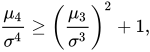
The kurtosis is bounded below by the squared skewness plus 1: where μ3 is the third central moment. The lower bound is realized by the Bernoulli distribution. There is no upper limit to the kurtosis of a general probability distribution, and it may be infinite.
A reason why some authors favor the excess kurtosis is that cumulants are extensive. Formulas related to the extensive property are more naturally expressed in terms of the excess kurtosis. For example, let X1, ..., Xn be independent random variables for which the fourth moment exists, and let Y be the random variable defined by the sum of the Xi. The excess kurtosis of Y iswhere is the standard deviation of Xi. In particular if all of the Xi have the same variance, then this simplifies to
![{\displaystyle \operatorname {Kurt} [Y]-3={\frac {1}{\left(\sum _{j=1}^{n}\sigma _{j}^{\,2}\right)^{2}}}\sum _{i=1}^{n}\sigma _{i}^{\,4}\cdot \left(\operatorname {Kurt} \left[X_{i}\right]-3\right),}](https://wikimedia.org/api/rest_v1/media/math/render/svg/8f295e334581a6f264d3ca40bf75df3293fb0f3e)

![{\displaystyle \operatorname {Kurt} [Y]-3={\frac {1}{n^{2}}}\sum _{i=1}^{n}\left(\operatorname {Kurt} \left[X_{i}\right]-3\right).}](https://wikimedia.org/api/rest_v1/media/math/render/svg/ab58bd1318d6a5b2e8619fc252545752b5228122)
The reason not to subtract 3 is that the bare moment better generalizes to multivariate distributions, especially when independence is not assumed. The cokurtosis between pairs of variables is an order four tensor. For a bivariate normal distribution, the cokurtosis tensor has off-diagonal terms that are neither 0 nor 3 in general, so attempting to "correct" for an excess becomes confusing. It is true, however, that the joint cumulants of degree greater than two for any multivariate normal distribution are zero.
Hub AI
Kurtosis AI simulator
(@Kurtosis_simulator)
Kurtosis
Kurtosis (from Greek: κυρτός (kyrtos or kurtos), meaning 'curved, arching') refers to the degree of tailedness in the probability distribution of a real-valued, random variable in probability theory and statistics. Similar to skewness, kurtosis provides insight into specific characteristics of a distribution. Various methods exist for quantifying kurtosis in theoretical distributions, and corresponding techniques allow estimation based on sample data from a population. It is important to note that different measures of kurtosis can yield varying interpretations.
The standard measure of a distribution's kurtosis, originating with Karl Pearson, is a scaled version of the fourth moment of the distribution. This number is related to the tails of the distribution, not its peak; hence, the sometimes-seen characterization of kurtosis as peakedness is incorrect. For this measure, higher kurtosis corresponds to greater extremity of deviations (or outliers), and not the configuration of data near the mean.
Excess kurtosis, typically compared to a value of 0, characterizes the tailedness of a distribution. A univariate normal distribution has an excess kurtosis of 0. Negative excess kurtosis indicates a platykurtic distribution, which does not necessarily have a flat top but produces fewer or less extreme outliers than the normal distribution. For instance, the uniform distribution (i.e. one that is uniformly finite over some bound and zero elsewhere) is platykurtic. On the other hand, positive excess kurtosis signifies a leptokurtic distribution. The Laplace distribution for example, has tails that decay more slowly than a normal one, resulting in more outliers. To simplify comparison with the normal distribution, excess kurtosis is calculated as Pearson's kurtosis minus 3. Some authors and software packages use kurtosis to refer specifically to excess kurtosis, but this article distinguishes between the two for clarity.
Alternative measures of kurtosis are: the L-kurtosis, which is a scaled version of the fourth L-moment; measures based on four population or sample quantiles. These are analogous to the alternative measures of skewness that are not based on ordinary moments.
The kurtosis is the fourth standardized moment, defined as where μ4 is the fourth central moment and σ is the standard deviation. Several letters are used in the literature to denote the kurtosis. A very common choice is κ, which is fine as long as it is clear that it does not refer to a cumulant. Other choices include γ2, to be similar to the notation for skewness, although sometimes this is instead reserved for the excess kurtosis.
The kurtosis is bounded below by the squared skewness plus 1: where μ3 is the third central moment. The lower bound is realized by the Bernoulli distribution. There is no upper limit to the kurtosis of a general probability distribution, and it may be infinite.
A reason why some authors favor the excess kurtosis is that cumulants are extensive. Formulas related to the extensive property are more naturally expressed in terms of the excess kurtosis. For example, let X1, ..., Xn be independent random variables for which the fourth moment exists, and let Y be the random variable defined by the sum of the Xi. The excess kurtosis of Y iswhere is the standard deviation of Xi. In particular if all of the Xi have the same variance, then this simplifies to
The reason not to subtract 3 is that the bare moment better generalizes to multivariate distributions, especially when independence is not assumed. The cokurtosis between pairs of variables is an order four tensor. For a bivariate normal distribution, the cokurtosis tensor has off-diagonal terms that are neither 0 nor 3 in general, so attempting to "correct" for an excess becomes confusing. It is true, however, that the joint cumulants of degree greater than two for any multivariate normal distribution are zero.