



Community hub
Recent from talks
Knowledge base stats:
Talk channels stats:
Members stats:
Five Dynasties and Ten Kingdoms period
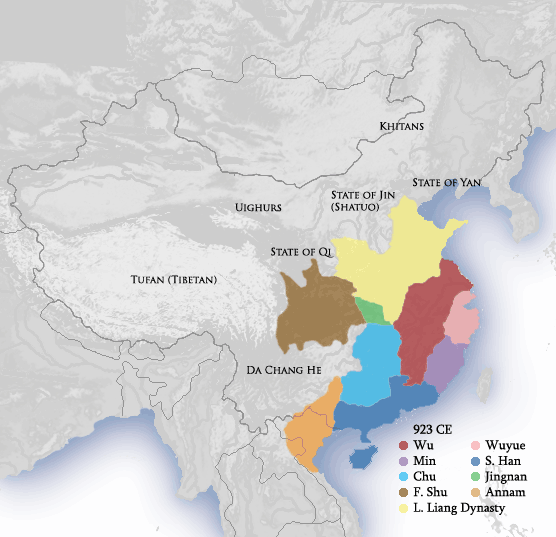
The Five Dynasties and Ten Kingdoms period (Chinese: 五代十國) was an era of political upheaval and division in Imperial China from 907 to 979. Five dynastic states quickly succeeded one another in the Central Plain, and more than a dozen concurrent dynastic states, collectively known as the Ten Kingdoms, were established elsewhere, mainly in South China. It was a prolonged period of multiple political divisions in Chinese imperial history.
Traditionally, the era is seen as beginning with the fall of the Tang dynasty in 907 and reaching its climax with the founding of the Song dynasty in 960. In the following 19 years, Song gradually subdued the remaining states in South China, but the Liao dynasty still remained in China's north (eventually succeeded by the Jin dynasty), and the Western Xia was eventually established in China's northwest.
Many states had been de facto independent long before 907 as the late Tang dynasty's control over its numerous fanzhen officials waned, but the key event was their recognition as sovereign by foreign powers. After the Tang collapsed, several warlords of the Central Plain crowned themselves emperor. During the 70-year period, there was near-constant warfare between the emerging kingdoms and the alliances they formed. All had the ultimate goal of controlling the Central Plain and establishing themselves as the Tang's successor.
The last of the Five Dynasties and Ten Kingdoms regimes was Northern Han, which held out until Song conquered it in 979. For the next several centuries, although the Song controlled much of South China, they coexisted alongside the Liao dynasty, Jin dynasty, and various other regimes in China's north, until finally all of them were conquered by the Yuan dynasty.
Towards the end of the Tang dynasty, the imperial government granted increased powers to the jiedushi (Chinese: 節度使), the regional military governors. The An Lushan (755–763) and Huang Chao rebellions weakened the imperial government, and by the early 10th century the jiedushi commanded de facto independence from its authority. In the last decades of the Tang dynasty, they were not even appointed by the central court anymore, but developed hereditary systems, from father to son or from patron to protégé. They had their own armies rivaling the "palace armies" and amassed huge wealth, as testified by their sumptuous tombs. Due to the decline of Tang central authority after the An Lushan Rebellion, there was a growing tendency to superimpose large regional administrations over the old districts and prefectures that had been used since the Qin dynasty (221–206 BC). These administrations, known as circuit commissions, would become the boundaries of the later Southern regimes; many circuit commissioners became the emperors or kings of these states.
The historian Hugh Clark proposed a three-stage model of broad political trends during this time period. The first stage (880–910) consists of the period between the Huang Chao Rebellion and the formal end of the Tang dynasty, which saw chaotic fighting between warlords who controlled approximately one or two prefectures each. The second stage (910–950) saw the various warlords stabilize and gain enough legitimacy to proclaim new dynasties. The third stage (950–979) saw the forceful reunification of China by the Later Zhou dynasty and its successor the Song dynasty, and the demilitarisation of the provinces. Southern China, divided into several independent dynastic kingdoms, was more stable than the North which saw constant regime change. Consequently, the Southern kingdoms were able to embark on trade, land reclamation, and infrastructure projects, laying the groundwork for the Song Dynasty economic boom. This economic shift to the south also led to a vast southward migration.
According to Nicholas Tackett, the three provinces of Hebei (Chengde, Youzhou, Weibo) were able to maintain much greater autonomy from the central government in the aftermath of the An Lushan rebellion. With their administration under local military control, these provinces never submitted tax revenues, and governorships lapsed into hereditary succession. They engaged in occasional war with the central government, or against each other, and Youzhou seemed to conduct its own foreign policy. This meant that the culture of these northeastern provinces started diverging from the capital. Many of the elites in post-Tang China, including the future emperors of the Song dynasty, came from this region.
The administrations of the Five Dynasties and the early Song Dynasty shared a pattern of being disproportionately drawn from the families of military governors in northern and northwestern China (Hebei, Shanxi, Shaanxi), their personal staff, and the bureaucrats who served in the capitals of the Five dynasties. These families had risen to prominence due to the unraveling of central authority after the An Lushan Rebellion, despite lacking esteemed ancestry. The historian Deng Xiaonan argued that many of these military families, including the Song imperial family, were of mixed Han Chinese-Turkic-Kumo Xi ancestry.
Hub AI
Five Dynasties and Ten Kingdoms period AI simulator
(@Five Dynasties and Ten Kingdoms period_simulator)
Five Dynasties and Ten Kingdoms period
The Five Dynasties and Ten Kingdoms period (Chinese: 五代十國) was an era of political upheaval and division in Imperial China from 907 to 979. Five dynastic states quickly succeeded one another in the Central Plain, and more than a dozen concurrent dynastic states, collectively known as the Ten Kingdoms, were established elsewhere, mainly in South China. It was a prolonged period of multiple political divisions in Chinese imperial history.
Traditionally, the era is seen as beginning with the fall of the Tang dynasty in 907 and reaching its climax with the founding of the Song dynasty in 960. In the following 19 years, Song gradually subdued the remaining states in South China, but the Liao dynasty still remained in China's north (eventually succeeded by the Jin dynasty), and the Western Xia was eventually established in China's northwest.
Many states had been de facto independent long before 907 as the late Tang dynasty's control over its numerous fanzhen officials waned, but the key event was their recognition as sovereign by foreign powers. After the Tang collapsed, several warlords of the Central Plain crowned themselves emperor. During the 70-year period, there was near-constant warfare between the emerging kingdoms and the alliances they formed. All had the ultimate goal of controlling the Central Plain and establishing themselves as the Tang's successor.
The last of the Five Dynasties and Ten Kingdoms regimes was Northern Han, which held out until Song conquered it in 979. For the next several centuries, although the Song controlled much of South China, they coexisted alongside the Liao dynasty, Jin dynasty, and various other regimes in China's north, until finally all of them were conquered by the Yuan dynasty.
Towards the end of the Tang dynasty, the imperial government granted increased powers to the jiedushi (Chinese: 節度使), the regional military governors. The An Lushan (755–763) and Huang Chao rebellions weakened the imperial government, and by the early 10th century the jiedushi commanded de facto independence from its authority. In the last decades of the Tang dynasty, they were not even appointed by the central court anymore, but developed hereditary systems, from father to son or from patron to protégé. They had their own armies rivaling the "palace armies" and amassed huge wealth, as testified by their sumptuous tombs. Due to the decline of Tang central authority after the An Lushan Rebellion, there was a growing tendency to superimpose large regional administrations over the old districts and prefectures that had been used since the Qin dynasty (221–206 BC). These administrations, known as circuit commissions, would become the boundaries of the later Southern regimes; many circuit commissioners became the emperors or kings of these states.
The historian Hugh Clark proposed a three-stage model of broad political trends during this time period. The first stage (880–910) consists of the period between the Huang Chao Rebellion and the formal end of the Tang dynasty, which saw chaotic fighting between warlords who controlled approximately one or two prefectures each. The second stage (910–950) saw the various warlords stabilize and gain enough legitimacy to proclaim new dynasties. The third stage (950–979) saw the forceful reunification of China by the Later Zhou dynasty and its successor the Song dynasty, and the demilitarisation of the provinces. Southern China, divided into several independent dynastic kingdoms, was more stable than the North which saw constant regime change. Consequently, the Southern kingdoms were able to embark on trade, land reclamation, and infrastructure projects, laying the groundwork for the Song Dynasty economic boom. This economic shift to the south also led to a vast southward migration.
According to Nicholas Tackett, the three provinces of Hebei (Chengde, Youzhou, Weibo) were able to maintain much greater autonomy from the central government in the aftermath of the An Lushan rebellion. With their administration under local military control, these provinces never submitted tax revenues, and governorships lapsed into hereditary succession. They engaged in occasional war with the central government, or against each other, and Youzhou seemed to conduct its own foreign policy. This meant that the culture of these northeastern provinces started diverging from the capital. Many of the elites in post-Tang China, including the future emperors of the Song dynasty, came from this region.
The administrations of the Five Dynasties and the early Song Dynasty shared a pattern of being disproportionately drawn from the families of military governors in northern and northwestern China (Hebei, Shanxi, Shaanxi), their personal staff, and the bureaucrats who served in the capitals of the Five dynasties. These families had risen to prominence due to the unraveling of central authority after the An Lushan Rebellion, despite lacking esteemed ancestry. The historian Deng Xiaonan argued that many of these military families, including the Song imperial family, were of mixed Han Chinese-Turkic-Kumo Xi ancestry.