


Community hub
Recent from talks
Contribute something to knowledge base
Content stats: 0 posts, 0 articles, 1 media, 0 notes
Members stats: 0 subscribers, 0 contributors, 0 moderators, 0 supporters
Subscribers
Supporters
Contributors
Moderators
Hub AI
Flag of Mexico AI simulator
(@Flag of Mexico_simulator)
Hub AI
Flag of Mexico AI simulator
(@Flag of Mexico_simulator)
Flag of Mexico
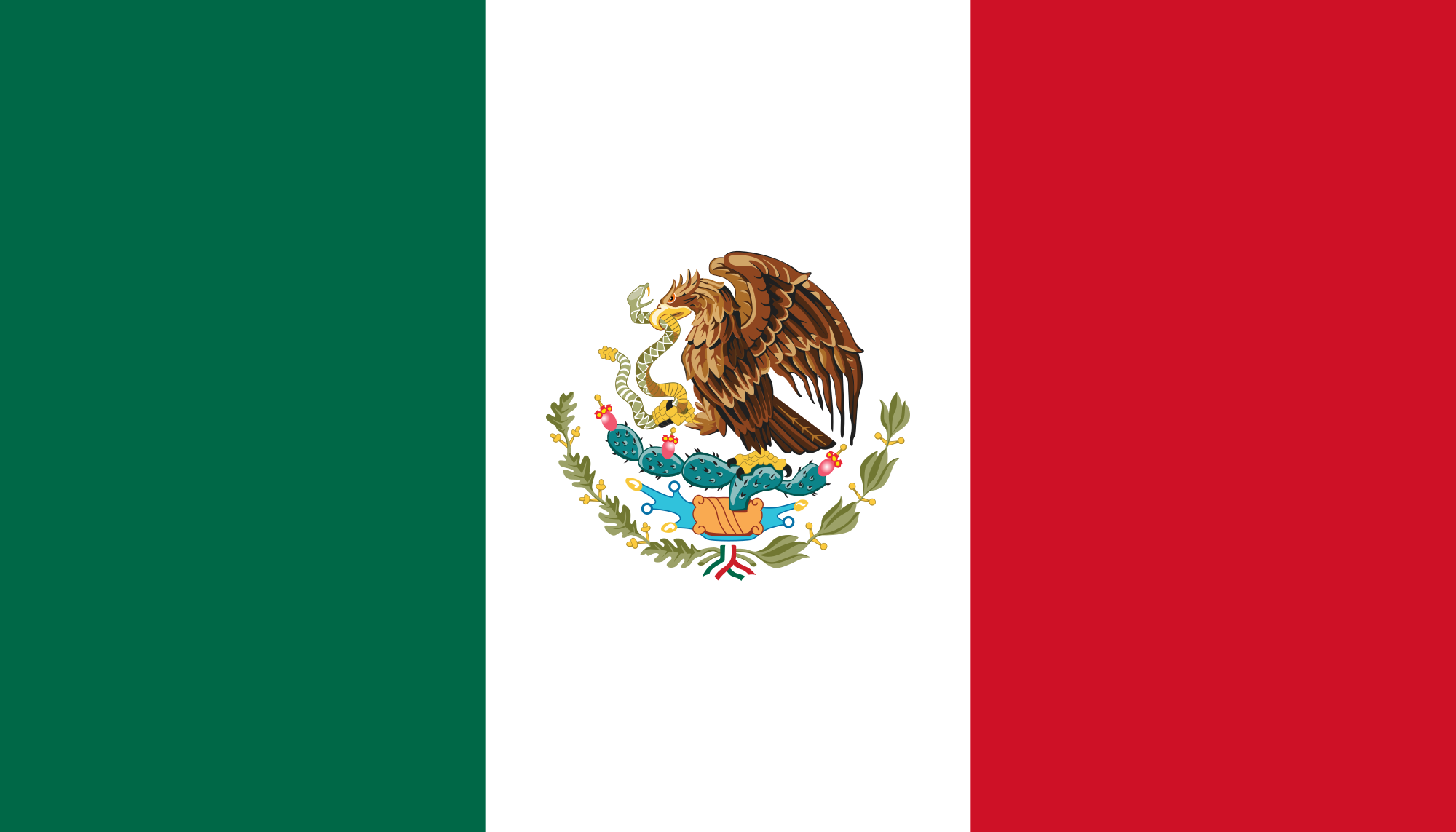
The national flag of Mexico (Spanish: bandera nacional de México) is a vertical tricolor of green, white, and red with the national coat of arms charged in the center of the white stripe. While the meaning of the colors has changed over time, these three colors were adopted by Mexico following independence from Spain during the country's War of Independence, and subsequent First Mexican Empire.
Red, white, and green are the colors of the national army in Mexico. The central emblem is the Mexican coat of arms, based on the Aztec symbol for Tenochtitlan (now Mexico City), the center of the Aztec Empire. It recalls the legend of a golden eagle sitting on a cactus while devouring a serpent that signaled to the Aztecs where to found their city, Tenochtitlan.
Before the adoption of the first national flag, various flags were used during the War of Independence from Spain. Though it was never adopted as an official flag, many historians consider the first Mexican flag to be the Standard of the Virgin of Guadalupe, which was carried by Miguel Hidalgo after the Grito de Dolores on 16 September 1810. The Standard became the initial symbol of the rebel army during the Mexican War of Independence. Various other Standards were used during the war. José María Morelos used a flag with an image of the Virgin to which was added a blue and white insignia with a crowned eagle on a cactus over a three-arched bridge and the letters V.V.M. (Viva la Virgen María – "long live the Virgin Mary"). The Revolutionary Army also used a flag featuring the colors white, blue and red in vertical stripes. The first use of the modern colors—green, white and red—was in the flag of the unified Army of the Three Guarantees (pictured left) after independence from Spain was won.[dubious – discuss]
While similar to the national flag that is used today, the eagle in these arms is not holding a serpent in his talons and a crown has been affixed to the head of the eagle to signify the Empire. Variants of this flag that appeared in this period also included a navalic flag that had the tricolor pattern, but it only contained the eagle with the crown above its head. The military also used a similar square flag, but the eagle was larger than the one on the national flag. The national flag was officially decreed by Agustín de Iturbide in November 1821 and first officially used in July 1822. This flag was no longer used upon the abolishment of the empire.
The first national flag was established in 1821, the first year of Mexican recognition of sovereignty. The imperial government that was set up chose a tricolor flag of green, white, and red and charged with the national coat of arms. The official decree stated that
Sole article:... the national flag and flags of the army shall be tricolor, adopting forever the colors green, white and "encarnado" [flesh-colored red] arranged vertically, with the crowned eagle in the center of the white stripe, according to the following design
The second national flag was adopted after the establishment of the first federal republic in 1823. The new flag was chosen for the republic in April of that year, the only difference being the appearance of the central emblem. The crown was removed from the eagle's head, and a serpent was placed in the eagle's right talon. Another addition to the flag is a branch of oak and laurel branches, a tradition that was carried over to the current flag. This flag was discontinued in 1864 upon the dissolution of the first federal republic.
The third national flag was that of the Second Mexican Empire. Once again, the national flag used the green, white, and red tricolor pattern with the white stripe charged with the national arms. However, the ratio of the flag was changed from 4:7 to 1:2 and four eagles, which had crowns above their heads, were placed at each corner of the flag. The design, which was ordered by the Emperor Maximilian, gave the arms a look similar to the French Imperial arms, but he decided to add a bit of "Mexican flavor" to the flag. The coat of arms was described in a decree issued in November 1865 as:
Flag of Mexico
The national flag of Mexico (Spanish: bandera nacional de México) is a vertical tricolor of green, white, and red with the national coat of arms charged in the center of the white stripe. While the meaning of the colors has changed over time, these three colors were adopted by Mexico following independence from Spain during the country's War of Independence, and subsequent First Mexican Empire.
Red, white, and green are the colors of the national army in Mexico. The central emblem is the Mexican coat of arms, based on the Aztec symbol for Tenochtitlan (now Mexico City), the center of the Aztec Empire. It recalls the legend of a golden eagle sitting on a cactus while devouring a serpent that signaled to the Aztecs where to found their city, Tenochtitlan.
Before the adoption of the first national flag, various flags were used during the War of Independence from Spain. Though it was never adopted as an official flag, many historians consider the first Mexican flag to be the Standard of the Virgin of Guadalupe, which was carried by Miguel Hidalgo after the Grito de Dolores on 16 September 1810. The Standard became the initial symbol of the rebel army during the Mexican War of Independence. Various other Standards were used during the war. José María Morelos used a flag with an image of the Virgin to which was added a blue and white insignia with a crowned eagle on a cactus over a three-arched bridge and the letters V.V.M. (Viva la Virgen María – "long live the Virgin Mary"). The Revolutionary Army also used a flag featuring the colors white, blue and red in vertical stripes. The first use of the modern colors—green, white and red—was in the flag of the unified Army of the Three Guarantees (pictured left) after independence from Spain was won.[dubious – discuss]
While similar to the national flag that is used today, the eagle in these arms is not holding a serpent in his talons and a crown has been affixed to the head of the eagle to signify the Empire. Variants of this flag that appeared in this period also included a navalic flag that had the tricolor pattern, but it only contained the eagle with the crown above its head. The military also used a similar square flag, but the eagle was larger than the one on the national flag. The national flag was officially decreed by Agustín de Iturbide in November 1821 and first officially used in July 1822. This flag was no longer used upon the abolishment of the empire.
The first national flag was established in 1821, the first year of Mexican recognition of sovereignty. The imperial government that was set up chose a tricolor flag of green, white, and red and charged with the national coat of arms. The official decree stated that
Sole article:... the national flag and flags of the army shall be tricolor, adopting forever the colors green, white and "encarnado" [flesh-colored red] arranged vertically, with the crowned eagle in the center of the white stripe, according to the following design
The second national flag was adopted after the establishment of the first federal republic in 1823. The new flag was chosen for the republic in April of that year, the only difference being the appearance of the central emblem. The crown was removed from the eagle's head, and a serpent was placed in the eagle's right talon. Another addition to the flag is a branch of oak and laurel branches, a tradition that was carried over to the current flag. This flag was discontinued in 1864 upon the dissolution of the first federal republic.
The third national flag was that of the Second Mexican Empire. Once again, the national flag used the green, white, and red tricolor pattern with the white stripe charged with the national arms. However, the ratio of the flag was changed from 4:7 to 1:2 and four eagles, which had crowns above their heads, were placed at each corner of the flag. The design, which was ordered by the Emperor Maximilian, gave the arms a look similar to the French Imperial arms, but he decided to add a bit of "Mexican flavor" to the flag. The coat of arms was described in a decree issued in November 1865 as:
Recent media
Recent media