


Community hub
Recent from talks
Contribute something
Nothing was collected or created yet.
Flame Nebula
View on Wikipedia| Emission nebula | |
|---|---|
 The Flame Nebula in visible light (broadband). The star above it is Alnitak. The nebulae to the upper left are IC 431 and IC 432. | |
| Observation data: J2000.0 epoch | |
| Right ascension | 05h 41m 54s |
| Declination | −01° 51′ 0.0″ |
| Distance | 1350[1] ly (415 pc) |
| Apparent magnitude (V) | 10 |
| Apparent dimensions (V) | 30'x30' |
| Constellation | Orion |
| Physical characteristics | |
| Radius | 6 ly |
| Designations | NGC 2024 and Sharpless 277 |
The Flame Nebula, designated as NGC 2024 and Sh2-277, is an emission nebula in the constellation Orion. It is about 1350 light-years away.[1] At that distance, the Flame Nebula lies within the Orion B cloud of the larger Orion Molecular Cloud Complex.
The bright star Alnitak (ζ Ori), the easternmost star in the Belt of Orion, appears very close to the Flame Nebula in the sky. But the star and nebula are not physically associated with one another. The Flame Nebula contains a young cluster of stars which includes at least one hot, luminous O-type star labeled IRS 2b.[2] The dense gas and dust in the foreground of the nebula heavily obscures the star cluster inside the nebula, making studies at infrared wavelengths most useful.
The energetic ultraviolet light emitted by the central O-type star IRS 2b into the Flame Nebula causes the gas to be excited and heated. The glow of the nebula results from the energy input from this central star. Within the nebula and surrounding the central hot star is a cluster of young, lower-mass stars,[3] 86% of which have circumstellar disks.[4] X-ray observations by the Chandra X-ray Observatory[5][6] show several hundred young stars, out of an estimated population of 800 stars.[7] X-ray and infrared images indicate that the young stars are concentrated near the center of the cluster.[8][9]

The Flame Nebula was observed with ALMA and this study found two populations, which are separated by a molecular cloud. The eastern population is 0.2-0.5 Myr old and has a disk fraction of 45±7%. The western population is slightly older at 1 Myr and has a lower disk fraction of 15±4%.[10] This disk fraction is lower than the one observed in the mid-infrared,[4] but the ALMA survey also observed a smaller region.[10] The eastern part contains the O8 star IRS 2b and the western part contains the B0.5V star IRS 1. Hubble observations have shown that the Flame Nebula contains 4 clear proplyds and 4 candidate proplyds. Three of these are in the older western region and are pointing towards IRS 1. The other 5 are in the younger eastern region and are pointing towards IRS 2b.[11]
Gallery
[edit]-
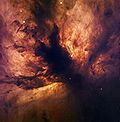 Optical image in B, V and R filters, from La Silla Observatory
 -
 Infrared image, from 2MASS
 -
 Near-infrared image, from VISTA
 -
 Visible light wide-field view of region of Orion's Belt and the Flame Nebula
 -
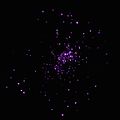 NGC 2024 seen by the Chandra X-ray Observatory
 -
 Flame Nebula and Horsehead Nebula
 -
 Horsehead and Flame Nebulae in H-alpha
 -
 The Flame Nebula (NGC 2024) - based on Chandra X-Ray and Spitzer Infrared images


References
[edit]- ^ a b Meyer, M. R.; et al. (2008). "Star Formation in NGC 2023, NGC 2024, and Southern L1630". In Reipurth, B. (ed.). Handbook of Star Forming Regions, Volume II: The Southern Sky ASP Monograph Publications. Vol. 5. Astronomical Society of the Pacific. p. 43. Bibcode:2008hsf1.book..662M. ISBN 978-1-58381-670-7.
- ^ Bik, A.; et al. (2003). "Identification of the ionizing source of NGC 2024". Astronomy & Astrophysics. 404 (1): 249–254. arXiv:astro-ph/0303029. Bibcode:2003A&A...404..249B. doi:10.1051/0004-6361:20030301.
- ^ Haisch, K. E. Jr.; Lada, E. A.; Lada, C. J. (2000). "A Near-Infrared L-Band Survey of the Young Embedded Cluster NGC 2024". Astronomical Journal. 120 (2): 1396–1409. arXiv:astro-ph/0006219. Bibcode:2000AJ....120.1396H. doi:10.1086/301521. S2CID 18143699.
- ^ a b Haisch, K. E. Jr.; et al. (2001). "A Mid-Infrared Study of the Young Stellar Population in the NGC 2024 Cluster". Astronomical Journal. 121 (3): 1512–1521. arXiv:astro-ph/0012482. Bibcode:2001AJ....121.1512H. doi:10.1086/319397. S2CID 1645511.
- ^ Skinner, S.; Gagné, M.; Belzer, E. (2003). "A Deep Chandra X-Ray Observation of the Embedded Young Cluster in NGC 2024". Astrophysical Journal. 598 (1): 375–391. arXiv:astro-ph/0306566. Bibcode:2003ApJ...598..375S. doi:10.1086/378085. S2CID 18798394.
- ^ Broos, P. S.; et al. (2013). "Identifying Young Stars in Massive Star-forming Regions for the MYStIX Project". Astrophysical Journal. 209 (2): 32. arXiv:1309.4500. Bibcode:2013ApJS..209...32B. doi:10.1088/0067-0049/209/2/32. S2CID 67827240.
- ^ Kuhn, M. A.; Getman, K. V.; Feigelson, E. D. (2015). "The Spatial Structure of Young Stellar Clusters. II. Total Young Stellar Populations". Astrophysical Journal. 802 (1): 60. arXiv:1501.05300. Bibcode:2015ApJ...802...60K. doi:10.1088/0004-637X/802/1/60. S2CID 119309858.
- ^ Getman, K. V.; Feigelson, E. D.; Kuhn, M. A. (2014). "Core-Halo Age Gradients and Star Formation in the Orion Nebula and NGC 2024 Young Stellar Clusters". Astrophysical Journal. 787 (2): 109. arXiv:1403.2742. Bibcode:2014ApJ...787..109G. doi:10.1088/0004-637X/787/2/109. S2CID 118503957.
- ^ Nemiroff, R.; Bonnell, J., eds. (10 May 2014). "Inside the Flame Nebula". Astronomy Picture of the Day. NASA. Retrieved February 14, 2015.
- ^ a b van Terwisga, S. E.; van Dishoeck, E. F.; Mann, R. K.; Di Francesco, J.; van der Marel, N.; Meyer, M.; Andrews, S. M.; Carpenter, J.; Eisner, J. A.; Manara, C. F.; Williams, J. P. (2020-08-01). "Protoplanetary disk masses in NGC 2024: Evidence for two populations". Astronomy and Astrophysics. 640: A27. arXiv:2004.13551. Bibcode:2020A&A...640A..27V. doi:10.1051/0004-6361/201937403. ISSN 0004-6361.
- ^ Haworth, Thomas; Jinyoung, Kim; Winter, Andrew; Hines, Dean; Clarke, Cathie; Sellek, Andrew; Ballabio, Giulia; Stapelfeldt, Karl (March 2021). "Proplyds in the flame nebula NGC 2024". Monthly Notices of the Royal Astronomical Society. 501 (3): 3502–3514. arXiv:2012.09166. doi:10.1093/mnras/staa3918.
External links
[edit]
- "NGC 2024". SIMBAD. Centre de données astronomiques de Strasbourg.
- Nemiroff, R.; Bonnell, J., eds. (13 July 1999). "The Flame Nebula in Infrared". Astronomy Picture of the Day. NASA.
- The Flame Nebula on WikiSky: DSS2, SDSS, GALEX, IRAS, Hydrogen α, X-Ray, Astrophoto, Sky Map, Articles and images
| Stars |
| ||||||||||||
|---|---|---|---|---|---|---|---|---|---|---|---|---|---|
| |||||||||||||
| Star clusters |
| ||||||||||||
| Nebulae |
| ||||||||||||
| Galaxies |
| ||||||||||||
| |||||||||||||
| |||||||||||||


Flame Nebula
View on GrokipediaOverview and Location
General Description
The Flame Nebula, designated as NGC 2024 and Sharpless 2-277, is an emission nebula energized by ultraviolet radiation from young, massive stars, which ionizes the surrounding hydrogen gas and produces prominent red hydrogen-alpha emissions.[2] This ionization causes the nebula to glow brightly in the red portion of the visible spectrum, as electrons recombine with protons to form neutral hydrogen atoms. Visually, the Flame Nebula exhibits a striking, flame-like shape characterized by bright ionized regions interspersed with prominent dark dust lanes that obscure background light, giving it a dramatic, fiery appearance in optical images.[2] It spans approximately 30 by 30 arcminutes in apparent size, making it a conspicuous feature adjacent to the iconic Horsehead Nebula.[5] As a key stellar nursery within the Orion B molecular cloud, the Flame Nebula hosts embedded protostars and Herbig-Haro objects, regions where jets from newborn stars interact with surrounding gas to form bright emission knots.[5][3] Less than 1 million years old, it represents one of the youngest active star-forming regions observable from Earth, actively producing new stars and brown dwarfs amid dense concentrations of gas and dust.[3][6]Coordinates and Distance
The Flame Nebula occupies equatorial coordinates of right ascension 05ʰ 41ᵐ 43ˢ and declination −01° 50′ 30″ (J2000 epoch).[7] Its corresponding galactic coordinates are longitude 206.5° and latitude −16.3°.[7] Distance measurements place the nebula approximately 1,340 light-years (410 parsecs) from Earth, derived from trigonometric parallaxes obtained by the Gaia mission and corroborated by spectroscopic radial velocity data of embedded young stars.[8] This estimate aligns with the nebula's position within the broader Orion Molecular Cloud Complex, where Gaia DR3 astrometric data from 2022 has refined the parallax-based distances for member stars, yielding a mean value of about 410 pc for the associated cluster with reduced uncertainty compared to prior releases.[8] As part of the Orion OB1 association—specifically the Orion B subgroup—the Flame Nebula shares kinematic and spatial properties with nearby star-forming regions, including a similar distance to the Orion Nebula (M42), facilitating comparative studies of their embedded populations.[9]Physical Properties
Size and Morphology
The Flame Nebula (NGC 2024) spans an apparent angular size of approximately 30 arcminutes in diameter.[10] At its distance of about 1,400 light-years (430 parsecs), this corresponds to a physical diameter of around 3.8 parsecs, or approximately 12 light-years.[8][11] The nebula's morphology is characterized by an elongated, flame-like outline formed by bright emission regions interspersed with prominent dark absorption lanes, including Bok globulettes—small, dense dust clouds that obscure background light.[12] These features create a complex gaseous architecture, with bright ridges of ionized hydrogen gas contrasting against the darker molecular material.[8] Internally, the structure reveals cavities and pillars sculpted by the stellar winds and radiation from embedded young stars, eroding the surrounding molecular cloud and producing an expanding H II bubble with distinct eastern and western loops.[8] Infrared observations highlight finger-like protrusions along these pillars, revealing denser filaments amid the diffuse gas.[13] Density variations are significant, with core regions reaching up to to particles per cm³, while outflows and ionization fronts contribute to the nebula's asymmetric shapes, as detailed in multiwavelength images from the Hubble Space Telescope and James Webb Space Telescope.[8][12]Composition and Spectrum
The Flame Nebula, an H II region within the Orion B molecular cloud, is primarily composed of hydrogen (about 74% by mass, or ~92% by number of atoms) and helium (about 24% by mass, or ~8% by number of atoms), with trace amounts of heavier elements such as oxygen, nitrogen, and carbon.[14] The hydrogen exists predominantly in neutral (H I) form in the outer envelopes but is ionized (H II) in the central regions due to ultraviolet radiation from embedded massive stars. Helium is partially ionized, with observations detecting around 3% ionized helium through recombination lines like He76α.[14] Dust grains interspersed within the gas make up a small fraction of the total mass but play a significant role in the nebula's appearance and physics. These include silicate and carbonaceous particles, which cause substantial extinction in visible wavelengths—visual magnitudes (A_V) ranging from 5.5 to 25—rendering the nebula opaque at optical bands while allowing greater transparency in the infrared.[14] The nebula's spectrum is dominated by emission lines from ionized gas recombination and forbidden transitions in low-density zones. Prominent features include the Hα line at 656.3 nm, arising from hydrogen recombination in the H II regions, which gives the nebula its characteristic red glow. Forbidden lines such as [O III] at 500.7 nm are also observed, particularly in the central areas, indicating photoionized oxygen in regions of lower electron density. Ionization is driven primarily by the O8 V star IRS 2b, a massive early-type star with an effective temperature of 22,000–34,000 K that emits sufficient ultraviolet photons (approximately 7.3 × 10^47 s⁻¹ in the Lyman continuum) to sustain the H II region.[14] The ionized gas reaches temperatures around 10,000 K, typical for such regions.[16] In contrast, cooler molecular cores, detected through rotational lines of CO isotopologues like ¹²CO(1–0), exhibit kinetic temperatures of 20–50 K, tracing denser, shielded gas.[17]Formation and Evolution
Star-Forming Processes
The star-forming processes in the Flame Nebula (NGC 2024) are dominated by the gravitational collapse of dense cores within the molecular cloud, a fundamental mechanism where regions exceeding their Jeans mass become unstable and contract under self-gravity, leading to the formation of protostars. This process has been particularly active following a cloud-cloud collision between two molecular components, which compressed the gas and triggered the birth of high-mass O- and B-type stars in a compact area spanning approximately 0.3 pc.[18] The collision is evidenced by complementary velocity structures in 13CO observations, indicating relative motions of about 2-3 km/s that drove the compression necessary for collapse.[19] The nebula contains over 100 young stellar objects (YSOs), many classified as Class 0 and Class I protostars embedded in infalling envelopes and surrounded by circumstellar accretion disks that facilitate ongoing mass buildup. These protostars, such as the FIR 1-5 sources, exhibit bipolar outflows and collimated jets, observable in near-infrared and molecular line emissions, which clear angular momentum and regulate accretion rates up to 10^{-5} M_\sun yr^{-1}. Radiation from the central massive stars provides crucial feedback, as their ultraviolet photons ionize and heat the surrounding medium, driving photoevaporation that erodes protoplanetary disks and sculpts dense pillars of gas and dust while potentially suppressing further collapse in exposed areas.[12] The estimated star formation rate in the region reflects efficient production of both high-mass stars (above 8 M_\sun) and low-mass counterparts, alongside candidates for brown dwarfs with masses as low as 2-3 M_Jup and free-floating planetary-mass objects down to 0.5 M_Jup detected via recent infrared imaging.[4] This rate underscores the nebula's role as a prolific site within the Orion B cloud, where feedback balances ongoing collapse to sustain a diverse stellar population. Recent observations indicate that magnetic fields, with strengths of ~0.1-0.3 mG, play a role in supporting the dense filament and regulating fragmentation during star formation.[8]Age and Dynamical History
The Flame Nebula, or NGC 2024, is estimated to be less than 1 million years old, with its stellar population exhibiting a core-halo age gradient where pre-main-sequence (PMS) stars in the dense core have a median age of approximately 0.2 million years, while those in the outer halo reach up to 1.5 million years.[20] This age is inferred from the evolutionary stages of young stellar objects (YSOs), including their positions on Hertzsprung-Russell diagrams and the dynamical timescales of molecular outflows, which indicate recent and ongoing star formation.[20] The dynamical history of NGC 2024 began with the collision of two molecular clouds within the Orion B giant molecular cloud approximately 0.3 million years ago, compressing the gas and triggering the initial collapse of dense cores.[21] This cloud-cloud collision, with a relative velocity of about 2.7 km s⁻¹ and a spatial separation of roughly 0.6 pc, increased the column density by a factor of two, leading to the rapid formation of protostars.[21] Shortly thereafter, the ignition of the first massive O- and early B-type stars ionized the surrounding gas, creating the expanding H II region that defines the nebula's current structure.[21] NGC 2024 remains embedded in the broader Orion B cloud, where these internal dynamical processes dominate over external influences. Stellar feedback from the young massive stars is expected to disperse the remaining gas reservoir in 1–2 million years, transitioning the embedded cluster into a loosely bound stellar association.[20] This dispersal will be driven by ultraviolet radiation and stellar winds that erode the molecular material, halting further star formation and allowing the surviving low-mass stars to expand outward.[20]Observation History
Discovery and Early Studies
The Flame Nebula, designated NGC 2024, was discovered by British astronomer William Herschel on January 1, 1786, during his sweeps of the northern sky and cataloged as IV.28 in his initial list of nebulae.[22] It was later included in John Herschel's General Catalogue of Nebulae and Clusters (1864) based on observations by both father and son, and standardized as NGC 2024 by J.L.E. Dreyer in the New General Catalogue published in 1888. This early visual detection identified it as a diffuse object within the Orion constellation, appearing as a hazy extension near the bright star ζ Orionis (Alnitak). The nebula was later redesignated Sh2-277 in the 1959 Sharpless Catalogue of H II Regions by American astronomer Stewart Sharpless, which compiled northern sky emission nebulae based on radio and optical data.[23] Early telescopic observations revealed NGC 2024 as a faint, fuzzy patch visible to amateur astronomers with small instruments under dark skies, often requiring averted vision to discern its outline against the glare of Alnitak.[11] The first photographic evidence emerged in the late 1880s, when long-exposure plates of the Orion region captured its flame-like silhouette amid the surrounding dust clouds, including the nearby Horsehead Nebula (B33). These pioneering images, taken with early dry-plate technology, demonstrated the nebula's irregular morphology and its embedding within the broader Orion B molecular cloud, sparking interest in its gaseous nature.[24] Spectroscopic studies in the early 20th century confirmed NGC 2024's status as an emission nebula, identifying bright emission lines indicative of ionization by nearby hot stars. During the 1920s and 1930s, Robert J. Trumpler at Lick Observatory conducted further spectroscopy of stars and gas in the Orion region, revealing NGC 2024's H II region characteristics—ionized hydrogen clouds shaped by ultraviolet radiation from embedded O-type stars—and its association with the diffuse Orion Nebula complex. Trumpler's analyses, incorporating radial velocity measurements, also highlighted interstellar absorption effects, providing foundational insights into the nebula's dynamical environment up to the mid-20th century.Modern Telescopic Observations
The Hubble Space Telescope has provided pivotal insights into the Flame Nebula through high-resolution imaging since the late 1990s. Early observations using the Wide Field Planetary Camera 2 (WFPC2) in 1999 captured detailed views of intricate dust lanes and embedded protostars, highlighting the nebula's complex structure illuminated by nearby massive stars. Later, in 2013, infrared imaging with the Wide Field Camera 3 (WFC3) revealed embedded young stellar clusters previously obscured by dust, showcasing the region's active star-forming environment.[1] These observations demonstrated how ultraviolet radiation from central O-type stars shapes the nebula's morphology, with dust features appearing as dark silhouettes against glowing gas. Advancements in infrared astronomy during the 2000s further illuminated the Flame Nebula's cooler components. NASA's Spitzer Space Telescope conducted mid-infrared surveys as part of the Massive Young Star-Forming Complex Study in Infrared and X-ray (MYStIX) project, mapping dust emission and identifying approximately 800 young stellar objects (YSOs), many of which are concentrated in the nebula's core.[13] These data revealed an age gradient, with stars at the center as young as 200,000 years old, contrasting with older peripheral members up to 1.5 million years, challenging uniform star formation models.[25] Complementing Spitzer, the European Space Agency's Herschel Space Observatory performed far-infrared observations in 2010–2011, targeting cold dust temperatures below 20 K and additional YSOs hidden in dense envelopes.[2] Using the PACS and SPIRE instruments at wavelengths of 70–500 μm, Herschel mapped the nebula's extended filaments, uncovering dense concentrations of material that glow brightly in far-infrared, indicative of ongoing collapse and protostellar activity. These surveys identified cooler, less evolved YSOs, enhancing the census of star formation efficiency in the region. The James Webb Space Telescope (JWST) marked a new era in 2025 with unprecedented depth into the Flame Nebula's interior. Observations released in March 2025, utilizing the Near-Infrared Camera (NIRCam) and Mid-Infrared Instrument (MIRI) across 1.15–4.3 μm and longer mid-infrared bands up to 21 μm, pierced dense dust to detect faint brown dwarfs and planetary-mass objects down to 0.5 Jupiter masses.[3] JWST's resolution of approximately 0.1 arcseconds resolved structures in pillars of gas and dust, revealing fragmentation processes and outflow signatures from low-mass objects not visible in prior telescopes.[4] This data confirmed a scarcity of objects below 2 Jupiter masses, suggesting a formation threshold influenced by the nebula's turbulent environment.Related Astronomical Objects
Proximity to Horsehead Nebula
The Horsehead Nebula, particularly the dark feature known as Barnard 33 silhouetted against the emission nebula IC 434, lies just south of the Flame Nebula (NGC 2024), with their centers separated by approximately 40 arcminutes and both embedded within the same filamentary structure of the Orion B molecular cloud complex.[26] This close spatial proximity places them in a shared star-forming environment about 1,300–1,500 light-years from Earth, where turbulent gas and dust dynamics connect the regions through networks of cool filaments.[27] Both nebulae are illuminated by the ultraviolet radiation from the nearby O9.7 supergiant Alnitak (ζ Orionis), which ionizes the surrounding hydrogen gas to create the bright emissions characteristic of the area. The Horsehead manifests as a dark silhouette against the glowing red backdrop of IC 434, formed by dense dust blocking the light, in stark contrast to the Flame Nebula's vivid, flame-like emission structure driven by its active H II region.[27] Their common origin traces back to the collapse and fragmentation of the Orion B cloud, fostering interconnected star formation processes across the filament. The combined region spans roughly 1 degree in the vicinity of Orion's Belt, encompassing a transitional zone where the Horsehead's photo-dissociation region (PDR)—where ultraviolet photons dissociate molecules—directly borders the expansive ionized H II zone of the Flame Nebula, illustrating their physical interdependence.[26][8]Illuminating Stars and Clusters
The primary illuminator of the Flame Nebula is the massive O-type supergiant star Alnitak (ζ Orionis), classified as spectral type O9.5 Iab with an estimated mass of approximately 33 solar masses and a surface temperature of around 29,500 K.[28] This hot star emits copious ultraviolet photons that ionize the nebula's hydrogen gas, stripping electrons and causing the emission of visible light through recombination processes.[29] Embedded within the Flame Nebula is the young stellar cluster, comprising several hundred members that include both high-mass stars and lower-mass pre-main-sequence objects such as T Tauri stars.[30] Prominent among the massive stars are IRS 1, a B0.5 V type, and IRS 2b, classified as O8 V, which contribute significantly to the local radiation field and ionization alongside Alnitak.[31][32] The cluster features a central stellar density of about 0.1 pc, along with variable stars and X-ray emitting sources linked to accretion activity in the young stellar objects.[33] NGC 2024 has an estimated age of 0.3–0.5 million years in its core, indicative of ongoing star formation, as determined from age gradients across the cluster.[25] Surveys using the 2MASS near-infrared catalog and Chandra X-ray Observatory have been instrumental in identifying cluster members, revealing approximately 50 X-ray emitting young stellar objects consistent with active accretion and magnetic activity.[30]References
- https://science.[nasa](/page/NASA).gov/missions/hubble/hubble-spots-swirls-of-dust-in-the-flame-nebula/