.jpg/2000px-1915ca_abger_fluegel_(cropped_and_mirrored).jpg)

Recent from talks
Flow separation
Knowledge base stats:
Talk channels stats:
Members stats:
Flow separation
In fluid dynamics, flow separation or boundary layer separation is the detachment of a boundary layer from a surface into a wake.
A boundary layer exists whenever there is relative movement between a fluid and a solid surface with viscous forces present in the layer of fluid close to the surface. The flow can be externally, around a body, or internally, in an enclosed passage. Boundary layers can be either laminar or turbulent. A reasonable assessment of whether the boundary layer will be laminar or turbulent can be made by calculating the Reynolds number of the local flow conditions.
Separation occurs in flow that is slowing down, with pressure increasing, after passing the thickest part of a streamline body or passing through a widening passage, for example.
Flowing against an increasing pressure is known as flowing in an adverse pressure gradient. The boundary layer separates when it has travelled far enough in an adverse pressure gradient that the speed of the boundary layer relative to the surface has stopped and reversed direction. The flow becomes detached from the surface, and instead takes the forms of eddies and vortices. The fluid exerts a constant pressure on the surface once it has separated instead of a continually increasing pressure if still attached. In aerodynamics, flow separation results in reduced lift and increased pressure drag, caused by the pressure differential between the front and rear surfaces of the object. It causes buffeting of aircraft structures and control surfaces. In internal passages separation causes stalling and vibrations in machinery blading and increased losses (lower efficiency) in inlets and compressors. Much effort and research has gone into the design of aerodynamic and hydrodynamic surface contours and added features which delay flow separation and keep the flow attached for as long as possible. Examples include the fur on a tennis ball, dimples on a golf ball, turbulators on a glider, which induce an early transition to turbulent flow; vortex generators on aircraft.
The flow reversal is primarily caused by adverse pressure gradient imposed on the boundary layer by the outer potential flow. The streamwise momentum equation inside the boundary layer is approximately stated as
where are streamwise and normal coordinates. An adverse pressure gradient is when , which then can be seen to cause the velocity to decrease along and possibly go to zero if the adverse pressure gradient is strong enough.


The tendency of a boundary layer to separate primarily depends on the distribution of the adverse or negative edge velocity gradient along the surface, which in turn is directly related to the pressure and its gradient by the differential form of the Bernoulli relation, which is the same as the momentum equation for the outer inviscid flow.
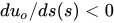
But the general magnitudes of required for separation are much greater for turbulent than for laminar flow, the former being able to tolerate nearly an order of magnitude stronger flow deceleration. A secondary influence is the Reynolds number. For a given adverse distribution, the separation resistance of a turbulent boundary layer increases slightly with increasing Reynolds number. In contrast, the separation resistance of a laminar boundary layer is independent of Reynolds number — a somewhat counterintuitive fact.

Hub AI
Flow separation AI simulator
(@Flow separation_simulator)
Flow separation
In fluid dynamics, flow separation or boundary layer separation is the detachment of a boundary layer from a surface into a wake.
A boundary layer exists whenever there is relative movement between a fluid and a solid surface with viscous forces present in the layer of fluid close to the surface. The flow can be externally, around a body, or internally, in an enclosed passage. Boundary layers can be either laminar or turbulent. A reasonable assessment of whether the boundary layer will be laminar or turbulent can be made by calculating the Reynolds number of the local flow conditions.
Separation occurs in flow that is slowing down, with pressure increasing, after passing the thickest part of a streamline body or passing through a widening passage, for example.
Flowing against an increasing pressure is known as flowing in an adverse pressure gradient. The boundary layer separates when it has travelled far enough in an adverse pressure gradient that the speed of the boundary layer relative to the surface has stopped and reversed direction. The flow becomes detached from the surface, and instead takes the forms of eddies and vortices. The fluid exerts a constant pressure on the surface once it has separated instead of a continually increasing pressure if still attached. In aerodynamics, flow separation results in reduced lift and increased pressure drag, caused by the pressure differential between the front and rear surfaces of the object. It causes buffeting of aircraft structures and control surfaces. In internal passages separation causes stalling and vibrations in machinery blading and increased losses (lower efficiency) in inlets and compressors. Much effort and research has gone into the design of aerodynamic and hydrodynamic surface contours and added features which delay flow separation and keep the flow attached for as long as possible. Examples include the fur on a tennis ball, dimples on a golf ball, turbulators on a glider, which induce an early transition to turbulent flow; vortex generators on aircraft.
The flow reversal is primarily caused by adverse pressure gradient imposed on the boundary layer by the outer potential flow. The streamwise momentum equation inside the boundary layer is approximately stated as
where are streamwise and normal coordinates. An adverse pressure gradient is when , which then can be seen to cause the velocity to decrease along and possibly go to zero if the adverse pressure gradient is strong enough.
The tendency of a boundary layer to separate primarily depends on the distribution of the adverse or negative edge velocity gradient along the surface, which in turn is directly related to the pressure and its gradient by the differential form of the Bernoulli relation, which is the same as the momentum equation for the outer inviscid flow.
But the general magnitudes of required for separation are much greater for turbulent than for laminar flow, the former being able to tolerate nearly an order of magnitude stronger flow deceleration. A secondary influence is the Reynolds number. For a given adverse distribution, the separation resistance of a turbulent boundary layer increases slightly with increasing Reynolds number. In contrast, the separation resistance of a laminar boundary layer is independent of Reynolds number — a somewhat counterintuitive fact.
Recent media