Hubbry Logo
FlufferFlufferMain
Open search
Fluffer
Community hub
Fluffer
logo
8 pages, 0 posts
0 subscribers
Be the first to start a discussion here.
Contribute something
Fluffer
Fluffer
from Wikipedia

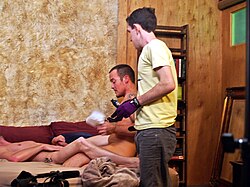
A fluffer on set of a gay pornographic movie.

A fluffer is a person employed to keep a porn performer's penis erect on the set.[1] After setting up the desired angle, the director asks the actors to hold position and calls for the fluffer to "fluff" the actors for the shot. These duties are considered part of the makeup department. While fluffing does not necessarily involve touching the actors, it could entail sexual acts such as fellatio or non-penetrative sex.[2]

According to some pornographic actors, including Aurora Snow,[3] James Deen[4] and Keiran Lee,[5] fluffers are no longer needed, saying that the role might have existed in the past, but disappeared due to medical advancements, such as Viagra and implants, and with advancements in prosthetics.[6] Hunter Skott, who has worked as a fluffer, contended in an interview that they "are only used for a gangbang or bukkake, not for regular [porn] movies".[2]

Film scholar Charles Burnetts, writing about the James Bond films, uses the term to describe members of a group of women in the films whom Bond seduces earlier in the movie but who disappear by the end and serve only to keep the male "agent" aroused until the arrival of the primary sexual object, the Bond girl. In particular, Burnetts states that the character of May Day from A View to a Kill, played by actress Grace Jones, "serves as a high-watermark for the fluffer character".[7]

Predating the pornographic usage, which came into use in the 1970s,[8][9] fluffer has been used by the real estate industry to refer to a person that stages homes[10] and as a term for a maid or housekeeper who fluffs pillows, or in general cleans and prepares work equipment.[11]

[edit]

In the 1998 video game Fallout 2, it is possible for the player to become a fluffer for a post-apocalyptic studio engaged in the porn industry.[12]

The 2001 film The Fluffer is about a film buff with a crush on a porn star who is straight, for whom he would end up working as a fluffer in gay porn.[13]

In episode 3 of season 2 of New Girl entitled "Fluffer", Nick Miller tells the protagonist Jessica Day that he will not be her "emotional fluffer", after he realises that he is providing her sentimental stimulation which allows her to maintain a more active sex life with a recurring character named Sam Sweeney.[14]

The oneiric slasher Knife+Heart follows a group of "low grade" gay pornographers in 1970s France. The film depicts a character named Mouth of Gold, or Mouth, who is a fluffer. In the film, he is a middle-aged man who works for free as he lives with his mother.[15]

See also

[edit]

References

[edit]
Revisions and contributorsEdit on WikipediaRead on Wikipedia
from Grokipedia
A fluffer is a person employed on a set whose role is to maintain the of performers between scenes, typically through manual or oral , to ensure efficient filming without delays. This practice emerged in the adult during the , when long shooting schedules and the absence of modern erectile aids made such assistance reportedly necessary for certain productions. The term was first notably referenced in Linda Lovelace's 1974 Ordeal. The term has since entered broader , often metaphorically referring to someone who provides temporary support or arousal in various contexts, but its primary association remains with . The concept of the fluffer gained cultural prominence through media portrayals, most notably in the 2001 , a satirical directed by and that explores obsession and the gay porn industry from the perspective of a young video store clerk who becomes a fluffer. Earlier references appear in industry discussions from the late , with the role described in accounts of pre-Viagra era shoots where performers might require help during setup or resets. However, the position's existence has long been debated within the industry, with some performers and producers dismissing it as a or exaggeration, arguing that co-stars, self-stimulation, or medications handle such needs today. In contemporary adult filmmaking, the dedicated fluffer role is considered largely obsolete due to advancements like drugs (e.g., , introduced in 1998) and shorter, more controlled production schedules, though anecdotal reports suggest informal assistance may still occur in specialized scenes such as group productions. The term persists in as a symbol of the behind-the-scenes realities of , highlighting the logistical challenges of simulating sex on camera.

Role in the Adult Film Industry

Definition

A fluffer is a contracted crew member on a set tasked with maintaining the level—typically an —of male performers during production breaks, setup periods, or between takes to facilitate uninterrupted filming. This role ensures that performers are ready to resume action promptly once cameras roll, minimizing downtime caused by physiological challenges under the pressures of on-set performance. The position is associated with adult films that feature performers engaging in penetrative scenes, as it addresses the specific needs of maintaining ; it primarily applies to productions involving performers in penetrative scenes, including both heterosexual and homosexual contexts, but not to female-only scenes where such assistance is unnecessary. Fluffers are typically non-performing staff, distinct from the main actors, though sometimes performers may take on the role informally, and operate off-camera, often remaining anonymous to avoid drawing attention from the production focus. However, the existence and prevalence of the dedicated fluffer role have been debated within the industry, with some performers and producers describing it as a or rare occurrence. The term "fluffer" originates from the verb "to fluff," meaning to stimulate, arouse, or prepare something lightly, which entered pornographic industry in the mid-20th century around the .

Duties and Techniques

The primary duties of a fluffer in the adult involve maintaining the of male performers between takes, particularly during interruptions such as camera repositioning, adjustments, or set resets, through non-penetrative stimulation to ensure quick recovery and continuity of filming. This role is most commonly required in group sex or scenes, where multiple male performers need to remain amid extended production times, but it is less prevalent in one-on-one or gonzo-style shoots. Fluffers assist in minimizing downtime by providing immediate arousal support, allowing directors to proceed efficiently without full reshoots. Techniques employed by fluffers typically include manual stimulation, oral sex, or verbal and visual encouragement, while avoiding penetrative intercourse to prevent performer fatigue or disruption to the scene's pacing. Lubricants or props may be used as needed to facilitate these methods, with the focus on sustaining arousal without contributing to the final footage. These approaches are directed by the production team to align with the scene's requirements, ensuring the fluffer's actions remain off-camera and non-intrusive to the edited product. In terms of workflow integration, fluffers operate under the director's cues, often positioned out of frame to respond promptly to pauses in filming, such as those caused by sound checks or crew movements. They coordinate implicitly with and crews to reduce interruptions, working in a discreet manner to keep the production flowing seamlessly. Compensation for fluffers is generally low, viewed as supplemental income rather than a primary , with individuals often hired informally through industry networks for short-term gigs. In heterosexual scenes, the role is typically filled by women, though it can be flexible based on the production's needs, such as male fluffers for gay-oriented content.

Historical Development

Origins in Early Pornography

The need for arousal maintenance in adult films became more apparent in the 1970s during the "porno chic" era, a period when hardcore adult films gained mainstream attention and commercial viability through feature-length productions with narrative elements. This shift was exemplified by Gerard Damiano's 1972 film Deep Throat, which grossed millions and elevated from underground loops to theatrical releases, necessitating longer shooting schedules that often spanned multiple days with repeated takes. Prior to the availability of erectile dysfunction medications like Viagra in 1998, adult film productions in the 1970s and 1980s grappled with unreliable male performances due to factors such as performance anxiety, substance use (including alcohol and for relaxation), and the physical demands of extended filming without cuts for explicit scenes. These challenges led to frequent delays between takes, prompting informal on-set assistance to maintain arousal through natural stimulation, often provided by co-stars, crew members, or other participants rather than a dedicated position. However, the existence and prevalence of such a role has been debated, with many industry figures describing it as a myth or limited to informal help. In contrast, pre-1960s stag films—short, silent 2-to-12-minute loops produced clandestinely for private male viewings—required minimal structure and rarely encountered such sustained performance issues due to their brevity and lack of plot-driven continuity. The term "fluffer" itself appears to have entered usage around this time, with early references tied to productions like Deep Throat. These developments were facilitated by the 1973 decision in , which clarified standards via a three-prong test, inadvertently spurring a surge in legal adult film production by providing producers with definitional boundaries that encouraged more structured, efficient operations on professionalized sets.

Changes Over Time

The introduction of sildenafil citrate, marketed as Viagra, in 1998 marked a pivotal shift in the adult film industry by enabling male performers to achieve on-demand erections, thereby minimizing production delays associated with erection maintenance. Industry professionals noted that the drug shortened preparation times between scenes, allowing for more efficient shoots and reducing reliance on external aids for performer readiness. This pharmacological advancement directly contributed to a decreased demand for any form of assistance. In the and , the rise of digital technologies further transformed production practices, making dedicated preparation support increasingly ad-hoc or obsolete in mainstream films. Faster digital , the proliferation of amateur-style content such as webcam performances, and shorter overall shoot durations—often limited to a single take or minimal retakes—diminished the need for such assistance. Veteran performer Sloane Steel explained that when assistance was needed, it was typically provided by other female performers earning supplemental income, primarily in niche group scenes rather than standard boy-girl productions. By the , prominent industry figures like described the concept of dedicated fluffers as a , asserting that female co-stars handle any necessary maintenance without specialized personnel. The U.S. industry saw a sharper decline post-2000, driven by heightened awareness protocols and elevated professional standards that favored self-managed performer aids over additional crew.

Contemporary Perspectives

Existence and Relevance Today

In the 2020s, the role of a dedicated fluffer in professional adult film productions is widely regarded as obsolete and largely mythical. Interviews with veteran performers such as , , , and indicate that no such position has existed on mainstream sets for at least 15 years, with the last reported instances dating to the mid-2000s. Similarly, performer has explicitly debunked the concept, stating that in group scenes, the female co-star handles any necessary arousal assistance without external personnel. This decline stems from the widespread adoption of medical and mechanical alternatives to maintain male performer erections during shoots. Common methods include oral medications like Viagra and Cialis, injectable treatments such as Caverject (alprostadil), and vacuum erection devices (pumps), which provide reliable, non-human support without interrupting production flow. Industry insiders confirm that these tools, combined with assistance from scene partners or "stunt cocks," have rendered dedicated fluffers unnecessary in scripted, professional environments. While the role has vanished from high-budget, regulated productions—where emphasis has shifted to performer protocols and standards—informal arousal support may occasionally appear in amateur or live cam content lacking medical aids. However, even in these niches, the practice remains rare and undocumented in credible industry analyses. Looking ahead as of 2025, the proliferation of AI-generated and experiences further diminishes any potential relevance for physical arousal roles like fluffing. AI tools enable rapid creation of customized, hyper-realistic content without live performers, while VR immerses users in simulated scenarios that bypass traditional filming logistics altogether. These technologies prioritize digital innovation over on-set human intervention, signaling a permanent away from outdated production practices.

Ethical and Professional Considerations

The fluffer role, integrated into adult film production processes, operates within broader power imbalances that can undermine consent on set, where producers and directors hold significant authority over support staff and performers. Reports from the 1980s and 1990s highlight coercion in low-budget productions, where economic pressures and lax oversight led to exploitative conditions, including pressured participation without clear boundaries. The #MeToo movement catalyzed reforms in the industry, with performers advocating for explicit consent protocols and the emerging use of intimacy coordinators in adult films since the early 2020s to enforce boundaries and mitigate exploitation risks. These changes have extended to ancillary roles like fluffers, promoting safer professional environments. Fluffers have historically endured anonymity and societal stigma, often facing shame that exacerbates challenges such as depression and anxiety, common among adult industry workers due to public judgment and isolation. Post-2010s performer advocacy has driven professionalization efforts, including unionization through organizations like the Adult Performance Artists Guild (APAG; founded in 2017 and federally recognized in 2021), which emphasizes , support, and destigmatization for all on-set personnel, including recent solidarity actions with other unions as of January 2025. Legally, the fluffer position intersects with regulations under U.S. federal and state laws, while posing elevated risks of sexually transmitted (STD) transmission through close physical contact, as documented in industry-wide outbreaks of and other infections in the 2000s and . Responses include mandatory testing and barrier use under Los Angeles County's Safer Sex in the Adult Film Industry Act (Measure B, 2012), alongside privacy protections for health records akin to HIPAA standards to safeguard performers' medical information from unauthorized disclosure. In heterosexual pornography, the fluffer role is predominantly filled by women, perpetuating stereotypes that position females as facilitators of male pleasure and reinforcing dynamics. Industry critiques and inclusivity initiatives call for diversifying such roles across and orientation to challenge these norms and promote equitable representation.

Cultural Representations

In Film and Television

One of the most prominent depictions of a fluffer appears in the 2001 The Fluffer, directed by and . The story follows Sean, a straight who takes a job as a fluffer on a gay pornography set, where he becomes obsessively infatuated with Johnny Rebel, a straight "gay-for-pay" performer whose hedonistic lifestyle leads to personal downfall. This narrative uses the fluffer's intimate yet anonymous role as a central metaphor for unrequited love, obsession, and the emotional undercurrents of the adult industry. Other films have referenced or alluded to the fluffer role more obliquely, often within broader explorations of production. In Paul Thomas Anderson's (1997), set in the 1970s and 1980s adult film scene, various behind-the-scenes assistants support the performers during shoots, evoking the practical demands of maintaining continuity on set without explicitly naming the fluffer position. Similarly, Kevin Smith's Zack and Miri Make a Porno (2008) satirizes low-budget porn , incorporating the fluffer as an authentic detail in the chaotic production process, highlighting the role's supportive yet unglamorous nature amid comedic mishaps. Television portrayals of fluffers tend to be brief and humorous, emphasizing the adult industry's eccentric underbelly. In the series Entourage (2004–2011), the term surfaces in season 3, episode 20 ("Adios Amigos"), where director Billy Walsh jokingly demands a fluffer in the green room to prepare for a meeting, underscoring the show's satirical take on Hollywood's fringes. Such references in shows like Entourage contribute to thematic trends in media, where the fluffer is frequently exaggerated for or to illustrate the role's blend of and professional disposability, often serving as a punchline or symbol of exploitation.

In Literature and Other Media

The term "fluffer" has appeared in contemporary , particularly in novels and series set within the adult film industry, where it often serves as a central to explore themes of desire, identity, and professional boundaries. In Hank Edwards' Fluffers, Inc. series (starting 2002), the protagonist Charlie Heggensford transitions from an farm boy to a professional fluffer in ' gay pornography scene, highlighting the role's challenges and interpersonal dynamics. Similarly, A.J. Llewellyn's (2018) depicts a romance involving a fluffer auditioning talent for a men's , using the occupation to delve into attraction and self-discovery in LGBTQ+ contexts. Shae York's novella Fluffer (2018) portrays the role through a steamy romance between a fluffer and a porn star, emphasizing emotional connections amid industry pressures. In music and , "fluffer" has been metaphorically referenced in hip-hop lyrics since the 1990s, often playing on ideas of softness or preparation without direct industry ties. For instance, Nice & Smooth's "" (1990) uses the phrase "more fluffer than a " to evoke abundance and smoothness in a boastful context. later adapted it humorously in "Pawfluffer Night" (2015), twisting the term into "pawfluffer" for a cat-themed track about indulgence and chaos. The slang's popularization traces to the 1970s porn industry but gained broader traction through online dictionaries in the 2000s, defining it as someone maintaining between scenes while noting its debated relevance today. Online culture has mythologized through memes and viral content, frequently exaggerating or debunking its realities for comedic effect. In the 2020s, videos, such as those by comedian , have humorously dissected the role's misconceptions, contributing to its status as internet shorthand for behind-the-scenes enablers. Discussions on forums like have similarly amplified myths, with threads from 2021 onward treating it as a punchline for industry absurdities. Beyond porn, the term has evolved into non-sexual , such as in pet communities for "extremely furry dogs" in "doggo" lingo since the 2010s, or predating that in as "fluffers" who stage homes for sales to enhance appeal, as noted in 1990s reports. This broader usage positions "fluffer" as a versatile for any preparatory or role in casual contexts.

References

Add your contribution
Related Hubs
Contribute something
User Avatar
No comments yet.