


Community hub
Recent from talks
Contribute something to knowledge base
Content stats: 0 posts, 0 articles, 1 media, 0 notes
Members stats: 0 subscribers, 0 contributors, 0 moderators, 0 supporters
Subscribers
Supporters
Contributors
Moderators
Hub AI
Fluoroscopy AI simulator
(@Fluoroscopy_simulator)
Hub AI
Fluoroscopy AI simulator
(@Fluoroscopy_simulator)
Fluoroscopy
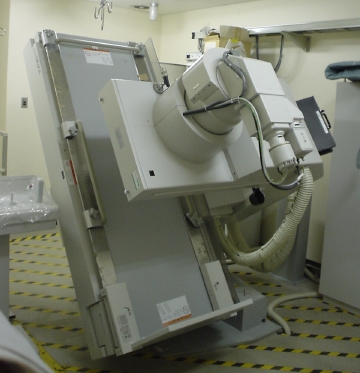
Fluoroscopy (/flʊəˈrɒskəpi/), informally referred to as "fluoro", is an imaging technique that uses X-rays to obtain real-time moving images of the interior of an object. In its primary application of medical imaging, a fluoroscope (/ˈflʊərəˌskoʊp/) allows a surgeon to see the internal structure and function of a patient, so that the pumping action of the heart or the motion of swallowing, for example, can be watched. This is useful for both diagnosis and therapy and occurs in general radiology, interventional radiology, and image-guided surgery.
In its simplest form, a fluoroscope consists of an X-ray source and a fluorescent screen, between which a patient is placed. However, since the 1950s most fluoroscopes have included X-ray image intensifiers and cameras as well, to improve the image's visibility and make it available on a remote display screen. For many decades, fluoroscopy tended to produce live pictures that were not recorded, but since the 1960s, as technology improved, recording and playback became the norm.
Fluoroscopy is similar to radiography and X-ray computed tomography (X-ray CT) in that it generates images using X-rays. The original difference was that radiography fixed still images on film, whereas fluoroscopy provided live moving pictures that were not stored. However, modern radiography, CT, and fluoroscopy now use digital imaging with image analysis software and data storage and retrieval. Compared to other x-ray imaging modalities the source projects from below leading to horizontally mirrored images, and in keeping with historical displays the grayscale remains inverted (radiodense objects such as bones are dark whereas traditionally they would be bright).
Although visible light can be seen by the naked eye (and thus forms images that people can look at), it does not penetrate most objects (only translucent or transparent ones). In contrast, X-rays can penetrate a wider variety of objects (such as the human body), but they are invisible to the naked eye. To take advantage of the penetration for image-forming purposes, one must somehow convert the X-rays' intensity variations (which correspond to material contrast and thus image contrast) into a form that is visible. Classic film-based radiography achieves this by the variable chemical changes that the X-rays induce in the film, and classic fluoroscopy achieves it by fluorescence, in which certain materials convert X-ray energy (or other parts of the spectrum) into visible light. This use of fluorescent materials to make a viewing scope is how fluoroscopy got its name.
As the X-rays pass through the patient, they are attenuated by varying amounts as they pass through or reflect off the different tissues of the body, casting an X-ray shadow of the radiopaque tissues (such as bone tissue) on the fluorescent screen. Images on the screen are produced as the unattenuated or mildly attenuated X-rays from radiolucent tissues interact with atoms in the screen through the photoelectric effect, giving their energy to the electrons. While much of the energy given to the electrons is dissipated as heat, a fraction of it is given off as visible light.
Early radiologists would adapt their eyes to view the dim fluoroscopic images by sitting in darkened rooms, or by wearing red adaptation goggles. After the development of X-ray image intensifiers, the images were bright enough to see without goggles under normal ambient light. Image Intensifiers are still being used to this day (2023) with many new models still using II (Image Intensifier) as its method of acquiring the image which is still popular due to lower cost compared to Flat Panel Detectors and there have been many debates on whether II or Flat Detector is more sensitive to X-Ray, which results in lower X-Ray Dosage used. (Depending upon what type of technology / panel is being used influences this answer greatly)
Nowadays, in all forms of digital X-ray imaging (radiography, fluoroscopy, and CT) the conversion of X-ray energy into visible light can be achieved by the same types of electronic sensors, such as flat panel detectors, which convert the X-ray energy into electrical signals: small bursts of electric current that convey information that a computer can analyze, store, and output as images. As fluorescence is a special case of luminescence, digital X-ray imaging is conceptually similar to digital gamma ray imaging (scintigraphy, SPECT, and PET) in that in both of these imaging mode families, the information conveyed by the variable attenuation of invisible electromagnetic radiation as it passes through tissues with various radiodensities is converted by an electronic sensor into an electric signal that is processed by a computer and output as a visible-light image.
Fluoroscopy has become an important tool in medical imaging to render moving pictures during a surgery or any other procedure.
Fluoroscopy
Fluoroscopy (/flʊəˈrɒskəpi/), informally referred to as "fluoro", is an imaging technique that uses X-rays to obtain real-time moving images of the interior of an object. In its primary application of medical imaging, a fluoroscope (/ˈflʊərəˌskoʊp/) allows a surgeon to see the internal structure and function of a patient, so that the pumping action of the heart or the motion of swallowing, for example, can be watched. This is useful for both diagnosis and therapy and occurs in general radiology, interventional radiology, and image-guided surgery.
In its simplest form, a fluoroscope consists of an X-ray source and a fluorescent screen, between which a patient is placed. However, since the 1950s most fluoroscopes have included X-ray image intensifiers and cameras as well, to improve the image's visibility and make it available on a remote display screen. For many decades, fluoroscopy tended to produce live pictures that were not recorded, but since the 1960s, as technology improved, recording and playback became the norm.
Fluoroscopy is similar to radiography and X-ray computed tomography (X-ray CT) in that it generates images using X-rays. The original difference was that radiography fixed still images on film, whereas fluoroscopy provided live moving pictures that were not stored. However, modern radiography, CT, and fluoroscopy now use digital imaging with image analysis software and data storage and retrieval. Compared to other x-ray imaging modalities the source projects from below leading to horizontally mirrored images, and in keeping with historical displays the grayscale remains inverted (radiodense objects such as bones are dark whereas traditionally they would be bright).
Although visible light can be seen by the naked eye (and thus forms images that people can look at), it does not penetrate most objects (only translucent or transparent ones). In contrast, X-rays can penetrate a wider variety of objects (such as the human body), but they are invisible to the naked eye. To take advantage of the penetration for image-forming purposes, one must somehow convert the X-rays' intensity variations (which correspond to material contrast and thus image contrast) into a form that is visible. Classic film-based radiography achieves this by the variable chemical changes that the X-rays induce in the film, and classic fluoroscopy achieves it by fluorescence, in which certain materials convert X-ray energy (or other parts of the spectrum) into visible light. This use of fluorescent materials to make a viewing scope is how fluoroscopy got its name.
As the X-rays pass through the patient, they are attenuated by varying amounts as they pass through or reflect off the different tissues of the body, casting an X-ray shadow of the radiopaque tissues (such as bone tissue) on the fluorescent screen. Images on the screen are produced as the unattenuated or mildly attenuated X-rays from radiolucent tissues interact with atoms in the screen through the photoelectric effect, giving their energy to the electrons. While much of the energy given to the electrons is dissipated as heat, a fraction of it is given off as visible light.
Early radiologists would adapt their eyes to view the dim fluoroscopic images by sitting in darkened rooms, or by wearing red adaptation goggles. After the development of X-ray image intensifiers, the images were bright enough to see without goggles under normal ambient light. Image Intensifiers are still being used to this day (2023) with many new models still using II (Image Intensifier) as its method of acquiring the image which is still popular due to lower cost compared to Flat Panel Detectors and there have been many debates on whether II or Flat Detector is more sensitive to X-Ray, which results in lower X-Ray Dosage used. (Depending upon what type of technology / panel is being used influences this answer greatly)
Nowadays, in all forms of digital X-ray imaging (radiography, fluoroscopy, and CT) the conversion of X-ray energy into visible light can be achieved by the same types of electronic sensors, such as flat panel detectors, which convert the X-ray energy into electrical signals: small bursts of electric current that convey information that a computer can analyze, store, and output as images. As fluorescence is a special case of luminescence, digital X-ray imaging is conceptually similar to digital gamma ray imaging (scintigraphy, SPECT, and PET) in that in both of these imaging mode families, the information conveyed by the variable attenuation of invisible electromagnetic radiation as it passes through tissues with various radiodensities is converted by an electronic sensor into an electric signal that is processed by a computer and output as a visible-light image.
Fluoroscopy has become an important tool in medical imaging to render moving pictures during a surgery or any other procedure.
Recent media
Recent media