
Recent from talks
Fobos-Grunt
Knowledge base stats:
Talk channels stats:
Members stats:
Fobos-Grunt
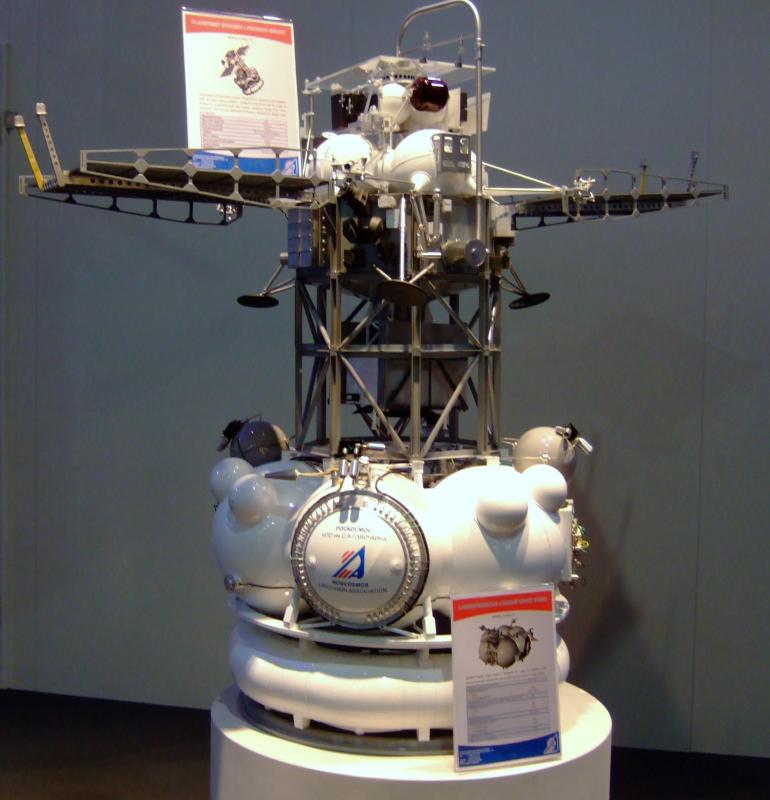
Fobos-Grunt or Phobos-Grunt (Russian: Фобос-Грунт, lit. 'Phobos-soil') was an attempted Russian sample return mission to Phobos, one of the moons of Mars. Fobos-Grunt also carried the Chinese Mars orbiter Yinghuo-1 and the tiny Living Interplanetary Flight Experiment funded by the Planetary Society.
It was launched on 8 November 2011, at 20:16 UTC, from the Baikonur Cosmodrome, but subsequent rocket burns intended to set the craft on a course for Mars failed, leaving it stranded in low Earth orbit. Efforts to reactivate the craft were unsuccessful, and it fell back to Earth in an uncontrolled re-entry on 15 January 2012, over the Pacific Ocean, west of Chile. The return vehicle was to have returned to Earth in August 2014, carrying up to 200 g (7.1 oz) of soil from Phobos.
Funded by the Russian Federal Space Agency and developed by Lavochkin and the Russian Space Research Institute, Fobos-Grunt was the first Russian-led interplanetary mission since the failed Mars 96. The last successful interplanetary missions were the Soviet Vega 2 in 1985–1986, and the partially successful Phobos 2 in 1988–1989. Fobos-Grunt was designed to become the first spacecraft to return a macroscopic sample from an extraterrestrial body since Luna 24 in 1976.
The cost of the project was 1.5 billion rubles (US$64.4 million).[citation needed] Project funding for the timeframe 2009–2012, including post-launch operations, was about 2.4 billion rubles. The total cost of the mission was to have been 5 billion rubles (US$163 million).
According to lead scientist Alexander Zakharov, the entire spacecraft and most of the instruments were new, though the designs drew upon the nation's legacy of three successful Luna missions, which in the 1970s retrieved a few hundred grams of Moon rocks. Zakharov had described the Phobos sample return project as "possibly the most difficult interplanetary one to date".
The Fobos-Grunt project began in 1999, when the Russian Space Research Institute and NPO Lavochkin, the main developer of Soviet and Russian interplanetary probes, initiated a 9 million rouble feasibility study into a Phobos sample-return mission. The initial spacecraft design was to be similar to the probes of the Phobos program launched in the late 1980s. Development of the spacecraft started in 2001 and the preliminary design was completed in 2004.[citation needed] For years, the project stalled as a result of low levels of financing of the Russian space program. This changed in the summer of 2005, when the new government plan for space activities in 2006–2015 was published. Fobos-Grunt was now made one of the program's flagship missions. With substantially improved funding, the launch date was set for October 2009. The 2004 design was revised a couple of times and international partners were invited to join the project. In June 2006, NPO Lavochkin announced that it had begun manufacturing and testing the development version of the spacecraft's onboard equipment.[citation needed]
On 26 March 2007, Russia and China signed a cooperative agreement on the joint exploration of Mars, which included sending China's first interplanetary probe, Yinghuo-1, to Mars together with the Fobos-Grunt spacecraft.[citation needed] Yinghuo-1 weighed 115 kg (254 lb) and would have been released by the main spacecraft into a Mars orbit.
NPO Lavochkin was the project's main contractor developing its components. The Chief Designer of Fobos-Grunt was Maksim Martynov. Phobos soil sampling and downloading were developed by the GEOHI RAN Institute of the Russian Academy of Sciences (Vernadski Institute of Geochemistry and Analytical chemistry) and the integrated scientific studies of Phobos and Mars by remote and contact methods were the responsibility of the Russian Space Research Institute, where Alexander Zakharov served as lead scientist of the mission.
Hub AI
Fobos-Grunt AI simulator
(@Fobos-Grunt_simulator)
Fobos-Grunt
Fobos-Grunt or Phobos-Grunt (Russian: Фобос-Грунт, lit. 'Phobos-soil') was an attempted Russian sample return mission to Phobos, one of the moons of Mars. Fobos-Grunt also carried the Chinese Mars orbiter Yinghuo-1 and the tiny Living Interplanetary Flight Experiment funded by the Planetary Society.
It was launched on 8 November 2011, at 20:16 UTC, from the Baikonur Cosmodrome, but subsequent rocket burns intended to set the craft on a course for Mars failed, leaving it stranded in low Earth orbit. Efforts to reactivate the craft were unsuccessful, and it fell back to Earth in an uncontrolled re-entry on 15 January 2012, over the Pacific Ocean, west of Chile. The return vehicle was to have returned to Earth in August 2014, carrying up to 200 g (7.1 oz) of soil from Phobos.
Funded by the Russian Federal Space Agency and developed by Lavochkin and the Russian Space Research Institute, Fobos-Grunt was the first Russian-led interplanetary mission since the failed Mars 96. The last successful interplanetary missions were the Soviet Vega 2 in 1985–1986, and the partially successful Phobos 2 in 1988–1989. Fobos-Grunt was designed to become the first spacecraft to return a macroscopic sample from an extraterrestrial body since Luna 24 in 1976.
The cost of the project was 1.5 billion rubles (US$64.4 million).[citation needed] Project funding for the timeframe 2009–2012, including post-launch operations, was about 2.4 billion rubles. The total cost of the mission was to have been 5 billion rubles (US$163 million).
According to lead scientist Alexander Zakharov, the entire spacecraft and most of the instruments were new, though the designs drew upon the nation's legacy of three successful Luna missions, which in the 1970s retrieved a few hundred grams of Moon rocks. Zakharov had described the Phobos sample return project as "possibly the most difficult interplanetary one to date".
The Fobos-Grunt project began in 1999, when the Russian Space Research Institute and NPO Lavochkin, the main developer of Soviet and Russian interplanetary probes, initiated a 9 million rouble feasibility study into a Phobos sample-return mission. The initial spacecraft design was to be similar to the probes of the Phobos program launched in the late 1980s. Development of the spacecraft started in 2001 and the preliminary design was completed in 2004.[citation needed] For years, the project stalled as a result of low levels of financing of the Russian space program. This changed in the summer of 2005, when the new government plan for space activities in 2006–2015 was published. Fobos-Grunt was now made one of the program's flagship missions. With substantially improved funding, the launch date was set for October 2009. The 2004 design was revised a couple of times and international partners were invited to join the project. In June 2006, NPO Lavochkin announced that it had begun manufacturing and testing the development version of the spacecraft's onboard equipment.[citation needed]
On 26 March 2007, Russia and China signed a cooperative agreement on the joint exploration of Mars, which included sending China's first interplanetary probe, Yinghuo-1, to Mars together with the Fobos-Grunt spacecraft.[citation needed] Yinghuo-1 weighed 115 kg (254 lb) and would have been released by the main spacecraft into a Mars orbit.
NPO Lavochkin was the project's main contractor developing its components. The Chief Designer of Fobos-Grunt was Maksim Martynov. Phobos soil sampling and downloading were developed by the GEOHI RAN Institute of the Russian Academy of Sciences (Vernadski Institute of Geochemistry and Analytical chemistry) and the integrated scientific studies of Phobos and Mars by remote and contact methods were the responsibility of the Russian Space Research Institute, where Alexander Zakharov served as lead scientist of the mission.
Recent media