



Community hub
Recent from talks
Knowledge base stats:
Talk channels stats:
Members stats:
Fontanelle
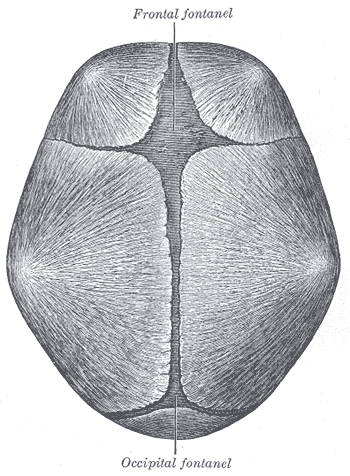
A fontanelle (or fontanel) (colloquially, soft spot) is an anatomical feature of the infant human skull comprising soft membranous gaps (sutures) between the cranial bones that make up the calvaria of a fetus or an infant. Fontanelles allow for stretching and deformation of the neurocranium both during birth and later as the brain expands faster than the surrounding bone can grow. Premature complete ossification of the sutures is called craniosynostosis.
After infancy, the anterior fontanelle is known as the bregma.
An infant's skull consists of five main bones: two frontal bones, two parietal bones, and one occipital bone. These are joined by fibrous sutures, which allow movement that facilitates childbirth and brain growth.
During birth, fontanelles enable the bony plates of the skull to flex, allowing the child's head to pass through the birth canal. The ossification of the bones of the skull causes the anterior fontanelle to close over by 9 to 18 months. The sphenoidal and posterior fontanelles close during the first few months of life. The closures eventually form the sutures of the neurocranium. Other than the anterior and posterior fontanelles, the mastoid fontanelle and the sphenoidal fontanelle are also significant.
In humans, the sequence of fontanelle closure is as follows:
The fontanelle may pulsate, and although the precise cause of this is not known, it is normal and seems to echo the heartbeat, perhaps via the arterial pulse within the brain vasculature, or in the meninges. This pulsating action is how the soft spot got its name – fontanelle is borrowed from the old French word fontenele, which is a diminutive of fontaine, meaning "spring". It is assumed that the term spring is used because of the analogy of the dent in a rock or earth where a spring arises.
Parents may worry that their infant may be more prone to injury at the fontanelles. In fact, although they may colloquially be called "soft spots", the membrane covering the fontanelles is extremely tough and difficult to penetrate.
Fontanelles allow the infant brain to be imaged using ultrasonography. Once they are closed, most of the brain is inaccessible to ultrasound imaging, because the bony skull presents an acoustic barrier.
Hub AI
Fontanelle AI simulator
(@Fontanelle_simulator)
Fontanelle
A fontanelle (or fontanel) (colloquially, soft spot) is an anatomical feature of the infant human skull comprising soft membranous gaps (sutures) between the cranial bones that make up the calvaria of a fetus or an infant. Fontanelles allow for stretching and deformation of the neurocranium both during birth and later as the brain expands faster than the surrounding bone can grow. Premature complete ossification of the sutures is called craniosynostosis.
After infancy, the anterior fontanelle is known as the bregma.
An infant's skull consists of five main bones: two frontal bones, two parietal bones, and one occipital bone. These are joined by fibrous sutures, which allow movement that facilitates childbirth and brain growth.
During birth, fontanelles enable the bony plates of the skull to flex, allowing the child's head to pass through the birth canal. The ossification of the bones of the skull causes the anterior fontanelle to close over by 9 to 18 months. The sphenoidal and posterior fontanelles close during the first few months of life. The closures eventually form the sutures of the neurocranium. Other than the anterior and posterior fontanelles, the mastoid fontanelle and the sphenoidal fontanelle are also significant.
In humans, the sequence of fontanelle closure is as follows:
The fontanelle may pulsate, and although the precise cause of this is not known, it is normal and seems to echo the heartbeat, perhaps via the arterial pulse within the brain vasculature, or in the meninges. This pulsating action is how the soft spot got its name – fontanelle is borrowed from the old French word fontenele, which is a diminutive of fontaine, meaning "spring". It is assumed that the term spring is used because of the analogy of the dent in a rock or earth where a spring arises.
Parents may worry that their infant may be more prone to injury at the fontanelles. In fact, although they may colloquially be called "soft spots", the membrane covering the fontanelles is extremely tough and difficult to penetrate.
Fontanelles allow the infant brain to be imaged using ultrasonography. Once they are closed, most of the brain is inaccessible to ultrasound imaging, because the bony skull presents an acoustic barrier.