Hubbry Logo
Fibrous jointFibrous jointMain
Open search
Fibrous joint
Community hub
Fibrous joint
logo
8 pages, 0 posts
0 subscribers
Be the first to start a discussion here.
Fibrous joint
Fibrous joint
from Wikipedia
Fibrous joint
Fibrous joints
Details
Identifiers
Latinarticulatio fibrosa, junctura fibrosa
TA98A03.0.00.004
TA21517
FMA7492
Anatomical terminology

In anatomy, fibrous joints are joints connected by fibrous tissue, consisting mainly of collagen. These are fixed joints where bones are united by a layer of white fibrous tissue of varying thickness. In the skull, the joints between the bones are called sutures. Such immovable joints are also referred to as synarthroses.

Types

[edit]

Most fibrous joints are also called "fixed" or "immovable". These joints have no joint cavity and are connected via fibrous connective tissue.

  • Sutures: The skull bones are connected by fibrous joints called sutures.[1] In fetal skulls, the sutures are wide to allow slight movement during birth. They later become rigid (synarthrodial).

Sutures

[edit]
Side view of the skull
Human skull side sutures right

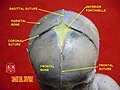
A suture is a type of fibrous joint that is only found in the skull (cranial suture). The bones are bound together by Sharpey's fibres. A tiny amount of movement is permitted at sutures, which contributes to the compliance and elasticity of the skull. These joints are synarthroses.[1] It is normal for many of the bones of the skull to remain unfused at birth. The fusion of the skull's bones before birth is known as craniosynostosis. The term "fontanelle" is used to describe the resulting "soft spots". The relative positions of the bones continue to change during the life of the adult (though less rapidly), which can provide useful information in forensics and archaeology. In old age, cranial sutures may ossify (turn to bone) completely.[3] The joints between the teeth and jaws (gomphoses) and the joint between the mandible and the cranium, the temporomandibular joint, form the only non-sutured joints in the skull.

Types of sutures

[edit]
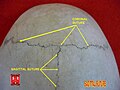
  • Serrate sutures – similar to a denticulate suture but the interlocking regions are serrated rather than square. Eg: Coronal suture, sagittal Sutures.
  • Plane sutures – edges of the bones are flush with each other as in a normal butt joint. Eg: Internasal suture.
  • Limbous sutures – edges are bevelled so the plane of the suture is sloping as in a mitre joint. Eg: Temporo-parietal suture.
  • Schindylesis – formed by two bones fitting into each other similar to a bridle joint. Eg: Palatomaxillary suture.
  • Denticulate sutures – the edges slot into each other as in a finger joint. Eg: Lambdoid suture.

List of sutures

[edit]
Cranial sutures viewed from top of head

Most sutures are named for the bones they articulate, but some have special names of their own.

Visible from the side

[edit]

Visible from the front or above

[edit]

Visible from below or inside

[edit]
[edit]

Syndesmosis

[edit]

A syndesmosis is a slightly mobile[4] fibrous joint in which bones such as the tibia and fibula are joined together by connective tissue. An example is the distal tibiofibular joint. Injuries to the ankle syndesmosis are commonly known as a "high ankle sprain". Although the syndesmosis is a joint, in the literature the term syndesmotic injury is used to describe injury of the syndesmotic ligaments. It comes from the Greek σύν, syn (meaning "with") and δεσμός, desmos (meaning "a band").[5] Syndesmosis sprains have received increasing recognition during recent years because of a heightened awareness of the mechanism, symptoms, and signs of injury.[6]

Diagnosis of a syndesmotic injury

[edit]

Diagnosis of syndesmosis injuries by physical examination is often straightforward. Physical examination findings that are often positive include the squeeze test and the external rotation test. Patients with high-grade syndesmosis injuries often cannot perform a single-leg heel raise. Patients report pain in varying degrees over the anterior and often posterior distal fibular joint.[7]

Syndesmotic tear

[edit]

The severity of acute syndesmosis injury is rated from grade I to III by several authors. A grade I injury is a partial anteroinferior tibiofibular ligament tear, meaning the exorotation and squeeze tests are negative for this grade. Grade II injury is a complete anteroinferior tibiofibular ligament and inferior interosseous ligament tear, meaning that squeeze test and exorotation are positive. This results in the injury being stabilized with immobilization but not operatively stabilized. A grade III injury is a complete anteroinferior tibiofibular ligament tear including a (partial) interosseous ligament tear and deltoid ligament avulsion, meaning the joint is unstable and positive on the exorotation and squeeze tests. This grade requires operative stabilization.[8] If the syndesmosis is torn apart as result of bone fracture, surgeons will sometimes fix the relevant bones together with a syndesmotic screw, temporarily replacing the syndesmosis, or with a tightrope fixation, which is called syndesmosis procedure.[9][10] The screw inhibits normal movement of the bones and, thereby, the corresponding joint(s). When the natural articulation is healed, the screw may be removed. The tightrope fixation with elastic fiberwire suture on the other hand allows physiologic motion of the ankle and may be permanent.

Gomphosis

[edit]
The teeth, viewed from the right

A gomphosis, also known as a dentoalveolar syndesmosis,[11] or 'peg and socket joint'[12] is a joint that binds the teeth to bony teeth sockets in the maxillary bone and mandible. Gomphos is the Greek word for "bolt". The fibrous connection between a tooth and its socket is a periodontal ligament. Specifically, the connection is made between the maxilla or mandible to the cementum of the tooth.

The motion of a gomphosis is minimal, though considerable movement can be achieved over time—the basis of using braces to realign teeth. The joint can be considered a synarthrosis.[13]

The gomphosis is the only joint-type in which a bone does not join another bone, as teeth are not technically bone. In modern, more anatomical, joint classification, the gomphosis is simply considered a fibrous joint because the tissue linking the structures is ligamentous. It has been suggested that this permanent soft-tissue attachment was a critical requisite in the evolution of the mammalian (synapsid) tusk.[14]

References

[edit]
[edit]
Revisions and contributorsEdit on WikipediaRead on Wikipedia
from Grokipedia
A fibrous joint is a connection between two bones in the human skeleton united by dense collagenous fibrous connective tissue, without a joint cavity or synovial fluid. Functionally, they are classified as synarthroses (immovable) or amphiarthroses (slightly movable). These joints provide strong structural stability and are essential for protecting vital organs, such as the brain, while resisting mechanical stress. Fibrous joints are structurally classified into three main types based on the nature of their connective tissue: sutures, syndesmoses, and gomphoses. Sutures consist of interlocking, wavy fibrous connections that bind flat bones together, primarily in the skull, where they form tight, immovable seams reinforced by Sharpey's fibers after ossification. In newborns, soft spots known as fontanelles allow skull flexibility during birth, which later close to form these sutures. Syndesmoses involve longer fibrous ligaments or membranes uniting parallel long bones, permitting slight movement (amphiarthrosis) for stability during activities like walking; examples include the distal tibiofibular joint and the interosseous membrane between the radius and ulna. Gomphoses are peg-and-socket joints where teeth are anchored to the alveolar sockets of the maxilla and mandible by the periodontal ligament, a specialized fibrous tissue that absorbs shock during chewing. Functionally, fibrous joints emphasize rigidity and load-bearing over mobility, developing from mesenchymal tissue and contributing to skeletal integrity throughout life. Over time, some sutures may fuse completely into synostoses, as seen in the by around age eight. Unlike more flexible synovial joints, fibrous joints lack and rely solely on their fibrous composition for durability in high-stress areas.

Overview

Definition and Characteristics

A fibrous joint, also known as a , is an immovable articulation between two bones connected exclusively by dense fibrous composed primarily of fibers, without the presence of a joint cavity. These joints provide robust structural stability, permitting little to no movement, and are essential for maintaining the integrity of the skeletal framework in areas requiring rigidity. Key histological characteristics include the composition of , featuring fibroblasts embedded within parallel bundles of fibers that resist tensile forces effectively. In certain fibrous joints, stability is further enhanced by Sharpey's fibers—oblique collagenous perforating fibers that anchor the directly into the underlying matrix. This arrangement contrasts with cartilaginous joints, which rely on or for slightly greater flexibility, and synovial joints, which feature a synovial cavity and articular enabling free movement. Fibrous joints encompass subtypes such as sutures, syndesmoses, and gomphoses, each adapted for specific stabilizing roles. Evolutionarily, these joints demonstrate persistence across vertebrates, particularly in cranial structures, underscoring their conserved role in skeletal support from early jawed ancestors to modern .

Functions and Biomechanics

Fibrous joints serve essential physiological roles in the by providing rigid stability through the union of bones via dense collagenous , which minimizes movement and maintains structural alignment. This immobility is particularly vital for protecting delicate underlying structures, such as the within the cranial vault formed by sutures, where the joints act as a shock-absorbing barrier against external impacts. Additionally, fibrous joints facilitate the distribution of mechanical forces across connected bones without permitting significant displacement, enabling efficient load transfer during activities like weight-bearing or mastication. The biomechanical properties of fibrous joints derive primarily from the composition and of collagen fibers, which confer high tensile strength to resist pulling and disruptive forces. These fibers exhibit robust resistance to shear stresses due to their dense, interwoven arrangement, preventing slippage between adjacent bones under lateral loads. The load-bearing capacity of fibrous tissues is quantified through stress-strain relationships, with the modulus of elasticity for dense typically ranging from 0.2 to 1 GPa in hydrated conditions, reflecting a balance of and limited extensibility that supports stability without . Within the broader skeletal system, fibrous joints play a key role in force transmission, particularly in high-stress regions such as the tibiofibular syndesmosis, where they prevent dislocation during rotational or compressive activities. This function enhances overall skeletal by linking parallel bones and distributing loads to reduce localized stress concentrations. Evolutionarily, fibrous joints have been conserved in mammals to ensure cranial protection for expanding volumes, differing from the more mobile cartilaginous or synovial joints prevalent in other species that favor agility over unyielding support.

Sutures

Structure and Development

Sutures, as a type of fibrous joint, feature interlocking bony edges where adjacent cranial bones meet in a convoluted, serrated , providing enhanced stability through mechanical interdigitation. These edges are bound together by a narrow band of dense fibrous , primarily composed of , which fills the gap and prevents significant movement between the bones. The fibrous layer is enveloped by periosteal coverings derived from the outer (periosteal) layer of the , which adheres closely to the surfaces along the suture lines. Occasional small blood vessels traverse the fibrous tissue, supplying nutrients while maintaining the overall avascular nature of the suture to support its immobile function. At the microscopic level, the fibers within the suture's fibrous are arranged in a wavy, undulating , particularly within the presumptive suture zone, which confers flexibility to accommodate subtle stresses during early growth without compromising structural integrity. This organization contrasts with the more linear alignment of in adjacent plates and allows for limited deformation in the neonatal period. The development of sutures occurs concurrently with the of cranial bones, beginning around weeks 7 to 8 of when centers emerge in the mesenchymal condensations surrounding the developing . By weeks 8 to 12, the spreading fronts from these centers define the boundaries of the future sutures at sites of dural reflections, leaving unossified gaps that remain patent to permit rapid expansion during fetal and early postnatal growth. Progressive fusion of the suture edges follows, driven by osteogenic activity from the , typically completing in adulthood to form a rigid calvaria. Integral to this process are the fontanelles, which are larger, membranous gaps at suture intersections serving as temporary soft spots that facilitate skull molding during birth and continued expansion as the doubles in volume within the first year of life. The , located at the junction of the coronal and sagittal sutures, remains open until approximately 18 months, allowing for clinical assessment of and hydration status in infants. Other fontanelles, such as the posterior one, close earlier, by 1 to 2 months, marking the transition from flexible to stabilizing skull architecture.

Types and Examples

Sutures exhibit morphological variations that enhance stability through different patterns of bone edge . The primary types include plane (also known as butt) sutures, which involve a simple end-to-end of margins without significant overlap or interdigitation, offering minimal resistance to shear forces; serrate sutures, characterized by a saw-tooth or wavy pattern that maximizes surface area contact for greater tensile strength; and squamous (or ) sutures, featuring beveled, overlapping edges resembling scales or a for added lateral stability. Key examples of these sutures are found throughout the cranium. The , a serrate type, joins the to the two parietal bones and is visible along the superior aspect of the in frontal views. The , also serrate, runs along the midline between the two parietal bones, observable from the superior view. The , another serrate example, connects the to the parietal bones at the posterior , best seen in posterior or inferior views. The squamous suture, a type, occurs between the parietal and temporal bones on the lateral skull surface. These sutures are distributed primarily within the (housing the ) and viscerocranium (), interconnecting the 22 bones of the adult via approximately 17 named sutures, though minor subsidiary lines increase the total complexity. Historically, the progressive fusion stages of cranial sutures have been utilized in for age-at-death estimation, with T. Wingate Todd's method from the establishing a foundational scoring system based on ectocranial and endocranial closure degrees across multiple sutures to predict adult ages up to 80 years.

Clinical Significance

Craniosynostosis represents a primary pathological condition involving the premature fusion of cranial sutures, leading to abnormal shapes and potential complications such as increased . This disorder affects approximately 1 in 2,100 to 2,500 live births overall, with involvement causing —the most common form, characterized by a long, narrow head shape—in about 40-50% of nonsyndromic cases. If untreated, the restricted growth can impair development and elevate risks of neurological deficits. Diagnosis of craniosynostosis typically relies on clinical examination supplemented by imaging, particularly low-dose computed tomography (CT) scans with three-dimensional reconstructions to assess suture fusion and skull deformities accurately. may identify mutations, such as those in the FGFR2 gene, which are implicated in syndromic forms like Crouzon or Apert syndromes, occurring in up to 20-30% of cases with multiple suture involvement. Treatment primarily involves surgical intervention to release the fused suture and reshape the cranium, with remodeling being a standard procedure performed ideally between 6 and 12 months of age to optimize growth and minimize reoperation needs. Earlier minimally invasive techniques may be used for infants under 6 months, while delayed in older children can still achieve functional outcomes but with increased complexity. Other clinical issues include delayed suture closure, often seen in metabolic disorders such as nutritional , which impairs bone mineralization and prolongs patency beyond typical timelines of 10-24 months. In trauma settings, diastatic fractures—separation of sutures without bony discontinuity—can occur in pediatric , frequently indicating abusive trauma and requiring prompt for detection.

Syndesmosis

Structure and Locations

Syndesmotic joints are a type of where two parallel long bones are connected by dense , including long ligaments or an , permitting slight movement while maintaining stability. These connections typically lack a joint cavity, distinguishing them from more rigid fibrous joints like sutures. The primary structural components include the anterior and posterior tibiofibular ligaments in the ankle or the in the , which bind the bones without significant interosseous space. Histologically, syndesmotic tissues consist of dense bands of collagenous fibers interspersed with elastic fibers, forming a robust yet slightly compliant structure that resists excessive separation under load. In the distal tibiofibular syndesmosis, for instance, the anterior inferior tibiofibular (AITFL) and posterior inferior tibiofibular (PITFL) exhibit thicknesses ranging from 1 to 3 mm, varying by individual and providing tensile strength through their layered fibrous composition. The interosseous , a distal extension of the , further reinforces this by acting as a fibrous spring, with similar histological features of interwoven and for controlled motion. The principal locations of syndesmotic joints are in the lower and upper limbs, where they support and rotational movements. The distal tibiofibular syndesmosis, located between the and just above the ankle , stabilizes the ankle mortise and prevents excessive talar eversion. In the , the radioulnar syndesmosis encompasses the proximal, middle, and distal connections between the and , primarily via the that spans their shafts, allowing forearm pronation and supination while limiting . These sites enable minimal physiologic motion, such as up to 2 mm of fibular translation in the ankle during normal dorsiflexion or 1-3 mm of anteroposterior displacement in the forearm under loading.

Injuries and Diagnosis

Syndesmotic joints, particularly in the ankle, are susceptible to traumatic injuries such as sprains and tears, often resulting from high-energy mechanisms in sports or accidents. These injuries are classified into three grades based on the extent of damage: grade I involves mild stretching of the ligaments without instability, grade II features partial tears with moderate instability, and grade III entails complete disruption of the syndesmotic ligaments, potentially accompanied by fractures. Syndesmotic sprains account for 1% to 18% of all ankle injuries, with higher prevalence in contact sports like soccer, , and , and are associated with 10% to 20% of ankle fractures requiring surgical intervention. The primary mechanisms of syndesmotic injury involve external rotation forces applied to a dorsiflexed and pronated foot, which progressively damage the anterior inferior tibiofibular (AITFL), interosseous (IOL), posterior inferior tibiofibular (PITFL), and . Hyperdorsiflexion can also widen the syndesmosis by forcing the talus anteriorly into the mortise, leading to fibular external rotation and separation. This widening, measurable as a tibiofibular clear space greater than 6 mm on , indicates significant ligamentous tear and . Symptoms typically include severe pain along the lateral ankle and syndesmosis, swelling, inability to bear weight, and pain exacerbated by dorsiflexion or rotation. Diagnosis begins with clinical assessment using tests such as the squeeze test, which compresses the mid-calf to elicit pain at the syndesmosis, and the external rotation test, which induces pain by rotating the foot externally in dorsiflexion; these have high sensitivity for detecting injury. Imaging modalities include plain radiographs to evaluate syndesmotic widening and alignment, MRI for detailed visualization (with 100% sensitivity for AITFL tears), and CT scans to assess bony alignment and subtle instability. Arthroscopy serves as the gold standard for confirmation, allowing direct visualization of ligament integrity and intra-articular damage. If untreated, syndesmotic injuries can lead to chronic due to incomplete of the ligaments, resulting in persistent , limited dorsiflexion, and accelerated development of posttraumatic . This arises from residual diastasis or scar tissue formation, increasing the risk of recurrent sprains and long-term joint degeneration.

Gomphosis

Structure and Function

The gomphosis, a specialized type of fibrous joint, features a peg-in-socket configuration in which the of a serves as the peg, inserting into the alveolar socket of the maxillary or mandibular . This arrangement is secured by the periodontal ligament, a specialized dense fibrous that envelops the and fills the space between it and the socket walls, preventing direct bone-to-bone contact. The ligament's thickness typically ranges from 0.15 to 0.38 mm, varying slightly by type and location along the , with the narrowest portion often in the middle third. The composition of the periodontal ligament includes bundles of type I collagen fibers organized into principal fiber groups, with Sharpey's fibers forming the critical terminal portions that embed into the of the root and the alveolar . These Sharpey's fibers, composed of bundles of approximately 45-55 nm in diameter and measuring 2-6 μm overall, create a robust yet flexible anchorage that suspends the within the socket rather than fusing it rigidly, allowing for the joint's functional resilience. This fibrous suspension distinguishes the gomphosis from more rigid synovial joints, emphasizing its role in dental stability. Functionally, the gomphosis maintains tooth position during oral activities while facilitating shock absorption to protect against mechanical stresses. During mastication, the periodontal dissipates forces typically ranging from 50 to 100 N by permitting controlled micromovements of the , on the order of 10-100 μm, which helps distribute occlusal loads and prevent damage to the or surrounding . This dynamic interplay ensures efficient without compromising attachment integrity. Gomphoses are located at the roots of all teeth, numbering 20 in the deciduous dentition of children and 28-32 in the permanent dentition of adults, depending on the eruption of third molars.

Clinical Aspects

Gomphotic joints, which connect teeth to alveolar via the periodontal , are susceptible to several pathological conditions that can lead to ligament destruction and . Periodontitis, a chronic inflammatory disease driven by bacterial plaque accumulation, affects approximately 47% of adults aged 30 years and older , resulting in progressive resorption of the periodontal ligament and supporting alveolar bone. Trauma-induced avulsion represents an acute where the is completely displaced from its socket, severing the gomphotic attachment and often requiring immediate reimplantation to preserve viability. Orthodontic mobility, induced by controlled forces during tooth movement, temporarily widens the periodontal ligament space, mimicking mild pathological instability but resolving post-treatment if unmanaged inflammation is avoided. The primary mechanism of gomphotic loss in periodontitis involves subgingival bacterial plaque triggering an inflammatory response that activates osteoclasts, leading to alveolar and degradation of the fibers. This process culminates in increased , classified using the : grade 0 (no detectable movement), grade 1 (slight horizontal mobility <1 mm), grade 2 (moderate horizontal mobility >1 mm but <2 mm), and grade 3 (severe horizontal or any vertical mobility). In trauma, avulsion directly disrupts the ligamentous attachment, while orthodontic procedures exploit physiological remodeling but risk exacerbating resorption if plaque control is inadequate. Diagnosis of gomphotic relies on clinical and radiographic assessments. Periodontal probing depths exceeding 3 mm signal active disease, indicating pocket formation and attachment loss beyond normal sulcular depths of 1-3 mm. Radiographs, particularly periapical views, quantify alveolar loss by measuring crestal height relative to the cemento-enamel junction, confirming the extent of gomphotic disruption. Therapeutic interventions aim to halt progression and restore stability. Non-surgical management includes scaling to remove plaque and , followed by root planing to smooth root surfaces and promote ligament reattachment, effectively reducing pocket depths and microbial load in mild to moderate cases. For advanced periodontitis with significant bone loss, surgical options such as flap elevation expose roots for thorough and may incorporate regenerative techniques like guided tissue regeneration to facilitate periodontal ligament reformation. In cases of total gomphotic failure, such as post-avulsion or end-stage periodontitis, dental implants provide a prosthetic replacement by osseointegrating posts directly into , bypassing the fibrous attachment.

References

Add your contribution
Related Hubs
User Avatar
No comments yet.