



Community hub
Recent from talks
Knowledge base stats:
Talk channels stats:
Members stats:
Forest glass
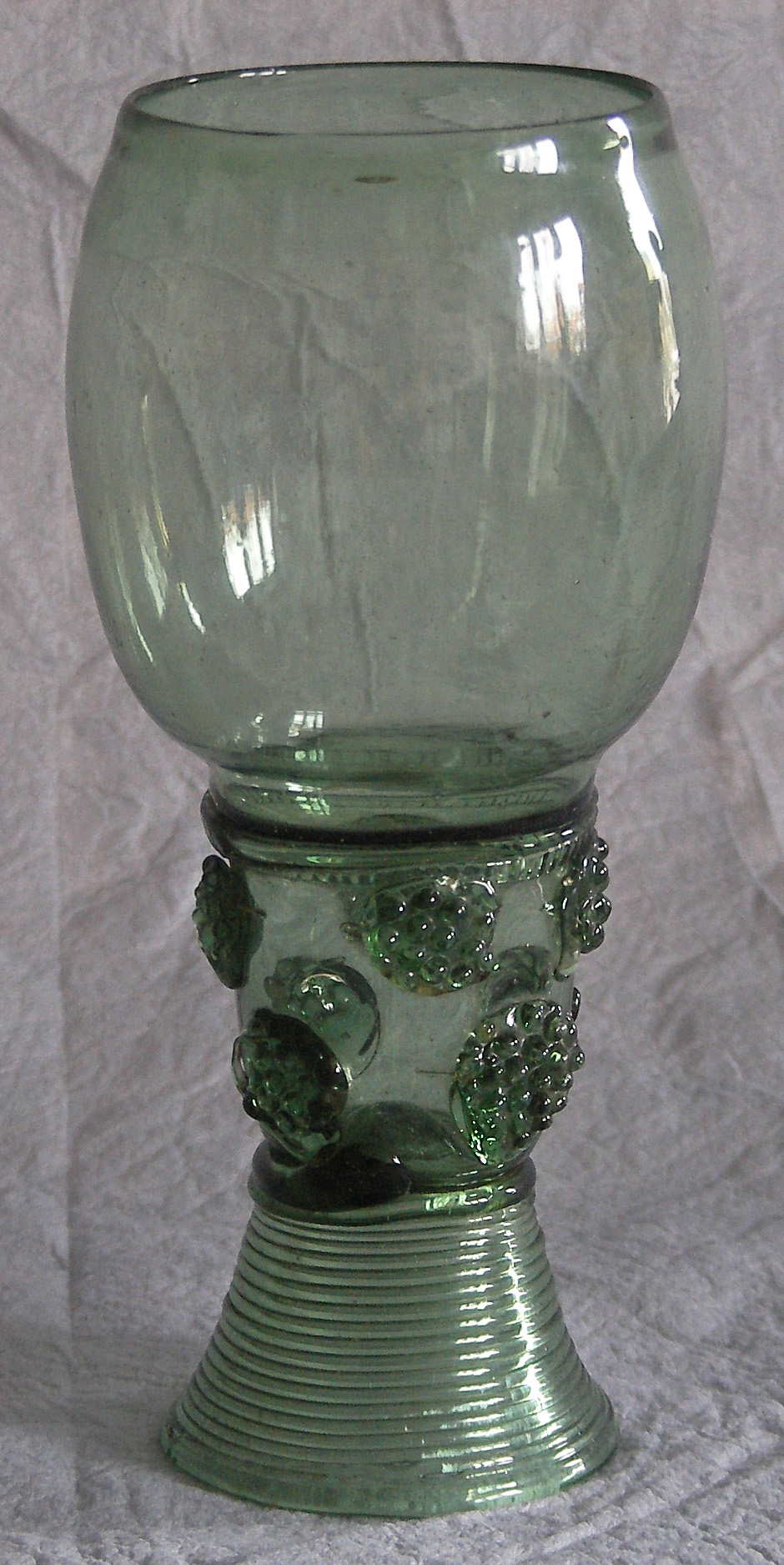
Forest glass (German: Waldglas) is a type of medieval glass produced in northwestern and central Europe from approximately 1000–1700 AD using wood ash and sand as the main raw materials and made in factories known as glasshouses in forest areas. It is characterized by a variety of greenish-yellow colors, the earlier products often being of crude design and poor quality, and was used mainly for everyday vessels and increasingly for ecclesiastical stained glass windows. Its composition and manufacture contrast sharply with Roman and pre-Roman glassmaking, centered on Mediterranean and contemporaneous Byzantine and Islamic glassmaking to the east.
While under Roman rule, the raw materials and manufacturing methods of northern Europe were those of the Roman tradition, using the mineral natron. For several centuries after the fall of the Western Roman Empire, around 450 AD, recycling of Roman glass formed the major part of the local industry and glassmaking skills declined. As the Carolingian Empire expanded in northwestern Europe approximately 800 AD, its demand for glass increased but the supply of traditional raw materials was costly and sporadic. An imperial desire to surpass the product quality of the declining Byzantine Empire and the Islamic Empire led to experimentation with new raw materials and the development of a new glassmaking technology.
Archaeologically, numerous medieval glasshouses have been found in western and central Europe, particularly in the mountains of Germany. Due to later reuse of the building material, most are poorly preserved, but there is evidence that both glassmaking and working were often done on the same site.
It is important to distinguish between glassmaking from raw materials and glass working, which is the production of finished articles by melting pieces of raw glass or cullet which may have been made elsewhere or by recycling old glass. Glass consists of four principal components:
In post-Roman times political problems in the Wadi El Natrun area disrupted the supply of natron so alternatives had to be developed. Eastern glassmakers reverted to using sodium-rich plant ash and for a while supplied southern Europe, using existing Roman trade routes. The Venetian glassmakers, who had inherited Roman glassmaking skills, monopolised the trade in plant ash and banned craftsmen from working outside the city. The remainder of Europe, north of the Alps, had to find another way of producing glass. The former and stabiliser components of glass occur in all regions as sand or quartz and as lime of various forms. The northern Europeans experimented with ash from wood, ferns and bracken as a source of the alkali flux. At its height the Roman glass industry was producing high quality, thin, colourless and clear glass of consistent composition. The earlier surviving Forest glass vessels are characterised by a wide variety of compositions and lower quality, often being greenish to brownish in colour, thick-walled, with inclusions and bubbles in the fabric. This suggests that using wood-ash was not merely a case of changing raw materials, but necessitated a whole new technology with attendant development problems.
Whereas Roman and earlier glass (of Si/Na/Ca composition) was of a marked uniformity over a wide area and centuries of time, the medieval glass (of Si/K/Ca composition) is characterised by a variety of compositions. This may be explained to some extent by examining how the melting temperature of glass depends on the relative proportions of its components, which for simplicity, are reduced to three. In practice glass contains many more components that complicate the system. The study of such ternary systems, together with analysis of trace elements is useful to archaeologists for establishing the provenance of glass.
It is believed that in pre-Medieval times the batch of raw materials was heated to a temperature where it partially melted, the unmelted parts removed and washed of non-reactive components, and added to the next batch. Because of the strong way that the Si/Na/Ca compositions affect the melting temperature, the resulting glass was of a fairly uniform composition regardless of the recipe of raw materials used. The melting temperatures of the Si/K/Ca glasses are not so strongly affected by composition, resulting in glasses of more varied composition, so the self-limiting features of the Na system that allowed the traditional partial-batch method to produce consistent compositions, ceased to apply, and a new way of controlling consistency had to be developed. The wide variety of compositions, together with historical accounts of glassmaking, suggest that the new method involved melting a complete batch of raw materials, removing the unreactive components as scum.
From approximately 1400 AD, in an effort to compete with the quality of Venetian glass, it was found that calcium oxide (CaO) added as flux to the sand-potash mix in the form of shells, limestone, or marble gave a clearer glass, by virtue of reducing the amount of potash required along with its attendant colorants.
Hub AI
Forest glass AI simulator
(@Forest glass_simulator)
Forest glass
Forest glass (German: Waldglas) is a type of medieval glass produced in northwestern and central Europe from approximately 1000–1700 AD using wood ash and sand as the main raw materials and made in factories known as glasshouses in forest areas. It is characterized by a variety of greenish-yellow colors, the earlier products often being of crude design and poor quality, and was used mainly for everyday vessels and increasingly for ecclesiastical stained glass windows. Its composition and manufacture contrast sharply with Roman and pre-Roman glassmaking, centered on Mediterranean and contemporaneous Byzantine and Islamic glassmaking to the east.
While under Roman rule, the raw materials and manufacturing methods of northern Europe were those of the Roman tradition, using the mineral natron. For several centuries after the fall of the Western Roman Empire, around 450 AD, recycling of Roman glass formed the major part of the local industry and glassmaking skills declined. As the Carolingian Empire expanded in northwestern Europe approximately 800 AD, its demand for glass increased but the supply of traditional raw materials was costly and sporadic. An imperial desire to surpass the product quality of the declining Byzantine Empire and the Islamic Empire led to experimentation with new raw materials and the development of a new glassmaking technology.
Archaeologically, numerous medieval glasshouses have been found in western and central Europe, particularly in the mountains of Germany. Due to later reuse of the building material, most are poorly preserved, but there is evidence that both glassmaking and working were often done on the same site.
It is important to distinguish between glassmaking from raw materials and glass working, which is the production of finished articles by melting pieces of raw glass or cullet which may have been made elsewhere or by recycling old glass. Glass consists of four principal components:
In post-Roman times political problems in the Wadi El Natrun area disrupted the supply of natron so alternatives had to be developed. Eastern glassmakers reverted to using sodium-rich plant ash and for a while supplied southern Europe, using existing Roman trade routes. The Venetian glassmakers, who had inherited Roman glassmaking skills, monopolised the trade in plant ash and banned craftsmen from working outside the city. The remainder of Europe, north of the Alps, had to find another way of producing glass. The former and stabiliser components of glass occur in all regions as sand or quartz and as lime of various forms. The northern Europeans experimented with ash from wood, ferns and bracken as a source of the alkali flux. At its height the Roman glass industry was producing high quality, thin, colourless and clear glass of consistent composition. The earlier surviving Forest glass vessels are characterised by a wide variety of compositions and lower quality, often being greenish to brownish in colour, thick-walled, with inclusions and bubbles in the fabric. This suggests that using wood-ash was not merely a case of changing raw materials, but necessitated a whole new technology with attendant development problems.
Whereas Roman and earlier glass (of Si/Na/Ca composition) was of a marked uniformity over a wide area and centuries of time, the medieval glass (of Si/K/Ca composition) is characterised by a variety of compositions. This may be explained to some extent by examining how the melting temperature of glass depends on the relative proportions of its components, which for simplicity, are reduced to three. In practice glass contains many more components that complicate the system. The study of such ternary systems, together with analysis of trace elements is useful to archaeologists for establishing the provenance of glass.
It is believed that in pre-Medieval times the batch of raw materials was heated to a temperature where it partially melted, the unmelted parts removed and washed of non-reactive components, and added to the next batch. Because of the strong way that the Si/Na/Ca compositions affect the melting temperature, the resulting glass was of a fairly uniform composition regardless of the recipe of raw materials used. The melting temperatures of the Si/K/Ca glasses are not so strongly affected by composition, resulting in glasses of more varied composition, so the self-limiting features of the Na system that allowed the traditional partial-batch method to produce consistent compositions, ceased to apply, and a new way of controlling consistency had to be developed. The wide variety of compositions, together with historical accounts of glassmaking, suggest that the new method involved melting a complete batch of raw materials, removing the unreactive components as scum.
From approximately 1400 AD, in an effort to compete with the quality of Venetian glass, it was found that calcium oxide (CaO) added as flux to the sand-potash mix in the form of shells, limestone, or marble gave a clearer glass, by virtue of reducing the amount of potash required along with its attendant colorants.