Hubbry Logo
NatronNatronMain
Open search
Natron
Community hub
Natron
logo
8 pages, 0 posts
0 subscribers
Be the first to start a discussion here.
Natron
Natron
from Wikipedia
Natron
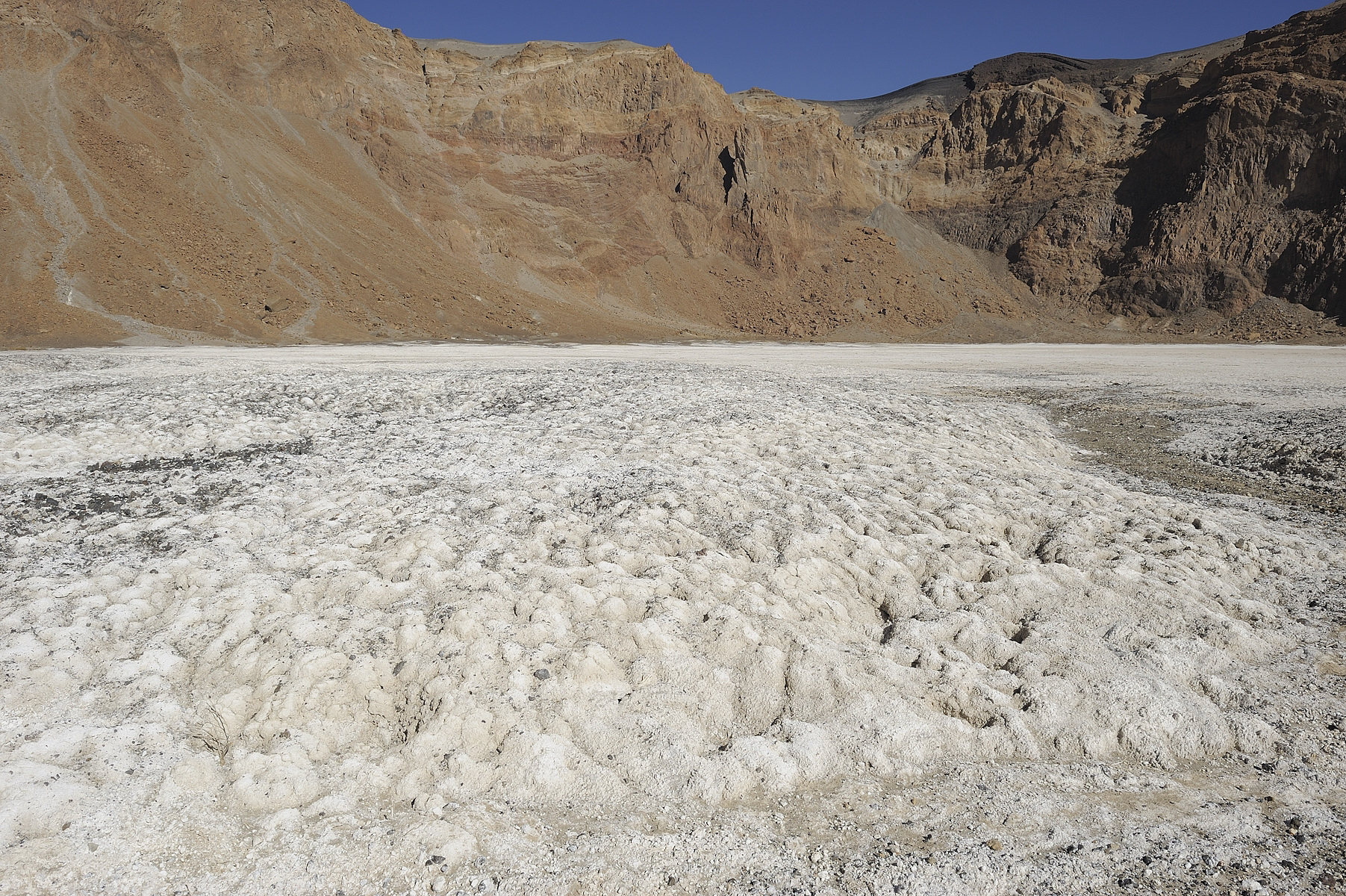
Natron deposits in the Era Kohor crater in the Tibesti Mountains, Chad
General
CategoryCarbonate mineral
FormulaNa2CO3·10H2O
IMA symbolNt[1]
Strunz classification5.CB.10
Dana classification15.01.02.01
Crystal systemMonoclinic
Crystal classPrismatic (2/m)
(same H-M symbol)
Space groupP2/m
Unit cella = 12.75 Å, b = 9 Å, c = 12.6 Å
β = 115.85°
Identification
ColourColourless to white, greyish, yellowish; colourless in transmitted light.
Crystal habitcrystalline, granular, and columnar crusts
Twinningon {001}
CleavageOn {001} distinct; on {010} imperfect; on {110} in traces.
FractureConchoidal
TenacityBrittle
Mohs scale hardness1 – 1.5
LustreVitreous
StreakWhite
DiaphaneityTransparent to translucent
Specific gravity1.478
Optical propertiesBiaxial (−)
Refractive indexnα = 1.405 nβ = 1.425 nγ = 1.440
Birefringenceδ = 0.035
2V angleMeasured: 71° , Calculated: 80°
SolubilitySoluble in water
References[2][3][4]

Natron is a naturally occurring mixture of sodium carbonate decahydrate (Na2CO3·10H2O, a kind of soda ash) and around 17% sodium bicarbonate (also called baking soda, NaHCO3) along with small quantities of sodium chloride and sodium sulfate. Natron is white to colourless when pure, varying to gray or yellow with impurities. Natron deposits are sometimes found in saline lake beds which arose in arid environments. Throughout history natron has had many practical applications that continue today in the wide range of modern uses of its constituent mineral components.

In modern mineralogy the term natron has come to mean only the sodium carbonate decahydrate (hydrated soda ash) that makes up most of the historical salt.

Natron deposits, Trou au Natron, Tibesti, Chad

Etymology

[edit]

The English and German word natron is a French cognate derived through the Spanish natrón from Latin natrium and Greek nitron (νίτρον). This derives from the Ancient Egyptian word nṯrj. Natron refers to Wadi El Natrun or Natron Valley in Egypt, from which natron was mined by the ancient Egyptians for use in burial rites. The modern chemical symbol for sodium, Na, is an abbreviation of that element's Neo-Latin name natrium, which was derived from natron. The name of the chemical element Nitrogen is also a cognate to natron, it derives from Greek nitron and -gen (a producer of something, in this case Nitric acid, which was produced from niter (nitre) (potassium nitrate)). Niter was also an obsolete name for natron because in earlier times, both minerals used to be confused with each other.

Importance in antiquity

[edit]
A faience vase fabricated in part from natron, dating to the New Kingdom of Egypt (c. 1450–1350 BC)

Historical natron was harvested directly as a salt mixture from dry lake beds in ancient Egypt, and has been used for thousands of years as a cleaning product for both the home and body. Blended with oil, it was an early form of soap. It softens water while removing oil and grease. Undiluted, natron was a cleanser for the teeth and an early mouthwash. The mineral was mixed into early antiseptics for wounds and minor cuts. Natron can be used to dry and preserve fish and meat. It was also an ancient household insecticide, and was used for making leather as well as a bleach for clothing.

The mineral was used during mummification ceremonies in ancient Egypt because it absorbs water and behaves as a drying agent. Moreover, when exposed to moisture, the carbonate in natron increases pH (raises alkalinity), which creates a hostile environment for bacteria. In some cultures, natron was thought to enhance spiritual safety for both the living and the dead. Natron was added to castor oil to make a smokeless fuel, which allowed Egyptian artisans to paint elaborate artworks inside ancient tombs without staining them with soot.

The Pyramid Texts describe how natron pellets were used as funerary offerings in the rites for the deceased pharaoh, "N". The ceremony required two kinds of natron, one sourced from northern (Lower) and one from southern (Upper) Egypt.

Smin, smin opens thy mouth. One pellet of natron.
O N., thou shalt taste its taste in front of the sḥ-ntr-chapels. One pellet of natron.
That which Horus spits out is smin. One pellet of natron.
That which Set spits out is smin. One pellet of natron.
That which the two harmonious gods (spit out) is smin. One pellet of natron.
To say four times: Thou hast purified thyself with natron, together with Horus (and) the Followers of Horus. Five pellets of natron from Nekheb, Upper Egypt.
Thou purifiest (thyself); Horus purifies (himself). One pellet of natron. Thou purifiest (thyself); Set purifies (himself). One pellet of natron.
Thou purifiest (thyself); Thot purifies (himself). One pellet of natron. Thou purifiest (thyself); the god purifies (himself). One pellet of natron.
Thou also purifiest (thyself)—thou who art among them. One pellet of natron.
Thy mouth is the mouth of a sucking calf on the day of his birth.
Five pellets of natron of the North, Wadi Natrûn (št-p.t)[5]

Natron is an ingredient for making a distinct color called Egyptian blue, and also as the flux in Egyptian faience. It was used along with sand and lime in ceramic and glass-making by the Romans and others at least until AD 640. The mineral was also employed as a flux to solder precious metals together.

Decline in use

[edit]

Most of natron's uses both in the home and by industry were gradually replaced with closely related sodium compounds and minerals. Natron's detergent properties are now commercially supplied by soda ash (pure sodium carbonate), the mixture's chief compound ingredient, along with other chemicals. Soda ash also replaced natron in glass-making. Some of its ancient household roles are also now filled by ordinary baking soda, which is sodium bicarbonate, natron's other key ingredient.

Chemistry of hydrated sodium carbonate

[edit]

Natron is also the mineralogical name for the compound sodium carbonate decahydrate (Na2CO3·10H2O), which is the main component in historical natron.[4]Sodium carbonate decahydrate has a specific gravity of 1.42 to 1.47 and a Mohs hardness of 1. It crystallizes in the monoclinic-domatic crystal system, typically forming efflorescences and encrustations.

The term hydrated sodium carbonate is commonly used to encompass the monohydrate (Na2CO3·H2O), the decahydrate and the heptahydrate (Na2CO3·7H2O), but is often used in industry to refer to the decahydrate only. Both the hepta- and the decahydrate effloresce (lose water) in dry air and are partially transformed into the monohydrate thermonatrite Na2CO3·H2O.

As a source of soda ash

[edit]

Sodium carbonate decahydrate is stable at room temperature but recrystallizes at only 32 °C (90 °F) to sodium carbonate heptahydrate, Na2CO3·7H2O, then above 37–38 °C (99–100 °F) to sodium carbonate monohydrate, Na2CO3·H2O. This recrystallization from decahydrate to monohydrate releases much crystal water in a mostly clear, colorless salt solution with little solid thermonatrite. The mineral natron is often found in association with thermonatrite, nahcolite, trona, halite, mirabilite, gaylussite, gypsum, and calcite. Most industrially produced sodium carbonate is soda ash (sodium carbonate anhydrate Na2CO3) which is obtained by calcination (dry heating at temperatures of 150 to 200 °C) of sodium bicarbonate, sodium carbonate monohydrate, or trona.

Geological occurrence

[edit]

Geologically, the mineral natron as well as the historical natron are formed as transpiro-evaporite minerals, i.e. crystallizing during the drying up of salt lakes rich in sodium carbonate. The sodium carbonate is usually formed by absorption of carbon dioxide from the atmosphere by a highly alkaline, sodium-rich lake brine, according to the following reaction scheme:

NaOH(aq) + CO2 → NaHCO3(aq)
NaHCO3(aq) + NaOH(aq) → Na2CO3(aq) + H2O

Pure deposits of sodium carbonate decahydrate are rare, due to the limited temperature stability of this compound and due to the fact that the absorption of carbon dioxide usually produces mixtures of bicarbonate and carbonate in solution. From such mixtures, the mineral natron (and also the historical one) will be formed only if the brine temperature during evaporation is maximally about 20 °C (68 °F) – or the alkalinity of the lake is so high, that little bicarbonate is present in solution (see reaction scheme above) – in which case the maximum temperature is increased to about 30 °C (86 °F). In most cases the mineral natron will form together with some amount of nahcolite (sodium bicarbonate), resulting in salt mixtures like the historical natron. Otherwise, the minerals trona[6] or thermonatrite and nahcolite are commonly formed. As the evaporation of a salt lake will occur over geological time spans, during which also part or all of the salt beds might redissolve and recrystallize, deposits of sodium carbonate can be composed of layers of all these minerals.

The following list may include geographical sources of either natron or other hydrated sodium carbonate minerals:

See also

[edit]

References

[edit]
[edit]
Revisions and contributorsEdit on WikipediaRead on Wikipedia
from Grokipedia
Natron is a naturally occurring with the Na₂CO₃·10H₂O, consisting primarily of hydrated . It forms as colorless to white, efflorescent crusts or masses in soda lakes and other arid saline environments, characterized by a , a Mohs of 1 to 1½, and a specific of approximately 1.46. The is highly soluble in , imparting an alkaline taste, and dehydrates to form thermonatrite upon exposure to air. In , natron played a pivotal role in mummification processes, where it served as a to remove moisture from bodies, preventing decay and preserving tissues for burial. Sourced mainly from deposits in the Wadi Natrun region, it was applied as a dry powder or in solution for about 40 days to the eviscerated corpse, often packed into body cavities and layered externally. This technique, documented in historical texts and confirmed through archaeological evidence, ensured long-term preservation without modern embalming chemicals. Beyond mummification, natron was essential in the production of vitreous materials, acting as a to lower melting points in early glazes, , and from the 4th millennium BCE onward. Egyptian deposits at Natrun and al-Barnuj supplied the mineral for these industries until the 7th–9th centuries CE, when shortages due to climate changes, political disruptions, and high demand led to its replacement by plant ash. Additionally, natron found applications in for treating dermatological conditions, imbalances, and parasitic infections; in and cookery; and in Greco-Roman therapeutic recipes, often applied externally across cultures in the and . Significant occurrences of natron include ancient mining sites in and modern deposits in regions like the ( and ) and , though it is best known through in Tanzania's . This shallow, endorheic , with a of 9–10.5, derives its name from the mineral due to its high natron content, which forms caustic salt crusts and supports unique , including the breeding grounds for 2.5 million lesser flamingos protected by the lake's harsh conditions. In August 2025, a proposed project that threatened the ecosystem was halted, preserving its status as a protected site.

Etymology and Historical Context

Etymology

The term "natron" derives from the ancient Egyptian word netjry (or nṯry), meaning "divine salt," which reflected its sacred status as a naturally occurring mixture of sodium salts harvested from Egyptian deposits. This nomenclature emphasized the substance's perceived purity and ritual importance in ancient Egyptian society. The word evolved linguistically through contact with other cultures, entering Greek as nitron (νίτρον), likely via trade routes in the eastern Mediterranean, and subsequently adopted into Latin as natronum or natrium during the Roman period. In medieval Arabic texts, it appeared as natrun or natrūn, preserving the root while adapting to Islamic scholarly traditions that documented Egyptian materials. This historical naming influenced modern scientific terminology, particularly in chemistry, where natrium—coined from natron by Swedish chemist Jöns Jacob Berzelius in 1814—served as the basis for the element sodium's Latin name and its periodic table symbol Na.

Significance in Ancient Civilizations

In , natron played a pivotal role in mummification practices, which began intentionally around 2600 BCE during the Fourth and Fifth Dynasties of . Embalmers covered the body with natron to absorb moisture and facilitate over approximately 40 days, preventing decay and preserving the corpse for the . This process, documented through archaeological remains of natron-encrusted and refuse in , underscored natron's essential function in funerary rituals across pharaonic periods. Beyond mummification, natron served as a key flux in the production of vitreous materials, including , glazes, and later , throughout , , and the Mediterranean region, with evidence of its use dating back to the early fourth millennium BCE. In and during the Late , natron was mixed with sand to lower melting temperatures, enabling the production of beads, vessels, and ornaments that circulated widely in . It also contributed to soap-like cleansing agents in , where it was combined with oils such as castor for washing linens and personal hygiene, as noted in papyri from around 210 BCE. In , particularly for in , natron was used as a possible flux in processes such as for jewelry and artifacts. Natron held profound cultural and religious significance in ancient Egyptian society, symbolizing purity and often used in rituals to cleanse participants before divine interactions. Priests ritually washed with natron solutions to achieve cultic purity, as described in temple inscriptions and medical texts like the . It featured in purification ceremonies, such as the "Opening of the Mouth" ritual, where natron was applied to statues or mummies to restore vitality and honor gods like . Offerings of natron to deities underscored its sacred status, linking it to themes of renewal and protection in religious practices. The economic importance of natron extended through extensive trade networks, with major deposits in Egypt's Wadi Natrun serving as a for exports to and from approximately 500 BCE to 300 CE. These routes, facilitated by ports and overland paths to the Mediterranean, supplied natron for and other industries, influencing economies in the Hellenistic and Roman periods as evidenced by chemical analyses of imported artifacts. While was a major supplier, recent indicates contributions from other sources, such as significant deposits in , integrating natron into broader Mediterranean exchange systems.

Decline and Transition to Modern Uses

The prominence of natron as a primary source of waned significantly after antiquity due to the advent of industrial synthetic production methods that offered greater scalability and cost efficiency. The , developed in 1791 by Nicolas Leblanc, enabled the manufacture of soda ash from abundant common salt, , and , diminishing the economic viability of importing natron from distant Egyptian deposits, which incurred high transportation costs and supply inconsistencies. By the mid-19th century, the , patented in 1861 by , further supplanted natural sources through its more efficient ammonia-soda method, which reduced production expenses and environmental waste compared to Leblanc while rendering imported natron obsolete for large-scale industrial applications like glassmaking and soap production. The industrial use of Egyptian natron declined sharply in the as global demand shifted to more accessible natural alternatives, particularly deposits in the United States. The vast reserves in Wyoming's Green River Basin, estimated at over 127 billion tons, began commercial extraction in the , with the first mine shaft in Sweetwater County operational by 1946; this development provided a cheaper, local natural soda source that outcompeted both synthetic methods and residual Egyptian natron . Today, natron persists in niche, non-industrial roles that echo its historical versatility while emphasizing . It is incorporated into artisanal soap-making, where its alkaline properties blend with oils to form , eco-friendly cleansers reminiscent of ancient formulations, often marketed for purification in products inspired by Egyptian rituals. In traditional West African practices, particularly among communities in regions like and , natron serves as a detergent for household cleaning, a in cooking, and an ingredient in crafts such as glazing and processing. Additionally, there has been a modest revival in historical reenactments and demonstrations, where natron is employed to recreate ancient mummification and purification techniques, fostering educational engagement with Egypt's cultural heritage. From an environmental and economic perspective, natural natron extraction aligns better with modern sustainability goals than synthetic soda ash production. Natural processes, including trona mining akin to natron harvesting, emit 0.3 to 0.7 metric tons of CO₂ per ton of product, significantly less than the higher energy-intensive and pollution-heavy outputs of the , which generates substantial waste and emissions. This lower footprint has spurred interest in natron for green consumer products, though its limited deposits constrain broader revival compared to synthetic alternatives' scalability.

Chemical Composition and Properties

Molecular Structure and Formulas

Natron is a naturally occurring mineral primarily composed of decahydrate, with the chemical formula \ceNa2CO310H2O\ce{Na2CO3 \cdot 10H2O}, alongside approximately 17% (\ceNaHCO3\ce{NaHCO3}), and minor impurities such as (\ceNaCl\ce{NaCl}) and (\ceNa2SO4\ce{Na2SO4}). This composition reflects its formation in alkaline lake environments, where varying hydration and ionic substitutions lead to an indefinite in natural deposits. The of pure natron ( decahydrate) belongs to the monoclinic system, with Cc, featuring granular to fine crystalline habits often appearing as efflorescent crusts due to partial in air. The unit cell parameters are approximately a=12.75a = 12.75 Å, b=9.00b = 9.00 Å, c=12.59c = 12.59 Å, and β=115.85\beta = 115.85^\circ, with Z=4Z = 4, accommodating the layered arrangement of ions and water molecules that contribute to its hygroscopic and efflorescent nature. The decahydrate form remains stable below approximately 32°C, but upon exposure to higher temperatures or dry conditions, it undergoes phase transitions by losing molecules, first forming the heptahydrate (\ceNa2CO37H2O\ce{Na2CO3 \cdot 7H2O}) around 32–35°C, then progressing to the monohydrate (\ceNa2CO3H2O\ce{Na2CO3 \cdot H2O}) above 35°C, and ultimately to anhydrous (soda ash, \ceNa2CO3\ce{Na2CO3}) upon further heating beyond 100°C. These hydration states and transitions are critical to understanding natron's behavior in both natural and processed forms. Historically, natron was recognized in ancient times as a form of "soda" or mineral based on its alkaline properties and uses, with early chemical analyses by in the late identifying it as a hydrated , though his proposed formula included mixtures with . In the , more precise confirmation of its composition came through advanced analytical techniques, including spectroscopic methods that verified the presence of and ions alongside impurities.

Physical and Chemical Properties

Natron occurs as white to colorless crystals or a fine , often appearing vitreous in luster and semitransparent, though impurities may impart grayish or yellowish hues. Its density ranges from 1.46 to 1.48 g/cm³, and it exhibits a Mohs of 1 to 1.5, making it soft and brittle with distinct cleavage on the {001} plane. In dry air, natron readily effloresces, losing water of hydration to form the monohydrate thermonatrite. Natron is highly soluble in , dissolving at approximately 21 g per 100 mL at 20°C to yield an alkaline solution with a around 11. This solubility contributes to its alkaline and behavior as a base in aqueous environments. Chemically, natron acts as a base, reacting with acids to produce gas, as exemplified by the reaction with : \ceNa2CO3+2HCl>2NaCl+H2O+CO2\ce{Na2CO3 + 2HCl -> 2NaCl + H2O + CO2} This arises from the ion's interaction with protons. Upon heating above 100°C, natron undergoes , progressively losing to yield anhydrous (soda ash). While non-toxic upon ingestion in small quantities, natron is an irritant to and eyes, potentially causing redness, discomfort, or serious upon direct contact.

Role as Soda Ash Precursor

Natron serves as a key natural precursor to soda ash (anhydrous , Na₂CO₃), which is produced through thermal processing of the mineral's hydrated and bicarbonated components. The primary method involves , where natron—typically a mixture of sodium carbonate decahydrate (Na₂CO₃·10H₂O), (NaHCO₃), and minor salts—is heated to 150–200°C. This drives off water from the hydrate and decomposes the bicarbonate, releasing CO₂ and additional water, resulting in crude soda ash. The key reactions are: Na2CO310H2ONa2CO3+10H2O\text{Na}_2\text{CO}_3 \cdot 10\text{H}_2\text{O} \rightarrow \text{Na}_2\text{CO}_3 + 10\text{H}_2\text{O} 2NaHCO3Na2CO3+CO2+H2O2\text{NaHCO}_3 \rightarrow \text{Na}_2\text{CO}_3 + \text{CO}_2 + \text{H}_2\text{O} Due to natron's composition, this yields approximately 50–60% anhydrous Na₂CO₃ by weight from the raw mineral. To achieve commercial-grade purity, the calcined product undergoes washing and purification, often involving dissolution in water to separate soluble impurities like sodium chloride (NaCl) and sodium sulfate (Na₂SO₄), followed by filtration and recrystallization. This results in soda ash with 90–99% purity, comparable to or exceeding that from the synthetic Solvay process, which reacts sodium chloride, ammonia, and limestone but requires more steps for impurity removal. While the Solvay process offers high efficiency in regions without natural deposits, natural methods from minerals like natron are generally lower in cost due to simpler extraction and reduced chemical inputs. Soda ash derived from natron is vital in several industries, acting as a flux in manufacturing to lower silica's melting point and improve durability, as a water-softening builder in detergents to precipitate calcium and magnesium ions, and in production to regulate and aid bleaching processes. Globally, soda ash production reached about 66 million metric tons in 2023, with approximately 30% sourced from natural minerals such as and natron, primarily from deposits and . Compared to synthetic production, processing natron into soda ash consumes less energy—avoiding the and in the Solvay method—and emits lower CO₂ levels, making it more environmentally favorable in terms of operational emissions. However, natural sourcing involves mining-related impacts, including habitat disruption and water use, which necessitate careful management to mitigate ecological effects.

Geological Occurrence and Extraction

Natural Formation Processes

Natron primarily forms through evaporative processes in alkaline lakes and soda flats within arid climates, where sodium-rich s concentrate and precipitate as water evaporates, leaving behind hydrated minerals. These brines originate from or surface waters enriched in sodium, often derived from of sodium-bearing rocks, and achieve high (pH >9) due to the absence of significant calcium and magnesium, which would otherwise form less soluble carbonates. The precipitation of natron involves the absorption of atmospheric or volcanic CO₂ into the alkaline brines, forming ions that react to produce sodium carbonate decahydrate under supersaturated conditions. Additionally, silica reactions play a role in the brine evolution, as dissolved silica from volcanic sources increases at high pH, contributing to the overall chemical stratification and stability in these environments. In closed-basin lakes, natron deposits are commonly associated with other evaporite minerals such as (sodium sesquicarbonate), (sodium chloride), and gaylussite (sodium calcium carbonate hydrate), which co-precipitate as brine salinity rises. Volcanic activity enhances sodium availability by introducing sodium ions through hot springs, ash falls, or hydrothermal fluids, which mix with lake waters and promote the development of these mineral assemblages. These associations occur in endorheic (inland drainage) basins, where outflow is limited, allowing progressive evaporation to build layered sequences. Natron deposits accumulate over millennia in such endorheic basins, driven by long-term climatic shifts that favor and over . In , for instance, Pleistocene drying events intensified in rift valley basins, leading to the concentration of brines and the formation of extensive natron layers during periods of heightened . Modern analogs of natron formation continue in the lakes, such as in , where ongoing evaporation of sodium- and silica-rich brines from geothermal springs sustains active precipitation of natron and related carbonates in a hyperalkaline environment. This process mirrors ancient formations, providing insights into the dynamic interplay of tectonics, volcanism, and climate in systems.

Major Global Deposits

Significant natron deposits occur in Wadi El Natrun, a depression in northern Egypt's Western Desert, which has served as a key ancient source for this mineral since approximately 3000 BCE. This site features extensive evaporitic basins with layers of hydrated sodium carbonate accumulated over millennia. The deposits here are noted for their high purity, making them ideal for historical applications such as mummification and glass production. Other notable deposits occur in the region, spanning and , where surface crusts form on the lake's margins due to evaporation in the Sahelian climate. These crusts provide a renewable but variable resource, exploited locally for salt and traditional uses. In , historically yielded soda ash from evaporite minerals such as through solar evaporation processes starting in the late , though the lake has since dried completely due to water diversions, ending commercial extraction by the mid-20th century. In , the area contains deposits associated with dry lake beds, contributing to U.S. soda ash production. In , and related deposits in the Plateau represent important modern sources. In (modern ), major deposits around and adjacent lakes such as Lake Erçek and Lake Arin hold substantial reserves, estimated in billions of tons for alone, potentially serving as significant sources beyond ancient Egyptian supplies. in represents an active volcanic with substantial subsurface deposits of . Exploration history ties modern understanding to 19th-century surveys, such as those by French chemist Claude-Louis Berthollet, which confirmed connections between Wadi El Natrun's deposits and ancient Mediterranean trade networks.

Mining and Processing Methods

Natron extraction primarily involves surface methods for shallow deposits in arid lake basins, where workers manually scrape or dig the crusts using tools like shovels and picks, particularly in African regions such as around . This labor-intensive approach targets the efflorescent layers formed by , yielding raw natron blocks that are transported by hand or animal for initial use or processing. In contrast, deeper beds, analogous to deposits mined in the United States since the 1950s, employ solution mining techniques that inject hot water—typically at temperatures around 60–80°C—into underground formations to dissolve the mineral into a solution, which is then pumped to the surface for recovery. Processing begins with preparation of the extracted material: surface-collected natron is crushed to uniform size, while solution-mined brine undergoes initial settling. The crushed ore or brine is then dissolved in water to form a saturated solution, followed by filtration to remove impurities such as silica, clay, and organic matter, often using settling ponds or mechanical filters. Purification yields a clear liquor that is concentrated through evaporation—traditionally via solar drying in arid climates like those of , which leverages natural heat to crystallize sodium carbonate decahydrate efficiently and with low energy input. For industrial-scale operations, mechanical evaporators or calciners may follow to produce denser forms, but solar methods remain prevalent in regions with abundant sunlight to minimize fossil fuel dependence. Post-2000s advancements emphasize , including systems that recapture and reuse process water, reducing freshwater consumption by up to 50% in modern facilities and mitigating wastewater discharge into sensitive ecosystems. In , , proposed mechanized —using excavators to harvest submerged deposits—has been explored but largely halted due to environmental concerns, favoring instead hybrid approaches that integrate manual oversight with automated pumps for minimal disturbance. These eco-methods address gaps in earlier practices by incorporating closed-loop systems and low-impact equipment, aligning with global standards for resource extraction in alkaline wetlands. Key challenges in natron mining include dust control during dry-season scraping, which requires wetting agents or enclosures to prevent airborne particulates from affecting air quality and nearby , and habitat disruption in ecologically vital areas like , a critical breeding ground for lesser flamingos where extraction activities can alter water chemistry and nesting sites, leading to population declines. Balancing economic yields with biodiversity conservation remains a priority, with ongoing monitoring to limit impacts on avian habitats through seasonal restrictions and buffer zones.

References

Add your contribution
Related Hubs
User Avatar
No comments yet.