
Recent from talks
Fort Frontenac
Knowledge base stats:
Talk channels stats:
Members stats:
Fort Frontenac
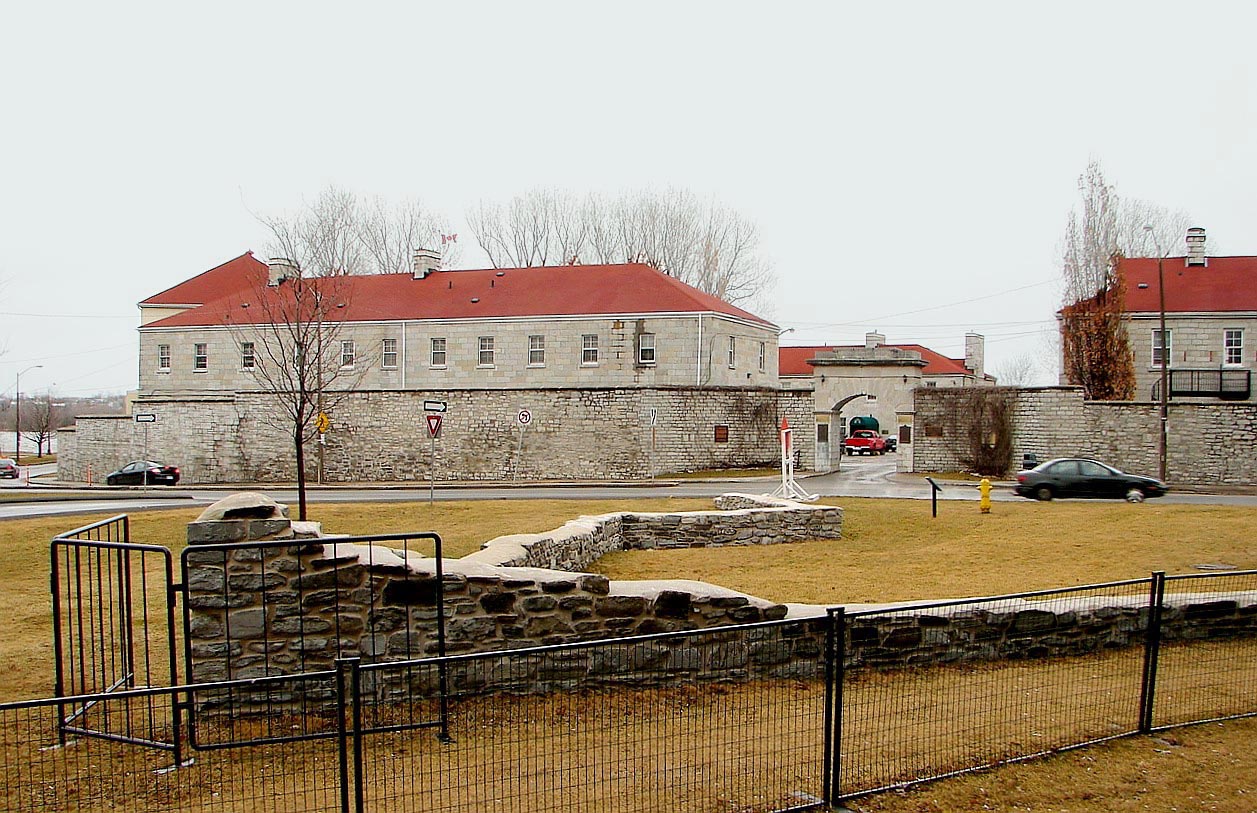
Fort Frontenac was a French trading post and military fort built in July 1673 at the mouth of the Cataraqui River where the St. Lawrence River leaves Lake Ontario (at what is now the western end of the La Salle Causeway), in a location traditionally known as Cataraqui. It is the present-day location of Kingston, Ontario, Canada. The original fort, a crude, wooden palisade structure, was called Fort Cataraqui but was later named for Louis de Buade de Frontenac, Governor of New France who was responsible for building the fort. It was abandoned and razed in 1689, then rebuilt in 1695.
The British destroyed the fort in 1758 during the Seven Years' War and its ruins remained abandoned until the British took possession and reconstructed it in 1783. In 1870–71 the fort was turned over to the Canadian military, who continue to use it.
The intent of Fort Frontenac was to control the lucrative fur trade in the Great Lakes Basin to the west and the Canadian Shield to the north. It was one of many French outposts that would be established throughout the Great Lakes and upper Mississippi regions. The fort was meant to be a bulwark against the English who were competing with the French for control of the fur trade. By constructing the trading post the French could encourage trade with the Iroquois, who were traditionally a threat to the French because of their alliance with the English. Another function of the fort was the provision of supplies and reinforcements to other French installations on the Great Lakes and in the Ohio Valley to the south.
Explorer René Robert Cavalier de La Salle was ordered by governor Daniel de Rémy de Courcelle to select a location for a fort. He selected the strategic junction of Lake Ontario, the Cataraqui River, and the St. Lawrence River. Governor Louis de Buade de Frontenac, de Courcelle's successor, was concerned about further Iroquois threats, and endorsed La Salle's proposal. Governor Frontenac and his close associates also hoped to personally benefit from building the fort by controlling trade. Frontenac, along with his entourage, journeyed up the St. Lawrence to the fort's future site where he met leaders of the Five Nations of the Iroquois on July 12, 1673 to encourage them to trade with the French, and to begin the fort's construction. The fort, which was constructed of wood surrounded by a wooden stockade consisting of sharpened poles, was completed within six days. La Salle administered the fort and built storage buildings and dwellings, brought in domestic animals and ensured some land outside the fort was cultivated with the aim of attracting settlers.
The fort was sited to protect a small sheltered bay (the "cannotage") that the French could use as a harbour for large lake-going boats. Unlike the Ottawa River fur trade route into the interior, which was only accessible by canoes, larger vessels could easily navigate the lower lakes. The cost of transporting goods such as furs, trade items, and supplies through at least the lower Great Lakes would be reduced.
La Salle was granted seigneurial privileges in the vicinity of the fort. In return for these privileges, La Salle was obliged to reimburse Frontenac for expenses related to building the fort, keep 20 workers onsite for two years, and maintain the fort. In 1675, La Salle rebuilt the structure. Stone bastions and a stone wall were constructed to strengthen the fort and much of the wooden pallisade was rebuilt. He was also required to attract settlers and meet their spiritual needs by building a chapel and establishing a mission with one or two Recollet priests. A description of the fort written in the 17th century mentions that:
Three quarters of it are of masonry or hardstone, the wall is three feet thick and twelve high. There is one place where it is only four feet, not being completed. The remainder is closed in with stakes. There is inside a house of squared logs, a hundred feet long. There is also a blacksmith's shop a guardhouse, a house for the officers, a well, and a cow-house. The ditches are fifteen feet wide. There is a good amount of land cleared and sown around about, in which a hundred paces away or almost there is a barn for storing the harvest. There are quite near the fort several French houses, an Iroquois village, a convent and a Recollet church.
La Salle used Fort Frontenac as a convenient base for his explorations into the interior of North America.
Hub AI
Fort Frontenac AI simulator
(@Fort Frontenac_simulator)
Fort Frontenac
Fort Frontenac was a French trading post and military fort built in July 1673 at the mouth of the Cataraqui River where the St. Lawrence River leaves Lake Ontario (at what is now the western end of the La Salle Causeway), in a location traditionally known as Cataraqui. It is the present-day location of Kingston, Ontario, Canada. The original fort, a crude, wooden palisade structure, was called Fort Cataraqui but was later named for Louis de Buade de Frontenac, Governor of New France who was responsible for building the fort. It was abandoned and razed in 1689, then rebuilt in 1695.
The British destroyed the fort in 1758 during the Seven Years' War and its ruins remained abandoned until the British took possession and reconstructed it in 1783. In 1870–71 the fort was turned over to the Canadian military, who continue to use it.
The intent of Fort Frontenac was to control the lucrative fur trade in the Great Lakes Basin to the west and the Canadian Shield to the north. It was one of many French outposts that would be established throughout the Great Lakes and upper Mississippi regions. The fort was meant to be a bulwark against the English who were competing with the French for control of the fur trade. By constructing the trading post the French could encourage trade with the Iroquois, who were traditionally a threat to the French because of their alliance with the English. Another function of the fort was the provision of supplies and reinforcements to other French installations on the Great Lakes and in the Ohio Valley to the south.
Explorer René Robert Cavalier de La Salle was ordered by governor Daniel de Rémy de Courcelle to select a location for a fort. He selected the strategic junction of Lake Ontario, the Cataraqui River, and the St. Lawrence River. Governor Louis de Buade de Frontenac, de Courcelle's successor, was concerned about further Iroquois threats, and endorsed La Salle's proposal. Governor Frontenac and his close associates also hoped to personally benefit from building the fort by controlling trade. Frontenac, along with his entourage, journeyed up the St. Lawrence to the fort's future site where he met leaders of the Five Nations of the Iroquois on July 12, 1673 to encourage them to trade with the French, and to begin the fort's construction. The fort, which was constructed of wood surrounded by a wooden stockade consisting of sharpened poles, was completed within six days. La Salle administered the fort and built storage buildings and dwellings, brought in domestic animals and ensured some land outside the fort was cultivated with the aim of attracting settlers.
The fort was sited to protect a small sheltered bay (the "cannotage") that the French could use as a harbour for large lake-going boats. Unlike the Ottawa River fur trade route into the interior, which was only accessible by canoes, larger vessels could easily navigate the lower lakes. The cost of transporting goods such as furs, trade items, and supplies through at least the lower Great Lakes would be reduced.
La Salle was granted seigneurial privileges in the vicinity of the fort. In return for these privileges, La Salle was obliged to reimburse Frontenac for expenses related to building the fort, keep 20 workers onsite for two years, and maintain the fort. In 1675, La Salle rebuilt the structure. Stone bastions and a stone wall were constructed to strengthen the fort and much of the wooden pallisade was rebuilt. He was also required to attract settlers and meet their spiritual needs by building a chapel and establishing a mission with one or two Recollet priests. A description of the fort written in the 17th century mentions that:
Three quarters of it are of masonry or hardstone, the wall is three feet thick and twelve high. There is one place where it is only four feet, not being completed. The remainder is closed in with stakes. There is inside a house of squared logs, a hundred feet long. There is also a blacksmith's shop a guardhouse, a house for the officers, a well, and a cow-house. The ditches are fifteen feet wide. There is a good amount of land cleared and sown around about, in which a hundred paces away or almost there is a barn for storing the harvest. There are quite near the fort several French houses, an Iroquois village, a convent and a Recollet church.
La Salle used Fort Frontenac as a convenient base for his explorations into the interior of North America.
Recent media