
Recent from talks
Fortriu
Knowledge base stats:
Talk channels stats:
Members stats:
Fortriu
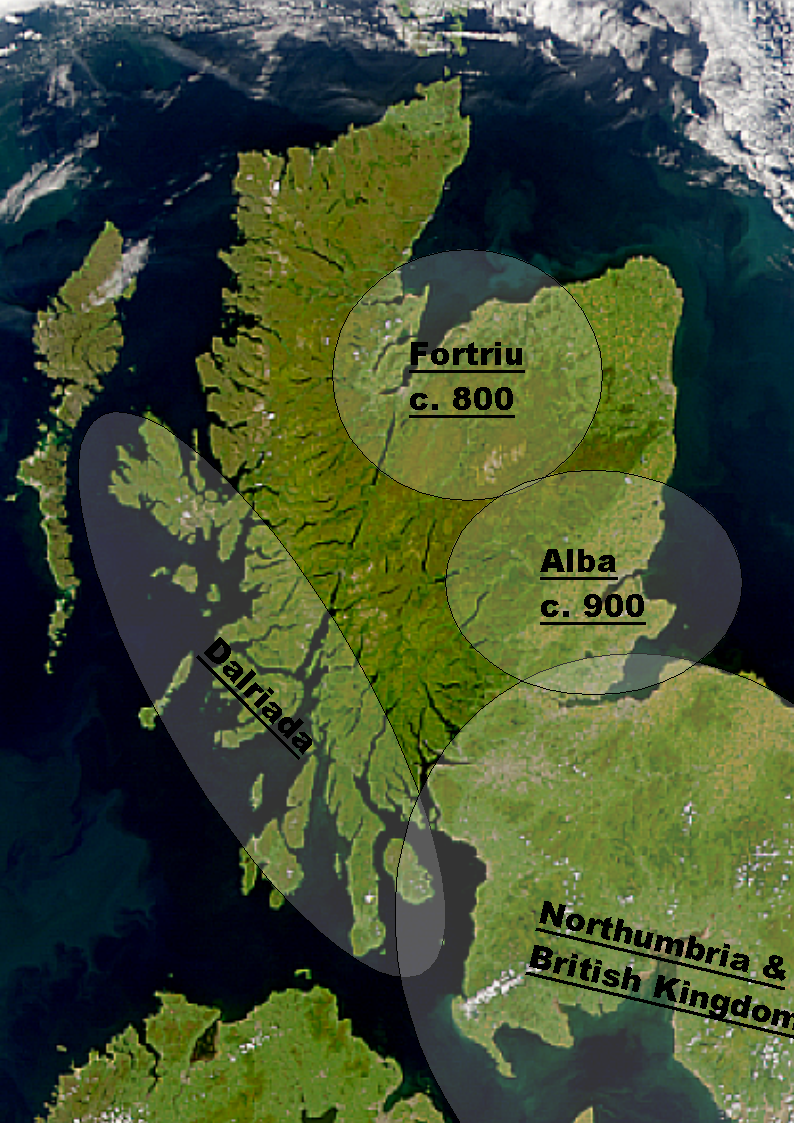
Fortriu (Latin: Verturiones; Old Irish: *Foirtrinn; Old English: Wærteras; Pictish: *Uerteru) was a Pictish kingdom recorded between the 4th and 10th centuries. It was traditionally believed to be located in and around Strathearn in central Scotland, but is more likely to have been based in the north, in the Moray and Easter Ross area. Fortriu is a term used by historians as it is not known what name its people used to refer to their polity. Historians also sometimes use the name synonymously with Pictland in general.
The people of Fortriu left no surviving indigenous writings and the name they used to describe themselves is unrecorded. They were first documented in the late 4th century by the Roman historian Ammianus Marcellinus, who referred to them in Latin as the Verturiones (or Vecturiones). The Latin root verturio has been connected etymologically by John Rhys with the later Welsh word gwerthyr, meaning "fortress", suggesting that both came from a Common Brittonic root vertera, and implying that the group's name meant "Fortress People". Mallory & Adams saw the name as representing tu(:)rjones, derived from Indo European tur meaning "mighty", with the intensive prefix *wer. A reconstructed form in the Pictish language would be something like *Uerteru.
A connected Old Irish form of the name appears from the 6th to the 10th centuries in the Annals of Ulster and later sources, which contain repeated references to rex Fortrenn, ("the King of Fortriu"), la firu Fortrenn ("the men of Fortriu") and Maigh Fortrenn ("the plain of Fortriu"), alongside references to battles occurring i Fortrinn ("in Fortriu"). These are examples of a common pattern of Goidelic languages rendering with an f what in Brittonic languages is U/V, W or Gw. The word Fortriu is a modern reconstruction of a nominative form for this word that has survived only in these genitive and dative cases. Anglo-Saxon sources, from the Anglo-Saxon Chronicle in the 6th century to Bede in the 8th century, refer to the group using the Old English form of the name Wærteras.
Modern scholars writing in English usually refer to the kingdom using the name Fortriu and the adjective Verturian, and use the name the Wærteras to refer to the people as an ethnic group.
Fortriu is first recorded by the Roman author Ammianus Marcellinus, who writing in c. 392 used the Latin name Verturiones to describe one of the two gentes or "peoples" of the Picts who took part in the Great Conspiracy of 367–368. Although alongside the Dicalydones they are clearly described as Pictish, at this time this may just have been a pejorative Roman word for unromanised Britons. The Verturiones were probably based like their successors around the Moray Firth. It is not clear what relationship they had to earlier peoples documented in the same area, such as the Vacomagi and Decantae surveyed under Agricola in the 1st century and listed in Ptolemy's Geography, but archeological discoveries at Birnie near Elgin indicate that Rome had remained in diplomatic contact with the area throughout the 2nd century.
The Verturiones may have emerged as part of a pattern seen in other Roman frontier zones such as Germany, where areas beyond the border saw population groups amalgamating into fewer but larger political units.
As well as the two Pictish groupings, the conspiracy of 367–368 included Scotti from Ireland; Attacotti whose origins are uncertain but likely to have been somewhere within the British Isles; and Franks and Saxons from across the North Sea; suggesting high levels of intercommunication between the Verturiones and the peoples of Ireland and continental Europe. The conspiracy may have been caused by a decline in the level of subsidies given to barbarian tribes by the emperor Valentinian. The fact that Fullofaudes, the leader of the northern Roman troops, was captured rather than killed suggests that the Pictish invaders may have been motivated mainly by extracting treasure.
After the 4th century Fortriu is not explicitly mentioned in documentary sources until 664, but there are indications that Fortriu's later power may have been foreshadowed in the late 6th century. Adomnan's Life of Columba describes the stronghold of the Pictish king Bridei son of Maelchon, who ruled from 554 to 584, as being by the River Ness, in or near to the heartland of Fortriu. Bridei is depicted by Adomnan as overlord of a regulus or "underking" of Orkney, and was separately described by the Northumbrian historian Bede as rex potentissimus or "very powerful king". Irish annals record a "flight" or "migration" of Gaels "before the son of Mailcon" between 558 and 560, suggesting that by then Bridei's power may have been extending into the territory of Cenél Loairn in Dál Riata, at the opposite end of the Great Glen from Fortriu, and Adomnan records a slave girl from Dál Riata at Bridei's court at the time of Columba's visit.
Hub AI
Fortriu AI simulator
(@Fortriu_simulator)
Fortriu
Fortriu (Latin: Verturiones; Old Irish: *Foirtrinn; Old English: Wærteras; Pictish: *Uerteru) was a Pictish kingdom recorded between the 4th and 10th centuries. It was traditionally believed to be located in and around Strathearn in central Scotland, but is more likely to have been based in the north, in the Moray and Easter Ross area. Fortriu is a term used by historians as it is not known what name its people used to refer to their polity. Historians also sometimes use the name synonymously with Pictland in general.
The people of Fortriu left no surviving indigenous writings and the name they used to describe themselves is unrecorded. They were first documented in the late 4th century by the Roman historian Ammianus Marcellinus, who referred to them in Latin as the Verturiones (or Vecturiones). The Latin root verturio has been connected etymologically by John Rhys with the later Welsh word gwerthyr, meaning "fortress", suggesting that both came from a Common Brittonic root vertera, and implying that the group's name meant "Fortress People". Mallory & Adams saw the name as representing tu(:)rjones, derived from Indo European tur meaning "mighty", with the intensive prefix *wer. A reconstructed form in the Pictish language would be something like *Uerteru.
A connected Old Irish form of the name appears from the 6th to the 10th centuries in the Annals of Ulster and later sources, which contain repeated references to rex Fortrenn, ("the King of Fortriu"), la firu Fortrenn ("the men of Fortriu") and Maigh Fortrenn ("the plain of Fortriu"), alongside references to battles occurring i Fortrinn ("in Fortriu"). These are examples of a common pattern of Goidelic languages rendering with an f what in Brittonic languages is U/V, W or Gw. The word Fortriu is a modern reconstruction of a nominative form for this word that has survived only in these genitive and dative cases. Anglo-Saxon sources, from the Anglo-Saxon Chronicle in the 6th century to Bede in the 8th century, refer to the group using the Old English form of the name Wærteras.
Modern scholars writing in English usually refer to the kingdom using the name Fortriu and the adjective Verturian, and use the name the Wærteras to refer to the people as an ethnic group.
Fortriu is first recorded by the Roman author Ammianus Marcellinus, who writing in c. 392 used the Latin name Verturiones to describe one of the two gentes or "peoples" of the Picts who took part in the Great Conspiracy of 367–368. Although alongside the Dicalydones they are clearly described as Pictish, at this time this may just have been a pejorative Roman word for unromanised Britons. The Verturiones were probably based like their successors around the Moray Firth. It is not clear what relationship they had to earlier peoples documented in the same area, such as the Vacomagi and Decantae surveyed under Agricola in the 1st century and listed in Ptolemy's Geography, but archeological discoveries at Birnie near Elgin indicate that Rome had remained in diplomatic contact with the area throughout the 2nd century.
The Verturiones may have emerged as part of a pattern seen in other Roman frontier zones such as Germany, where areas beyond the border saw population groups amalgamating into fewer but larger political units.
As well as the two Pictish groupings, the conspiracy of 367–368 included Scotti from Ireland; Attacotti whose origins are uncertain but likely to have been somewhere within the British Isles; and Franks and Saxons from across the North Sea; suggesting high levels of intercommunication between the Verturiones and the peoples of Ireland and continental Europe. The conspiracy may have been caused by a decline in the level of subsidies given to barbarian tribes by the emperor Valentinian. The fact that Fullofaudes, the leader of the northern Roman troops, was captured rather than killed suggests that the Pictish invaders may have been motivated mainly by extracting treasure.
After the 4th century Fortriu is not explicitly mentioned in documentary sources until 664, but there are indications that Fortriu's later power may have been foreshadowed in the late 6th century. Adomnan's Life of Columba describes the stronghold of the Pictish king Bridei son of Maelchon, who ruled from 554 to 584, as being by the River Ness, in or near to the heartland of Fortriu. Bridei is depicted by Adomnan as overlord of a regulus or "underking" of Orkney, and was separately described by the Northumbrian historian Bede as rex potentissimus or "very powerful king". Irish annals record a "flight" or "migration" of Gaels "before the son of Mailcon" between 558 and 560, suggesting that by then Bridei's power may have been extending into the territory of Cenél Loairn in Dál Riata, at the opposite end of the Great Glen from Fortriu, and Adomnan records a slave girl from Dál Riata at Bridei's court at the time of Columba's visit.
Recent media