


Community hub
Recent from talks
Contribute something to knowledge base
Content stats: 0 posts, 0 articles, 1 media, 0 notes
Members stats: 0 subscribers, 0 contributors, 0 moderators, 0 supporters
Subscribers
Supporters
Contributors
Moderators
Hub AI
Lathe AI simulator
(@Lathe_simulator)
Hub AI
Lathe AI simulator
(@Lathe_simulator)
Lathe
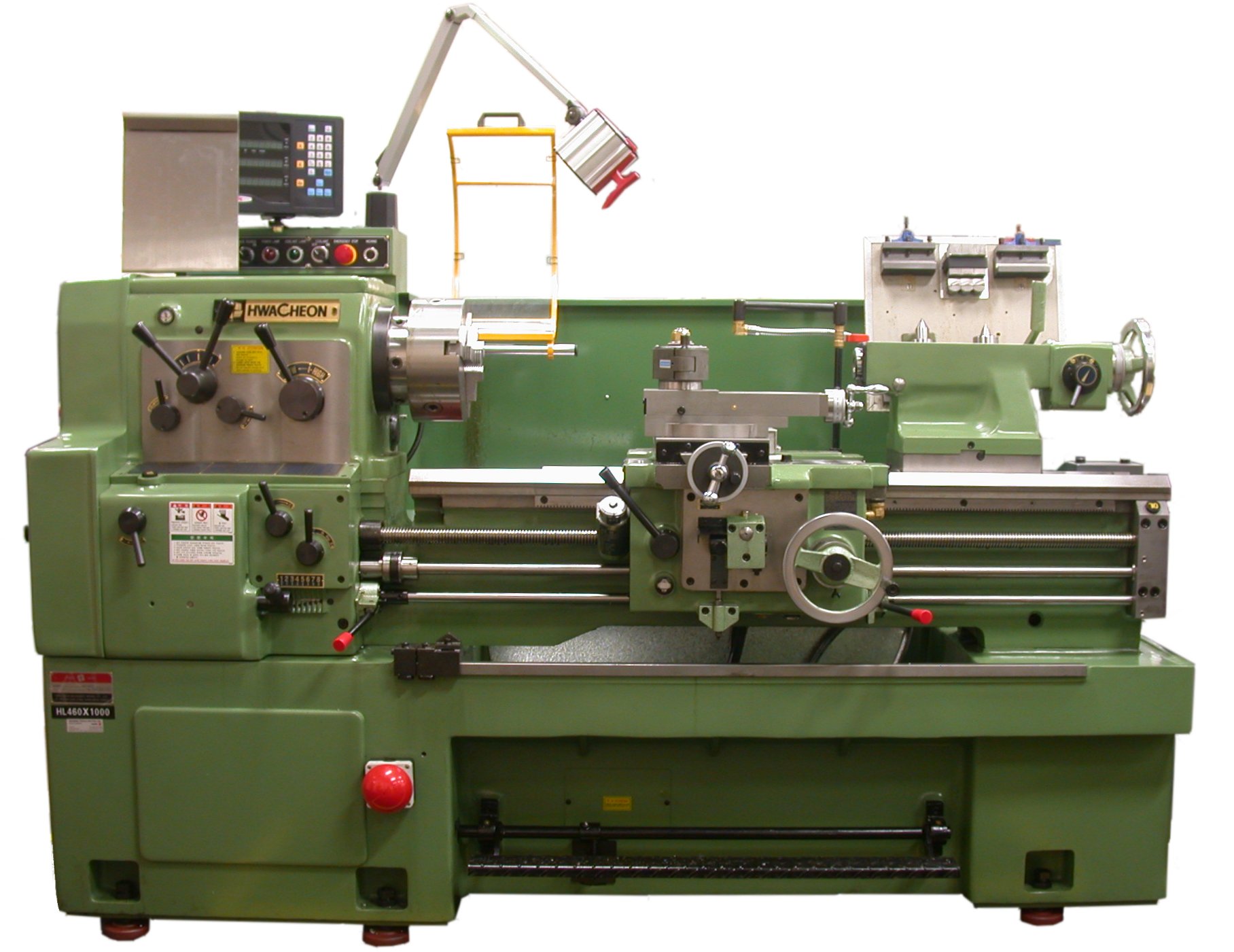
A lathe (/leɪð/) is a machine tool that rotates a workpiece about an axis of rotation to perform various operations such as cutting, sanding, knurling, drilling, deformation, facing, threading and turning, with tools that are applied to the workpiece to create an object with symmetry about that axis.
Lathes are used in woodturning, metalworking, metal spinning, thermal spraying, reclamation, and glass-working. Lathes can be used to shape pottery, the best-known such design being the potter's wheel. Most suitably equipped metalworking lathes can be used to produce most solids of revolution, plane surfaces, and screw threads or helices. Ornamental lathes can produce more complex three-dimensional solids. The workpiece is usually held in place by either one or two centers, at least one of which can typically be moved horizontally to accommodate varying workpiece lengths. Other work-holding methods include clamping the work about the axis of rotation using a chuck or collet, or attaching it to a faceplate using clamps or dog clutch. Lathes equipped with special lathe milling fixtures can be used to complete milling operations.
Examples of objects that can be produced on a lathe include screws, candlesticks, gun barrels, cue sticks, table legs, bowls, baseball bats, pens, musical instruments (especially woodwind instruments), and crankshafts.
The lathe is an ancient tool. The earliest evidence of a lathe dates back to 4th century BC Egypt an is a depiction in the tomb of Petosiris. There is also tenuous evidence for a turned artifact at a Mycenaean Greek site, dating back as far as the 13th or 14th century BC.
Clear evidence of turned artifacts have been found from the 6th century BC: fragments of a wooden bowl in an Etruscan tomb in Northern Italy as well as two flat wooden dishes with decorative turned rims from modern Turkey.
During the Warring States period in China, c. 400 BC, the ancient Chinese used rotary lathes to sharpen tools and weapons on an industrial scale.
The first known painting showing a lathe dates to the 4th century BC in ancient Egypt. Pliny later describes the use of a lathe for turning soft stone in his Natural History (Book XXX, Chapter 44).
Precision metal-cutting lathes were developed organically during the lead up to the Industrial Revolution, with many inventors contributing. They were critical to the manufacture of mechanical inventions of that period. There are many claims in the literature for the person who invented the precision lathe.
Lathe
A lathe (/leɪð/) is a machine tool that rotates a workpiece about an axis of rotation to perform various operations such as cutting, sanding, knurling, drilling, deformation, facing, threading and turning, with tools that are applied to the workpiece to create an object with symmetry about that axis.
Lathes are used in woodturning, metalworking, metal spinning, thermal spraying, reclamation, and glass-working. Lathes can be used to shape pottery, the best-known such design being the potter's wheel. Most suitably equipped metalworking lathes can be used to produce most solids of revolution, plane surfaces, and screw threads or helices. Ornamental lathes can produce more complex three-dimensional solids. The workpiece is usually held in place by either one or two centers, at least one of which can typically be moved horizontally to accommodate varying workpiece lengths. Other work-holding methods include clamping the work about the axis of rotation using a chuck or collet, or attaching it to a faceplate using clamps or dog clutch. Lathes equipped with special lathe milling fixtures can be used to complete milling operations.
Examples of objects that can be produced on a lathe include screws, candlesticks, gun barrels, cue sticks, table legs, bowls, baseball bats, pens, musical instruments (especially woodwind instruments), and crankshafts.
The lathe is an ancient tool. The earliest evidence of a lathe dates back to 4th century BC Egypt an is a depiction in the tomb of Petosiris. There is also tenuous evidence for a turned artifact at a Mycenaean Greek site, dating back as far as the 13th or 14th century BC.
Clear evidence of turned artifacts have been found from the 6th century BC: fragments of a wooden bowl in an Etruscan tomb in Northern Italy as well as two flat wooden dishes with decorative turned rims from modern Turkey.
During the Warring States period in China, c. 400 BC, the ancient Chinese used rotary lathes to sharpen tools and weapons on an industrial scale.
The first known painting showing a lathe dates to the 4th century BC in ancient Egypt. Pliny later describes the use of a lathe for turning soft stone in his Natural History (Book XXX, Chapter 44).
Precision metal-cutting lathes were developed organically during the lead up to the Industrial Revolution, with many inventors contributing. They were critical to the manufacture of mechanical inventions of that period. There are many claims in the literature for the person who invented the precision lathe.
Recent media
Recent media