


Community hub
Recent from talks
Contribute something to knowledge base
Content stats: 0 posts, 0 articles, 1 media, 0 notes
Members stats: 0 subscribers, 0 contributors, 0 moderators, 0 supporters
Subscribers
Supporters
Contributors
Moderators
Hub AI
Four Seasons Restaurant AI simulator
(@Four Seasons Restaurant_simulator)
Hub AI
Four Seasons Restaurant AI simulator
(@Four Seasons Restaurant_simulator)
Four Seasons Restaurant
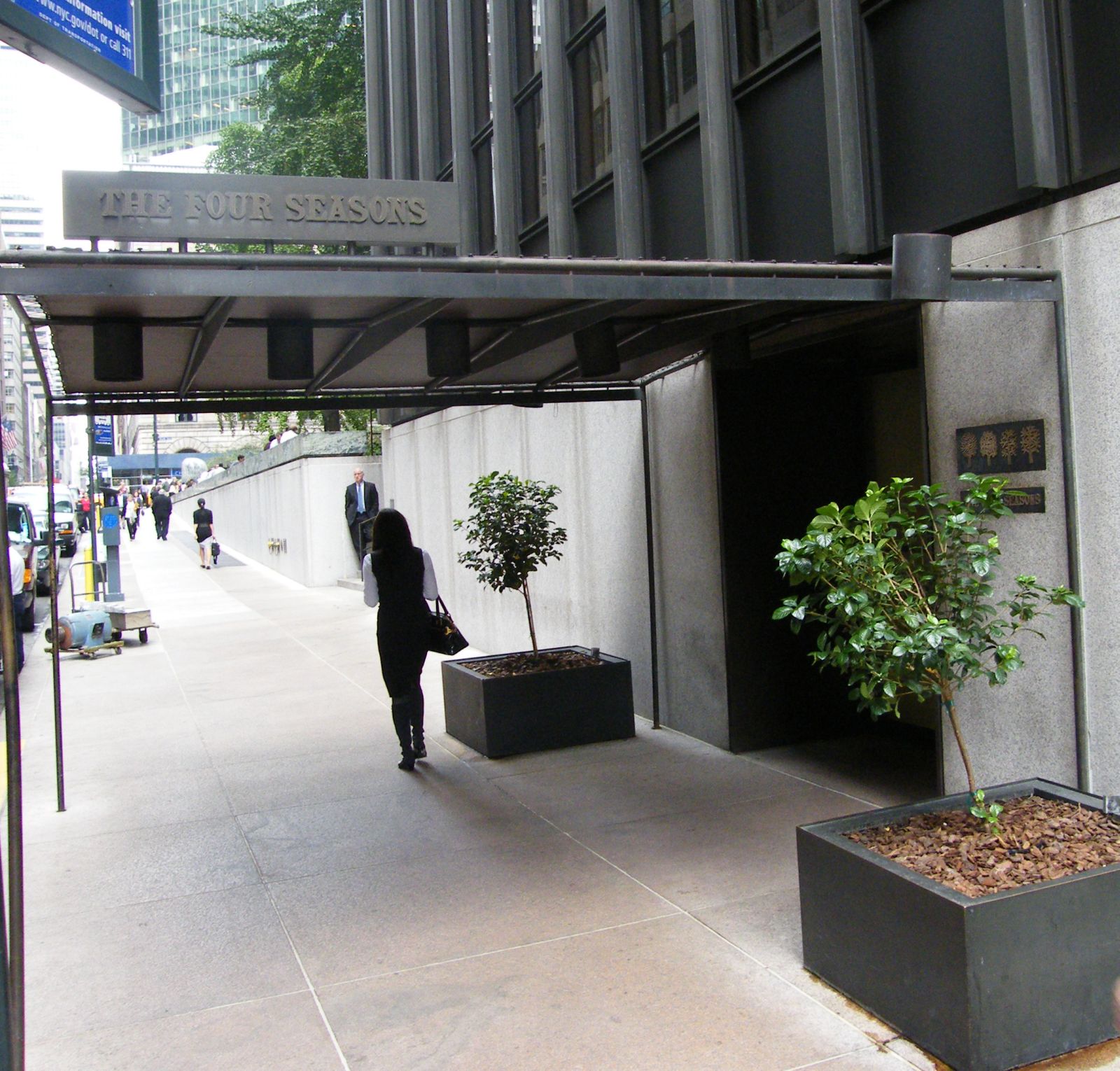
The Four Seasons Restaurant (known colloquially as the Four Seasons) was a New American cuisine restaurant in the Midtown Manhattan neighborhood of New York City from 1959 to 2019. The Four Seasons operated within the Seagram Building at 99 East 52nd Street for most of its existence, although it relocated to 42 East 49th Street in its final year of operation. The restaurant was themed around the seasons of the year, with menus, decorations, and vegetation that changed every three months. It attracted numerous high-profile personalities and often hosted "power lunches". Despite mixed commentary of the restaurant's food, the Four Seasons was highly popular, winning the James Beard Award many times.
The Four Seasons was created in order to fill a vacant space next to the Seagram Building's lobby. Originally operated by Restaurant Associates, the Four Seasons opened on July 20, 1959, and soon became a popular luxury restaurant. Following a downturn in patronage in 1973, Tom Margittai and Paul Kovi acquired the Four Seasons, which subsequently became known for its power lunches. In 1994, Margittai and Kovi passed operation of the restaurant to their junior partners, Alex von Bidder and Julian Niccolini, who operated the restaurant until the Seagram Building location closed in July 2016. After a two-year hiatus, von Bidder and Niccolini reopened the restaurant on 49th Street in August 2018, but the Four Seasons was unprofitable in its new location and closed permanently on June 11, 2019.
The interior of the original restaurant was primarily designed by Philip Johnson, who worked with several designers, including L. Garth and Ada Louise Huxtable. The interior consisted of two discrete spaces known as the Grill Room and the Pool Room, connected by a corridor, as well as a basement lobby on 52nd Street. The New York City Landmarks Preservation Commission designated these spaces as an interior landmark in 1989. The spaces had plantings and custom tableware and furniture. Art inside the restaurant included a permanent mural by James Rosenquist; a major Richard Lippold sculpture; a curtain designed by Pablo Picasso; and various temporary exhibitions that included works by Joan Miró, Frank Stella, Ronnie Landfield, Robert Indiana, Richard Anuszkiewicz and others. The restaurant attracted celebrities, businessmen, and politicians including Anna Wintour, Henry Kissinger, Martha Stewart, Bill Clinton, George Lois, Bill Bernbach, and Jackie Kennedy.
The Seagram Building in Midtown Manhattan, New York City, had been completed in 1958 to designs by Ludwig Mies van der Rohe, Philip Johnson, and Kahn & Jacobs. During the building's planning, the space behind the ground-story lobby had been intended as a major public area. A crafts museum, an automotive showroom, and an upscale restaurant, were variously proposed for that space. Philip Johnson described it as "leftover space", saying that "we could as well have put a Chrysler showroom there". The building's leasing agent Cushman & Wakefield selected Joseph Baum of Restaurant Associates in 1957 to operate the Four Seasons Restaurant in the space. Samuel Bronfman, the chairman of the building's developer Seagram, agreed to the restaurant plan after he learned that it would increase his building's value.
The restaurant's managers had free rein to create a restaurant, which ultimately cost $4.5 million (equivalent to $37,000,000 in 2024). At the time, it was the most expensive restaurant ever built in New York City. Philip Johnson was hired to design the Four Seasons, as Mies was uninterested in designing the restaurant space inside the Seagram Building. William Pahlmann was also hired for general design; Richard Kelly for lighting design; Karl Linn for landscaping; Everett Lawson Conklin for horticultural detail; Marie Nichols for weavings; and Richard Lippold for the Grill Room's brass sculptures. Interiors magazine said that Restaurant Associates was "evidently convinced that in interiors, as well as food, you get what you pay for".
The restaurant opened on July 20, 1959. Time magazine described the Four Seasons as employing "25 chefs and bakers and a battalion of 125 cummerbunded captains, waiters, wine stewards, barmen and busboys". Conversely, The New York Times wrote that there were 15 busboys, 20 captains, and 50 waiters. The Four Seasons' staff had their own seamstress and a chef who cooked exclusively for them. The executive chef was Albert Stockli, who created several menu items specifically for the restaurant and worked with Restaurant Associates until 1965. Dishes on the Four Seasons' menu were sourced from around the world. At the time of the restaurant's opening, The New York Times reported that lunch typically cost $6, while dinner cost $10 to $12, excluding alcoholic beverages. The opening of the Four Seasons prompted other New York restaurant owners to boycott Seagram liquor, as the company had helped finance a competitor within its own building.
Soon after its opening, the Four Seasons became a popular event venue. For example, it hosted a birthday party for then-U.S. president John F. Kennedy in May 1962, as well as a dinner for the Confrérie des Chevaliers du Tastevin wine-tasting organization in December 1962. Kennedy's birthday party was the first time that the restaurant was completely closed to the public, but a similar closure also occurred in 1965, when Sharman Douglas hosted a party there for Princess Margaret. The stature of the restaurant was such that, according to Peter Hellman of New York magazine, Stockli "could barely be bothered to greet" a visiting royal family who walked through the door. The Four Seasons was also a popular drinking spot in the mid-1960s.
By the early 1970s, the restaurant was past its prime. This was in part due to the New York City fiscal crisis, as well as the fact that younger audiences were not necessarily interested in the Four Seasons' unconventional menu items. The Wall Street Journal said that "power lunchers looked the place over, saw tourists, and were horrified". Though the restaurant still attracted a loyal following on weekends, it was no longer popular on weekdays. Philip Johnson recalled that, on one day in early 1973, he and his partner John Burgee were the only people eating lunch at the Four Seasons. Restaurant Associates initially decided to continue operating the Four Seasons, which was one of the company's flagship restaurants, even as it closed other restaurants to save money. The firm ultimately decided to give up its lease of the Four Seasons by 1973, though it took over a year for Restaurant Associates to relinquish its lease.
Four Seasons Restaurant
The Four Seasons Restaurant (known colloquially as the Four Seasons) was a New American cuisine restaurant in the Midtown Manhattan neighborhood of New York City from 1959 to 2019. The Four Seasons operated within the Seagram Building at 99 East 52nd Street for most of its existence, although it relocated to 42 East 49th Street in its final year of operation. The restaurant was themed around the seasons of the year, with menus, decorations, and vegetation that changed every three months. It attracted numerous high-profile personalities and often hosted "power lunches". Despite mixed commentary of the restaurant's food, the Four Seasons was highly popular, winning the James Beard Award many times.
The Four Seasons was created in order to fill a vacant space next to the Seagram Building's lobby. Originally operated by Restaurant Associates, the Four Seasons opened on July 20, 1959, and soon became a popular luxury restaurant. Following a downturn in patronage in 1973, Tom Margittai and Paul Kovi acquired the Four Seasons, which subsequently became known for its power lunches. In 1994, Margittai and Kovi passed operation of the restaurant to their junior partners, Alex von Bidder and Julian Niccolini, who operated the restaurant until the Seagram Building location closed in July 2016. After a two-year hiatus, von Bidder and Niccolini reopened the restaurant on 49th Street in August 2018, but the Four Seasons was unprofitable in its new location and closed permanently on June 11, 2019.
The interior of the original restaurant was primarily designed by Philip Johnson, who worked with several designers, including L. Garth and Ada Louise Huxtable. The interior consisted of two discrete spaces known as the Grill Room and the Pool Room, connected by a corridor, as well as a basement lobby on 52nd Street. The New York City Landmarks Preservation Commission designated these spaces as an interior landmark in 1989. The spaces had plantings and custom tableware and furniture. Art inside the restaurant included a permanent mural by James Rosenquist; a major Richard Lippold sculpture; a curtain designed by Pablo Picasso; and various temporary exhibitions that included works by Joan Miró, Frank Stella, Ronnie Landfield, Robert Indiana, Richard Anuszkiewicz and others. The restaurant attracted celebrities, businessmen, and politicians including Anna Wintour, Henry Kissinger, Martha Stewart, Bill Clinton, George Lois, Bill Bernbach, and Jackie Kennedy.
The Seagram Building in Midtown Manhattan, New York City, had been completed in 1958 to designs by Ludwig Mies van der Rohe, Philip Johnson, and Kahn & Jacobs. During the building's planning, the space behind the ground-story lobby had been intended as a major public area. A crafts museum, an automotive showroom, and an upscale restaurant, were variously proposed for that space. Philip Johnson described it as "leftover space", saying that "we could as well have put a Chrysler showroom there". The building's leasing agent Cushman & Wakefield selected Joseph Baum of Restaurant Associates in 1957 to operate the Four Seasons Restaurant in the space. Samuel Bronfman, the chairman of the building's developer Seagram, agreed to the restaurant plan after he learned that it would increase his building's value.
The restaurant's managers had free rein to create a restaurant, which ultimately cost $4.5 million (equivalent to $37,000,000 in 2024). At the time, it was the most expensive restaurant ever built in New York City. Philip Johnson was hired to design the Four Seasons, as Mies was uninterested in designing the restaurant space inside the Seagram Building. William Pahlmann was also hired for general design; Richard Kelly for lighting design; Karl Linn for landscaping; Everett Lawson Conklin for horticultural detail; Marie Nichols for weavings; and Richard Lippold for the Grill Room's brass sculptures. Interiors magazine said that Restaurant Associates was "evidently convinced that in interiors, as well as food, you get what you pay for".
The restaurant opened on July 20, 1959. Time magazine described the Four Seasons as employing "25 chefs and bakers and a battalion of 125 cummerbunded captains, waiters, wine stewards, barmen and busboys". Conversely, The New York Times wrote that there were 15 busboys, 20 captains, and 50 waiters. The Four Seasons' staff had their own seamstress and a chef who cooked exclusively for them. The executive chef was Albert Stockli, who created several menu items specifically for the restaurant and worked with Restaurant Associates until 1965. Dishes on the Four Seasons' menu were sourced from around the world. At the time of the restaurant's opening, The New York Times reported that lunch typically cost $6, while dinner cost $10 to $12, excluding alcoholic beverages. The opening of the Four Seasons prompted other New York restaurant owners to boycott Seagram liquor, as the company had helped finance a competitor within its own building.
Soon after its opening, the Four Seasons became a popular event venue. For example, it hosted a birthday party for then-U.S. president John F. Kennedy in May 1962, as well as a dinner for the Confrérie des Chevaliers du Tastevin wine-tasting organization in December 1962. Kennedy's birthday party was the first time that the restaurant was completely closed to the public, but a similar closure also occurred in 1965, when Sharman Douglas hosted a party there for Princess Margaret. The stature of the restaurant was such that, according to Peter Hellman of New York magazine, Stockli "could barely be bothered to greet" a visiting royal family who walked through the door. The Four Seasons was also a popular drinking spot in the mid-1960s.
By the early 1970s, the restaurant was past its prime. This was in part due to the New York City fiscal crisis, as well as the fact that younger audiences were not necessarily interested in the Four Seasons' unconventional menu items. The Wall Street Journal said that "power lunchers looked the place over, saw tourists, and were horrified". Though the restaurant still attracted a loyal following on weekends, it was no longer popular on weekdays. Philip Johnson recalled that, on one day in early 1973, he and his partner John Burgee were the only people eating lunch at the Four Seasons. Restaurant Associates initially decided to continue operating the Four Seasons, which was one of the company's flagship restaurants, even as it closed other restaurants to save money. The firm ultimately decided to give up its lease of the Four Seasons by 1973, though it took over a year for Restaurant Associates to relinquish its lease.
Recent media
Recent media