Hubbry Logo
Four Strong WindsFour Strong WindsMain
Open search
Four Strong Winds
Community hub
Four Strong Winds
logo
7 pages, 0 posts
0 subscribers
Be the first to start a discussion here.
Four Strong Winds
Four Strong Winds
from Wikipedia

"Four Strong Winds" is a song written in 1962 by Ian Tyson and recorded by Canadian folk duo Ian and Sylvia on their 1963 album Four Strong Winds. The song was the first one that Tyson wrote.[vague] Tyson has stated that he wrote the song in about 20 minutes in the New York apartment of his manager at the time Albert Grossman. Tyson said that he was inspired to write it after hearing Bob Dylan sing.[1] The song is a melancholy reflection on a failing romantic relationship. The singer expresses a desire for a possible reunion in a new place in the future ("You could meet me if I sent you down the fare") but acknowledges the likelihood that the relationship is over ("But our good times are all gone/And I'm bound for moving on ...").

"Four Strong Winds" is a significant composition of the early 1960s folk revival,[2] and has been recorded by numerous artists, including Bobby Bare, whose 1964 rendition was a hit on the U.S. country chart, and Neil Young, who has performed the song frequently throughout his career.

The song has a clear Canadian context and subtext, including an explicit mention of the province Alberta as well as references to long, cold winters. In 2005, CBC Radio One listeners chose it as the greatest Canadian song of all time on the program 50 Tracks: The Canadian Version.[3] It is considered the unofficial anthem of Alberta.[4][5]

Composition and initial recordings

[edit]

"Four Strong Winds" was the first song Ian Tyson wrote; before it, he, as well as the duo Ian & Sylvia, had played only covers. In the autumn of 1962, Tyson ran into Bob Dylan, whom Tyson recalled as "this kind of little grubby kid", at the Greenwich Village bar Kettle of Fish, and Dylan played for him a song he had just written; Tyson would later say that he believed, though he was not sure, that the song was "Blowin' in the Wind".[6][7] Tyson decided he could write a song as well, so he asked Albert Grossman, who managed both Ian & Sylvia and Bob Dylan, and "who was the only one [on the local folk music scene] that had a roof over his head:"...'Can I use your apartment tomorrow, cause I want to try and write a song?'"...I went over there and it was a funky, little apartment. Took my guitar and just opened up the case and started to fooling around and strumming. And it took half an hour" to write "Four Strong Winds".[7]

Later, Tyson played the song for his fellow folk musicians at the local music venues Kettle of Fish and The Bitter End, and was surprised to see that the song "blew everybody away."[8]

Tyson would later credit Dylan with giving new impetus to Ian & Sylvia's career by inspiring the duo to follow his lead in writing "original folk songs". As Tyson put it, "We had to go in some direction, because we had used up all the real roots music from the Delta on north. Bob blazed the trail into the wilderness, into unknown territory."[8]

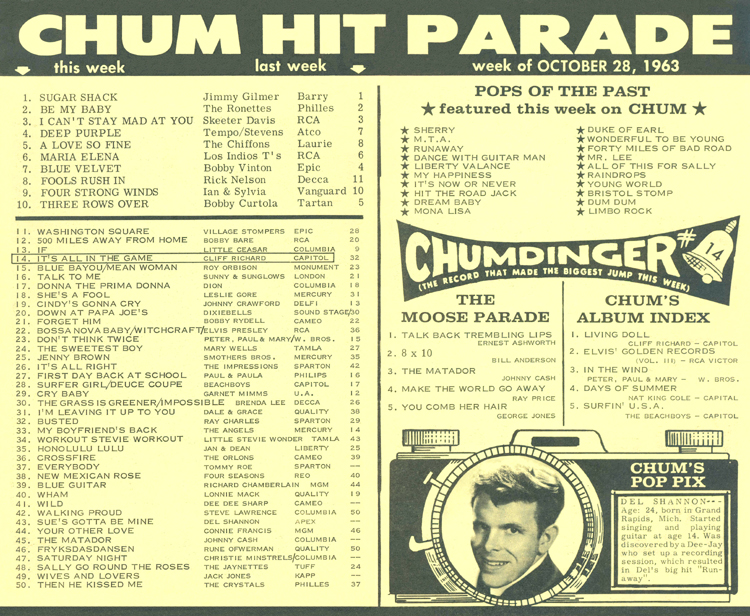
The song was included in Ian & Sylvia's second Vanguard LP, Four Strong Winds (stereo: VSD-2149; monaural: VRS-9133), released July 1963.[9] The album entered the Billboard Top LPs chart at number 150 the week of September 28, 1963.[10] The song was a hit in Canada, making number 9 on the single charts there in October 1963.[11]

In the United States, the song did not have the same initial chart success. Ian and Sylvia's single version (released on Vanguard 35021) entered the Cashbox magazine Looking Ahead chart in September 1963. It was then recorded by the Brothers Four in a version that "bubbled under" the Billboard Hot 100 in October 1963.[12] It was released in a country arrangement by Bobby Bare in 1964 and became a number three hit on the U.S. Country singles chart in early 1965. That recording reached just number 40 in Canada.[13]

The song also became a big hit in Norway in 1966 in a Norwegian version, "Mot ukjent sted" by the Vanguards; and a big hit in Sweden in 1967 in a Swedish version, "Mot okänt land", recorded by Hep Stars. (The title of both of these renditions translates to "Towards an Unknown Land".)

Other versions

[edit]

The song has been recorded by many other artists, including the Journeymen, the Seekers, Judy Collins, the Chad Mitchell Trio, the Browns, Bob Dylan, Marianne Faithfull, the Searchers, Bruce & Terry, John Denver, the Kingston Trio, Trini Lopez, Waylon Jennings, Chad and Jeremy, the Wolfe Tones, Blue Rodeo, Joan Baez, Vanity Fare, Glenn Yarborough, Saori Minami, Harry Belafonte, Tony Rice, Johnny Cash, the Carter Family, Sarah McLachlan, David Wiffen, Schooner Fare, the Pilgrims, and David Houston.

Neil Young recorded the song for his 1978 album Comes a Time, with harmony vocals from Nicolette Larson, and on the Band's The Last Waltz. It has received significant airplay over album oriented rock and classic rock radio stations and has become part of Young's concert repertoire, including featured performances during Young's yearly appearances at Farm Aid benefit concerts.[14][15] In Canada, his version reached No. 18 on the AC charts, No. 48 on the country charts, and No. 61 on the rock charts.[16][17][18]

Swedish artist Ulf Lundell recorded a translated cover titled "Fyra vindar", for his 1985 album Den vassa eggen, which did not make the cut but was later included in a remastered edition in 1998. Another recording of the Swedish version "Mot okänt land", appears on the 2016 album Vid Grinden by Georga.

Canadian legacy

[edit]

The song is performed on the last night of the Edmonton Folk Music Festival each year.

Tyson and Gordon Lightfoot performed the song at the opening ceremonies of the 1988 Winter Olympics in Calgary.[19]

Ian and Sylvia sang the song together at the 50th anniversary of the Mariposa Folk Festival on July 11, 2010, in Orillia, Ontario. On April 5, 2013, a recording of the song by Ian Tyson was played during the funeral of former Alberta Premier Ralph Klein, as the honour guard brought his urn into the Jack Singer Concert Hall.[20]

The song is referenced in the 1989 novel A Prayer for Owen Meany by John Irving, which deals with Americans living near or across the Canada–United States border. The narrator remembers how the main character Owen loved to hear that song as sung by the character of Hester.[21]

References

[edit]
[edit]
Revisions and contributorsEdit on WikipediaRead on Wikipedia
from Grokipedia
"Four Strong Winds" is a folk song written by Canadian singer-songwriter in 1961, first recorded by the folk duo on their album of the same name released in 1963. The song's lyrics evoke themes of love, separation, and the vast , with references to places like and the northern lights, capturing a sense of wistful longing and homesickness. Tyson composed the song in approximately 20 to 30 minutes while staying at his manager Albert Grossman's apartment in , inspired by hearing perform at the Kettle of Fish bar in [Greenwich Village](/page/Greenwich Village) earlier that evening. He later recalled thinking Dylan's raw, simple style was achievable, stating, "I thought, ‘I can do that. How hard can this be?’" and quickly penned the tune on his guitar. The track reached the top 10 on Canadian charts in as a single and became a staple of the folk revival movement of the . Widely covered by numerous artists, "Four Strong Winds" has been interpreted by performers including on his 1978 album , , , , and himself. In 1979, Young's version brought renewed international attention to the song, and Tyson noted that royalties from covers like Young's helped him purchase his ranch in . Its enduring popularity led to its induction into the Canadian Songwriters Hall of Fame in 2003, and in 2005, CBC Radio One listeners voted it the greatest Canadian song of all time on the program 50 Tracks: The Canadian Version. The holds significant cultural status in , often described as an unofficial anthem, and has been performed at national events, including memorials for fallen Mounties in Mayerthorpe in 2005 and the funeral of former Alberta Premier in 2013. It was reprised in a notable 1986 special featuring Tyson, Sylvia, , Murray McLauchlan, and , and sung at the Mariposa Folk Festival's 50th anniversary in 2010. Tyson's (1933–2022) legacy as a poet and folk icon, further cemented by this composition, earned him inductions into the Canadian Country Music Hall of Fame and as a Governor General's laureate.

Origins and Composition

Ian Tyson's Inspiration

, born on September 25, 1933, in , grew up on a small farm near Duncan and developed an early passion for the rugged outdoor life of . In his late teens and early twenties, he pursued a career as a rodeo rider, competing across and gaining a deep appreciation for the prairies' vast landscapes and challenging conditions. A serious injury sidelined him from rodeo, leading him to pick up the guitar during recovery; after graduating from the Vancouver School of Art in 1958, he hitchhiked to , where he immersed himself in the burgeoning scene as a performer and aspiring songwriter. In Toronto's vibrant folk clubs, Tyson met Sylvia Fricker in 1959, a fellow performer from Chatham, Ontario; their shared musical interests quickly blossomed into a professional and personal partnership, with the duo Ian & Sylvia forming and performing full-time by 1961. This relationship profoundly shaped Tyson's creative output, infusing his work with themes of romantic longing and separation, as the couple navigated the uncertainties of life on the road in the North American folk revival. Their bond provided the emotional core for many songs, including the narrative of parted lovers facing life's transient demands. The inspiration for "Four Strong Winds" emerged from Tyson's own experiences of and migration, drawing on the stark contrasts of Canada's regional climates—from the mild, rainy coasts of and to the harsh, wind-swept prairies of . Conceived during a reflective period in 1961 amid his travels and budding career, the song captures the ache of leaving loved ones behind for economic opportunities elsewhere, symbolized by the relentless prairie winds that evoke isolation and inevitable change. Tyson has described it as rooted in pangs for a girlfriend in , regretting constant departures, while the lyrics depict a romance strained by one partner's move to 's fall weather, highlighting the pull between coastal comfort and prairie hardship.

Writing Process

Ian Tyson composed "Four Strong Winds" in approximately 20 to 30 minutes in 1961 while staying at his manager Albert Grossman's apartment in . Inspired by hearing perform at the Kettle of Fish bar in earlier that evening, Tyson picked up his guitar and quickly developed both the melody and lyrics, drawing from his experiences of prairie life in . This rapid creation marked the song as Tyson's first original composition, crafted without any noted formal revisions or extensive deliberation. The song is structured as a simple folk ballad in 3/4 waltz time, emphasizing its gentle, reflective suitable for accompaniment. Its , set in (A - D - E - A), follows a straightforward I-IV-V-I pattern that reinforces the ballad's unadorned authenticity and ease of play. This minimalistic musical framework allows the lyrics to take center stage, aligning with the folk tradition of prioritizing over complexity. Lyrically, "Four Strong Winds" explores themes of farewell and impending separation, using the of autumn winds to symbolize inevitable change and transience. The narrator expresses reluctance to leave a loved one, with specific references to Alberta's prairies and the journey to underscoring a sense of geographic and emotional displacement. Tyson intended the piece as a personal expression rooted in his own life, without anticipating its widespread appeal beyond intimate folk circles.

Original Recording and Release

Ian & Sylvia's Version

The first professional recording of "Four Strong Winds," composed by , was made by the Canadian folk duo in spring 1963 at Vanguard Recording Studio on 23rd Street in . The session was produced by Maynard Solomon, co-founder of the Vanguard label, which specialized in during the early 1960s revival. This version served as the title track for 's second studio album, Four Strong Winds, released in August 1963 by . The album captured the duo's emerging style, blending traditional folk influences with original material, and marked a key moment in their transition from coffeehouse performers to the New York folk scene. Musically, the recording emphasized a simple acoustic guitar-led arrangement in the vein of early folk, with Tyson's resonant vocals supported by Sylvia Tyson's close harmonies, creating an intimate, evocative sound. The track runs approximately 3:30, showcasing the song's melancholic prairie imagery without additional instrumentation. Before committing the song to tape, debuted "Four Strong Winds" in live settings during 1962–1963, performing it at folk clubs such as the Village Gate to build their reputation among the era's burgeoning folk audience.

Commercial Performance

The single "Four Strong Winds" achieved significant success in , reaching the top 10 on national charts in 1963 and becoming a major hit for the folk duo . In the United States, however, the song received limited airplay primarily due to its classification within the folk , which at the time garnered less mainstream radio support compared to pop and rock formats, and it failed to chart on the Hot 100. The accompanying album, Four Strong Winds, also released in 1963 on , performed modestly in sales but contributed to the duo's growing reputation in the North American folk scene; it entered the Top LPs chart at No. 150 in 1964. Early critical reception highlighted the song's poignant lyrics and harmonies, positioning as admired figures in the early folk revival. Appearances in 1963 on programs and U.S. folk radio stations, along with performances on the ABC variety show , further increased the song's visibility among folk audiences on both sides of the border. While the single saw no major international chart success outside at the time, its release established a foundation for the duo's enduring popularity within the folk revival movement.

Cover Versions

Early Covers (1960s)

One of the earliest and most successful covers of "Four Strong Winds" came from singer , who released a Nashville-produced version in October as a single on RCA Victor (catalog 8443). This adaptation transformed the folk ballad into a hit, peaking at on the U.S. Hot Country Singles chart in early 1965 and crossing over to the pop market with a No. 60 peak on the , thereby exposing the to mainstream American listeners beyond the folk niche. The offered a harmonious folk rendition on their 1964 album Sing of , released by , which resonated strongly within the burgeoning U.S. circuit and contributed to the song's integration into the early folk revival. Their close-knit vocal arrangement emphasized the song's melancholic themes, appealing to audiences in intimate venues where thrived during that era. In 1965, British singer included a delicate pop-folk interpretation on her debut album via , infusing the song with a youthful, orchestral lightness that introduced it to European pop audiences and contrasted its rustic origins. This cover marked one of the song's first transatlantic adaptations, broadening its appeal in the mid-1960s British Invasion-adjacent scene. Bob Dylan recorded the song with the Band during the 1967 Basement Tapes sessions, later released on The Basement Tapes Complete: The Bootleg Series Vol. 11 in 2014. This raw, informal take highlighted Dylan's influence on folk songwriting and connected back to Tyson's inspiration from Dylan.

Later Covers and Revivals

Neil Young's rendition of "Four Strong Winds" appeared on his 1978 album Comes a Time, featuring an acoustic arrangement with harmonica that emphasized the song's folk roots. The single reached No. 61 on the Canadian RPM Top Singles chart, No. 48 on the RPM Country Tracks chart, and the top 20 on the RPM Adult Contemporary chart, contributing to renewed interest in folk-rock during the late 1970s. The Band performed the song live with at their farewell concert in 1976, featured in the film and album (released 1978), capturing a communal folk-rock spirit. re-recorded the song as a solo artist on his 1989 album I Outgrew the Wagon, infusing it with a cowboy-country style reflective of his later career focus on Western themes. In the and , the song saw covers that highlighted its enduring appeal across folk and country genres. recorded it as a studio outtake in 1980, later released posthumously on the 1998 compilation Forever, John. Following Ian Tyson's death on December 29, 2022, the song experienced a revival through tributes, such as a performance by , , and Shannon Johnson at the 2023 opening night. Streams of various recordings surged on platforms like in the ensuing months, reflecting widespread appreciation for Tyson's legacy.

Legacy and Cultural Significance

Recognition in Canada

"Four Strong Winds" has been widely recognized as a defining element of Canadian musical heritage. In 2005, CBC Radio One listeners voted it the greatest Canadian song of all time as part of the series 50 Tracks: The Canadian Version, surpassing other iconic tracks such as Barenaked Ladies' "If I Had $1,000,000" and Neil Young's "Heart of Gold," as well as songs by artists like The Tragically Hip and Joni Mitchell. This poll underscored the song's enduring status as an unofficial anthem, evoking themes of love, longing, and the vast Canadian landscape. The song's significance was further affirmed through its inclusion in prestigious Canadian collections and honors. The song itself was inducted into the Canadian in 2003. Ian Tyson was inducted into the Canadian in 2019 for his songwriting legacy, which includes "Four Strong Winds," highlighting its foundational role in the nation's songwriting legacy. It has also been featured in compilations celebrating Canadian , reinforcing its place in the cultural canon. The track's resonance extends to national events, where it has been performed to symbolize Canadian identity; for instance, and sang it during the opening ceremony of the 1988 Winter Olympics. Following Ian Tyson's death on December 29, 2022, at age 89, "Four Strong Winds" experienced a surge in popularity and tributes across . Parliamentary recognition came swiftly, with the honoring Tyson in debates on February 2, 2023, praising the song as a "classic Canadian" work that captured the nation's spirit. These tributes, from media outlets to official statements, cemented the song's role as a cornerstone of .

International Influence

The song "Four Strong Winds" played a pivotal role in the American folk revival, emerging as a standard that resonated with songwriters and performers during the era's surge in acoustic storytelling and social introspection. Its melancholic narrative of parting lovers and wandering influenced the raw, confessional style prevalent among Dylan contemporaries, with himself recording a version during the 1967 Basement Tapes sessions, later released on The Bootleg Series Vol. 11: Complete in 2014. Bobby Bare's 1964 cover further embedded it in the U.S. scene, peaking at No. 3 on the chart and bridging folk authenticity with country accessibility. In , the track found adaptation within the folk traditions of the , particularly through Irish artists who incorporated its themes of exile and longing into their repertoires. , a prominent Irish folk singer, released a cover in 1973 on his album First Campaign, aligning the song's prairie imagery with Celtic balladry. Similarly, , an influential Irish folk group, recorded it in 2009 for their album The Legendary Wolfe Tones, Vol. 1, preserving its emotional core while evoking transatlantic migration narratives. British group also contributed to its transatlantic reach with a 1965 cover on their album Take Me for What I'm Worth, helping sustain its presence in the UK folk circuit amid the decade's beat and folk crossover. The song maintained an enduring foothold in American country music, exemplified by its integration into Nashville's production ecosystem and endorsements from genre icons. Ian & Sylvia recorded sessions in Nashville during the late 1960s and 1971, collaborating with local musicians like to develop a country-influenced sound. acknowledged its excellence by covering it on his 2006 posthumous album American V: A Hundred Highways, produced in Nashville, where the stripped-down arrangement highlighted its timeless lament. Post-2010, "Four Strong Winds" has seen substantial global traction through digital streaming, amassing millions of plays across platforms and underscoring its cross-generational appeal in circles. Neil Young's 1978 version alone has exceeded 13 million Spotify streams, reflecting renewed interest among younger listeners drawn to its introspective folk roots. Johnny Cash's rendition has garnered over 2.4 million streams, while & Sylvia's original surpasses 2.6 million, contributing to a collective that has revitalized the for contemporary audiences. This streaming resurgence has indirectly shaped modern acts, with the 's structure and themes echoing in the narrative-driven works of bands like , who cite folk revival influences in their rustic, heartfelt sound.

References

Add your contribution
Related Hubs
User Avatar
No comments yet.