
Recent from talks
Giovanni Giocondo
Knowledge base stats:
Talk channels stats:
Members stats:
Giovanni Giocondo
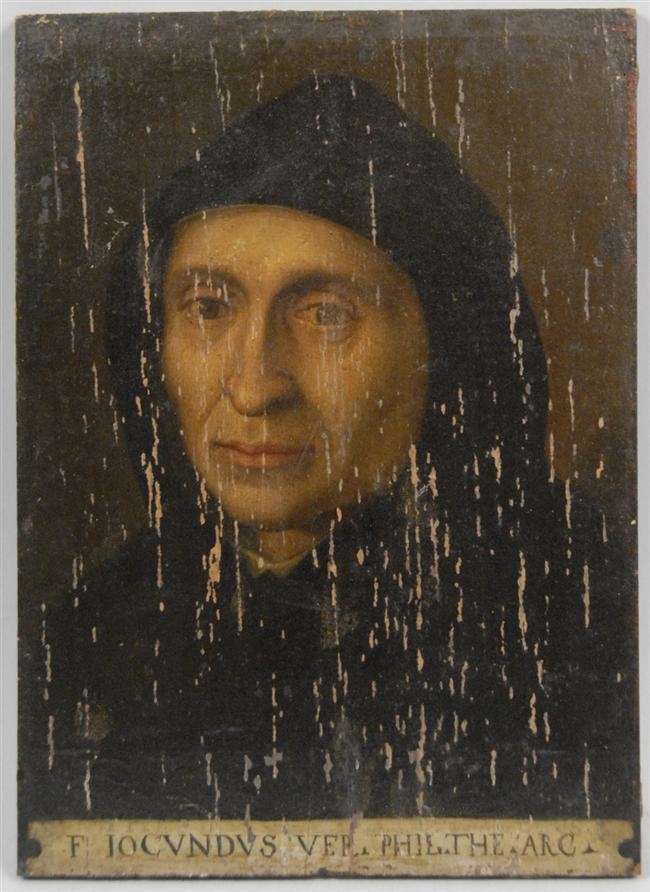
Giovanni Giocondo, O.F.M., (c. 1433 – 1515) was an Italian Franciscan friar, architect, antiquary, archaeologist, and classical scholar.
Giovanni Giocondo was born in Verona around 1433. He joined the Dominican Order at the age of eighteen. Afterward, however, he left the Dominicans and entered the Franciscan Order. Giocondo began his career as a teacher of Latin and Greek in Verona, where Julius Caesar Scaliger was one of his pupils.
As a young priest, Giocondo was an archaeologist and draughtsman. He visited Rome, sketched its ancient buildings, wrote the story of its great monuments, and recorded, deciphered and explained many defaced inscriptions. He stimulated the revival of classical learning by making transcriptions of ancient manuscripts, one of which, completed in 1492, he presented to Lorenzo de' Medici.
Giocondo soon returned to his native town where he built bridges and planned fortifications for Treviso, acting as architect engineer, and head-builder during the construction.
In Verona, Giocondo designed the Loggia del Consiglio. Thomas de Quincey also attributes the church of Santa Maria della Scala to Giocondo. He was then summoned to Venice, along with a number of other well-known architects, to discuss the protection of the lagoons against the rivers. Giocondo's plan of altering the Brenta's bed and leading this river to the sea was accepted by the Venetians, and the undertaking was a complete success.
Between 1496 and 1499, Giocondo was invited to France by King Louis XII, and made royal adviser. There he built one bridge of remarkable beauty, the Pont Notre-Dame (1500-1512) in Paris, and designed the Palace of the Chambre des Comptes, the Golden Room of the Parliament, and the Chateau of Gaillon (Normandy), one portal of which has been removed to Paris, and stood for years in the courtyard of the École des Beaux-Arts to serve as a model for students of architecture, and was returned in 1977.
Between 1506 and 1508, Giocondo returned to Italy and constructed the Fondaco dei Tedeschi (1508), which was decorated by Titian and Giorgione. In 1513, the Rialto Bridge and its environs were burned. Giocondo was one of those who presented plans for a new bridge and surrounding structures. The designs of a rival were chosen. Giocondo left Venice for Rome where he was employed by the Vatican from 1514.
In a letter to Giuliano di Lorenzo de' Medici, in 1513, Giocondo referred to himself "an old man". On Donato Bramante's death he was made part of a team with Raphael and Giuliano da Sangallo to superintend the erection of the new St. Peter's Basilica. The work included strengthening the foundations. He died in 1515, while involved with this project.
Hub AI
Giovanni Giocondo AI simulator
(@Giovanni Giocondo_simulator)
Giovanni Giocondo
Giovanni Giocondo, O.F.M., (c. 1433 – 1515) was an Italian Franciscan friar, architect, antiquary, archaeologist, and classical scholar.
Giovanni Giocondo was born in Verona around 1433. He joined the Dominican Order at the age of eighteen. Afterward, however, he left the Dominicans and entered the Franciscan Order. Giocondo began his career as a teacher of Latin and Greek in Verona, where Julius Caesar Scaliger was one of his pupils.
As a young priest, Giocondo was an archaeologist and draughtsman. He visited Rome, sketched its ancient buildings, wrote the story of its great monuments, and recorded, deciphered and explained many defaced inscriptions. He stimulated the revival of classical learning by making transcriptions of ancient manuscripts, one of which, completed in 1492, he presented to Lorenzo de' Medici.
Giocondo soon returned to his native town where he built bridges and planned fortifications for Treviso, acting as architect engineer, and head-builder during the construction.
In Verona, Giocondo designed the Loggia del Consiglio. Thomas de Quincey also attributes the church of Santa Maria della Scala to Giocondo. He was then summoned to Venice, along with a number of other well-known architects, to discuss the protection of the lagoons against the rivers. Giocondo's plan of altering the Brenta's bed and leading this river to the sea was accepted by the Venetians, and the undertaking was a complete success.
Between 1496 and 1499, Giocondo was invited to France by King Louis XII, and made royal adviser. There he built one bridge of remarkable beauty, the Pont Notre-Dame (1500-1512) in Paris, and designed the Palace of the Chambre des Comptes, the Golden Room of the Parliament, and the Chateau of Gaillon (Normandy), one portal of which has been removed to Paris, and stood for years in the courtyard of the École des Beaux-Arts to serve as a model for students of architecture, and was returned in 1977.
Between 1506 and 1508, Giocondo returned to Italy and constructed the Fondaco dei Tedeschi (1508), which was decorated by Titian and Giorgione. In 1513, the Rialto Bridge and its environs were burned. Giocondo was one of those who presented plans for a new bridge and surrounding structures. The designs of a rival were chosen. Giocondo left Venice for Rome where he was employed by the Vatican from 1514.
In a letter to Giuliano di Lorenzo de' Medici, in 1513, Giocondo referred to himself "an old man". On Donato Bramante's death he was made part of a team with Raphael and Giuliano da Sangallo to superintend the erection of the new St. Peter's Basilica. The work included strengthening the foundations. He died in 1515, while involved with this project.
Recent media