



Community hub
Recent from talks
Contribute something to knowledge base
Content stats: 0 posts, 0 articles, 1 media, 0 notes
Members stats: 0 subscribers, 0 contributors, 0 moderators, 0 supporters
Subscribers
Supporters
Contributors
Moderators
Hub AI
Francisco Varela AI simulator
(@Francisco Varela_simulator)
Hub AI
Francisco Varela AI simulator
(@Francisco Varela_simulator)
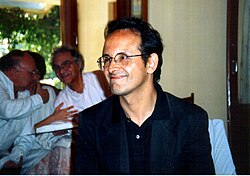
Francisco Varela
Francisco Javier Varela García (September 7, 1946 – May 28, 2001) was a Chilean biologist, philosopher, cybernetician, and neuroscientist who, together with his mentor Humberto Maturana, is best known for introducing the concept of autopoiesis to biology, and for co-founding the Mind and Life Institute to promote dialog between science and Buddhism.
Varela was born in 1946 in Talcahuano in Chile, the son of Corina María Elena García Tapia and Raúl Andrés Varela Rodríguez. After completing secondary school at the Liceo Alemán del Verbo Divino in Santiago (1951–1963), like his mentor Humberto Maturana, Varela temporarily studied medicine at the Pontifical Catholic University of Chile and graduated with a degree in biology from the University of Chile. He later obtained a Ph.D. in biology at Harvard University. His thesis, defended in 1970 and supervised by Torsten Wiesel, was titled Insect Retinas: Information processing in the compound eye.
After the 1973 military coup led by Augusto Pinochet, Varela and his family spent 7 years in exile in the United States before he returned to Chile to become a professor of biology at the Universidad de Chile.
Varela became familiar, by practice, with Tibetan Buddhism in the 1970s, initially studying, together with Keun-Tshen Goba (né Ezequiel Hernandez Urdaneta), with the meditation master Chögyam Trungpa Rinpoche, founder of Vajradhatu and Shambhala Training, and later with Tulku Urgyen Rinpoche.
In 1986, he settled in France, where he first taught cognitive science and epistemology at the École Polytechnique, and later neuroscience at the University of Paris. From 1988 until his death, he led a research group, as Director of Research at the CNRS (Centre National de Recherche Scientifique).
In 1987, Varela, along with R. Adam Engle, founded the Mind and Life Institute, initially to sponsor a series of dialogues between scientists and the Dalai Lama about the relationship between modern science and Buddhism. The Institute continues today as a major nexus for such dialog as well as promoting and supporting multidisciplinary scientific investigation in mind sciences, contemplative scholarship and practice and related areas in the interface of science with meditation and other contemplative practices, especially Buddhist practices.
Varela died in 2001 in Paris of Hepatitis C after having written an account of his 1998 liver transplant. Varela had four children, including the actress, environmental spokesperson, and model Leonor Varela.
Varela was trained as a biologist, mathematician and philosopher through the influence of different teachers, Humberto Maturana and Torsten Wiesel.
Francisco Varela
Francisco Javier Varela García (September 7, 1946 – May 28, 2001) was a Chilean biologist, philosopher, cybernetician, and neuroscientist who, together with his mentor Humberto Maturana, is best known for introducing the concept of autopoiesis to biology, and for co-founding the Mind and Life Institute to promote dialog between science and Buddhism.
Varela was born in 1946 in Talcahuano in Chile, the son of Corina María Elena García Tapia and Raúl Andrés Varela Rodríguez. After completing secondary school at the Liceo Alemán del Verbo Divino in Santiago (1951–1963), like his mentor Humberto Maturana, Varela temporarily studied medicine at the Pontifical Catholic University of Chile and graduated with a degree in biology from the University of Chile. He later obtained a Ph.D. in biology at Harvard University. His thesis, defended in 1970 and supervised by Torsten Wiesel, was titled Insect Retinas: Information processing in the compound eye.
After the 1973 military coup led by Augusto Pinochet, Varela and his family spent 7 years in exile in the United States before he returned to Chile to become a professor of biology at the Universidad de Chile.
Varela became familiar, by practice, with Tibetan Buddhism in the 1970s, initially studying, together with Keun-Tshen Goba (né Ezequiel Hernandez Urdaneta), with the meditation master Chögyam Trungpa Rinpoche, founder of Vajradhatu and Shambhala Training, and later with Tulku Urgyen Rinpoche.
In 1986, he settled in France, where he first taught cognitive science and epistemology at the École Polytechnique, and later neuroscience at the University of Paris. From 1988 until his death, he led a research group, as Director of Research at the CNRS (Centre National de Recherche Scientifique).
In 1987, Varela, along with R. Adam Engle, founded the Mind and Life Institute, initially to sponsor a series of dialogues between scientists and the Dalai Lama about the relationship between modern science and Buddhism. The Institute continues today as a major nexus for such dialog as well as promoting and supporting multidisciplinary scientific investigation in mind sciences, contemplative scholarship and practice and related areas in the interface of science with meditation and other contemplative practices, especially Buddhist practices.
Varela died in 2001 in Paris of Hepatitis C after having written an account of his 1998 liver transplant. Varela had four children, including the actress, environmental spokesperson, and model Leonor Varela.
Varela was trained as a biologist, mathematician and philosopher through the influence of different teachers, Humberto Maturana and Torsten Wiesel.
Recent media
Recent media