


Community hub
Recent from talks
Contribute something to knowledge base
Content stats: 0 posts, 0 articles, 1 media, 0 notes
Members stats: 0 subscribers, 0 contributors, 0 moderators, 0 supporters
Subscribers
Supporters
Contributors
Moderators
Hub AI
Autopoiesis AI simulator
(@Autopoiesis_simulator)
Hub AI
Autopoiesis AI simulator
(@Autopoiesis_simulator)
Autopoiesis
The term autopoiesis (from Greek αὐτo- (auto) 'self' and ποίησις (poiesis) 'creation, production'), one of several current theories of life, refers to a system capable of producing and maintaining itself by creating its own parts. The term was introduced in the 1972 publication Autopoiesis and Cognition: The Realization of the Living by Chilean biologists Humberto Maturana and Francisco Varela to define the self-maintaining chemistry of living cells.
The concept has since been applied to the fields of cognition, neurobiology, systems theory, architecture and sociology. Niklas Luhmann briefly introduced the concept of autopoiesis to organizational theory.
In their 1972 book Autopoiesis and Cognition, Chilean biologists Maturana and Varela described how they invented the word autopoiesis.
"It was in these circumstances ... in which he analyzed Don Quixote's dilemma of whether to follow the path of arms (praxis, action) or the path of letters (poiesis, creation, production), I understood for the first time the power of the word "poiesis" and invented the word that we needed: autopoiesis. This was a word without a history, a word that could directly mean what takes place in the dynamics of the autonomy proper to living systems."
They explained that,
"An autopoietic machine is a machine organized (defined as a unity) as a network of processes of production (transformation and destruction) of components which: (i) through their interactions and transformations continuously regenerate and realize the network of processes (relations) that produced them; and (ii) constitute it (the machine) as a concrete unity in space in which they (the components) exist by specifying the topological domain of its realization as such a network."
They described the "space defined by an autopoietic system" as "self-contained", a space that "cannot be described by using dimensions that define another space. When we refer to our interactions with a concrete autopoietic system, however, we project this system on the space of our manipulations and make a description of this projection."
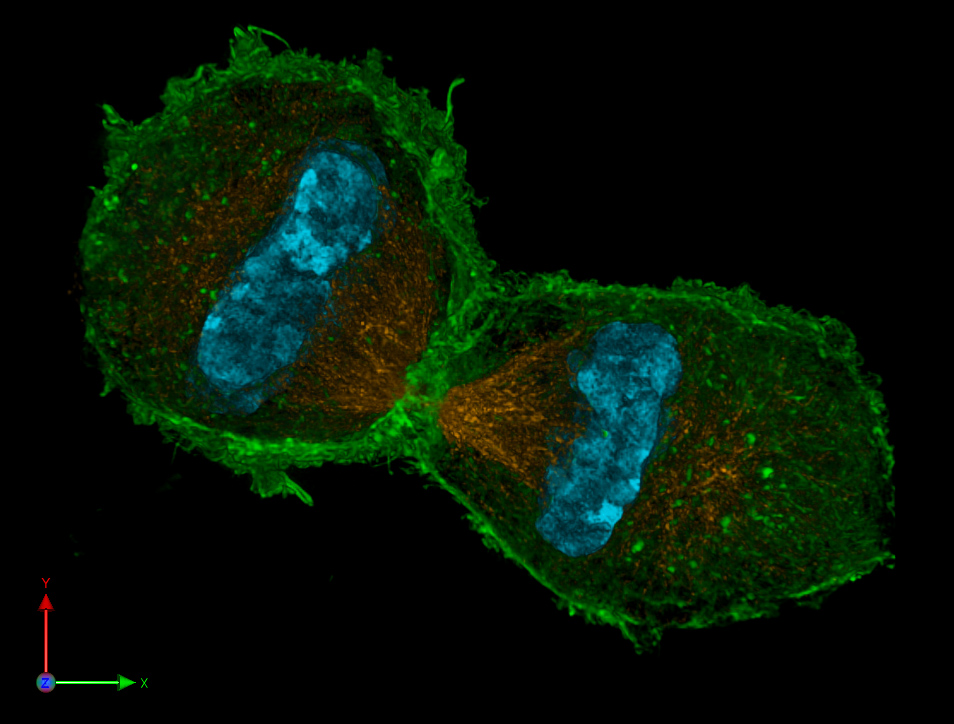
Autopoiesis was originally presented as a system description that was said to define and explain the nature of living systems. A canonical example of an autopoietic system is the biological cell. The eukaryotic cell, for example, is made of various biochemical components such as nucleic acids and proteins, and is organized into bounded structures such as the cell nucleus, various organelles, a cell membrane and cytoskeleton. These structures, based on an internal flow of molecules and energy, produce the components which, in turn, continue to maintain the organized bounded structure that gives rise to these components.
Autopoiesis
The term autopoiesis (from Greek αὐτo- (auto) 'self' and ποίησις (poiesis) 'creation, production'), one of several current theories of life, refers to a system capable of producing and maintaining itself by creating its own parts. The term was introduced in the 1972 publication Autopoiesis and Cognition: The Realization of the Living by Chilean biologists Humberto Maturana and Francisco Varela to define the self-maintaining chemistry of living cells.
The concept has since been applied to the fields of cognition, neurobiology, systems theory, architecture and sociology. Niklas Luhmann briefly introduced the concept of autopoiesis to organizational theory.
In their 1972 book Autopoiesis and Cognition, Chilean biologists Maturana and Varela described how they invented the word autopoiesis.
"It was in these circumstances ... in which he analyzed Don Quixote's dilemma of whether to follow the path of arms (praxis, action) or the path of letters (poiesis, creation, production), I understood for the first time the power of the word "poiesis" and invented the word that we needed: autopoiesis. This was a word without a history, a word that could directly mean what takes place in the dynamics of the autonomy proper to living systems."
They explained that,
"An autopoietic machine is a machine organized (defined as a unity) as a network of processes of production (transformation and destruction) of components which: (i) through their interactions and transformations continuously regenerate and realize the network of processes (relations) that produced them; and (ii) constitute it (the machine) as a concrete unity in space in which they (the components) exist by specifying the topological domain of its realization as such a network."
They described the "space defined by an autopoietic system" as "self-contained", a space that "cannot be described by using dimensions that define another space. When we refer to our interactions with a concrete autopoietic system, however, we project this system on the space of our manipulations and make a description of this projection."
Autopoiesis was originally presented as a system description that was said to define and explain the nature of living systems. A canonical example of an autopoietic system is the biological cell. The eukaryotic cell, for example, is made of various biochemical components such as nucleic acids and proteins, and is organized into bounded structures such as the cell nucleus, various organelles, a cell membrane and cytoskeleton. These structures, based on an internal flow of molecules and energy, produce the components which, in turn, continue to maintain the organized bounded structure that gives rise to these components.
Recent media
Recent media