


Community hub
Recent from talks
Contribute something
Nothing was collected or created yet.
Fred Carter
View on Wikipedia
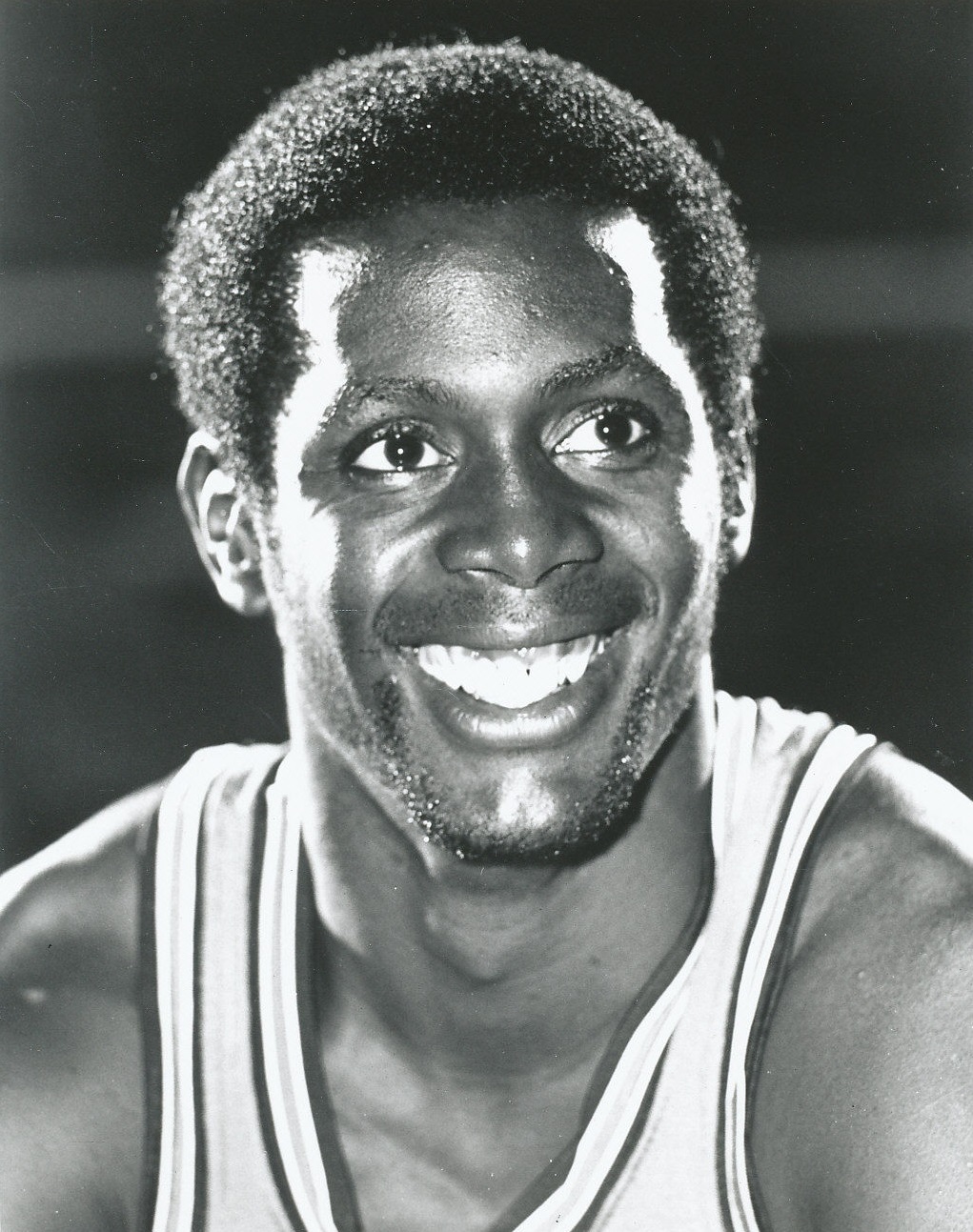
Fredrick James Carter (born February 14, 1945), nicknamed "Mad Dog" or "Doggy",[1][2] is an American former professional basketball player and coach, who played in the National Basketball Association (NBA) for eight seasons (1969–77) for the Baltimore Bullets, Philadelphia 76ers, and Milwaukee Bucks.[2] He also coached the Mount St. Mary's Women's Basketball Team for three years to a 60-32 record and three years of AIAW tournament play.
Key Information


Early life
[edit]Carter was born on February 14, 1945, in Philadelphia, Pennsylvania, one of four children. His father was a junk dealer and his mother a domestic worker. He attended Benjamin Franklin High School.[3][2] He was All-Public League in Philadelphia his senior year, playing center, averaging 17 points per game.[4] He had decided to drop out and join the Army, but there was no one there to swear him in. Instead, he went with a girlfriend to visit Cheyney University for her freshman orientation. He realized he could compete in college and decided to finish high school.[1]
College
[edit]Carter was recruited by fellow Philadelphian, and College Basketball Hall of Fame Coach, Jim Phelan of Mount St. Mary's College (the "Mount"; now Mount St. Mary's University) in Emmitsburg, Maryland. Phelan was scouting a Philadelphia high school all-star game in which Carter participated and won Most Valuable Player. Phelan decided to recruit Carter for the Mount. Carter later applied and was accepted to the school in 1965, but had a concern. The school had only integrated in the early 1960s, and on his drive to the rural campus with Phelan, Carter asked how many black students attended the Mount. Phelan told him to look in mirror (he would be the only one).[5]
In fact, the school did not pose a serious problem for Carter. Fans at basketball games would chant "In Fred We Trust", and Phelan and his wife Dottie became Carter's surrogate parents on campus. But he faced obstacles when going to play teams in the American South. Among other things, during a tournament at Randoph-Macon College in Ashland, Virginia, he was punched twice while retrieving his warmups at halftime.[5] At Hampden-Sydney College, also in Virginia, he was called "every name in the book". On another trip, a restaurant refused Carter service, and the whole team walked out with him.[6]
The team's record during Carter's tenure was 81-27, with a Mason-Dixon Conference title. He scored 1,840 points, averaging 21.9 points and 11 rebounds a game. He was injured during part of his senior year after being poked in the eye.[6][7]
Career
[edit]Baltimore Bullets
[edit]A 6 ft 3 in (1.91 m) guard, Carter was selected by the Baltimore Bullets in the third round (43rd overall) of the 1969 NBA draft.[3][6] Bullet teammate, and fellow Philadelphian, Ray Scott gave Carter the nickname "Mad Dog" after Carter once bit Scott during a one-on-one practice drill.[6] Carter played on Bullets teams that included future Naismith Memorial Basketball Hall of Fame players Gus Johnson, Earl Monroe, and Wes Unseld, as well as players like Jack Marin, Kevin Loughery, and Scott.[6] They taught Carter what was needed to be a successful NBA player.[1]
In the final game of the 1971 Eastern Conference playoffs against the Bullets archrivals, the New York Knicks, with 68 seconds remaining and the Bullets up by two points, Carter hit a 20-foot jump shot that secured victory for the Bullets. The Bullets were so desperate to defeat New York, who had knocked them out of the playoffs the last two years,[8][9] that with one minute left, during a timeout, coach Gene Shue looked heavenward and prayed, "'Please, let us win this one.'" They did, 93-91, and the shot made Carter a hero in Baltimore. He had 14 points, 10 rebounds, and 2 assists in the victory.[6][10]
Philadelphia 76ers
[edit]Despite the heroics, Carter was traded two games into the next season, along with Loughery, to the Philadelphia 76ers for Archie Clark, a 1973 second-round selection (19th overall–Louie Nelson) and cash, on October 17, 1971.[1][11][12] He averaged nearly 14 points a game for the Sixers that first year.[2] The next season, he led the 76ers by averaging 20 points a game,[2] but played for a team that has the worst single season win-loss record in NBA history, 9-73.[3] Carter is sometimes remembered as the best player on the worst team. He has described the experience as a building block in life, teaching him how to get through hard times, staying motivated by the principles of respecting oneself and respecting the game.[1]
Carter played four more years for the Sixers, averaging 21.4, 21.9 (10th in the league), and 18.9 points per game; 4.8, 4.4 and 3.6 rebounds per game; and 5.7, 4.4. and 4.5 assists per game in the following three seasons. The 76ers reached the playoffs in 1976, where Carter averaged 28 points per game in three games against the Buffalo Braves. Carter was traded to the Milwaukee Bucks for his final season, 1976-1977, when a severely sprained ankle ended his career.[3][5][2][13]
Over the course of his NBA playing career Carter scored 9,271 points, averaging 15.2 points a game, with a 42.5 field goal percentage.[2][5]
Coaching
[edit]Mount St. Mary's Women's team
[edit]Carter came back to the Mount when he was hired to coach the women's basketball team in April 1978. He wound up putting in more time coaching than when he was a player. Phelan said Carter worked the women's team harder than Phelan worked the men's team. Carter took the team to a 19-12 record in the 1978-1979 season, and a place in the Eastern AIAW Division II tournament (coming in fourth); an 18-9 record in the 1979-1980 season (coming in third in Eastern AIAW Division II tournament); and a 23-11 record in 1980-1981 (coming in third in Eastern AIAW Division II tournament).[13][14]
Coaching in the NBA
[edit]Carter later became the assistant coach for the Atlanta Hawks (1981-1983), Chicago Bulls (1984-1985), and Washington Bullets (1985-1987). He was an assistant coach for the 76ers from 1987 to 1992, and in the beginning of the 1992-1993 season before becoming the head coach of the Sixers for almost two seasons, from late-1992 to mid-1994.[15][6]
Basketball analyst
[edit]Following his coaching tenure with the Sixers, Carter began a successful career as a basketball analyst. He spent eight years at ESPN and five years at NBA TV, before his retirement.[6] During his time as co-host of NBA Tonight he was known for his claim of being "the best player on the worst team in NBA history."[16]
Legacy
[edit]On December 1, 2007, Carter had his jersey, number "33", retired at halftime of the Mount St. Mary's v. Loyola College of Baltimore men's basketball game at Coach Jim Phelan Court in Knott Arena in Emmitsburg, Maryland. He was the first Mountaineer basketball player to have his number retired.[7]
NBA career statistics
[edit]| GP | Games played | GS | Games started | MPG | Minutes per game |
| FG% | Field goal percentage | 3P% | 3-point field goal percentage | FT% | Free throw percentage |
| RPG | Rebounds per game | APG | Assists per game | SPG | Steals per game |
| BPG | Blocks per game | PPG | Points per game | Bold | Career high |
Regular season
[edit]| Year | Team | GP | GS | MPG | FG% | 3P% | FT% | RPG | APG | SPG | BPG | PPG |
|---|---|---|---|---|---|---|---|---|---|---|---|---|
| 1969–70 | Baltimore | 76 | – | 16.0 | .358 | – | .690 | 2.5 | 1.6 | – | – | 5.2 |
| 1970–71 | Baltimore | 77 | – | 22.2 | .417 | – | .650 | 3.3 | 2.1 | – | – | 10.4 |
| 1971–72 | Baltimore | 2 | – | 34.0 | .222 | – | .333 | 9.5 | 6.0 | – | – | 7.5 |
| 1971–72 | Philadelphia | 77 | – | 27.9 | .444 | – | .630 | 4.0 | 2.6 | – | – | 13.8 |
| 1972–73 | Philadelphia | 81 | – | 37.0 | .421 | – | .704 | 6.0 | 4.3 | – | – | 20.0 |
| 1973–74 | Philadelphia | 78 | – | 39.0 | .430 | – | .709 | 4.8 | 5.7 | 1.4 | 0.3 | 21.4 |
| 1974–75 | Philadelphia | 77 | – | 39.6 | .447 | – | .738 | 4.4 | 4.4 | 1.1 | 0.3 | 21.9 |
| 1975–76 | Philadelphia | 82 | – | 36.5 | .417 | – | .702 | 3.6 | 4.5 | 1.7 | 0.2 | 18.9 |
| 1976–77 | Philadelphia | 14 | – | 16.9 | .426 | – | .526 | 1.7 | 1.5 | 0.8 | 0.1 | 6.9 |
| 1976–77 | Milwaukee | 47 | – | 18.6 | .416 | – | .753 | 2.0 | 2.2 | 0.6 | 0.1 | 8.3 |
| Career | 611 | – | 30.0 | .425 | – | .693 | 3.9 | 3.5 | 1.2 | 0.2 | 15.2 | |
Playoffs
[edit]| Year | Team | GP | GS | MPG | FG% | 3P% | FT% | RPG | APG | SPG | BPG | PPG |
|---|---|---|---|---|---|---|---|---|---|---|---|---|
| 1969–70 | Baltimore | 7 | – | 36.1 | .383 | – | .607 | 4.4 | 3.4 | – | – | 14.1 |
| 1970–71 | Baltimore | 18 | – | 33.2 | .415 | – | .644 | 4.6 | 2.0 | – | – | 14.6 |
| 1975–76 | Philadelphia | 3 | – | 41.7 | .433 | – | .867 | 3.3 | 5.0 | 1.3 | 0.3 | 28.0 |
| Career | 28 | – | 34.8 | .410 | – | .687 | 4.4 | 2.7 | 1.3 | 0.3 | 15.9 | |
References
[edit]- ^ a b c d e Perner, Mark (March 14, 2016). "9–73 Sixers don't define Fred Carter". inquirer.com. Philadelphia Inquirer. Retrieved April 19, 2020.
- ^ a b c d e f g "Fred Carter Stats". Basketball-Reference.com. Sports Reference LLC. Retrieved April 19, 2020.
- ^ a b c d Caldwell, Dave (March 27, 2023). "'A slow motion nightmare season': Mad Dog Carter and the NBA's worst-ever team". The Guardian. ISSN 0261-3077. Retrieved November 12, 2024.
- ^ Simmons, Bill (March 3, 1963). "West Phila., Franklin Gain Public Finals". The Philadelphia Inquirer. p. 100.
- ^ a b c d "Mount legend and NBA veteran, Fred Carter". w.emmitsburg.net. Retrieved November 12, 2024.
- ^ a b c d e f g h Klingaman, Mike (February 15, 2013). "Catching Up With ... Fred Carter". Baltimore Sun.
- ^ a b Goldberg, Stan (December 3, 2007). "MSM retires Fred Carter's jersey". The Frederick News-Post. Retrieved November 12, 2024.
- ^ "1969 NBA Playoffs Summary". Basketball-Reference.com. Retrieved November 12, 2024.
- ^ "1970 NBA Playoffs Summary". Basketball-Reference.com. Retrieved November 12, 2024.
- ^ "1971 NBA Eastern Conference Finals Game 7: Bullets vs Knicks, April 19, 1971". Basketball-Reference.com. Retrieved November 12, 2024.
- ^ "76ers Deal Clark to Bullets For Loughery and Carter," The Associated Press (AP), Sunday, October 17, 1971. Retrieved March 16, 2022.
- ^ 1973 NBA Draft Pick Transactions, April 24 – Pro Sports Transactions. Retrieved March 16, 2022.
- ^ a b Williamson, Nancy (March 5, 1979). "Mad Dog Used To Be One Of The Most Charged-Up Players In The NBA, But Now Fred Carter Gets His Kicks As the Successful Coach Of His Alma Mater's Women's Team". Sports Illustrated.
- ^ "Mount St. Mary's Women's Basketball Record Book, The Mount, Women's Basketball," (PDF). Mount St. Mary's University. Retrieved November 12, 2024.
- ^ "Fred Carter". Basketball-Reference.com. Sports Reference LLC. Retrieved April 19, 2020.
- ^ Kerby, Trey. "Fred Carter wants to remain immortal, if you don't mind," yahoo!sports, Wednesday, March 24, 2010. Retrieved March 16, 2022.
- ^ Kennedy, Pagan (October 26, 2012). "Who Made That Fist Bump". nytimes.com. The New York Times Magazine. ISSN 0362-4331. Retrieved August 15, 2019.
External links
[edit]- Career statistics from NBA.com · Basketball Reference
Fred Carter
View on GrokipediaEarly Life and Education
Childhood and High School
Frederick James Carter was born on February 14, 1945, in Philadelphia, Pennsylvania.[1] He grew up as one of four children in a working-class family, with his mother employed as a domestic worker and his father operating as a junk dealer; Carter assisted his father in the business, later describing the experience as "We were Sanford and Son before there was Sanford and Son."[4] Carter attended Benjamin Franklin High School in Philadelphia, where he developed his basketball skills playing as a center.[1] He briefly dropped out during high school with plans to enlist in the U.S. Army, but an empty enlistment office prompted a reevaluation; after attending a college orientation at Cheyney University with his girlfriend and encountering encouraging familiar faces, he returned to school to earn his high school diploma.[4][6] His talent came to prominence in a Philadelphia city all-star game in the early 1960s, where he was selected as MVP while coaches scouted another player, drawing the attention of Mount St. Mary's University coach Jim Phelan for recruitment.[6]College Career
Carter enrolled at Mount St. Mary's College (now Mount St. Mary's University) in 1965, becoming the first African American resident student at the institution.[7] He played for the Mountaineers men's basketball team under coach Jim Phelan from 1965 to 1969, contributing significantly to the program's development during that era.[3] Over his four-year college career, Carter appeared in 84 games, averaging 21.0 points and 11.0 rebounds per game.[3] His career totals included 1,840 points (third all-time at Mount St. Mary's), 910 rebounds (eighth all-time), and 735 field goals made (fourth all-time).[3] These performances highlighted his scoring efficiency and rebounding prowess as a 6-foot-3 guard-forward.[1] Carter's standout college play led to his selection by the Baltimore Bullets in the third round (43rd overall) of the 1969 NBA Draft.[1] In recognition of his contributions, his jersey number 33 was retired by Mount St. Mary's on December 1, 2007, making him one of only three players to receive this honor, and he was inducted into the Mount St. Mary's Athletics Hall of Fame.[3]Professional Playing Career
Baltimore Bullets (1969–1973)
Fred Carter was selected by the Baltimore Bullets in the third round (14th pick, 43rd overall) of the 1969 NBA draft out of Mount St. Mary's University.[1] He signed a multi-year contract with the team on September 1, 1969, and made his NBA debut on October 21, 1969.[8][1] As a 6-foot-3 guard known for his tenacity—earning the nickname "Mad Dog" from teammate Ray Scott—Carter provided defensive energy and scoring off the bench during his early professional years.[4] In his rookie 1969–70 season, Carter appeared in 76 games, averaging 16.0 minutes, 5.2 points, 2.5 rebounds, and 1.6 assists per game while shooting 42.1% from the field.[1] The Bullets finished with a 35–47 record, missing the playoffs, but Carter contributed to a roster featuring stars like Earl Monroe and Wes Unseld. His role expanded in 1970–71, where he played 77 games, boosting his averages to 22.2 minutes, 10.4 points, 3.3 rebounds, and 2.1 assists per game, with a field goal percentage of 45.2%.[1] The team improved to 42–40 and reached the Eastern Division semifinals, where Carter's aggressive play helped in matchups against division rivals. Early in the 1971–72 season, after appearing in just two games with averages of 34.0 minutes, 7.5 points, 9.5 rebounds, and 6.0 assists, Carter was traded to the Philadelphia 76ers on October 18, 1971, along with Kevin Loughery in exchange for Archie Clark and a 1972 second-round draft pick.[1][8][9] One notable contribution prior to the trade occurred in a December 1971 game against the New York Knicks, where Carter hit a key field goal to secure a 93–91 lead with 11 seconds left, aiding a Bullets victory. Despite the short stint in 1971–72, his three seasons with Baltimore established him as a versatile guard capable of impacting both ends of the court.Philadelphia 76ers (1973–1977)
Carter served as a primary scoring and playmaking guard for the Philadelphia 76ers during the 1973–74 and 1974–75 seasons, averaging 21.4 points, 4.8 rebounds, and a league-high 5.7 assists per game in 78 appearances in 1973–74, while shooting 43.0% from the field and 70.9% from the free-throw line.[1] In 1974–75, he elevated his scoring to 21.9 points per game across 77 games, with 4.4 rebounds and 4.4 assists, improving his field-goal percentage to 44.7% and free-throw accuracy to 73.8%.[1] These performances underscored his role as a versatile backcourt leader on teams that struggled with overall records, finishing 25–57 in 1973–74 and 34–48 in 1974–75, missing the playoffs both years.| Season | Games | MPG | PPG | RPG | APG | FG% | FT% |
|---|---|---|---|---|---|---|---|
| 1973–74 | 78 | 39.0 | 21.4 | 4.8 | 5.7 | .430 | .709 |
| 1974–75 | 77 | 39.6 | 21.9 | 4.4 | 4.4 | .447 | .738 |
Playing Style, Achievements, and Incidents
Carter played as a shooting guard and point guard, known for an aggressive, scoring-focused style that earned him the nickname "Mad Dog" due to his tenacious and exuberant on-court demeanor.[4][11] Described as a "gunner," he emphasized driving to the basket and perimeter shooting, averaging 15.2 points, 3.9 rebounds, and 3.5 assists per game across 611 regular-season appearances with a 42.5% field goal percentage.[1][12] His scrappy defense complemented this offensive approach, though his shooting efficiency reflected the era's challenges for guards reliant on mid-range attempts.[13] Over his NBA tenure from 1969 to 1977, Carter's primary achievements included earning team MVP honors for the 1972–73 Philadelphia 76ers, the franchise's worst season at 9–73, where he led the team in scoring at 20.1 points per game.[14][1] He contributed to the 76ers' playoff qualification in 1976, appearing in three postseason games with averages of 28.0 points, 9.7 rebounds, and 4.3 assists per game before the team's first-round exit.[15] Career playoff stats across 28 games showed 17.5 points, 5.7 rebounds, and 2.5 assists per game, underscoring his scoring reliability in limited postseason exposure.[1] No All-Star selections or league-wide awards marked his resume, as his production peaked on underperforming teams.[2] Notable incidents were scarce, with Carter's career defined more by team struggles than personal controversies. His tenure overlapped with the 76ers' infamous 9–73 campaign, where excessive turnovers and unstructured play drew internal criticism, though Carter disputed claims of over-reliance on fast breaks as the sole cause.[16] Traded to the Milwaukee Bucks on December 3, 1976, after the 76ers acquired Julius Erving, rendering Carter's gunner style redundant in the revamped offense; he played 15 games for Milwaukee before retiring.[12] No suspensions, ejections, or off-court issues appear in records, reflecting a professional but unremarkable disciplinary profile.[1]Coaching Career
College Coaching at Mount St. Mary's
Fred Carter coached the Mount St. Mary's women's basketball team from 1978 to 1981.[3] Over these three seasons, he achieved an overall record of 60 wins and 32 losses.[17] The season-by-season results were as follows:| Season | Record | Winning Percentage |
|---|---|---|
| 1978–79 | 19–12 | .613 |
| 1979–80 | 18–9 | .667 |
| 1980–81 | 23–11 | .676 |
NBA Assistant Coaching Roles
Carter served as an assistant coach for the Atlanta Hawks during the 1981–82 and 1982–83 seasons under head coach Hubert Davis.[19] He then joined the Chicago Bulls as an assistant for the 1984–85 season, working under Kevin Loughery.[19] From 1985 to 1987, Carter was an assistant with the Washington Bullets for two seasons, first under Gene Shue in 1985–86 and then under Bob Staak in 1986–87.[19] In 1987, he returned to the Philadelphia 76ers, where he had previously played, serving as an assistant coach from the 1987–88 season through the 1991–92 season under head coaches such as Jim Lynam and Jim O'Brien.[19] These roles spanned multiple franchises and contributed to his eventual promotion to head coaching positions, though assistant coaching records from this era may be incomplete in available databases.[19]| Season | Team | Head Coach |
|---|---|---|
| 1981–82 | Atlanta Hawks | Hubert Davis |
| 1982–83 | Atlanta Hawks | Hubert Davis |
| 1984–85 | Chicago Bulls | Kevin Loughery |
| 1985–86 | Washington Bullets | Gene Shue |
| 1986–87 | Washington Bullets | Bob Staak |
| 1987–88 | Philadelphia 76ers | Jim Lynam |
| 1988–89 | Philadelphia 76ers | Jim Lynam |
| 1989–90 | Philadelphia 76ers | Jim Lynam |
| 1990–91 | Philadelphia 76ers | Jim O'Brien |
| 1991–92 | Philadelphia 76ers | Jim O'Brien |
Broadcasting and Analysis Career
Roles as Basketball Analyst
Following his interim head coaching role with the Philadelphia 76ers from December 1992 to April 1994, Carter entered broadcasting as a basketball analyst.[20] He served in this capacity at ESPN for eight years, providing commentary and analysis on NBA games and related programming.[21] A key role involved co-hosting NBA 2Night on ESPN2, where he offered insights drawn from his playing and coaching experience, often emphasizing defensive strategies and team dynamics.[22][23] Carter later joined NBA TV as an analyst for five years, contributing to studio shows including NBA TV Daily.[24] In these appearances, he focused on game breakdowns, player evaluations, and league trends, leveraging his background as a former All-Star guard known for tenacity on defense.[25] His tenure at NBA TV extended into the late 2000s, with contributions noted as recent as 2007.[26] By 2013, Carter had retired from active broadcasting roles, having established a reputation for straightforward, experience-based analysis across both networks.[20]Notable Contributions and Perspectives
Carter served as a basketball analyst for ESPN, appearing on programs such as NBA 2Night and SportsCenter, where he delivered commentary informed by his playing and coaching background.[23] He also authored the recurring "Fred's Points" column on ESPN.com, offering weekly assessments of NBA players, teams, and strategic elements, including evaluations of emerging talents like Kenyon Martin and established stars like Jason Kidd and Kobe Bryant.[27][28] These contributions emphasized practical insights into team dynamics and individual matchups, such as highlighting the Portland Trail Blazers' potential alongside Tim Duncan's dominance and Michael Jordan's enduring influence.[29] His analytical style featured an energetic, direct approach, often marked by pointing at the camera to engage viewers and underscore key observations.[23] Carter advocated for coaches aligned with organizational needs, as in his endorsement of Don Chaney for the New York Knicks due to Chaney's grasp of required playing styles and patience in rebuilding.[23] He defended figures like Larry Brown against criticism, arguing for recognition of their tactical acumen amid challenging circumstances.[30] In playoff analysis, Carter identified the Los Angeles Lakers and Shaquille O'Neal as formidable, citing their unstoppable momentum in matchups.[31] Carter expressed skepticism toward deliberate underperformance in the league, comparing the 2013–14 Philadelphia 76ers—mired in a 25-game losing streak—to his own 1972–73 76ers team that won just 9 games, deeming the modern iteration inferior in execution and resolve.[14] His perspectives consistently drew from firsthand experience, prioritizing competitive intensity and foundational skills over transient trends, as seen in discussions of toughest postseason venues like Boston's arenas, where hostile crowds amplified pressure.[32]Legacy and Assessment
Achievements and Honors
In college at Mount St. Mary's University, Carter averaged 21.0 points and 11.0 rebounds per game over his career, accumulating 1,840 points (third all-time at the institution), 910 rebounds (eighth all-time), and 731 field goals (fourth all-time).[3] He was inducted into the Mount St. Mary's Athletics Hall of Fame in 1979 as part of the Class of 1969 for men's basketball.[3] The university retired his jersey on December 1, 2007, honoring him as one of only three players to receive this distinction.[3] During his eight-season NBA career, Carter amassed 10,270 points, 2,381 rebounds, and 2,122 assists in 688 regular-season games.[1] He finished 25th in league MVP voting during the 1971–72 season.[1] In the 1974–75 season, he ranked tenth in scoring average with 20.8 points per game while with the Philadelphia 76ers.[1] Despite the 76ers' league-worst 9–73 record in 1972–73, Carter led the team in scoring and was recognized informally as its MVP.[33] In the 1975–76 playoffs, he averaged 28.0 points per game across three contests.[1] Carter received no official NBA All-Star selections or major individual awards.[1]Criticisms and Realistic Evaluation
Carter's playing career, while marked by tenacity and earning him the nickname "Mad Dog" for his aggressive style, drew criticism for a "gunner" approach prioritizing personal scoring over team play, which contributed to his trade from the Philadelphia 76ers in December 1976 after the acquisition of Julius Erving rendered his shot-heavy tendencies redundant.[12] Over eight NBA seasons, he averaged 15.2 points per game across 611 regular-season appearances with the Baltimore Bullets, Philadelphia 76ers, and Milwaukee Bucks, but lacked All-Star selections or championship contributions, with his tenure on the 1972-73 76ers—winners of just nine games—cementing a legacy tied more to futility than excellence despite leading that team in scoring at 20.0 points per game.[1] As head coach of the 76ers from March 1993 to the end of the 1993-94 season, Carter compiled a 32-76 record (.296 winning percentage), including a 7-19 mark in his interim stint after Doug Moe's firing and no playoff appearances, underscoring limited success in turning around underperforming rosters despite prior praise for player motivation.[19][34] His decade as an NBA assistant with teams like the Atlanta Hawks, Chicago Bulls, and Washington Bullets provided tactical experience, yet the head coaching outcomes suggest shortcomings in game management or roster evaluation, as the 76ers finished last in their division both years under him.[19] A realistic assessment positions Carter as a gritty journeyman whose on-court intensity influenced peers but yielded no sustained impact, with career totals reflecting solid but unremarkable production amid consistently mediocre teams.[1] His coaching foray, while demonstrating persistence after playing days, failed to translate assistant insights into wins, highlighting the challenges of elevating talent-poor squads in a competitive league.[19] In broadcasting, spanning ESPN and NBA TV, he offered straightforward analysis without notable controversies, contributing reliably but not innovatively to coverage. Overall, Carter's legacy endures through emblematic association with NBA lows—like the 9-73 76ers—rather than highs, valuing his unyielding ethic over statistical or titular acclaim.[4]Career Statistics
Regular Season
Fred Carter appeared in 611 regular-season games over eight NBA seasons from 1969–70 to 1976–77, primarily as a shooting guard and point guard for the Baltimore Bullets, Philadelphia 76ers, and Milwaukee Bucks.[1] His career per-game averages were 15.2 points, 3.9 rebounds, 3.5 assists, and 1.2 steals, with a field-goal percentage of 42.5%.[1] [35] Carter's scoring peaked in 1974–75 with the 76ers, where he averaged 21.9 points per game across 77 contests.[1] The following table summarizes his regular-season per-game statistics:[1]| Season | Team(s) | G | MP | FG | FGA | FG% | FT | FTA | FT% | TRB | AST | PTS |
|---|---|---|---|---|---|---|---|---|---|---|---|---|
| 1969–70 | BAL | 76 | 16.0 | 2.1 | 5.8 | .358 | 1.1 | 1.5 | .690 | 2.5 | 1.6 | 5.2 |
| 1970–71 | BAL | 77 | 22.2 | 4.4 | 10.6 | .417 | 1.5 | 2.4 | .650 | 3.3 | 2.1 | 10.4 |
| 1971–72 | BAL/PHI | 79 | 28.0 | 5.6 | 12.9 | .438 | 2.3 | 3.7 | .621 | 4.1 | 2.7 | 13.6 |
| 1972–73 | PHI | 81 | 37.0 | 8.4 | 19.9 | .421 | 3.2 | 4.5 | .704 | 6.0 | 4.3 | 20.0 |
| 1973–74 | PHI | 78 | 39.0 | 9.1 | 21.0 | .430 | 3.3 | 4.6 | .709 | 4.8 | 5.7 | 21.4 |
| 1974–75 | PHI | 77 | 39.6 | 9.3 | 20.8 | .447 | 3.3 | 4.5 | .738 | 4.4 | 4.4 | 21.9 |
| 1975–76 | PHI | 82 | 36.5 | 8.1 | 19.4 | .417 | 2.7 | 3.8 | .702 | 3.6 | 4.5 | 18.9 |
| 1976–77 | PHI/MIL | 61 | 18.2 | 3.4 | 8.2 | .418 | 1.1 | 1.6 | .708 | 1.9 | 2.0 | 8.0 |
| Career | 611 | 29.7 | 6.4 | 15.1 | .425 | 2.3 | 3.4 | .689 | 3.9 | 3.5 | 15.2 |
Playoffs
Carter participated in the NBA playoffs on three occasions, appearing in a total of 28 games across his career with the Baltimore Bullets and Philadelphia 76ers.[1] His playoff averages were 15.9 points, 4.4 rebounds, 2.7 assists, 1.3 steals, and 0.3 blocks per game, reflecting a slightly elevated scoring output compared to his regular-season marks.[36] [1]| Year | Team | G | MP | FG% | FT% | RPG | APG | PPG |
|---|---|---|---|---|---|---|---|---|
| 1970 | BAL | 7 | 36.1 | .383 | .607 | 4.4 | 3.9 | 14.1 |
| 1971 | BAL | 18 | 33.2 | .415 | .644 | 4.6 | 3.5 | 14.6 |
| 1976 | PHI | 3 | 41.7 | .433 | .867 | 1.3 | 5.0 | 28.0 |
| Career | - | 28 | - | - | - | 4.4 | 2.7 | 15.9 |