


Community hub
Recent from talks
Contribute something
Nothing was collected or created yet.
James Worthy
View on Wikipedia
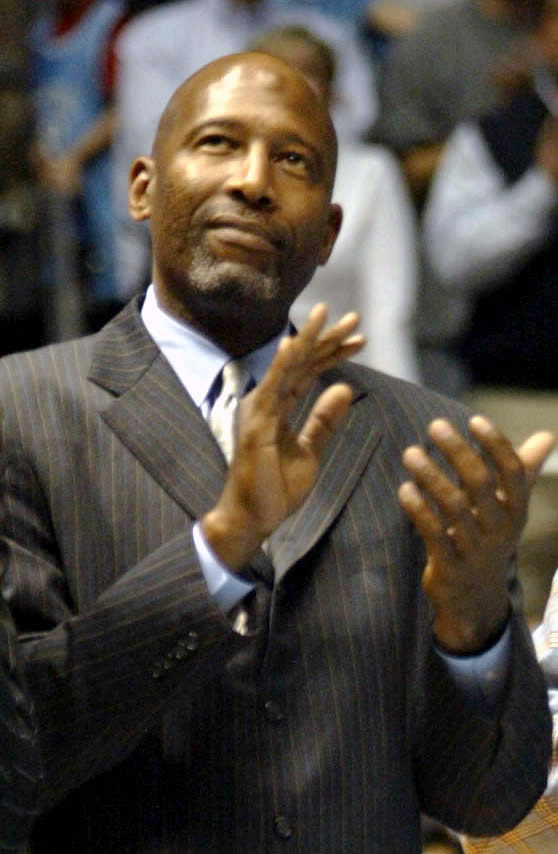
James Ager Worthy (born February 27, 1961) is an American former professional basketball player.[1] Nicknamed "Big Game James", he played his entire professional career with the Los Angeles Lakers in the National Basketball Association (NBA). Worthy was a seven-time NBA All-Star, a two-time All-NBA Team member who won three NBA championships and was voted the NBA Finals Most Valuable Player (MVP) in 1988. He was named to both the NBA's 50th and 75th anniversary teams.
Key Information


A standout college basketball player for the North Carolina Tar Heels, the small forward was a consensus first-team All-American and shared national player of the year honors en route to leading his team to the 1982 NCAA championship. Named the NCAA tournament Most Outstanding Player, he was selected by the Lakers with the first overall pick of the 1982 NBA draft.
Early life
[edit]Worthy was born in Gastonia, North Carolina. His 21.5 points, 12.5 rebounds and 5.5 assists per game during his senior season at Ashbrook High School led the team to the state championship game. Named both a Parade Magazine and McDonald's All-American, he was selected to play in the 1979 McDonald's All-American Game, which featured future fellow Hall of Famers including Isiah Thomas, Dominique Wilkins, and Ralph Sampson.
College career
[edit]After graduating from high school, Worthy attended the University of North Carolina at Chapel Hill. An immediate standout as a freshman, his debut was cut short near mid-season by a broken ankle. As a sophomore, he was a key member of UNC's 1981 NCAA runner-up team starring alongside Al Wood and Sam Perkins.
As a junior power forward Worthy was the leading scorer (15.6 points per game) of a Tar Heels NCAA championship team that featured one of the greatest collections of talent in collegiate basketball history,[2] including future NBA stars sophomore Sam Perkins and freshman Michael Jordan. A consensus first-team All-American,[3] Worthy was named co-winner of the Helms Foundation Player of the Year with Ralph Sampson of Virginia.[4][5] He dominated the 1982 championship game against the Georgetown Hoyas, sealing the Tar Heels' 63–62 victory by intercepting an inadvertent pass thrown by Hoya point guard Fred Brown with just seconds remaining. His 13–17 shooting, 28 point, 4 rebound finale capped a standout performance throughout the NCAA tournament, earning him its Most Outstanding Player award. A tip dunk in front of Patrick Ewing captioned "James Worthy slams the door on Georgetown" made the cover of Sports Illustrated.[6]
In the wake of this success, Worthy elected to forgo his senior year and enter the NBA draft. He completed his degree later, via summer school. He is one of eight players to have their numbers retired by the Tar Heels.[3] In 2002, Worthy was named to the ACC 50th Anniversary men's basketball team honoring the fifty greatest players in Atlantic Coast Conference history.[7]
Professional career
[edit] | This section of a biography of a living person needs additional citations for verification. (October 2021) |
Number 1 pick
[edit]The Los Angeles Lakers had received the Cleveland Cavaliers' 1982 first-round draft pick in a 1979 exchange for Don Ford.[8] The Cavaliers finished with the NBA's worst record in the 1981–82 season, leaving a coin toss to decide whether they or the worst record runner-up San Diego Clippers would get the first overall pick in the upcoming draft. The Lakers won the flip, the first and only time a reigning NBA champion picked first overall. They chose Worthy over Dominique Wilkins and Terry Cummings.[9]
1982–1983
[edit]The lanky small forward immediately made an impact as a rookie, averaging 13.4 points per game and shooting a Laker rookie record .579 field goal percentage.[9] With his speed, dynamic ability to score with either hand, and dazzling play above the rim, Worthy thrived in the Lakers' high-octane "Showtime" offense. When not finishing fast breaks with his trademark Statue of Liberty dunks or swooping finger rolls, Worthy was also one of the best post players at his position, with a quick spin move off the low blocks and a deadly turnaround midrange jumpshot. His rookie year ended just when he was hitting his stride, breaking his leg on April 10, 1983, while landing improperly after trying to tap in a missed shot against the Phoenix Suns.[10] He was still named to the 1983 All-Rookie First Team but missed the rest of the season and playoffs, with the Lakers being swept 4–0 by the Philadelphia 76ers in the Finals.[9]
1983–1984
[edit]Back and healthy for the opening of the 1983–84 season, Worthy began the season as a starter at power forward in place of Kurt Rambis, who was on the injured reserve list.[11][12] By December, Lakers head coach Pat Riley said that "it's becoming more and more obvious Worthy is not a legitimate power forward" due to his rebounding,[13] describing him as "a finesse guy who likes to get the ball and go with it".[14] The Los Angeles Times wrote that "he really is a small forward in a big forward's body."[15] Worthy returned to the small forward position and came off the bench after Rambis recovered from his foot injuries.[16][17] Riley cited Rambis's defense and rebounding. Worthy provided offense as a sixth man and was also prone to foul trouble.[18] He developed into one of the league's top small forwards.[19] He remained as a reserve even when All-Star small forward Jamaal Wilkes was sidelined by a gastrointestinal illness during the playoffs, as Riley opted to start Michael Cooper instead. However, Worthy became a starter in the final game of the Western Conference finals against the Suns.[17][19] He was essential for the Lakers during the 1984 NBA Finals against the Boston Celtics.[15] Late in Game 2, Worthy made an errant cross-court pass that was stolen by Gerald Henderson and taken in for the game-tying score, leading to a Celtics win in overtime. Boston won the series in seven games. Worthy had a very strong Finals, with 22.1 pts per game (second to Abdul-Jabbar) on 63.8% shooting. The Lakers would go into the off-season bitter about the loss and motivated for 1985.
1984–1985
[edit]Worthy began the 1984–85 season as a reserve, while Wilkes returned as the starting small forward.[20] After the Lakers opened the season slowly and were outrebounded in each of their first four games, Riley started Worthy in place of Rambis. "We're looking for rebounding. We're experimenting", said the coach.[21] A few games later, Riley replaced Wilkes in the starting lineup with Larry Spriggs.[20] The Lakers dominated the West and returned to the NBA Finals. During the play-off run Worthy emerged as a feared clutch performer, averaging 21.5 points per game on 62.2% shooting in the playoffs and 23.7 points per game in a match-up against the Celtics in the championship series.[22] His all-round play helped lead the team to a 4–2 victory clinched on the celebrated parquet floor of the old Boston Garden and confirmed him as one of the league's premier players. It was also in 1985 that Worthy first donned goggles after suffering a scratched cornea during a March 13 game at the Utah Jazz, wearing them for the rest of his career.
1985–1986
[edit]
The 1985–86 season held tremendous promise for the Lakers, who again stormed through the regular season and seemed destined to meet Boston once again. Worthy continued to improve, raising his scoring from 17.6 to 20 points per game on 58% shooting and was named to the first of seven consecutive All-Star appearances.[9] A trip to the Finals disappeared in a preternatural tip in the Western Conference final by 7' 4" Houston Rockets star Ralph Sampson, with the Rockets going on to be drubbed by the Celtics in the Championship series.
1986–1987
[edit]With stalwart center Abdul-Jabbar finally showing signs of his age the Lakers added center-forward Mychal Thompson during the 1986–1987 regular season to address the need for frontcourt help. The result was a 65–17 record and what many regard as one of the NBA's all-time great teams[23] sprinting to another NBA title over the Celtics. Worthy was at the top of his game, leading the team with 23.6 points per game in the playoffs. He had a number of huge games during this '87 play-off run, in particular a vintage 39 point performance (including 6 dunks) in a 122–121 win at Seattle in Game 3 of the Western Conference Finals and 33 pts 10 assists 9 rebounds in a game 1 victory in the NBA Finals versus the Celtics. The Lakers won the championship 4 games to 2.
1987–1988
[edit]Once again Riley drove the Lakers hard in 1987–88. During the regular season Worthy averaged 19.7 points and scored 38 points against the Atlanta Hawks. He led the Lakers in scoring in the 1988 play-offs and led the NBA in points scored during the play-offs. During the Finals against the Pistons Worthy once again excelled, averaging 22 ppg, 7.4 rebounds, and 4.4 assists in the series.[24] A 28-point, 9 rebound Game 6 and monster 36–16–10 triple-double that carried the Lakers to victory in Game 7 earned Worthy the NBA Finals MVP award and the Lakers the first back-to-back titles in the NBA since '68–'69 Celtics.
1988–1989
[edit]With Riley clamoring for a "Three-peat" in 1988–89 the Lakers marched through the regular season and met the Pistons for an encore in the Finals. With Abdul-Jabbar playing his last games and Johnson and Byron Scott missing three due to injuries even Worthy at his play-off best was not nearly enough. In spite of averaging a career Finals high 25.5 ppg,[25] including a career-high 40 points trying to stave off elimination in Game 4, the Lakers were swept in four.[9]
1989–1990
[edit]The Lakers ran hot again in 1989–90 despite internal friction that had developed during Pat Riley's final year as head coach,[citation needed] their 63–19 record the NBA's best.[26] Worthy averaged 21.1 points per game and became the first player in NBA history to shoot at least 53% in each of his first eight seasons.[9] In spite of stepped-up performances by both Johnson (25.2 ppg) and Worthy (24.2 ppg) in the play-offs, LA fell in the Conference semifinals to a hot Phoenix Suns team.
1990–1991
[edit]The Lakers once more won the West in 1991 and marched through the playoffs to the Finals thanks to Worthy's team-leading and career-high 21.4 ppg in '91 and the addition of former North Carolina Tarheel star Sam Perkins at center. Unfortunately, Worthy suffered a high ankle sprain in Game 5 of the Western Conference Finals against the Blazers and was very limited heading into the Finals against the Chicago Bulls. Despite LA pulling out a Game 1 victory in Chicago it ultimately wasn't enough against a surging Bulls squad led by another teammate from the 1982 NCAA Championship team, an emergent Michael Jordan. The Lakers ultimately fell in five, with Worthy sidelined for Game 5 after re-injuring his ankle the previous game.
Retirement
[edit]Johnson's sudden retirement in November 1991 threw the Lakers franchise into disarray. Injuries and high mileage soon spelled the end for Worthy. The high ankle injury during the 1991 playoffs and season-ending knee surgery in 1992 robbed much of his quickness and leaping ability, and with it both his ability to finish on the fast break and drive to the hoop to score. After struggling with knee pain in the 1994–95 preseason and no prospects of another title run in any foreseeable future, Worthy announced his retirement in November 1994, after 12 seasons in the NBA.
"Big Game James"
[edit]Even on Lakers teams dominated by fellow Hall of Fame members Abdul-Jabbar and Johnson, Worthy stood out as a star during their years together. He led the Lakers in playoff scoring in their championship runs in 1987 (23.6) and 1988 (21.1) and was second to Abdul-Jabbar in the 1985 championship run (21.5). He always saved his best for the playoffs and averaged 3.5 points higher per game than in the regular season. That, his heroics in the 1982 NCAA Championship game alongside Michael Jordan, spectacular offensive displays, and flashes of defensive brilliance, cemented his legacy as "Big Game James".
Worthy played in 926 NBA regular-season games, averaging 17.6 points, 5.1 rebounds and three assists per game.[27] He played in 143 playoff games and averaged 21.1 points, 5.2 rebounds and 3.2 assists per game and had a 54.4 field goal percentage. In 34 NBA Finals games he averaged 22.2 pts per game on 53% shooting. Worthy played in 4 Game 7s in his career and averaged 27 points and 8.2 rebounds on 60% shooting in these winner-take-all contests. He ranks sixth all-time in Lakers team scoring (16,320), third all-time in team steals (1,041) and seventh all-time in team field goal percentage (.521). Worthy was voted one of the 50 Greatest Players in NBA History in 1996 and named to the NBA 75th Anniversary Team in 2021. To commemorate the NBA's 75th Anniversary The Athletic ranked their top 75 players of all time, and named Worthy as the 59th greatest player in NBA history.[28] Worthy was inducted into the Naismith Memorial Basketball Hall of Fame in 2003. His jersey No. 42 was retired by the Lakers.
NBA career statistics
[edit]| GP | Games played | GS | Games started | MPG | Minutes per game |
| FG% | Field goal percentage | 3P% | 3-point field goal percentage | FT% | Free throw percentage |
| RPG | Rebounds per game | APG | Assists per game | SPG | Steals per game |
| BPG | Blocks per game | PPG | Points per game | Bold | Career high |
| † | Won an NBA championship | * | Led the league |
Regular season
[edit]| Year | Team | GP | GS | MPG | FG% | 3P% | FT% | RPG | APG | SPG | BPG | PPG |
|---|---|---|---|---|---|---|---|---|---|---|---|---|
| 1982–83 | L.A. Lakers | 77 | 1 | 25.6 | .579 | .250 | .624 | 5.2 | 1.7 | 1.2 | .8 | 13.4 |
| 1983–84 | L.A. Lakers | 82* | 53 | 29.5 | .556 | .000 | .759 | 6.3 | 2.5 | .9 | .9 | 14.5 |
| 1984–85† | L.A. Lakers | 80 | 76 | 33.7 | .572 | .000 | .776 | 6.4 | 2.5 | 1.1 | .8 | 17.6 |
| 1985–86 | L.A. Lakers | 75 | 73 | 32.7 | .579 | .000 | .771 | 5.2 | 2.7 | 1.1 | 1.0 | 20.0 |
| 1986–87† | L.A. Lakers | 82* | 82 | 34.4 | .539 | .000 | .751 | 5.7 | 2.8 | 1.3 | 1.0 | 19.4 |
| 1987–88† | L.A. Lakers | 75 | 72 | 35.4 | .531 | .125 | .796 | 5.0 | 3.9 | 1.0 | .7 | 19.7 |
| 1988–89 | L.A. Lakers | 81 | 81 | 36.5 | .548 | .087 | .782 | 6.0 | 3.6 | 1.3 | .7 | 20.5 |
| 1989–90 | L.A. Lakers | 80 | 80 | 37.0 | .548 | .306 | .782 | 6.0 | 3.6 | 1.2 | .6 | 21.1 |
| 1990–91 | L.A. Lakers | 78 | 74 | 38.6 | .492 | .289 | .797 | 4.6 | 3.5 | 1.3 | .4 | 21.4 |
| 1991–92 | L.A. Lakers | 54 | 54 | 39.0 | .447 | .209 | .814 | 5.6 | 4.7 | 1.4 | .4 | 19.9 |
| 1992–93 | L.A. Lakers | 82 | 69 | 28.8 | .447 | .270 | .810 | 3.0 | 3.4 | 1.1 | .3 | 14.9 |
| 1993–94 | L.A. Lakers | 80 | 2 | 20.0 | .406 | .288 | .741 | 2.3 | 1.9 | .6 | .2 | 10.2 |
| Career | 926 | 717 | 32.4 | .521 | .241 | .769 | 5.1 | 3.0 | 1.1 | .7 | 17.6 | |
Playoffs
[edit]| Year | Team | GP | GS | MPG | FG% | 3P% | FT% | RPG | APG | SPG | BPG | PPG |
|---|---|---|---|---|---|---|---|---|---|---|---|---|
| 1984 | L.A. Lakers | 21 | 0 | 33.7 | .599 | .500 | .609 | 5.0 | 2.7 | 1.3 | .5 | 17.7 |
| 1985† | L.A. Lakers | 19 | 19 | 32.9 | .622 | .500 | .676 | 5.1 | 2.2 | .9 | .7 | 21.5 |
| 1986 | L.A. Lakers | 14 | 14 | 38.5 | .558 | .000 | .681 | 4.6 | 3.2 | 1.1 | .7 | 19.6 |
| 1987† | L.A. Lakers | 18 | 18 | 37.8 | .591 | .000 | .753 | 5.6 | 3.5 | 1.6 | 1.2 | 23.6 |
| 1988† | L.A. Lakers | 24 | 24 | 37.3 | .523 | .111 | .758 | 5.8 | 4.4 | 1.4 | .8 | 21.1 |
| 1989 | L.A. Lakers | 15 | 15 | 40.0 | .567 | .375 | .788 | 6.7 | 2.8 | 1.2 | 1.1 | 24.8 |
| 1990 | L.A. Lakers | 9 | 9 | 40.7 | .497 | .250 | .837 | 5.6 | 3.0 | 1.6 | .3 | 24.2 |
| 1991 | L.A. Lakers | 18 | 18 | 40.7 | .465 | .167 | .736 | 4.1 | 3.9 | 1.1 | .1 | 21.1 |
| 1993 | L.A. Lakers | 5 | 0 | 29.6 | .372 | .250 | .600 | 3.4 | 2.6 | 1.0 | .0 | 13.8 |
| Career | 143 | 117 | 37.0 | .544 | .209 | .727 | 5.2 | 3.2 | 1.2 | .7 | 21.1 | |
Post-NBA
[edit]TV career
[edit]Worthy is a studio analyst for Spectrum SportsNet and co-host of Access SportsNet, the networks' pregame and postgame show for Lakers game telecasts on in Los Angeles; he also served as an NBA analyst for KCBS-TV in Los Angeles.
Worthy has acted in several television shows. He portrayed the Klingon Koral in the Star Trek: The Next Generation episode "Gambit, Part II".[29] He also guest starred as himself on Everybody Loves Raymond[30][unreliable source] and Webster.[citation needed]
Coaching career
[edit]On September 28, 2015, Worthy was hired to work with the Lakers coaching staff with a focus on the team's big men.[31][32]
Personal life
[edit]Worthy was married for 12 years to Angela Wilder, whom he met in 1981 at the University of North Carolina where she was a cheerleader while he was playing.[33] The couple had two daughters before divorcing in 1996.[34]
On November 14, 1990, Worthy was arrested in Houston, and charged with two counts of solicitation of prostitution in a Houston Police Department sting operation.[35][36] He was sentenced to one year of probation, fined $1,000 and ordered to perform 40 hours of community service.[35]
Philanthropy
[edit]Worthy is the founder of the James Worthy Foundation,[37] and dedicates a substantial amount of his time and resources to support non-profit community organizations such as Boys & Girls Clubs, Big Brothers of America, YMCA, and others.
See also
[edit]References
[edit]- ^ "worthy-others-join-team-120911". Twcsportsnet.com. September 12, 2012. Archived from the original on October 20, 2013. Retrieved June 28, 2014.
- ^ "James Worthy Bio". NBA.com. Archived from the original on July 24, 2008. Retrieved June 28, 2014.
- ^ a b UNC Men's Basketball Media Guide Archived September 17, 2009, at the Wayback Machine, 2007, p. 95.
- ^ "James Worthy". Naismith Memorial Basketball Hall of Fame. Archived from the original on May 13, 2020. Retrieved May 2, 2020.
- ^ Moore, David Leon (June 30, 1982). "Lakers 'settle' for Worthy as No.1 section in NBA draft". The Sun. pp. C-1, C-4. Archived from the original on February 10, 2024. Retrieved May 2, 2020 – via Newspapers.com.
Worthy, who averaged 15.6 points last season, was named first-team all-America by just about everybody in the picking business and was named co-college player of the year (along with Sampson) by the First Interstate Bank Athletic Foundation (formerly the Helms Foundation).
- ^ Finally, its Carolina. (1982) Sports Illustrated Archived November 3, 2012, at the Wayback Machine
- ^ "ACC 50th Anniversary Men's Basketball Team". TheACC.com. Atlantic Coast Conference. September 29, 2007. Archived from the original on September 29, 2007. Retrieved July 21, 2021.
- ^ "No. 6: James Worthy". Los Angeles Times. Archived from the original on May 4, 2014.
- ^ a b c d e f Howard-Cooper, Scott (November 11, 1994). "Worthy Hangs It Up, and so Will the Lakers". Los Angeles Times. Archived from the original on April 10, 2022. Retrieved April 10, 2022.
- ^ Worthy injures leg, April 10, 1983 on YouTube
- ^ Chortkoff, Mitch (October 20, 1983). "Wilkes steps forward to start Lakers off". The Daily Breeze. p. D1. Retrieved February 19, 2025 – via Newspapers.com.
- ^ Moore, David (November 13, 1983). "Lakers not playing as well without Nixon, Rambis". Fort Worth Star-Telegram. p. 14B. Retrieved February 19, 2025 – via Newspapers.com.
- ^ Chortkoff, Mitch (December 4, 1983). "Lakers give Scott his shot". The Daily Breeze. p. D4. Retrieved February 19, 2025 – via Newspapers.com.
- ^ Johnson, Roy S. (December 24, 1983). "The road back is bumpy for LA's Kupchak". The Plain Dealer. p. 7-C. Retrieved February 19, 2025 – via Newspapers.com.
- ^ a b Bonk, Thomas (October 6, 1984). "Wilkes Fighting For Job". Los Angeles Times. Part III, p. 5. Retrieved February 20, 2025 – via Newspapers.com.
- ^ Chortkoff, Mitch (April 4, 1984). "Kareem nears record as Wilkes falters". The Daily Breeze. p. D1. Retrieved February 19, 2025 – via Newspapers.com.
- ^ a b Chortkoff, Mitch (June 3, 1984). "Worthy's work in playoffs may force Wilkes evaluation". The Daily Breeze. p. D1. Retrieved February 19, 2025 – via Newspapers.com.
- ^ Greenberg, Alan (April 18, 1984). "This Time, the Lakers Will Have Their Fine Young Forward for the Playoffs, and It's Already Made a Difference to Him". Los Angeles Times. Part III, pp. 1, 9. Retrieved February 19, 2025 – via Newspapers.com.
- ^ a b Springer, Steve (May 13, 1984). "The Lakers' Supporting Cast Stages Another Scintillating Performance". Los Angeles Times. Part III, p. 11. Retrieved February 19, 2025 – via Newspapers.com.
- ^ a b Chortkoff, Mitch (November 19, 1984). "Riley's getting the job done". News-Pilot. p. B1. Retrieved February 19, 2025 – via Newspapers.com.
- ^ Chortkoff, Mitch (November 3, 1984). "Worthy helps power Lakers past Spurs". The Daily Breeze. pp. C1, C6. Retrieved February 19, 2025 – via Newspapers.com.
- ^ "1985 NBA Finals Composite Box Score". basketballreference.com. Archived from the original on September 23, 2011. Retrieved December 2, 2017.
- ^ The 7 Greatest NBA Offenses of All Time: Archived September 19, 2015, at the Wayback Machine "The best offensive team of the Showtime Lakers era — and the best offense in NBA history"
- ^ "1988 NBA Finals Composite Box Score". basketballreference.com. Archived from the original on August 7, 2011. Retrieved December 2, 2017.
- ^ "1989 NBA Finals Composite Box Score". basketballreference.com. Archived from the original on September 21, 2012. Retrieved December 2, 2017.
- ^ "1989-90 NBA Season Summary". Basketball-Reference.com. Retrieved July 12, 2025.
- ^ "James Worthy Career Stats". basketballreference.com. Archived from the original on September 26, 2011. Retrieved December 2, 2017.
- ^ Buha, Jovan (January 8, 2022). "NBA 75: At No. 59, James Worthy fit equally well as a role player and primary option for Showtime Lakers of '80s". The New York Times. Archived from the original on March 5, 2023. Retrieved March 5, 2023.
- ^ Star Trek – The Next Generation, Episode 157: Gambit, Part 2. Paramount Home Video (VHS). Hollywood, California: Paramount Pictures. February 2, 1999. ASIN B000003K5M. Archived from the original on March 8, 2021. Retrieved March 19, 2018.
- ^ James Worthy at IMDb
- ^ "Lakes Hire James Worthy to Work with Coaching Staff". NBA.com. September 28, 2015. Archived from the original on November 1, 2015. Retrieved October 21, 2015.
- ^ "Lakers hire James Worthy to work with coaching staff, player development". SilverScreenAndRoll.com. September 28, 2015. Archived from the original on September 29, 2015. Retrieved September 28, 2015.
- ^ Leung, Rebecca (September 20, 2013). "Dancing With The Devil". CBSNews.com. Archived from the original on August 8, 2020. Retrieved April 15, 2020.
- ^ Ryon, Ruth (October 28, 2007). "Britney finds an entertaining dwelling". Los Angeles Times. Archived from the original on August 8, 2020. Retrieved April 15, 2020 – via SFGate.com.
- ^ a b "SPORTS PEOPLE: PRO BASKETBALL; Worthy Arrested". The New York Times. November 16, 1990. Archived from the original on March 11, 2008. Retrieved May 5, 2010.
- ^ "Worthy Is Arrested on Sex Charge : Lakers: Houston vice officers take him into custody hours before game on two counts of solicitation of prostitution". Los Angeles Times. November 16, 1990. Archived from the original on April 13, 2020. Retrieved April 13, 2020.
- ^ "James Worthy – Foundation | The official website of NBA player and analyst James Worthy". Jamesworthy42.com. Archived from the original on May 22, 2018. Retrieved June 28, 2014.
External links
[edit]
- Career statistics from NBA.com · Basketball Reference
- Official website
- Basketball Hall of Fame profile


| International | |
|---|---|
| National | |