



Community hub
Recent from talks
Knowledge base stats:
Talk channels stats:
Members stats:
Fred Forest
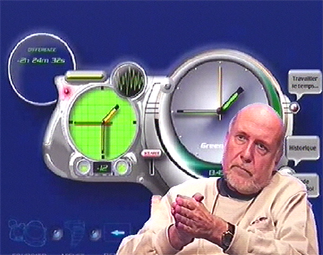
Fred Forest (born July 6, 1933) is a French new media artist. He makes use of video, photography, the printed press, mail, radio, television, telephone, telematics, and the internet in a wide range of installations, performances, and public interventions that explore both the ramifications and potential of media space. He was a cofounder of both the Sociological Art Collective (1974) and the Aesthetics of Communication movement (1983).
Forest has taken part in the Biennale of Venice (1976) and the Documenta of Kassel (1977, 1987) and his work has won awards at the São Paulo Art Biennial (1973) and the Festival of Electronic Arts of Locarno (1995). In 2004, Forest's archives, including his video works, were added to the collection of the Institut national de l'audiovisuel of France. A retrospective of his work was held at the Slought Foundation in Philadelphia in 2007.
The holder of a state doctorate in the humanities from the Sorbonne (his 1985 thesis committee included Abraham Moles, Frank Popper, and Jean Duvignaud), Forest has also taught on the faculty of the Ecole Nationale Supérieure d'Art, Cergy-Pontoise; the University of Paris, Panthéon-Sorbonne; and the University of Nice, Sophia-Antipolis. He is the author of numerous books on art, communication, and technology including Pour un art actuel: l'art à l'heure d’Internet (1998, For an Art of Today: Art in the Internet Age), Fonctionnements et dysfonctionnements de l’art contemporain (2000, The Inner Workings and Dysfunctionality of Contemporary Art), and L’œuvre-système invisible (2006, The Invisible System Work).
Aside from his artworks, which are often imbedded in the mass media and use publicity as a raw material, Forest is well known in France as a fierce critic of the contemporary art establishment—a critical stance that led him to take the Musée National d'Art Moderne (Centre Georges Pompidou) to court (1994–97) over its refusal to disclose the purchase prices of recent acquisitions. He is also one of the founders of the French Fête de l’Internet, or Internet Fest.
Forest was born on July 6, 1933 in Mascara, French Algeria. A self-taught artist whose formal education ended after primary school (he was later authorized to present a doctoral thesis under special provisions), Forest worked for fifteen years as a postal service employee, first in Algeria and then in France, before deciding to devote himself exclusively to artistic pursuits. In the early 1960s, he worked as an illustrator for the French newspapers Combat and Les Echos and experimented with the projection of moving and still images on tableaux-écrans, or screen-paintings. Having received a Sony CV-2400 Portapak video recorder in 1967 as part of a promotional campaign by Sony France, he ranks as one of the first artists in Europe and the world to experiment with video. Forest's first experimental video tapes, "The Telephone Booth" and "The Wall of Arles," date from 1967. His first formal exhibition of video art, "Interrogation 69," an interactive video installation, took place in May 1969 in the city of Tours.
Influenced by the political and cultural ferment of May 68, Situationist critiques of the society of spectacle, Marshall McLuhan's writings, Umberto Eco's concept of the "open work," and the avant-garde's proclaimed goal of breaking down the barrier between art and everyday life, Forest stopped producing traditional art objects in 1969 and focused instead on a utopian form of "social praxis" operating "under the cover of art." Because of its portability, low-fi aesthetic, immediacy, and potential for interactive feedback, video was the tool of choice for such experimental social praxis; however, Forest also became interested in the mass media at an early stage in his career. His first major series of works with the mass media was the "Space-Media" project of 1972, which included a small "parasitic" blank square ("150 cm2 of Newspaper") published in the January 12, 1972 edition of the daily Le Monde, which the readers were encouraged to mail back to Forest, filled in with commentary, creative writing, or artwork of their own. "Space-Media" was the subject of a major article by the philosopher and new media theorist Vilém Flusser, with whom Forest collaborated throughout his career.
In 1974, Forest joined forces with Hervé Fischer and Jean-Paul Thénot to form the Collectif d’Art Sociologique (disbanded in 1979). The members of the Collective were invited to represent France at the 76th Biennale of Venice by Pierre Restany, who became a lifelong friend and supporter of Forest and his work.
Forest's video and video-based installation and performance works from this period include "Gestures in Work and Social Life" (1972–74), "Electronic Investigation of Rue Guénégaud" (1973), "Senior Citizen Video" (1973), "Video Portrait of a Collector in Real Time" (1974), "Restany Dines at La Coupole" (1974), "TV Shock, TV Exchange" (1975), "Madame Soleil Exhibited in the Flesh" (1975), and "The Video Family" (1976).
Hub AI
Fred Forest AI simulator
(@Fred Forest_simulator)
Fred Forest
Fred Forest (born July 6, 1933) is a French new media artist. He makes use of video, photography, the printed press, mail, radio, television, telephone, telematics, and the internet in a wide range of installations, performances, and public interventions that explore both the ramifications and potential of media space. He was a cofounder of both the Sociological Art Collective (1974) and the Aesthetics of Communication movement (1983).
Forest has taken part in the Biennale of Venice (1976) and the Documenta of Kassel (1977, 1987) and his work has won awards at the São Paulo Art Biennial (1973) and the Festival of Electronic Arts of Locarno (1995). In 2004, Forest's archives, including his video works, were added to the collection of the Institut national de l'audiovisuel of France. A retrospective of his work was held at the Slought Foundation in Philadelphia in 2007.
The holder of a state doctorate in the humanities from the Sorbonne (his 1985 thesis committee included Abraham Moles, Frank Popper, and Jean Duvignaud), Forest has also taught on the faculty of the Ecole Nationale Supérieure d'Art, Cergy-Pontoise; the University of Paris, Panthéon-Sorbonne; and the University of Nice, Sophia-Antipolis. He is the author of numerous books on art, communication, and technology including Pour un art actuel: l'art à l'heure d’Internet (1998, For an Art of Today: Art in the Internet Age), Fonctionnements et dysfonctionnements de l’art contemporain (2000, The Inner Workings and Dysfunctionality of Contemporary Art), and L’œuvre-système invisible (2006, The Invisible System Work).
Aside from his artworks, which are often imbedded in the mass media and use publicity as a raw material, Forest is well known in France as a fierce critic of the contemporary art establishment—a critical stance that led him to take the Musée National d'Art Moderne (Centre Georges Pompidou) to court (1994–97) over its refusal to disclose the purchase prices of recent acquisitions. He is also one of the founders of the French Fête de l’Internet, or Internet Fest.
Forest was born on July 6, 1933 in Mascara, French Algeria. A self-taught artist whose formal education ended after primary school (he was later authorized to present a doctoral thesis under special provisions), Forest worked for fifteen years as a postal service employee, first in Algeria and then in France, before deciding to devote himself exclusively to artistic pursuits. In the early 1960s, he worked as an illustrator for the French newspapers Combat and Les Echos and experimented with the projection of moving and still images on tableaux-écrans, or screen-paintings. Having received a Sony CV-2400 Portapak video recorder in 1967 as part of a promotional campaign by Sony France, he ranks as one of the first artists in Europe and the world to experiment with video. Forest's first experimental video tapes, "The Telephone Booth" and "The Wall of Arles," date from 1967. His first formal exhibition of video art, "Interrogation 69," an interactive video installation, took place in May 1969 in the city of Tours.
Influenced by the political and cultural ferment of May 68, Situationist critiques of the society of spectacle, Marshall McLuhan's writings, Umberto Eco's concept of the "open work," and the avant-garde's proclaimed goal of breaking down the barrier between art and everyday life, Forest stopped producing traditional art objects in 1969 and focused instead on a utopian form of "social praxis" operating "under the cover of art." Because of its portability, low-fi aesthetic, immediacy, and potential for interactive feedback, video was the tool of choice for such experimental social praxis; however, Forest also became interested in the mass media at an early stage in his career. His first major series of works with the mass media was the "Space-Media" project of 1972, which included a small "parasitic" blank square ("150 cm2 of Newspaper") published in the January 12, 1972 edition of the daily Le Monde, which the readers were encouraged to mail back to Forest, filled in with commentary, creative writing, or artwork of their own. "Space-Media" was the subject of a major article by the philosopher and new media theorist Vilém Flusser, with whom Forest collaborated throughout his career.
In 1974, Forest joined forces with Hervé Fischer and Jean-Paul Thénot to form the Collectif d’Art Sociologique (disbanded in 1979). The members of the Collective were invited to represent France at the 76th Biennale of Venice by Pierre Restany, who became a lifelong friend and supporter of Forest and his work.
Forest's video and video-based installation and performance works from this period include "Gestures in Work and Social Life" (1972–74), "Electronic Investigation of Rue Guénégaud" (1973), "Senior Citizen Video" (1973), "Video Portrait of a Collector in Real Time" (1974), "Restany Dines at La Coupole" (1974), "TV Shock, TV Exchange" (1975), "Madame Soleil Exhibited in the Flesh" (1975), and "The Video Family" (1976).