



Community hub
Recent from talks
Contribute something to knowledge base
Content stats: 0 posts, 0 articles, 1 media, 0 notes
Members stats: 0 subscribers, 0 contributors, 0 moderators, 0 supporters
Subscribers
Supporters
Contributors
Moderators
Hub AI
Free Papua Movement AI simulator
(@Free Papua Movement_simulator)
Hub AI
Free Papua Movement AI simulator
(@Free Papua Movement_simulator)
Free Papua Movement
The Free Papua Movement or Free Papua Organization (Indonesian: Organisasi Papua Merdeka, OPM) is a name given to a separatist movement that aims to separate West Papua from Indonesia and establish an independent state in the region. The territory is currently divided into six Indonesian provinces of Central Papua, Highland Papua, Papua, South Papua, Southwest Papua, and West Papua, also formerly known as Papua, Irian Jaya and West Irian.
The movement consists of three elements: a disparate group of armed units each with limited territorial control with no single commander; several groups in the territory that conduct demonstrations and protests; and a small group of leaders based abroad that raise awareness of issues in the territory whilst striving for international support for independence.
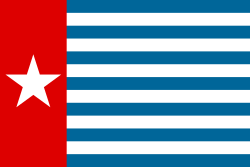
Since its inception, the OPM has attempted diplomatic dialogue, conducted Morning Star flag-raising ceremonies, and undertaken militant actions as part of the Papua conflict. Supporters routinely display the Morning Star flag and other symbols of Papuan unity, such as the national anthem "Hai Tanahku Papua" and a national coat of arms, which had been adopted in the period 1961 until Indonesian administration began in May 1963 under the New York Agreement. Beginning in 2021, the movement is considered as a "Terrorist and Separatist Organisation" (Indonesian: Kelompok Teroris dan Separatis) in Indonesia, and its activities have incurred charges of treason and terrorism.
During World War II, the Netherlands East Indies (later Indonesia) were guided by Sukarno to supply oil for the Japanese war effort and subsequently declared independence as the Republic of Indonesia on 17 August 1945. The Netherlands New Guinea (Western New Guinea, then a part of the Netherlands East Indies) and Australian administered territories of Papua and British New Guinea resisted Japanese control and were allies with the American and Australian forces during the Pacific War.
The pre-war relationship of the Netherlands and its New Guinea colony was replaced with the promotion of Papuan civil and other services until Indonesian administration began in 1963. Though there was agreement between Australia and the Netherlands by 1957 that it would be preferable for their territories to unite for independence, the lack of development in the Australian territories and the interests of the United States kept the two regions separate. The OPM was founded in December 1963, with the announcement that "We do not want modern life! We refuse any kinds of development: religious groups, aid agencies, and governmental organizations just Leave Us Alone! [sic]" Originally the group was a nonviolent spiritual movement based in cargoism and was led by Aser Demotekay, former head of Demta District. His policy of nonviolence and cooperation with Indonesian government, led to the creation of a more radical splinter group under Jacob Prai, former student of Demotekay.
Netherlands New Guinea held elections in January 1961 and a New Guinea Council was inaugurated in April 1961. However, in Washington, D.C. there was a desire for Indonesia to release CIA pilot Allen Pope, and there was a proposal for United Nations trusteeship of West New Guinea, Indonesian President Sukarno said he was willing 'to borrow the hand of the United Nations to transfer the territory to Indonesia', and the National Security Advisor McGeorge Bundy began to lobby U.S. President John F. Kennedy to get the administration of West New Guinea transferred to Indonesia. The resulting New York Agreement was drafted by Robert Kennedy and signed by the Netherlands and Indonesia before being approved subject to the Charter of the United Nations article 85 in General Assembly resolution 1752 on 21 September 1962.
Although the Netherlands had insisted the West New Guinea people be allowed self-determination in accord with the United Nations charter and General Assembly Resolution 1514 (XV) which was to be called the "Act of Free Choice"; the New York Agreement instead provided a seven year delay and gave the United Nations no authority to supervise the act. Separatist groups raise the West Papua Morning Star flag each year on 1 December, which they call "Papuan independence day". An Indonesian police officer speculated that people doing this could be charged with the crime of treason, which carries the penalty of imprisonment for seven to twenty years in Indonesia.
In October 1968, Nicolaas Jouwe, member of the New Guinea Council and of the National Committee elected by the Council in 1962, lobbied the United Nations claiming 30,000 Indonesian troops and thousands of Indonesian civil servants were repressing the Papuan population. According to US Ambassador Galbraith, the Indonesian Foreign Minister Adam Malik also believed the Indonesian military was the cause of problems in the territory and the number of troops should be reduced by at least one half. Ambassador Galbraith further described the OPM to "represent an amorphous mass of anti-Indonesia sentiment" and that "possibly 85 to 90 percent [of Papuans], are in sympathy with the Free Papua cause or at least intensely dislike Indonesians".
Free Papua Movement
The Free Papua Movement or Free Papua Organization (Indonesian: Organisasi Papua Merdeka, OPM) is a name given to a separatist movement that aims to separate West Papua from Indonesia and establish an independent state in the region. The territory is currently divided into six Indonesian provinces of Central Papua, Highland Papua, Papua, South Papua, Southwest Papua, and West Papua, also formerly known as Papua, Irian Jaya and West Irian.
The movement consists of three elements: a disparate group of armed units each with limited territorial control with no single commander; several groups in the territory that conduct demonstrations and protests; and a small group of leaders based abroad that raise awareness of issues in the territory whilst striving for international support for independence.
Since its inception, the OPM has attempted diplomatic dialogue, conducted Morning Star flag-raising ceremonies, and undertaken militant actions as part of the Papua conflict. Supporters routinely display the Morning Star flag and other symbols of Papuan unity, such as the national anthem "Hai Tanahku Papua" and a national coat of arms, which had been adopted in the period 1961 until Indonesian administration began in May 1963 under the New York Agreement. Beginning in 2021, the movement is considered as a "Terrorist and Separatist Organisation" (Indonesian: Kelompok Teroris dan Separatis) in Indonesia, and its activities have incurred charges of treason and terrorism.
During World War II, the Netherlands East Indies (later Indonesia) were guided by Sukarno to supply oil for the Japanese war effort and subsequently declared independence as the Republic of Indonesia on 17 August 1945. The Netherlands New Guinea (Western New Guinea, then a part of the Netherlands East Indies) and Australian administered territories of Papua and British New Guinea resisted Japanese control and were allies with the American and Australian forces during the Pacific War.
The pre-war relationship of the Netherlands and its New Guinea colony was replaced with the promotion of Papuan civil and other services until Indonesian administration began in 1963. Though there was agreement between Australia and the Netherlands by 1957 that it would be preferable for their territories to unite for independence, the lack of development in the Australian territories and the interests of the United States kept the two regions separate. The OPM was founded in December 1963, with the announcement that "We do not want modern life! We refuse any kinds of development: religious groups, aid agencies, and governmental organizations just Leave Us Alone! [sic]" Originally the group was a nonviolent spiritual movement based in cargoism and was led by Aser Demotekay, former head of Demta District. His policy of nonviolence and cooperation with Indonesian government, led to the creation of a more radical splinter group under Jacob Prai, former student of Demotekay.
Netherlands New Guinea held elections in January 1961 and a New Guinea Council was inaugurated in April 1961. However, in Washington, D.C. there was a desire for Indonesia to release CIA pilot Allen Pope, and there was a proposal for United Nations trusteeship of West New Guinea, Indonesian President Sukarno said he was willing 'to borrow the hand of the United Nations to transfer the territory to Indonesia', and the National Security Advisor McGeorge Bundy began to lobby U.S. President John F. Kennedy to get the administration of West New Guinea transferred to Indonesia. The resulting New York Agreement was drafted by Robert Kennedy and signed by the Netherlands and Indonesia before being approved subject to the Charter of the United Nations article 85 in General Assembly resolution 1752 on 21 September 1962.
Although the Netherlands had insisted the West New Guinea people be allowed self-determination in accord with the United Nations charter and General Assembly Resolution 1514 (XV) which was to be called the "Act of Free Choice"; the New York Agreement instead provided a seven year delay and gave the United Nations no authority to supervise the act. Separatist groups raise the West Papua Morning Star flag each year on 1 December, which they call "Papuan independence day". An Indonesian police officer speculated that people doing this could be charged with the crime of treason, which carries the penalty of imprisonment for seven to twenty years in Indonesia.
In October 1968, Nicolaas Jouwe, member of the New Guinea Council and of the National Committee elected by the Council in 1962, lobbied the United Nations claiming 30,000 Indonesian troops and thousands of Indonesian civil servants were repressing the Papuan population. According to US Ambassador Galbraith, the Indonesian Foreign Minister Adam Malik also believed the Indonesian military was the cause of problems in the territory and the number of troops should be reduced by at least one half. Ambassador Galbraith further described the OPM to "represent an amorphous mass of anti-Indonesia sentiment" and that "possibly 85 to 90 percent [of Papuans], are in sympathy with the Free Papua cause or at least intensely dislike Indonesians".
Recent media
Recent media