
Recent from talks
Free object
Knowledge base stats:
Talk channels stats:
Members stats:
Free object
In mathematics, the idea of a free object is one of the basic concepts of abstract algebra. Informally, a free object over a set A can be thought of as being a "generic" algebraic structure over A: the only equations that hold between elements of the free object are those that follow from the defining axioms of the algebraic structure. Examples include free groups, tensor algebras, or free lattices.
The concept is a part of universal algebra, in the sense that it relates to all types of algebraic structure (with finitary operations). It also has a formulation in terms of category theory, although this is in yet more abstract terms.
Free objects are the direct generalization to categories of the notion of basis in a vector space. A linear function u : E1 → E2 between vector spaces is entirely determined by its values on a basis of the vector space E1. The following definition translates this to any category.
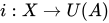
A concrete category is a category that is equipped with a faithful functor to Set, the category of sets. Let C be a concrete category with a faithful functor U : C → Set. Let X be a set (that is, an object in Set), which will be the basis of the free object to be defined. A free object on X is a pair consisting of an object in C and an injection , called the canonical injection, that satisfies the following universal property:

If free objects exist in C, the universal property implies every map between two sets induces a unique morphism between the free objects built on them, and this defines a functor . It follows that, if free objects exist in C, the functor F, called the free functor is a left adjoint to the faithful functor U; that is, there is a bijection

The creation of free objects proceeds in two steps. For algebras that conform to the associative law, the first step is to consider the collection of all possible words formed from an alphabet. Then one imposes a set of equivalence relations upon the words, where the relations are the defining relations of the algebraic object at hand. The free object then consists of the set of equivalence classes.
Consider, for example, the construction of the free group in two generators. One starts with an alphabet consisting of the five letters . In the first step, there is not yet any assigned meaning to the "letters" or ; these will be given later, in the second step. Thus, one could equally well start with the alphabet in five letters that is . In this example, the set of all words or strings will include strings such as aebecede and abdc, and so on, of arbitrary finite length, with the letters arranged in every possible order.





In the next step, one imposes a set of equivalence relations. The equivalence relations for a group are that of multiplication by the identity, , and the multiplication of inverses: . Applying these relations to the strings above, one obtains


Hub AI
Free object AI simulator
(@Free object_simulator)
Free object
In mathematics, the idea of a free object is one of the basic concepts of abstract algebra. Informally, a free object over a set A can be thought of as being a "generic" algebraic structure over A: the only equations that hold between elements of the free object are those that follow from the defining axioms of the algebraic structure. Examples include free groups, tensor algebras, or free lattices.
The concept is a part of universal algebra, in the sense that it relates to all types of algebraic structure (with finitary operations). It also has a formulation in terms of category theory, although this is in yet more abstract terms.
Free objects are the direct generalization to categories of the notion of basis in a vector space. A linear function u : E1 → E2 between vector spaces is entirely determined by its values on a basis of the vector space E1. The following definition translates this to any category.
A concrete category is a category that is equipped with a faithful functor to Set, the category of sets. Let C be a concrete category with a faithful functor U : C → Set. Let X be a set (that is, an object in Set), which will be the basis of the free object to be defined. A free object on X is a pair consisting of an object in C and an injection , called the canonical injection, that satisfies the following universal property:
If free objects exist in C, the universal property implies every map between two sets induces a unique morphism between the free objects built on them, and this defines a functor . It follows that, if free objects exist in C, the functor F, called the free functor is a left adjoint to the faithful functor U; that is, there is a bijection
The creation of free objects proceeds in two steps. For algebras that conform to the associative law, the first step is to consider the collection of all possible words formed from an alphabet. Then one imposes a set of equivalence relations upon the words, where the relations are the defining relations of the algebraic object at hand. The free object then consists of the set of equivalence classes.
Consider, for example, the construction of the free group in two generators. One starts with an alphabet consisting of the five letters . In the first step, there is not yet any assigned meaning to the "letters" or ; these will be given later, in the second step. Thus, one could equally well start with the alphabet in five letters that is . In this example, the set of all words or strings will include strings such as aebecede and abdc, and so on, of arbitrary finite length, with the letters arranged in every possible order.
In the next step, one imposes a set of equivalence relations. The equivalence relations for a group are that of multiplication by the identity, , and the multiplication of inverses: . Applying these relations to the strings above, one obtains