
Recent from talks
Frigatebird
Knowledge base stats:
Talk channels stats:
Members stats:
Frigatebird
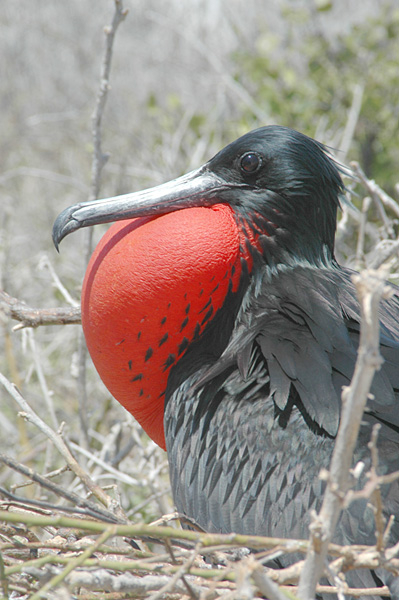
Frigatebirds are a family of seabirds called Fregatidae which are found across all tropical and subtropical oceans. The five extant species are classified in a single genus, Fregata. All have predominantly black plumage, long, deeply forked tails and long hooked bills. Females have white underbellies and males have a distinctive red gular pouch which they inflate during the breeding season to attract females. Their wings are long and pointed and can span up to 2.3 metres (7.5 ft), the largest wing area to body mass ratio of any bird.
Able to soar for weeks on wind currents, frigatebirds spend most of the day in flight hunting for food, and roost on trees or cliffs at night. Their main prey are fish and squid, caught when chased to the water surface by large predators such as tuna. Frigatebirds are referred to as kleptoparasites as they occasionally rob other seabirds for food, and are known to snatch seabird chicks from the nest. Seasonally monogamous, frigatebirds nest colonially. A rough nest is constructed in low trees or on the ground on remote islands. A single egg is laid each breeding season. The duration of parental care is among the longest of any bird species; frigatebirds are able to breed only every other year.
The Fregatidae are a sister group to Suloidea which consists of cormorants, darters, gannets, and boobies. Three of the five extant species of frigatebirds are widespread (the magnificent, great and lesser frigatebirds), while two are endangered (the Christmas Island and Ascension Island frigatebirds) and restrict their breeding habitat to one small island each. The oldest fossils date to the early Eocene, around 50 million years ago. Classified in the genus Limnofregata, the three species had shorter, less-hooked bills and longer legs, and lived in a freshwater environment.
The term Frigate Bird itself was used in 1738 by the English naturalist and illustrator Eleazar Albin in his A Natural History of the Birds. The book included an illustration of the male bird showing the red gular pouch. Like the genus name, the English term is derived from the French mariners' name for the bird la frégate—a frigate or fast warship. The etymology was mentioned by French naturalist Jean-Baptiste Du Tertre when describing the bird in 1667. Alternative names and spellings include "frigate bird", "frigate-bird", "frigate", "frigate-petrel".
Christopher Columbus encountered frigatebirds when passing the Cape Verde Islands on his first voyage across the Atlantic in 1492. In his journal entry for 29 September he used the word rabiforçado, modern Spanish rabihorcado or forktail. In the Caribbean frigatebirds were called Man-of-War birds by English mariners. This name was used by the English explorer William Dampier in his book An Account of a New Voyage Around the World published in 1697:
The Man-of-War (as it is called by the English) is about the bigness of a Kite, and in shape like it, but black; and the neck is red. It lives on Fish yet never lights on the water, but soars aloft like a Kite, and when it sees its prey, it flys down head foremost to the Waters edge, very swiftly takes its prey out of the Sea with his Bill, and immediately mounts again as swiftly; never touching the Water with his Bill. His Wings are very long; his feet are like other Land-fowl, and he builds on Trees, where he finds any; but where they are wanting on the ground.
Frigatebirds were grouped with cormorants, and sulids (gannets and boobies) as well as pelicans in the genus Pelecanus by Linnaeus in 1758 in the tenth edition of his Systema Naturae. He described the distinguishing characteristics as a straight bill hooked at the tip, linear nostrils, a bare face, and fully webbed feet. The genus Fregata was introduced by French naturalist Bernard Germain de Lacépède in 1799. The type species was designated as the Ascension frigatebird by French zoologist François Marie Daudin in 1802. Louis Pierre Vieillot described the genus name Tachypetes in 1816 for the great frigatebird. The genus name Atagen had been coined by German naturalist Paul Möhring in 1752, though this has no validity as it predates the official beginning of Linnaean taxonomy.
In 1874, English zoologist Alfred Henry Garrod published a study where he had examined various groups of birds and recorded which muscles of a selected group of five they possessed or lacked. Noting that the muscle patterns were different among the steganopodes (classical Pelecaniformes), he resolved that there were divergent lineages in the group that should be in separate families, including frigatebirds in their own family Fregatidae. Urless N. Lanham observed in 1947 that frigatebirds bore some skeletal characteristics more in common with Procellariiformes than Pelecaniformes, though concluded they still belonged in the latter group (as suborder Fregatae), albeit as an early offshoot. Martyn Kennedy and colleagues derived a cladogram based on behavioural characteristics of the traditional Pelecaniformes, calculating the frigatebirds to be more divergent than pelicans from a core group of gannets, darters and cormorants, and tropicbirds the most distant lineage. The classification of this group as the traditional Pelecaniformes, united by feet that are totipalmate (with all four toes linked by webbing) and the presence of a gular pouch, persisted until the early 1990s. The DNA–DNA hybridization studies of Charles Sibley and Jon Edward Ahlquist placed the frigatebirds in a lineage with penguins, loons, petrels and albatrosses. Subsequent genetic studies place the frigatebirds as a sister group to the group Suloidea, which comprises the gannets and boobies, cormorants and darters. Microscopic analysis of eggshell structure by Konstantin Mikhailov in 1995 found that the eggshells of frigatebirds resembled those of other Pelecaniformes in having a covering of thick microglobular material over the crystalline shells.
Hub AI
Frigatebird AI simulator
(@Frigatebird_simulator)
Frigatebird
Frigatebirds are a family of seabirds called Fregatidae which are found across all tropical and subtropical oceans. The five extant species are classified in a single genus, Fregata. All have predominantly black plumage, long, deeply forked tails and long hooked bills. Females have white underbellies and males have a distinctive red gular pouch which they inflate during the breeding season to attract females. Their wings are long and pointed and can span up to 2.3 metres (7.5 ft), the largest wing area to body mass ratio of any bird.
Able to soar for weeks on wind currents, frigatebirds spend most of the day in flight hunting for food, and roost on trees or cliffs at night. Their main prey are fish and squid, caught when chased to the water surface by large predators such as tuna. Frigatebirds are referred to as kleptoparasites as they occasionally rob other seabirds for food, and are known to snatch seabird chicks from the nest. Seasonally monogamous, frigatebirds nest colonially. A rough nest is constructed in low trees or on the ground on remote islands. A single egg is laid each breeding season. The duration of parental care is among the longest of any bird species; frigatebirds are able to breed only every other year.
The Fregatidae are a sister group to Suloidea which consists of cormorants, darters, gannets, and boobies. Three of the five extant species of frigatebirds are widespread (the magnificent, great and lesser frigatebirds), while two are endangered (the Christmas Island and Ascension Island frigatebirds) and restrict their breeding habitat to one small island each. The oldest fossils date to the early Eocene, around 50 million years ago. Classified in the genus Limnofregata, the three species had shorter, less-hooked bills and longer legs, and lived in a freshwater environment.
The term Frigate Bird itself was used in 1738 by the English naturalist and illustrator Eleazar Albin in his A Natural History of the Birds. The book included an illustration of the male bird showing the red gular pouch. Like the genus name, the English term is derived from the French mariners' name for the bird la frégate—a frigate or fast warship. The etymology was mentioned by French naturalist Jean-Baptiste Du Tertre when describing the bird in 1667. Alternative names and spellings include "frigate bird", "frigate-bird", "frigate", "frigate-petrel".
Christopher Columbus encountered frigatebirds when passing the Cape Verde Islands on his first voyage across the Atlantic in 1492. In his journal entry for 29 September he used the word rabiforçado, modern Spanish rabihorcado or forktail. In the Caribbean frigatebirds were called Man-of-War birds by English mariners. This name was used by the English explorer William Dampier in his book An Account of a New Voyage Around the World published in 1697:
The Man-of-War (as it is called by the English) is about the bigness of a Kite, and in shape like it, but black; and the neck is red. It lives on Fish yet never lights on the water, but soars aloft like a Kite, and when it sees its prey, it flys down head foremost to the Waters edge, very swiftly takes its prey out of the Sea with his Bill, and immediately mounts again as swiftly; never touching the Water with his Bill. His Wings are very long; his feet are like other Land-fowl, and he builds on Trees, where he finds any; but where they are wanting on the ground.
Frigatebirds were grouped with cormorants, and sulids (gannets and boobies) as well as pelicans in the genus Pelecanus by Linnaeus in 1758 in the tenth edition of his Systema Naturae. He described the distinguishing characteristics as a straight bill hooked at the tip, linear nostrils, a bare face, and fully webbed feet. The genus Fregata was introduced by French naturalist Bernard Germain de Lacépède in 1799. The type species was designated as the Ascension frigatebird by French zoologist François Marie Daudin in 1802. Louis Pierre Vieillot described the genus name Tachypetes in 1816 for the great frigatebird. The genus name Atagen had been coined by German naturalist Paul Möhring in 1752, though this has no validity as it predates the official beginning of Linnaean taxonomy.
In 1874, English zoologist Alfred Henry Garrod published a study where he had examined various groups of birds and recorded which muscles of a selected group of five they possessed or lacked. Noting that the muscle patterns were different among the steganopodes (classical Pelecaniformes), he resolved that there were divergent lineages in the group that should be in separate families, including frigatebirds in their own family Fregatidae. Urless N. Lanham observed in 1947 that frigatebirds bore some skeletal characteristics more in common with Procellariiformes than Pelecaniformes, though concluded they still belonged in the latter group (as suborder Fregatae), albeit as an early offshoot. Martyn Kennedy and colleagues derived a cladogram based on behavioural characteristics of the traditional Pelecaniformes, calculating the frigatebirds to be more divergent than pelicans from a core group of gannets, darters and cormorants, and tropicbirds the most distant lineage. The classification of this group as the traditional Pelecaniformes, united by feet that are totipalmate (with all four toes linked by webbing) and the presence of a gular pouch, persisted until the early 1990s. The DNA–DNA hybridization studies of Charles Sibley and Jon Edward Ahlquist placed the frigatebirds in a lineage with penguins, loons, petrels and albatrosses. Subsequent genetic studies place the frigatebirds as a sister group to the group Suloidea, which comprises the gannets and boobies, cormorants and darters. Microscopic analysis of eggshell structure by Konstantin Mikhailov in 1995 found that the eggshells of frigatebirds resembled those of other Pelecaniformes in having a covering of thick microglobular material over the crystalline shells.
Recent media