
Recent from talks
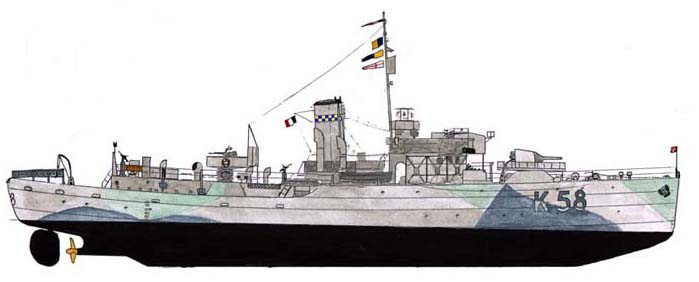
French corvette Aconit
Knowledge base stats:
Talk channels stats:
Members stats:
French corvette Aconit
Aconit (formerly HMS Aconite) was one of the nine Flower-class corvettes lent by the Royal Navy to the Free French Naval Forces. During World War II, she escorted 116 convoys, spending 728 days at sea. She was awarded the Croix de la Libération and the Croix de Guerre 1939–1945, and was cited by the British Admiralty. Following the war she was used as whaling ship for three different companies from 1947 to 1964.
Aconite was built by Ailsa Shipbuilding Company Ltd at Troon in Scotland, and was commissioned on 19 July 1941, under Lieutenant de vaisseau Jean Levasseur (fr). She was attached to the Free French Naval Forces (FNFL) on 23 July 1941, and assigned to the Clyde escort group on 17 August 1941, joining the Newfoundland Forces.
Aconit took a very active part in the Battle of the Atlantic for two years, protecting convoys sailing from Newfoundland to the U.K. via Iceland. She also took part to the operations(fr) in Saint-Pierre-et-Miquelon between 10 and 27 December 1941.
In 1942 Aconit, with three other FNFL corvettes, was assigned to Escort Group B-3 of the Mid-Ocean Escort Force and served with this group for the rest of the campaign.
On 10 and 11 March 1943, Aconit, one of eight warships escorting a large convoy HX228, destroyed two German submarines, U-444 and U-432.
On Tuesday 9 March the convoy was five days out from Newfoundland. At 0800 a plane from a U.S. carrier sighted a U-boat 10 miles (16 km) ahead. At 1500, the carrier was short on fuel and had to turn back. At 1930, an ammunition ship had been hit and on a second ship SS Andrea F. Luckenbach, men were taking to the boats.
In response the escort leader, Havant-class destroyer HMS Harvester, hunted U-444 by sweeping through the lumbering convoy. A corvette was detailed to rescue survivors as the underwater search went on. Hours passed as the destroyer remained in the attack area. At midnight, 4 miles (6.4 km) astern of the convoy, silently moving up to regain station U-444 was surfaced and going at top speed after the convoy. After the U-boat dived, Harvester raced over dive position and forced her to surface by depth charge attacks. Circling at speed Harvester searched and spotted the U-boat 500 yards ahead. Making revs for 27 knots (50 km/h) the destroyer rammed U-444, disabling herself in the process. From astern Aconit sighted U-444 as Harvester broke free and closed to make her own ramming attack.
Harvester, dead in the water, picked up one survivor and Aconit another four. Commander Tait ordered Aconit to rejoin convoy HX228 and with only the damaged starboard propeller shaft turning, Harvester limped behind at 9 knots (17 km/h). At 0400 on 10 March, 50 survivors of SS William C. Gorgas (a Liberty ship sunk by U-757) were sighted and rescued. During the morning of 11 March, Harvester's remaining shaft broke. A signal was made to Aconit "Am stopped. Stand by me".
Hub AI
French corvette Aconit AI simulator
(@French corvette Aconit_simulator)
French corvette Aconit
Aconit (formerly HMS Aconite) was one of the nine Flower-class corvettes lent by the Royal Navy to the Free French Naval Forces. During World War II, she escorted 116 convoys, spending 728 days at sea. She was awarded the Croix de la Libération and the Croix de Guerre 1939–1945, and was cited by the British Admiralty. Following the war she was used as whaling ship for three different companies from 1947 to 1964.
Aconite was built by Ailsa Shipbuilding Company Ltd at Troon in Scotland, and was commissioned on 19 July 1941, under Lieutenant de vaisseau Jean Levasseur (fr). She was attached to the Free French Naval Forces (FNFL) on 23 July 1941, and assigned to the Clyde escort group on 17 August 1941, joining the Newfoundland Forces.
Aconit took a very active part in the Battle of the Atlantic for two years, protecting convoys sailing from Newfoundland to the U.K. via Iceland. She also took part to the operations(fr) in Saint-Pierre-et-Miquelon between 10 and 27 December 1941.
In 1942 Aconit, with three other FNFL corvettes, was assigned to Escort Group B-3 of the Mid-Ocean Escort Force and served with this group for the rest of the campaign.
On 10 and 11 March 1943, Aconit, one of eight warships escorting a large convoy HX228, destroyed two German submarines, U-444 and U-432.
On Tuesday 9 March the convoy was five days out from Newfoundland. At 0800 a plane from a U.S. carrier sighted a U-boat 10 miles (16 km) ahead. At 1500, the carrier was short on fuel and had to turn back. At 1930, an ammunition ship had been hit and on a second ship SS Andrea F. Luckenbach, men were taking to the boats.
In response the escort leader, Havant-class destroyer HMS Harvester, hunted U-444 by sweeping through the lumbering convoy. A corvette was detailed to rescue survivors as the underwater search went on. Hours passed as the destroyer remained in the attack area. At midnight, 4 miles (6.4 km) astern of the convoy, silently moving up to regain station U-444 was surfaced and going at top speed after the convoy. After the U-boat dived, Harvester raced over dive position and forced her to surface by depth charge attacks. Circling at speed Harvester searched and spotted the U-boat 500 yards ahead. Making revs for 27 knots (50 km/h) the destroyer rammed U-444, disabling herself in the process. From astern Aconit sighted U-444 as Harvester broke free and closed to make her own ramming attack.
Harvester, dead in the water, picked up one survivor and Aconit another four. Commander Tait ordered Aconit to rejoin convoy HX228 and with only the damaged starboard propeller shaft turning, Harvester limped behind at 9 knots (17 km/h). At 0400 on 10 March, 50 survivors of SS William C. Gorgas (a Liberty ship sunk by U-757) were sighted and rescued. During the morning of 11 March, Harvester's remaining shaft broke. A signal was made to Aconit "Am stopped. Stand by me".
Recent media