
Recent from talks
French franc
Knowledge base stats:
Talk channels stats:
Members stats:
French franc
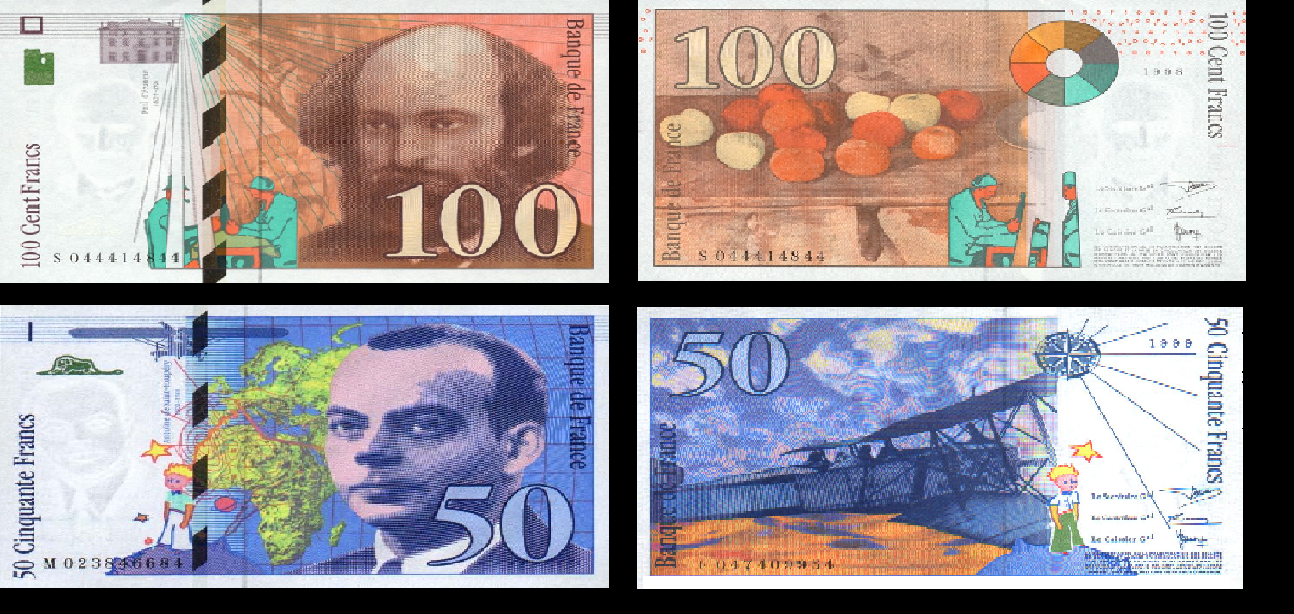
The franc (/fræŋk/; French: franc français, [fʁɑ̃ fʁɑ̃sɛ]; sign: F or Fr), also commonly distinguished as the French franc (FF), was a currency of France. Between 1360 and 1641, it was the name of coins worth 1 livre tournois and it remained in common parlance as a term for this amount of money. It was reintroduced (in decimal form) in 1795. After two centuries of inflation, it was redenominated in 1960, with each new franc (NF) being worth 100 old francs. The NF designation was continued for a few years before the currency returned to being simply the franc. Many French residents, though, continued to quote prices of especially expensive items in terms of the old franc (equivalent to the new centime), up to and even after the introduction of the euro (for coins and banknotes) in 2002. The French franc was a commonly held international reserve currency of reference in the 19th and 20th centuries. Between 1998 and 2002, the conversion of francs to euros was carried out at a rate of 6.55957 francs to 1 euro.
The French franc traces its origins to the Carolingian monetary system of the 8th century AD, and more specifically to the livre tournois, an offshoot of the same system which emerged in the 13th century. Here is a table of changes to the value of the livre parisis and the livre tournois in terms of silver or gold until the French franc was introduced in 1795.
Emperor Charlemagne's monetary system was introduced in 781 AD to the Frankish Carolingian Empire and spread over the centuries to much of Western Europe, with a Livre (pound) of silver divided into 20 sols or sous (shillings) and the sol divided into 12 deniers (pennies). Only the denier existed as a coin for the next 500 years, with the sou and livre functioning as accounting multiples of the denier. The first livre and denier weighed 407.92 g and 1.7 g, respectively, of the finest silver available.
Livres and deniers issued c. 1000 under the Capetian dynasty contained 305.94 g and 1.27475 g fine silver, respectively. The French mark of 8 ounces was a unit of weight equal to 244.752 grams, and equal in weight to 192 deniers or 16 sols of this period.
In subsequent centuries the French kings would struggle to implement fixed standards for the livre over a decentralized realm of Frankish feudal rulers, many of whom claimed the right to issue currency within their own domains, and often resorting to currency debasements in moments of stringency. While monetary values as proclaimed by French kings would eventually be identified as the livre parisis, other regions almost always got by with currencies of lower standard. One such currency, the livre tournois, would eventually become the preferred accounting system under a more centralized French kingdom.
The emergence of the livre tournois as France's preferred accounting system occurred during the reign of King Louis IX with the issuance of the silver gros tournois with 58 issued to a French mark of silver of fineness 23⁄24 (hence 4.044 g fine silver in a gros), and valued at 1 sol (12 deniers) in France's Touraine region, though valued less than 1 sol parisis. The new coin's reputation and handling convenience versus those of debased deniers assured the adoption of the gros tournois to the rest of Western Europe.
Towards the reign of King Philip IV le Bel came pressures to further debase the denier, which occurred in 1317 when the gros tournois was raised to 15 deniers tournois or 12 deniers (1 sol) parisis, thus commencing the fixed parity of 4 deniers parisis to 5 deniers tournois. While French kings would continue to prescribe coin values in multiples of 4 and 12 deniers parisis until the end of the 15th century, the rest of France would gradually choose to recognize their increased values in multiples of 5 and 15 deniers tournois.
The start of the Hundred Years' War against England in 1337 would increase the pressure to further debase the French livre. An attempt in 1343 to reverse earlier depreciations of circulating deniers and reinstate the old 1317-era gros tournois (forte monnaie, or strong money) caused financial havoc especially with borrowers who received depreciated coins and who then had to repay debts in forte monnaie. Lower valuations for the livre had to be accepted subsequently as the war raged on.
Hub AI
French franc AI simulator
(@French franc_simulator)
French franc
The franc (/fræŋk/; French: franc français, [fʁɑ̃ fʁɑ̃sɛ]; sign: F or Fr), also commonly distinguished as the French franc (FF), was a currency of France. Between 1360 and 1641, it was the name of coins worth 1 livre tournois and it remained in common parlance as a term for this amount of money. It was reintroduced (in decimal form) in 1795. After two centuries of inflation, it was redenominated in 1960, with each new franc (NF) being worth 100 old francs. The NF designation was continued for a few years before the currency returned to being simply the franc. Many French residents, though, continued to quote prices of especially expensive items in terms of the old franc (equivalent to the new centime), up to and even after the introduction of the euro (for coins and banknotes) in 2002. The French franc was a commonly held international reserve currency of reference in the 19th and 20th centuries. Between 1998 and 2002, the conversion of francs to euros was carried out at a rate of 6.55957 francs to 1 euro.
The French franc traces its origins to the Carolingian monetary system of the 8th century AD, and more specifically to the livre tournois, an offshoot of the same system which emerged in the 13th century. Here is a table of changes to the value of the livre parisis and the livre tournois in terms of silver or gold until the French franc was introduced in 1795.
Emperor Charlemagne's monetary system was introduced in 781 AD to the Frankish Carolingian Empire and spread over the centuries to much of Western Europe, with a Livre (pound) of silver divided into 20 sols or sous (shillings) and the sol divided into 12 deniers (pennies). Only the denier existed as a coin for the next 500 years, with the sou and livre functioning as accounting multiples of the denier. The first livre and denier weighed 407.92 g and 1.7 g, respectively, of the finest silver available.
Livres and deniers issued c. 1000 under the Capetian dynasty contained 305.94 g and 1.27475 g fine silver, respectively. The French mark of 8 ounces was a unit of weight equal to 244.752 grams, and equal in weight to 192 deniers or 16 sols of this period.
In subsequent centuries the French kings would struggle to implement fixed standards for the livre over a decentralized realm of Frankish feudal rulers, many of whom claimed the right to issue currency within their own domains, and often resorting to currency debasements in moments of stringency. While monetary values as proclaimed by French kings would eventually be identified as the livre parisis, other regions almost always got by with currencies of lower standard. One such currency, the livre tournois, would eventually become the preferred accounting system under a more centralized French kingdom.
The emergence of the livre tournois as France's preferred accounting system occurred during the reign of King Louis IX with the issuance of the silver gros tournois with 58 issued to a French mark of silver of fineness 23⁄24 (hence 4.044 g fine silver in a gros), and valued at 1 sol (12 deniers) in France's Touraine region, though valued less than 1 sol parisis. The new coin's reputation and handling convenience versus those of debased deniers assured the adoption of the gros tournois to the rest of Western Europe.
Towards the reign of King Philip IV le Bel came pressures to further debase the denier, which occurred in 1317 when the gros tournois was raised to 15 deniers tournois or 12 deniers (1 sol) parisis, thus commencing the fixed parity of 4 deniers parisis to 5 deniers tournois. While French kings would continue to prescribe coin values in multiples of 4 and 12 deniers parisis until the end of the 15th century, the rest of France would gradually choose to recognize their increased values in multiples of 5 and 15 deniers tournois.
The start of the Hundred Years' War against England in 1337 would increase the pressure to further debase the French livre. An attempt in 1343 to reverse earlier depreciations of circulating deniers and reinstate the old 1317-era gros tournois (forte monnaie, or strong money) caused financial havoc especially with borrowers who received depreciated coins and who then had to repay debts in forte monnaie. Lower valuations for the livre had to be accepted subsequently as the war raged on.
Recent media